

Vacation crept in. Not as indulgence, but as allowance.

Diary of a Child Sniper – Chapter 12 – Where Has the Sniper Gone
- Diary of a Child Sniper
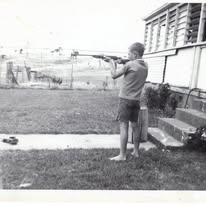
Vacation crept in. Not as indulgence, but as allowance.
Diary of a Child Sniper
Chapter 7 — Kiacatoo The First Time
Time changed the venue, but not the purpose.
Booroma fell away not with drama, but with erosion. A change in management, a shift in tone, the quiet re-drawing of lines that had once been understood without being spoken. The relationship didn’t end; it simply stopped breathing. What had been structure became formality. What had been trust became permission. And so, almost without ceremony, the centre of gravity moved closer to home.
Kiacatoo.
A quarter of a million acres outside Condobolin, flat in the way only the Lachlan plains can be flat, land that doesn’t rise or fall so much as stretch, endlessly, until the horizon forgets what it’s holding up. It was managed in part by Uncle Lionel one of the so called Fab 4, which made it feel immediately familiar, almost domestic despite its scale. And more than that, it was home territory for Mum. Her family. Her stories. Her shorthand. We weren’t visitors here in the same way we had been at Booroma. We were folded back in.
On paper, Kiacatoo was a wheat property. In reality, it was an idea.
The owner lived in Macquarie Street, Sydney, the kind of address that carries weight without ever touching soil. A doctor. Educated. Analytical. Comfortable with abstraction. He didn’t farm the land so much as model it. Numbers made sense to him in a way seasons didn’t. Spreadsheets behaved. Weather did not.
His great insight, or what he believed to be one, was efficiency. Two lambings a year instead of one. On a balance sheet, it was elegant. Double the output. Better utilisation of assets. Faster turnover. A system pushed harder to produce more.
What the numbers didn’t show was recovery.
Ewes weren’t machines. They didn’t reset because the calendar told them to. Two lambings a year meant no breathing space, no restoration, no margin. Weaker sheep. Slower lambs. Less resistance. And in the paddocks, the foxes noticed.
Foxes always notice. So did we.
What emerged wasn’t just an increase in vermin, but a landscape under pressure. Predation wasn’t the problem, it was the symptom. The land was being asked to give more than it could regenerate. The animals were being leaned on because the model demanded it, not because the conditions supported it.
I didn’t have words for any of that then. What I understood was simpler, and colder. There were more foxes to shoot.
That convergence, the fading of Booroma and the pull of Kiacatoo, felt inevitable in hindsight. A perfect storm of human decisions layered over environmental ones. The weather that year didn’t help. Heavy rains turned the red soil into a slick, treacherous black paste that waited patiently for mistakes. It clung. It trapped. It punished confidence.
One night, spotlighting near the far reaches of the property, it caught us. The vehicle slid, then surrendered. Wheels spinning uselessly, mud climbing up the guards as if claiming the machine for itself. There was no recovery gear that could argue with that much country and that much rain.
So we walked. Torches on, torches off. Moonlight when it was enough. Silence where it wasn’t.
Every few steps, the beam would sweep low, not looking for the path, but for movement. Vermin didn’t stop because you were inconvenienced. If anything, the night felt more alive once the engine noise was gone. The land reclaimed its voice.
I remember the strange calm of it. No panic. No sense of danger. Just purpose adjusting to circumstance. Walking home because that’s what was required. Eyes scanning not with fear, but with readiness.
That pattern was already set in me by then. The rifles were still instruments. The task was still the task. But Kiacatoo softened something Booroma never had.
This was almost family land. Family air. Mum was home in a way she hadn’t been before, and that mattered more than anyone said out loud. The trips felt less like deployments and more like holidays with responsibility attached. Meals lingered. Stories widened. The edges weren’t as sharp.
But beneath it all, the same lesson continued to write itself into me.
When systems are pushed too hard, something else always pays the price.
Sometimes it’s sheep.
Sometimes it’s land.
And sometimes it’s the people who grow up learning how to operate inside those systems — quietly, efficiently, without ever being asked whether the model itself was right.
The doctor would have disagreed with that framing, of course.
From Macquarie Street, the land wasn’t a living thing. It was a body. Something to be diagnosed, optimised, improved. Inputs adjusted. Outputs measured. If something underperformed, you didn’t question the treatment — you escalated it.
In medicine, recovery is often assumed to follow intervention. In farming, it doesn’t always. But that difference only matters if you’ve ever waited on a paddock to forgive you.
He hadn’t.
The next phase of his thinking was already mapped out: a five-thousand-acre clearing. As soon as the ground dried enough to carry machinery, the country would be opened up. More efficiency. Fewer hiding places. Cleaner lines. Less friction between intention and yield.
Before that happened, though, we walked it. No tracks. No markers. Just bush laid out the way it had decided to be. Sparse vegetation made walking easy, almost deceptive in how forgiving it felt underfoot. You could move quietly if you knew how. The breeze mattered. Direction mattered. Timing mattered.
This was still hunting country, even if it was living on borrowed time.
We took to it on foot, spreading out, reading the air. The wind wasn’t an obstacle, it was an ally if you treated it with respect. Vermin were there, as they always were, but finding them still required skill. You couldn’t blunder through and expect success. Presence had to be masked. Movement had to be deliberate.
That was a very different discipline to spotlighting from a vehicle.
From the tray or the cab, the world moved past you quickly. The beam swept. Eyes flashed. Targets appeared, were engaged, and disappeared again in seconds. The vehicle became momentum. Distance collapsed. Decisions were made on the run, often literally. If you missed, you didn’t stop, you circled. If the prey broke cover, you accelerated. Speed substituted for patience. Reach replaced intimacy.
There was a brutal efficiency to it. Effective. Productive. Almost industrial.
On foot, nothing was rushed. Every step announced itself unless you told it not to. Every shift of weight mattered. The breeze wasn’t something you drove through, it was something you negotiated with. If you got it wrong, the land told on you immediately. A rabbit froze where it shouldn’t have. A fox broke early. A shape that should have been there simply wasn’t.
Walking stripped away momentum and left only intention. You weren’t hunting through the land; you were hunting within it. You learned to slow your breathing to match the cadence of movement. You paused not because you were tired, but because the moment asked for it. Sight lines were earned, not stumbled upon. Shots were fewer, but cleaner. Each one carried more weight because effort had already been spent just arriving there.
Vehicles were about coverage. Walking was about commitment.
Neither was right or wrong, they served different purposes, but the contrast stayed with me. From a vehicle, prey became something you encountered. On foot, it became something you pursued with consent from the environment itself. You had to be accepted by the night before it would reveal anything to you.
That distinction mattered more than I understood at the time.
The vehicle insulated you from consequence. Mud was something you drove through, until it wasn’t. Distance was a problem solved with the throttle. Failure could be corrected by turning around and trying again.
On foot, there was no insulation. No reset. Every mistake accumulated. The land remembered you even if you wished it wouldn’t.
Standing there years later looking across a golden vista of ripened wheat, I can see how much that mattered. Why those nights walking, slow, quiet, deliberate, etched themselves deeper than the faster kills from the spotlight.
One demanded results. The other demanded respect. And long before I had language for it, I was learning the difference.
What struck me, even then, was the contradiction. The land was easy to cross, but not careless. Open, but not empty. Alive in a restrained way, balanced on its own terms. It didn’t fight you. It just asked to be understood.
And understanding it meant accepting how easily it could erase you.
Without tracks, without fences, without landmarks that insisted on being remembered, the bush repeated itself. One stand of scrub looked much like the next. One rise felt like every other rise. The horizon offered no favours. If you relied on certainty rather than attention, you could walk for hours and swear you’d made no progress at all.
Vehicles cheat that problem. They carry direction with them. Noise, vibration, lights, all the accompaniments of certainty. The engine announces where you are and where you’re going. Even when the stars are lost behind cloud or distance, the vehicle imposes its own orientation. Forward is forward because the bonnet says so.
On foot, none of that exists. Once the stars disappear, you are left with subtler agreements. Breeze on one cheek more than the other. The way the ground firms or softens underfoot. A slight change in vegetation density that suggests you’ve crossed an invisible line. Memory not as image, but as rhythm, this feels like something I’ve already passed.
Wandering becomes the wrong word. It wasn’t wandering. It was listening.
You didn’t navigate by destination so much as by coherence. By playing by the rules, don’t fight the land, don’t rush it, don’t try to impose your will, you traced a shape in your mind. A circle, sometimes enormous, sometimes tightening, but always continuous. You trusted that if you honoured the process, the geometry would hold.
And it did. We came back to the clearing without angst. No relief. No triumph. Just arrival. The vehicle sat where it had left us, exactly as expected, as though it had never been in doubt. The miles walked, many of them, didn’t register as distance so much as completion. The circle closed because it had always been there.
That kind of confidence didn’t come from dominance. It came from compliance. You didn’t conquer the bush. You aligned with it. And that was the antithesis of what was coming.
Soon, bulldozers would flatten nuance. Chains would tear through what had taken decades to settle into this fragile equilibrium. Funnelweb spiders, so many of them Uncle Lionel became quite the supplier to the local research station, would be . The sameness would be replaced by uniformity, a different thing entirely. The doctor would see hectares converted and count it as progress, the way one might count successful procedures without asking what the patient had lost in the process.
Standing there, rifle in hand, I felt none of that language. No hectares. No yield. No optimisation. I only knew that we were walking through something in its final moments, not dramatically, not violently, but inevitably. Like a patient whose chart has already been marked procedure approved.
The land didn’t argue. It never does. It simply absorbs what’s done to it and responds later, in ways you can’t always reverse. That’s the part spreadsheets don’t capture, lag. Delay. The distance between cause and effect.
By then I was sixteen, or close enough to feel it. The world was beginning to assert itself beyond the farm, but only at the edges. School still imposed structure. Bells rang. Subjects rotated. Expectations were contained. I could still step back into childhood roles when required. But the lessons weren’t waiting for adulthood.
I was watching systems designed by people who would never stand in the mud they created. I was watching living things weakened because recovery time didn’t fit the model. I was watching land reclassified from being to asset. And I was learning how to function inside that without protest.
Efficiency rewarded obedience. Skill rewarded silence. Results mattered more than reflection.
Those ideas lodged themselves early.
Later, much later, I would recognise them again. In businesses that chased growth faster than resilience. In financial structures that prized optimisation over durability. In organisations where people were treated like balance-sheet entries, expected to perform without recovery.
At sixteen, I didn’t call it that. I just learned how to do the job well. And that, I would eventually understand, was part of the cost.
The shearing shed at Kiacatoo was not quite the sprawling mass of Booroma, but it was still substantial. Big enough to matter. Big enough to hold results.
Boards laid out, numbers tallied, pelts counted and stacked in the same familiar choreography. On the surface, the outcome looked reassuringly similar. The take wasn’t down in any meaningful way. The work had been done. The rifles had earned their keep. On paper, it could have passed as another successful year.
But something had shifted. At Booroma, there had been intent. A sharpness to the days. A sense that every hour was being leaned into, that the purpose of being there pressed forward from morning to night. Even rest felt earned, pauses taken between objectives, not instead of them.
At Kiacatoo, the edges were softer. Mornings didn’t always begin with urgency. Evenings stretched longer than they needed to. There were more conversations that wandered. More moments where the work paused not because it was finished, but because no one pushed it forward.
Vacation crept in. Not as indulgence, but as allowance.
I noticed it without understanding it. The child’s awareness is good at spotting change, poor at assigning cause. I could see that the annuals mattered less this year, not in result, but in drive. The why behind them felt muted, as though the work was happening out of habit rather than hunger.
At the time, I told myself it was because we were “home.” Because Mum was relaxed. Because family filled the spaces between tasks. Those explanations were easy, and they were true enough to stand on their own.
They just weren’t complete. Only many years later did the fuller shape of it come into focus. The knowledge that what I’d read as easing was, in part, accommodation. That the family wasn’t drifting, it was adjusting. Tempering expectations. Leaving space where pressure might once have lived.
Severe depression has a way of rewriting urgency without announcing itself. It dulls purpose first. Energy later. The reasons stay intact, but the fire behind them burns lower, safer, less demanding.
Back then, I didn’t know any of that.
I only knew that the boards of the shearing shed told one story, and the atmosphere told another. That success could be measured without feeling driven by it. That results didn’t always require the same cost.
And quietly, without realising it, I was learning another lesson. That output and intent are not the same thing. That families sometimes change the way they work not because the work no longer matters, but because someone inside them needs it to matter less for a while.
Author