

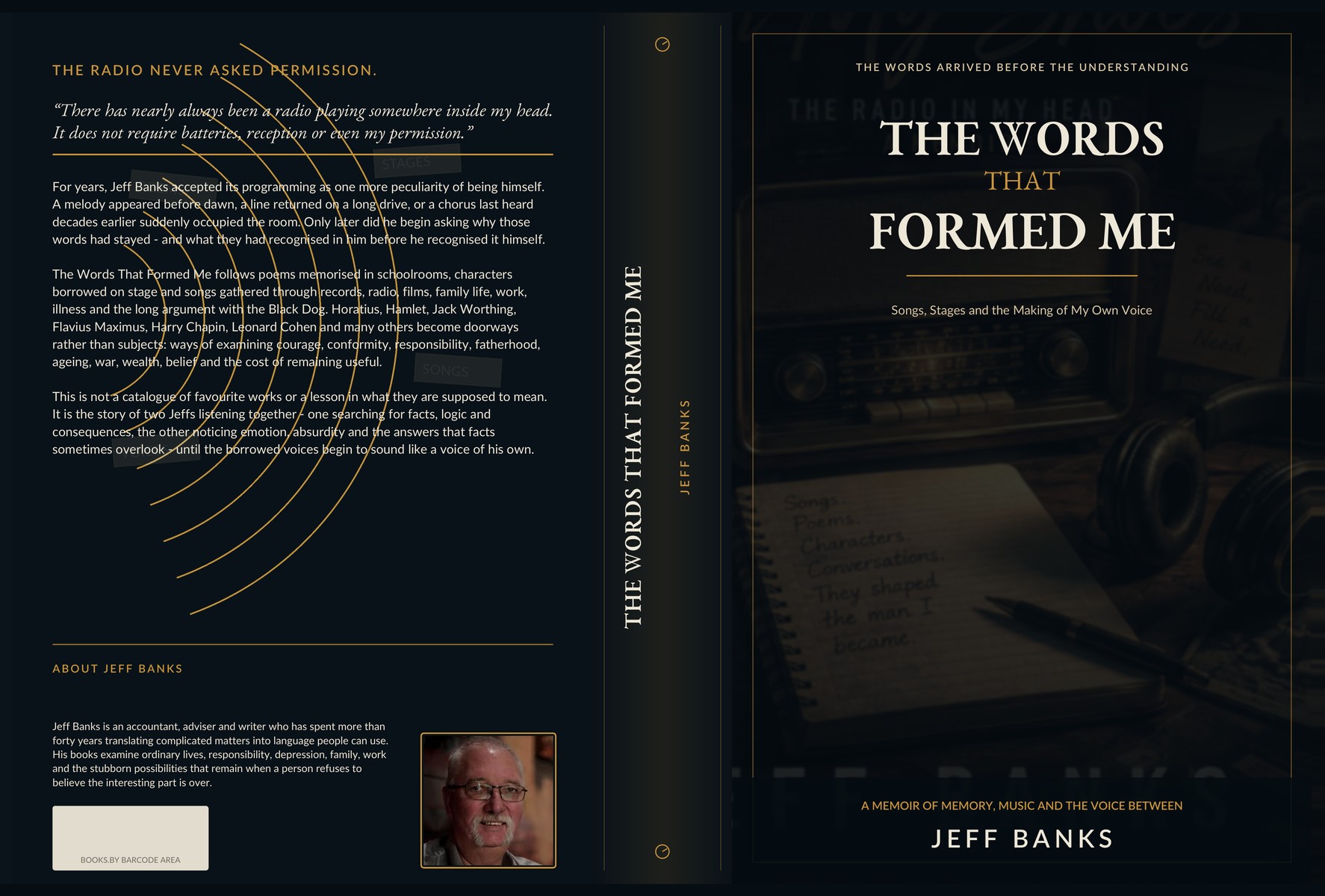
THE WORDS THAT FORMED ME Chapter 28 - The Songs That Lied

THE WORDS THAT FORMED ME Chapter 28 - The Songs That Lied | Travelling Around Australia with Jeff Banks

I have done that with responsibility. I found Bigweld, service above self, pay it forward and every story in which the useful outsider arrives when official structures have failed. I placed them around the table and asked whether I should help, knowing perfectly well how the vote would go. The dissenting voice suggesting rest, boundaries or the possibility that another adult might carry his own parcel was frequently ruled out of order.

THE WORDS THAT FORMED ME

CHAPTER 28

The Songs That Lied

There are times when I have watched an English football crowd rise as one, scarves lifted, voices joined, and felt the force of thousands of people believing the same thing at precisely the same moment. The words roll around the ground with enough power to make a television speaker sound inadequate, and for a few minutes individuality appears to have been suspended by mutual agreement. You’ll Never Walk Alone¹ becomes less a song than a declaration of membership, and I can understand why people surrender themselves to it. I can also understand why I never quite could.

It is not that I dislike Gerry and the Pacemakers, nor that I am immune to a grand chorus delivered with sufficient conviction. There is something stirring about a crowd singing without embarrassment, especially in an age when many people struggle to speak plainly even to those they love. My problem is not with the singing, the emotion or even the hope. My problem is that the song makes a promise that life has shown no particular intention of keeping.

The promise works beautifully while the crowd remains assembled. Nobody standing in the Kop, or in any other mass of voices that has adopted the song, is alone during those few minutes because thousands of strangers are breathing in roughly the same places and producing roughly the same words. The evidence seems overwhelming, as evidence often does when everybody in the room has agreed not to test it too closely. Then the match ends, the scarves come down, the turnstiles release their customers, and every person walks back into the life that was waiting outside the gate.

Some return to family, noise, argument, affection and the ordinary irritation of somebody having used the last of something without replacing it. Others return to an empty house, a troubled marriage, a sick child, a dead-end job, a fear they have not named or a mind that becomes dangerous when the distractions stop. They may carry the tune home, but the crowd does not come with it. The song has not deliberately deceived them, because songs do not possess accountants, lawyers or departments responsible for misleading and deceptive conduct. Nevertheless, the promise has expired before some people have reached the railway station.

That is where my resistance begins. You’ll Never Walk Alone does not say that somebody might walk beside you if they notice, have the time, understand the need and are prepared to remain after the first reassuring sentence. It does not say that the road may contain long stretches where no hand arrives and no voice answers. It offers certainty because certainty is easier to sing than qualification, and a football crowd would be considerably less impressive if the chorus stopped to consider exceptions, exclusions and the applicable terms and conditions.

The song was born in a different place, within the musical Carousel, where it was offered as comfort inside grief rather than as a terrace guarantee. That matters, because words spoken to one hurting person are not necessarily dishonest merely because they cannot rearrange the universe around her. Comfort is allowed to be larger than the evidence for a few minutes. The Gerry and the Pacemakers recording changed the scale, however, and the crowd changed the function again, until private consolation became public fervour and public fervour began sounding like proof.

Fervour has always worried me because it can make a statement feel true without requiring anybody to make it true. A room full of people chanting that they care is not the same as one person turning up after the room has emptied. A business announcing that its people are its greatest asset may still make those assets redundant by spreadsheet before lunch. A community may speak passionately about mental health while remaining deeply uncomfortable when somebody’s mental health becomes inconvenient, repetitive, untidy or impossible to solve in a single conversation.

The sheep are not necessarily foolish when they move together. A flock has practical reasons for behaving like a flock, including the possibility that the one animal confidently heading elsewhere has misunderstood the location of the gate. There is warmth in belonging and safety in numbers, and I have spent enough of my life outside rooms to know that exclusion is not automatically evidence of superior perception. Yet conformity becomes dangerous when the movement of the group is offered as a substitute for thought, and the song of the group is accepted as a substitute for action.

You’ll Never Walk Alone leads the sheep with magnificent efficiency. It tells each individual that the mass has already solved the loneliness problem, provided everybody continues singing at the required volume. The person who questions the promise risks appearing mean-spirited, because nobody wants the man in Row 17 explaining statistical probability during the emotional climax. I have often been that man in other rooms, although usually without a scarf and sometimes with a calculator, and it has rarely improved my popularity.

The difficulty is that I want the promise to be true. I would prefer a world in which nobody walked alone, every cry was heard and every person who fell found somebody beside them before the ground became familiar. I would like the crowd’s words to operate as a binding commitment rather than an expression of temporary goodwill. The anger comes not because I reject the ideal, but because I have seen how cheaply ideals can be purchased when singing them is counted as sufficient payment.

There have been times in my life when people were around me and I still walked alone. The Black Dog did not always wait for an empty room, and loneliness was not measured by the number of chairs occupied nearby. A person can be loved, needed, consulted and spoken to throughout a day while remaining unseen in the one place where recognition is most required. The song’s logic fails there because company and companionship are not the same thing, just as hearing words is not always the same as listening.

My own competence helped to hide the distance. The capable person is often left alone because capability is treated as self-replenishing, rather like a public utility that merely requires the occasional bill to be paid. People bring their problems to the person who appears able to carry them, and the arrangement can feel like connection because there is conversation, urgency and even gratitude. Yet being useful to somebody does not necessarily mean that person has noticed you, and a man may walk beside many people while none of them is walking beside him.

I cannot place the first time Jim Stafford’s Swamp Witch² entered my life with the same certainty I can attach to some other songs. It seems simply to have been there, one of those strange stories the radio delivered without first checking whether the listener needed a swamp, a plague, a suspicious town and a woman everybody feared until they wanted something from her. Black Water Hattie lived beyond the accepted boundary, which made her dangerous while life was normal and useful when normality collapsed. The town did not become wiser before it became desperate; it merely ran out of respectable options.

That story felt more truthful to me than the great communal promise. Hattie did not gather the townspeople together and assure them that no one would ever suffer alone. She saw the need, filled the need and remained outside the applause that followed, assuming there was applause and not merely relief wearing its Sunday clothes. The people who had feared her accepted what she provided because survival has a way of relaxing principles that were never principles in the first place.

There is a part of me that has always understood Black Water Hattie. The outsider develops skills the village may eventually require, although the village often prefers not to acknowledge where those skills came from. It may mock the person who thinks differently, reject the warning that disrupts comfortable habits and question the motives of anybody who refuses to repeat the approved answer. Then the swamp rises, the fever spreads, the numbers no longer reconcile, and somebody remembers the difficult person beyond the boundary.

In far too many situations, the only Black Water Hattie available was me. That sounds more heroic than it felt, and heroism is often what other people call an unpaid responsibility after they have stepped safely away from it. I was not waiting in a mysterious shack stirring solutions in a vat, although there were days in accounting when the difference was largely presentational. I was simply the person who saw the problem, could imagine a response and found it almost impossible to pretend I had not noticed.

Bigweld’s instruction to see a need and fill a need⁶ gave that instinct a respectable uniform. It turned intervention into service and made action appear morally superior to observation, which it often is. A person lying on the ground does not require a philosophical conference on whether assistance might create dependency. He requires somebody to kneel, ask what hurts and decide whether an ambulance would be more useful than a motivational speech.

The problem begins when every need becomes mine. Once I accept that songs do not save people, crowds disperse and institutions often arrive after the paperwork, the road leads very quickly into a rabbit hole. If nobody else is coming, then I should go. If those already there are offering slogans, procedures or sympathy without movement, then I should push past them and do something that changes the immediate condition.

That belief can produce good work. It can also produce a life in which the person who recognises the lie becomes trapped into compensating for it. The world says nobody walks alone, the evidence says otherwise, and the capable dissenter quietly volunteers to escort everybody home. He may call it responsibility, service, decency or simply doing what needs to be done, but the road grows longer each time somebody else discovers that he is willing to walk it.

I should have been the man who sometimes said enough was enough. I could see the pattern, calculate the cost and explain with great clarity why a particular burden did not belong to me. The analytical Jeff could prepare a convincing report supported by history, precedent and a projected exhaustion date. The human Jeff would then notice somebody falling, put the report in a drawer and move towards them.

That is where my anger at conformity becomes uncomfortable, because I was not merely its victim. I rebelled against the flock while allowing another expectation to govern me just as completely. The ordinary sheep followed the approved path because belonging required it, while I followed the rescue path because usefulness had become my form of belonging. We were both being led, although my shepherd wore the more flattering name of responsibility.

Black Water Hattie offers action where You’ll Never Walk Alone offers assurance, but that does not make Hattie’s course automatically better. The person who repeatedly saves the town may prevent the town from learning how to drain the swamp, maintain its health or listen before the fever starts. Rescue can become another performance in which everybody knows their part: the people ignore the warning, the crisis arrives, the outsider intervenes, gratitude is briefly expressed, and normal neglect resumes before the chairs have been stacked away.

I have lived versions of that cycle in business, community work and personal relationships. Advice was requested, considered, admired and then set aside until consequence turned it into an emergency. By then the question was no longer how to make a sensible decision but how to prevent a foolish one from becoming fatal. The same people who resisted being led would arrive asking to be carried, and I would become angry at their refusal to act earlier while still taking hold of the stretcher.

Perhaps that was my own song that lied. I told myself that I acted because somebody had to, which was usually true but not always complete. Being needed gave me a place in rooms where simply being Jeff had never felt sufficient. The emergency removed ambiguity because nobody asks whether the rescuer belongs while the building is on fire, and a man uncertain of his value can become very attached to smoke.

The danger is not confined to people like me. Societies often prefer rescue stories because they preserve the existing arrangement. A hero can be praised without asking why a hero was required, and a charity can be celebrated without examining the system that keeps producing the need for charity. The crowd sings about solidarity, Hattie brings the cure, and the village avoids the more difficult question of why it abandoned some people to the swamp in the first place.

Conformity is not merely wearing the same clothes, repeating the same political phrase or accepting that flowers must be red because the teacher has a limited supply of crayons. It is the deeper agreement that certain questions will not be asked because asking them threatens the shape of the room. We may argue loudly about who should rescue the fallen while never asking why the road has been designed to make falling inevitable. We may praise endurance because changing the conditions would require more from us than admiring those who survive them.

Paul Simon’s *El Condor Pasa (If I Could)*³ does not make the same promise as You’ll Never Walk Alone, but it lives in the same country of longing. Its movement is away from the fixed, the hard and the imposed, towards something freer, lighter and closer to the earth. The preferences sound simple, yet each one contains the small, devastating qualification that desire does not create capacity. The dream can name the life it would prefer without providing the bridge from here to there.

That has always been the difficulty with dreams. They are powerful enough to reveal dissatisfaction but not always strong enough to alter its cause. A man may know he would rather be something else, somewhere else or somehow less tied to the ground, and the knowledge may sharpen the pain of remaining exactly where he is. The song does not exactly lie, because it admits the conditional, but it allows the imagination to fly while the body continues attending meetings.

There were many times when I could see the better course. I knew the room was demanding conformity, the system was rewarding mediocrity or the client was asking for comfort rather than truth. I could imagine the freedom of refusing the role, leaving the argument, closing the file or allowing consequences to find the address unaided. Then responsibility, money, family, habit or the simple inability to abandon somebody would tie me back to the ground.

The flock prefers to believe that those who remain have chosen the field. It is reassuring to think everybody could leave if they really wanted to, because that turns confinement into a personal failure rather than a shared condition. We celebrate the rare person who escapes and use that exception as evidence that the gate was never locked. The condor becomes an inspirational poster while the nails holding it to the wall are supplied by the same people praising flight.

The Boxer⁴ is less polite about the transaction between dreams and reality. It understands promises as the cheap currency of people who do not expect to honour them, and it knows that a person hears selectively when hope is in short supply. The young man leaves with an idea of possibility and meets the indifferent machinery of the city, where wanting work does not create work and loneliness will accept comfort from places certainty might once have condemned. He dreams, receives the world’s answer and remains marked by the exchange.

I have always found that more believable. The fighter does not stand untouched in some golden sky while a crowd assures him that companionship has cancelled consequence. He carries the evidence of every blow, including the ones he insists will be the last. His persistence is not clean inspiration but something closer to the stubborn refusal of the body to accept the resignation already prepared by the mind.

There is conformity in defeat as well as victory. We admire the fighter who remains because endurance allows spectators to avoid asking whether he should still be in the ring. A person who leaves a damaging job, relationship, organisation or expectation may be called weak by people who were never required to absorb the blows. Staying becomes a virtue because staying preserves the structure, while departure is treated as betrayal because it exposes what the structure was costing.

I have stayed in places after the sensible leaving time had passed. Sometimes loyalty was the reason, sometimes hope, sometimes financial necessity and sometimes the belief that one more effort might finally make the system behave as it had always claimed to behave. I could hear the crowd celebrating endurance while the analytical Jeff quietly updated the damage schedule. The human Jeff continued to believe that abandoning the ring would also abandon people who had not caused the fight.

The song understands that contradiction without solving it. The fighter may declare departure and still remain, not because he is stupid but because human decisions are rarely completed at the moment they are spoken. The mind can know, the mouth can announce, and the feet can refuse to move. That is not hypocrisy so much as the ordinary delay between recognising a truth and becoming capable of living it.

You’ll Never Walk Alone attempts to close that gap with certainty. The Boxer leaves it open and lets the bruise remain visible. One song gathers everybody into a single promise, while the other preserves the loneliness of the individual inside the noise surrounding him. I know which one feels more honest to me, but honesty does not necessarily provide warmth, and warmth should not be dismissed merely because it cannot survive an audit.

Harry Chapin’s Circle, often known through its opening idea as All My Life’s a Circle,⁵ offers another kind of comfort. It suggests bends rather than straight lines, returns rather than final endings, and the possibility that what appears lost may come around again in another form. I can understand why it has stayed with so many people, because a circle is kinder than a wall. It allows us to imagine that separation is temporary and that unfinished things may yet find another meeting place.

The trouble arrives when the metaphor meets a road that genuinely ends. Harry Chapin died at thirty-eight, travelling to perform at a charity concert, and there is no honest way to make that fact curve neatly back into the song. His work continued, his influence travelled and the causes he served did not disappear with him, but the man died. A legacy may form a circle around an absence without reversing the absence itself.

I do not offer his death as a clever rebuttal to his song. That would be cheap, and Chapin gave too much of himself to deserve being reduced to an argument in somebody else’s chapter. I offer it because life does not respect the shapes our songs draw around it. A circle can help us carry grief, but it cannot guarantee the person will return to complete the line.

No dead ends is a beautiful idea until you meet one. Some careers stop, some bodies fail, some relationships cannot be repaired, some apologies arrive after the only person who needed them can hear, and some roads end without providing a scenic turning area. We may continue in a different direction, but that is not the same as proving the first road never ended. Language becomes dishonest when it denies the ending rather than helping us stand in front of it.

The songs that lied were not always the songs that contained false words. Sometimes the lie was created by what I asked the song to do. I used music to place order around experiences that had none, to suggest company where I felt isolation and to make endurance sound like choice. The songs offered images, and I promoted those images into guarantees because a guarantee is attractive when the world has stopped answering correspondence.

The same thing happens beyond music. Companies publish values they have no system for enforcing, governments announce commitments without measuring whether anybody receives the promised result, and communities praise inclusion while quietly excluding those who make inclusion difficult. We hang the words in reception areas, print them on annual reports and repeat them at conferences until the existence of the statement is mistaken for evidence of the behaviour. The song is sung, therefore the work is assumed to have been done.

Conformity protects this arrangement because the person who questions the words threatens everybody who has invested in repeating them. It is easier to call the dissenter negative than to examine whether the positive statement has become a decorative fraud. The room may prefer enthusiasm to accuracy, especially when accuracy arrives carrying consequences. I learned early that a correct answer can be resented when it interrupts a comfortable mistake.

That lesson followed me through school, business and the long effort to become understandable without becoming smaller. People often say they want honesty, but many mean they want reassurance delivered in an honest-sounding voice. They want the adviser to confirm that the chosen road will eventually become a circle, that the promised crowd will remain beside them and that somebody in the swamp has already prepared the cure. Telling them that the bridge is damaged, the fighter is bleeding and Hattie has stopped answering the door is rarely regarded as good relationship management.

Not Your Ordinary Accountant grew partly from refusing that version of service. Speaking in another person’s language did not mean telling them what they wanted to hear; it meant making the truth understandable enough that they could no longer hide behind confusion. That approach attracted people who wanted help and alarmed some who wanted absolution. It also kept me close to the rescue pattern, because once I had explained the danger clearly, I found it difficult to leave them inside it.

The fervour then followed me down another road. I became angry not only at the original problem but at every person and system that had allowed it to continue. Each failure connected to another failure, each slogan concealed another absence, and the rabbit hole widened into a network large enough to require its own postcode. A man who begins by questioning one false promise can eventually find himself cross-examining civilisation before breakfast.

There is energy in that anger. It drove books, advice, arguments, service and the refusal to accept that a foolish procedure became intelligent merely because it had been laminated. It also exhausted me, because the world produces nonsense faster than one man can prepare a response. Even Black Water Hattie would have required office hours, and the swamp showed no respect for weekends.

The Black Dog understood the weakness in my position. It knew that the man who believed he must comfort the fallen could be defeated simply by showing him how many had fallen. It did not need to prove that I was useless; it only needed to demonstrate that usefulness had no finish line. Every person helped left another still waiting, and every crisis resolved made the next unresolved crisis appear like an accusation.

You’ll Never Walk Alone could not reach that place because its promise became part of the pressure. If nobody was supposed to walk alone, then every lonely person became evidence that somebody had failed to walk beside them. I was inclined to nominate myself for the vacancy, even when I had never been appointed and lacked the capacity to fill it. The song that should have comforted me became another standard I could not meet.

Swamp Witch carried a similar danger from the opposite direction. Hattie acted, solved the immediate problem and disappeared, which sounds very much like the ideal rescue for somebody who does not want gratitude, attention or a committee meeting. Yet disappearing has a cost when it becomes the only way the helper knows how to survive. The town receives the cure, but nobody asks who carries Hattie when the swamp rises around her.

That question sits closer to me than I would once have admitted. I knew how to arrive with an answer, a shoulder, a calculation, a letter, a plan or the calm voice suggesting the situation was not yet fatal. I was less skilled at standing in the town square without something useful in my hands. The person behind the service could remain as hidden as the person behind any public image, except my costume was competence rather than glamour.

The chapter could become an argument that action is always superior to words. That would satisfy the analytical Jeff because Hattie produced a measurable result while the crowd produced sound waves and temporary emotional cohesion. It would also be too simple. Words can keep a person alive long enough for action to reach them, and a crowd can create belonging that continues beyond the final note when its members accept the promise as an obligation rather than a performance.

Perhaps the song is not the liar. Perhaps the lie begins when we sing in the future tense and behave in the past tense, as though declaring the value completed our responsibility to live it. You will never walk alone can be either an empty assurance or a decision made by the person saying it. The words remain identical, but one version requires nothing after the final note and the other may rearrange a life.

Hattie’s action can also lie when it allows the rescuer to avoid asking why he needs to be indispensable. Service is not automatically pure simply because somebody benefits from it. It may contain love, responsibility, ego, fear, habit and the quiet bargain that usefulness will purchase belonging. The mixture does not invalidate the help, but neither should the good result prevent the helper from examining what sent him into the swamp.

El Condor Pasa can be a dream of freedom or a graceful method of postponing departure. The Boxer can honour endurance or help us romanticise damage that should never have been accepted. Circle can soften the terror of endings or persuade us not to recognise one when it is standing directly in front of us. Every song contains the possibility that the listener will recruit it into the defence of whatever he already intended to do.

That may be the deepest conformity of all. We imagine the flock is created by other people imposing their answers upon us, yet we also assemble private flocks inside our own minds. We collect songs, sayings, mentors, memories and convenient examples that all nod at the same conclusion. Then we call the result independent thought because the meeting occurred without witnesses.

I have done that with responsibility. I found Bigweld, service above self, pay it forward and every story in which the useful outsider arrives when official structures have failed. I placed them around the table and asked whether I should help, knowing perfectly well how the vote would go. The dissenting voice suggesting rest, boundaries or the possibility that another adult might carry his own parcel was frequently ruled out of order.

The stronger chapter on conformity cannot merely accuse the crowd. It must look at the man who prides himself on resisting the crowd and ask where he has built another one. My nonconformity became an identity, and identities defend themselves even when the evidence changes. I could reject the approved path with considerable courage while remaining obedient to the expectation that I must always be the person who saw more, carried more and stayed longer.

There is no clean answer between the stadium and the swamp. The stadium offers belonging without proof, while the swamp offers action without shared responsibility. One may leave the lonely person unsupported after the song, and the other may leave the helper unsupported after the rescue. The better course may depend on whether the crowd is prepared to follow its words into the street and whether Hattie is prepared to let somebody else stir the next vat.

I do not want to answer the question because a final answer would become another song asking to be believed. I want to leave the contrast alive: thousands promising that nobody will be alone, and one feared outsider quietly doing what the thousands have not yet done. I want to ask whether the promise creates the action or excuses its absence, and whether the action challenges the system or merely saves it from the consequences of refusing to change. Those questions are less comfortable than a chorus, which may be why they have fewer people singing them.

Now, when You’ll Never Walk Alone rises from a crowd, I can still feel its force. I do not sneer at the people singing, because some of them have probably carried others through storms I know nothing about, and some may be holding themselves upright with the words. I simply cannot hear the promise without also seeing the road after the crowd disperses. Somewhere beyond the stadium lights, somebody is walking alone, somebody else is deciding whether to follow, and a tired figure in the swamp is wondering whether this time the town might come looking before it needs the cure.

The radio in my head does not settle the argument. It allows Gerry and the Pacemakers to fill the grandstand, Jim Stafford to send Hattie through the darkness, Paul Simon to let the condor dream and the boxer absorb another blow, and Harry Chapin to draw a circle around a life that ended far too soon. I hear the hope, the lie, the action, the damage and the longing, sometimes all before the first song has finished. Perhaps the words formed me not by giving me truths to repeat, but by teaching me to ask what happens after everybody has repeated them.

Notes

  1. You’ll Never Walk Alone was written by Richard Rodgers, with lyrics by Oscar Hammerstein II, for the 1945 musical Carousel. The version central to this chapter was recorded by Gerry and the Pacemakers and released in 1963; it later became closely associated with Liverpool Football Club.
  2. Swamp Witch was written and recorded by Jim Stafford. It appeared on his self-titled album Jim Stafford in 1974.
  3. El Condor Pasa (If I Could) adapts music associated with Peruvian composer Daniel Alomía Robles, with English lyrics by Paul Simon and credited contributions from Jorge Milchberg. The Simon & Garfunkel recording appeared on Bridge Over Troubled Water in 1970.
  4. The Boxer was written by Paul Simon and recorded by Simon & Garfunkel. It was released as a single in 1969 and later included on Bridge Over Troubled Water in 1970.
  5. Circle, commonly referred to by its opening phrase All My Life’s a Circle, was written and recorded by Harry Chapin and released on Sniper and Other Love Songs in 1972. Chapin died in a road accident on 16 July 1981 while travelling to perform at a charity concert.
  6. Bigweld is a character voiced by Mel Brooks in the 2005 animated film Robots. His maxim “See a need, fill a need” becomes a guiding principle for the young inventor Rodney Copperbottom.

Author

Menu