

WHEN THE DARKNESS COMES - Chapter 24 - When the Darkness Comes

WHEN THE DARKNESS COMES - Chapter 24 - When the Darkness Comes | Travelling Around Australia with Jeff Banks

Tomorrow is the important word, but it does not need to stand alone to become important. For all the darkness described in these pages, I have always wanted tomorrow, even when I desperately wanted the feeling I was carrying towards it to stop. I wanted to know what my children would do tomorrow, what Robyn and I might do tomorrow and, apparently, what ridiculous project I might decide needs doing tomorrow. That is why I promised myself this is the last time, because I don't want to spend tomorrow writing another chapter about yesterday's darkness when there is an entire day available in the other direction.

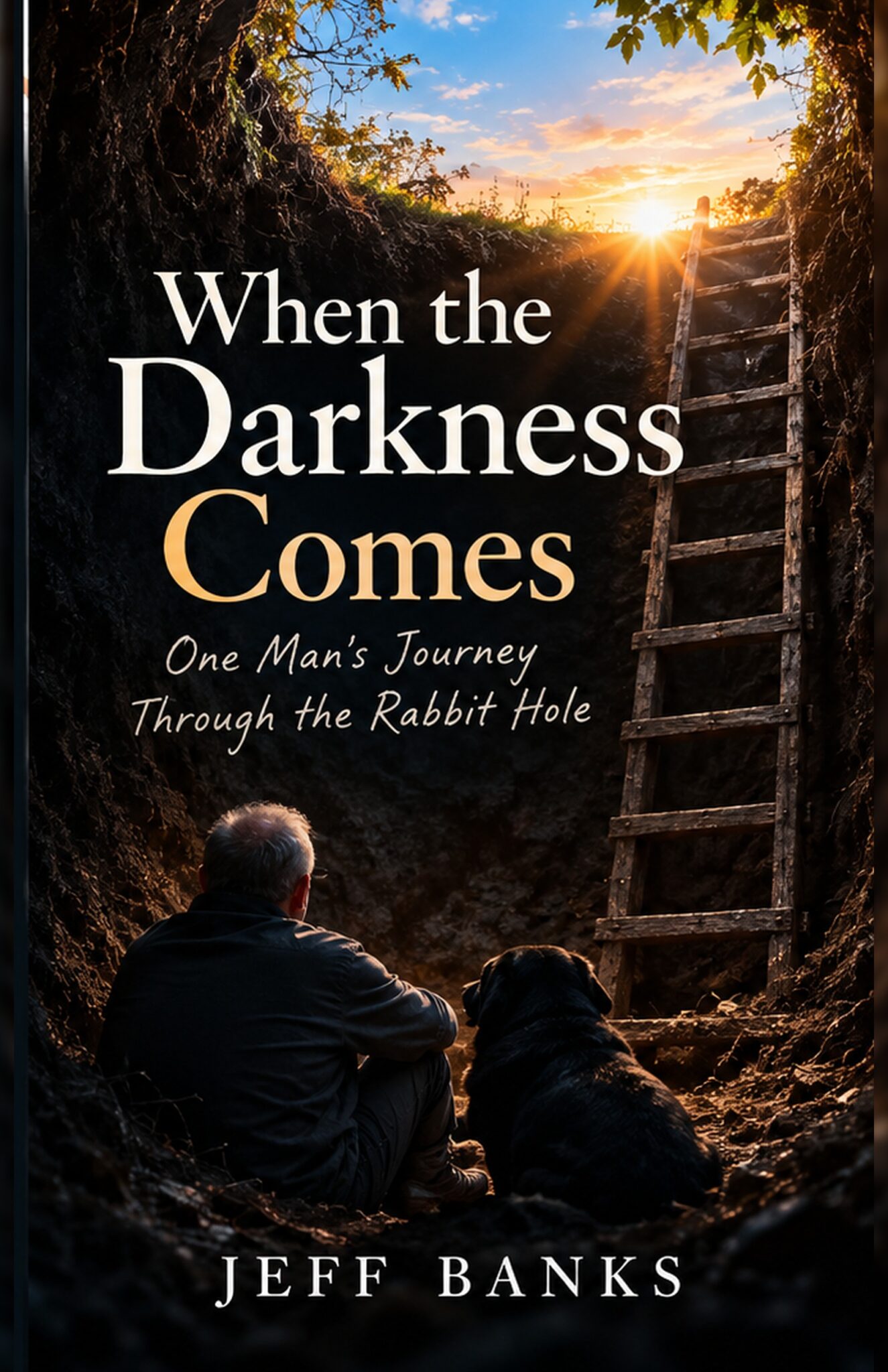
WHEN THE DARKNESS COMES

One Man’s Journey Through the Rabbit Hole

Chapter 24

When the Darkness Comes

I took pause before I started writing this chapter. That is probably an unusual admission after spending twenty-three chapters writing about depression, but this one was different because I had already made myself a promise: this would be the last chapter I would ever write about it.

I had a shower first, which is hardly an earth-shattering beginning to the final chapter of a book. Somewhere in the familiar process I noticed that the routine was slightly off, not dramatically so, just a few simple little mistakes in things I normally do without thinking, and they were enough for me to notice that something wasn’t quite where it usually sat.

That was when the problem with this entire exercise presented itself in a way I hadn’t really considered when I started. I was about to sit down at the computer and deliberately think about depression again, examine it again, write about it again and search for meaning in it again, and suddenly I was vexed by the possibility that thinking about the bloody thing might be one of the worst measures I could use to deal with it. What if writing about depression actually makes it worse?

There is no scientific proposition hiding in that question, and I am certainly not suggesting that somebody else should stop talking, writing or thinking about their depression because I have reached some grand conclusion about what they should do. I am talking about me, because after all these chapters I have begun to wonder whether repeatedly examining my own darkness sometimes encourages me to look in precisely the wrong direction.

I have spent a great deal of this book talking about the Black Dog because the Black Dog is one of the ways depression has been explained to me. I didn’t invent him, and perhaps I have relied upon him because I have never had adequate words of my own for something I can recognise far more easily than I can describe. Somebody else gave me a Dog, somebody else gave me darkness, and somewhere along the way I collected rabbit holes, ruts and spirals because they were at least words I could use when my own vocabulary refused to turn up.

That inability to find the words is particularly strange for me because words have rarely been the problem in other parts of my life. I spent decades taking things that clients found complicated and trying to explain them in their language, and one of the foundations of Banks Consultancy was precisely that: speak in your language. Give me a tax problem, a business structure or a set of accounts and I could usually find another way of explaining it if the first explanation didn’t work, because underneath the language there was something reasonably definite that I was trying to describe.

Depression doesn’t give me that luxury. I can recognise it when it arrives and sometimes recognise that it is coming before I can explain what I have recognised, but ask me to describe precisely what has changed and suddenly the bloke who could talk for a living is rummaging around in somebody else’s collection of metaphors. There is something almost ridiculous about being able to explain a complicated tax arrangement to somebody who doesn’t understand tax and then being unable to explain to the woman I have spent most of my life with why I don’t feel right this morning.

Perhaps part of the problem is that the words we normally use describe emotions that seem too small or too familiar for what I am trying to explain. Sad doesn’t do it because sometimes I am not sad. Unhappy doesn’t do it because I can identify perfectly good things in my life and know that I am fortunate to have them. Worried requires something I am worried about, angry needs somewhere to point the anger, and tired suggests that a decent night’s sleep might settle the account. Even depressed can become circular: I know I am depressed because I feel depressed, which is not much of an explanation from a bloke who spent a career demanding that numbers actually reconcile.

So I reach for physical descriptions instead. I can talk about the pit in my stomach because I can feel where it seems to sit, the weight on my chest because something genuinely feels heavy, the rut because movement becomes harder, the rabbit hole because thoughts can lead down into other thoughts, the spiral because there seems to be a direction to the descent, the pendulum because I have known the movement between peaks and troughs, and the darkness because sometimes the light seems to have disappeared without anything outside me actually changing.

They are useful descriptions, but they are still only approximations. None of them quite explains the peculiar experience of knowing intellectually that there may be nothing wrong while simultaneously feeling something is very wrong, and none captures the frustration of Logical Jeff standing there with all the evidence while another part of me simply refuses to accept his submission.

Maybe that is why the words won’t come. Language works particularly well when there is an object to describe, an event to recount, a problem to define or an argument to make, but I am trying to describe an absence and a presence at the same time: the absence of any obvious reason to feel the way I do and the overwhelming presence of the feeling itself. I keep trying to give shape to something that seems to change shape while I am looking at it.

There is another possibility that bothers me more now that I have reached the end of this book. Perhaps every time I reach for the Dog, the pit, the rabbit hole or the darkness, I am not getting closer to describing what happens to me at all; perhaps I am simply giving myself a familiar vocabulary in which to continue thinking about it. The metaphor becomes convenient, then familiar, then almost real, until instead of saying that I woke this morning and something felt wrong, I begin looking around the room to see where the bloody Dog is sitting.

That may explain why somebody who has now written an entire book about depression can arrive at its final chapter and admit that the words still don’t come. I have found hundreds of thousands of them around the subject, but finding words about depression and finding the words for what depression actually feels like inside me have turned out to be two quite different things.

Perhaps that matters more than I realised. If I don’t have the words myself, I inevitably reach for other people’s explanations, other people’s descriptions and other people’s ideas about how depression is supposed to work, and then I begin thinking about it in the terms available to me. That thinking can become its own rabbit hole, because instead of getting me out of the burrow it can send me further down while I carefully examine the walls on the way.

There was a woman at the retreat who may have given me something much more useful without ever presenting it as an answer. She was someone I could talk to without the conversation requiring an answer to every question being raised, and perhaps that was important precisely because so much of my life has been built around finding answers.

Accountants aren’t supposed to be particularly comfortable with unreconciled balances. Businesspeople aren’t generally rewarded for identifying a problem, contemplating it deeply and then deciding that it can remain unresolved because perhaps there isn’t an answer available today.

I have spent a lifetime reading the question, working out what is required and doing what sits in front of me. I built a considerable part of my professional identity around dragging other people kicking and screaming towards compliance and towards things that needed to be done, because staring at the requirement, worrying about the requirement or inventing a more frightening version of the requirement never struck me as particularly useful when the bloody thing still needed doing.

Depression has never respected that methodology. I can read the question perfectly well and still have no idea what it is asking, and on some mornings the only question available is the same one that has followed me through this book: why today?

Perhaps today because there is no reason for it not to be. That may be one of the hardest things for the accountant in me to accept, because I have spent years searching for triggers, causes, events and explanations that might make the emotional ledger balance when sometimes there simply isn’t an entry on the other side.

Something happened yesterday, therefore I feel like this today, is at least a proposition I can investigate. Nothing happened yesterday, everything was reasonably fine, I went to sleep and woke with a pit in my stomach anyway is a much less satisfactory set of accounts, but perhaps occasionally there simply isn’t a missing transaction to find.

That doesn’t mean I have stopped wanting an explanation, because wanting one and having one are two quite different things. It means I am beginning to question whether searching endlessly for the reason I feel down can sometimes become part of feeling down, particularly when every answer leads to another question and every question points the binoculars back towards the Dog.

The binoculars may be one of the most important things I have stumbled across while writing this book. The Black Dog might be sitting in the corner of the office, but if I am looking through the binoculars towards something else, I cannot simultaneously spend every moment checking whether he has moved.

That sounds dangerously like denial, and I have spent enough of this book examining my own capacity for denial to be suspicious of convenient conclusions. I don’t think it is denial, though, because ignoring something you know is there is different from pretending it doesn’t exist.

I know the Dog exists, just as I know the pit, the weight and the spiral exist and that the pendulum can still swing with sufficient force to make a mess of things. Knowing they exist, however, doesn’t require me to maintain twenty-four-hour surveillance on them.

Working against the Dog can take my eyes off the light, and therein may lie one of his greatest tricks. If he can persuade me to spend all my energy fighting him, he has already determined what I will spend the day looking at.

That is an uncomfortable proposition after writing an entire book with him wandering through it. I started writing because I wanted to understand what had happened to me, what continued to happen to me and why a bloke who could find solutions to so many other things remained incapable of finding a reliable answer to this one.

Perhaps I have understood more, although I am less convinced now that understanding was ever going to produce the answer I thought I was looking for. I certainly know more about the patterns, the triggers that sometimes exist, the triggers I probably invented afterwards because I desperately wanted one, the medications, the flattening, the usefulness, the anger, the collateral damage, the retirement brochure that didn’t quite tell the truth and the peculiar capacity to function while something considerably less functional was happening underneath.

I also know more about the push. For years I regarded that drive as simply part of who I was: build the practice, look after the clients, provide for the family, solve the next problem, finish the next project, keep going and, when necessary, drag myself or somebody else kicking and screaming across whatever line needed crossing.

Writing this book has complicated that comfortable interpretation. The push may have been one of the things that kept me moving while also being one of the things that kept the lid on the pot, and the fact that the lid remained on doesn’t necessarily mean there wasn’t pressure underneath it.

I am still not sure whether the push fed the Dog or starved him, and it may have done both depending upon the day. Perhaps my need to decide which one it was is simply another attempt to reconcile accounts that refuse to reconcile, but what I do know is that the push exists.

I have demonstrated that often enough across a lifetime that I don’t need another questionnaire, another chapter or another bloke with a clipboard to establish it. The question now may be where I point it, because there is a difference between pushing against the darkness and pushing towards the light.

They can look like the same movement from a distance, but one keeps the darkness as the reference point while the other requires me to turn around. That may be the distinction I have been missing while spending so much time trying to work out how to fight something I cannot even adequately describe.

For a long time endurance was enough. When the rut arrived I endured it, when the pit opened I waited for it to close, and when the weight settled on my chest I knew from experience that eventually it would become lighter even if the bloke underneath it wasn’t particularly convinced at the time.

I don’t want endurance to be the only strategy anymore. I have the drive, I have the ability and I have the push, and perhaps the next job is to use those things to move in the direction I know I want to go rather than allowing the weight to determine the direction for me.

That direction appears to be towards something I keep calling happiness, although after all these words I remain spectacularly incapable of defining what happiness actually is. There is something reassuringly consistent about finishing a book intended partly to understand myself and discovering that one of the largest entries in the ledger remains unreconciled.

I know that I want it, even if I cannot produce a definition that would survive five minutes of cross-examination. I have described it as the light at the end of the tunnel, crossing some line into a place I would recognise as happy, or finding a way to stop the pendulum creating quite so much havoc when it swings.

Maybe the blinkers need to become stronger and the binoculars need to remain pointed more deliberately towards the light. That isn’t because darkness has ceased to exist behind me; it is because I have already spent a considerable amount of time establishing that it does.

There is an A4 financial-year diary sitting on my desk, given to me by Justin, and on 1 July 2024 I began using it to record moods and songs because at the time that seemed like information worth collecting. It was worth collecting, because the diary became evidence when I was trying to understand patterns that otherwise disappeared into memory, and the songs became another strange little measure of something happening inside my head before Logical Jeff necessarily received the memo.

For a bloke who once believed he could remember almost everything he read, there was probably something appropriately humbling about needing an A4 diary to tell him how he had felt. It sat there and did its job without complaining, which is more than can be said for some of the systems I have used over the years.

I am going to take it off the desk now and put it on a shelf in the library. I am not going to throw it away because that would give the gesture far more theatrical significance than it deserves, and I am certainly not going to burn it in some grand ceremony announcing that Jeff Banks has conquered depression.

It can sit there and collect dust, and I rather hope that is precisely what it does. The diary was important when I needed it, but perhaps continuing to record every movement now would become another version of watching the Dog.

I don’t need to audit every morning to prove that some mornings are good, some are ordinary, some are bloody awful and occasionally there appears to be no sensible reason why. I already have enough evidence to establish that proposition, and another page of ticks, songs and observations isn’t necessarily going to alter it.

Robyn will still be there through all of that. I would love to report that writing this book has suddenly equipped me with a magnificent new emotional vocabulary and that tomorrow morning, should the darkness arrive, I will sit beside her and provide a concise but comprehensive briefing on the state of Jeff, but I won’t.

Nothing has changed that much, and the words that have been difficult to find for most of my life have not magically appeared merely because I managed to put a couple of hundred pages between two covers. She will continue to be her rock and, when I need it, the rock that I need, and that arrangement has survived long enough without requiring me to rewrite either of us for the sake of a satisfying final chapter.

The Dog may never leave either. Earlier I might have wanted the ending of this book to contain some evidence that he had finally packed his bags, wandered down the driveway and become somebody else’s bloody problem, but I don’t believe that anymore.

I suspect he will remain capable of appearing. There may still be mornings when I recognise him immediately and others when the bastard has been sitting quietly in the corner for a while before I notice him.

There are strategies I can put in place to mitigate what he brings to the table. Some will work, some probably won’t, and there will undoubtedly be occasions when something that worked perfectly well last time produces bugger-all benefit this time.

That has been one of the frustrations running through the entire story. Depression has never shown much interest in behaving consistently merely because consistency would make it considerably easier for me to understand.

The difference may be that I no longer need to understand every appearance before I decide what to do next. Recognising the spiral, the rabbit hole, the pit and the weight may be useful if recognition tells me where I am, but recognition becomes less useful if I then sit down beside them and start taking detailed measurements.

Wallowing has its own gravity. Once I allow the weight to decide the direction of travel, down becomes easier than up and examining why I am travelling down can become another way of continuing the journey.

That is where the push matters now, not as proof that depression can be overcome by determination, because my own life would make nonsense of that proposition. It matters as evidence that I already possess something I can use when I recognise the direction in which I am moving, and perhaps I can become better at pointing it towards the light.

Whether the light is happiness remains another question. I have spent enough time looking for the definition of happiness to know that I could probably turn that search into another book, and I have just promised myself that I am finished writing books about this particular part of me.

Perhaps happiness will eventually turn out to be less of a destination than I have imagined. Perhaps I will recognise it only after I have been standing in it for a while, or perhaps Logical Jeff will continue demanding measurable criteria while the other Jeff simply gets on with experiencing whatever is there.

I don’t know, and for once I am prepared to leave those three words attached to the rest of the paragraph rather than pretend the absence of an answer is itself some profound revelation. I don’t know why the darkness sometimes arrives, why apparently trivial things can send me down the spiral while significant things occasionally don’t, or why remedies that have helped on one occasion can be useless on another.

Perhaps every one of those questions does not require an answer before I am permitted to continue with the day. That may also be what I received from the lady at the retreat, because sometimes being able to talk without the person listening needing to supply the answer is more useful than another attempt to fix something that neither of us completely understands.

I have been a fixer for most of my life. Problems were there to be solved, requirements were there to be met, clients were there to be dragged kicking and screaming to compliance and questions were there to be read carefully enough that you answered the one actually asked rather than the more frightening one you had invented in your head.

Maybe depression is the question for which I have spent too many years assuming there must be an answer at the back of the book. There may not be, and I no longer know whether searching every page for it is helping.

That is why this is the last chapter I intend to write about depression, but the promise is not that I will never feel it again. It is not that the Dog is dead, the pendulum has stopped, the pit has been filled in, the rabbit hole has collapsed or I have finally found the switch controlling the light at the end of the tunnel.

The promise is much smaller than that, and perhaps much more useful. I have spent enough time looking at the darkness to know it is there, and I no longer need to keep staring at it merely to prove its existence.

This book began because I wanted to understand something that had followed me through an extraordinarily full life. It has been there alongside a marriage, children, grandchildren, businesses, clients, friends, arguments, successes, failures, golf, fishing, ridiculous ideas, retirement, books, songs and more ordinary days than I could ever hope to remember.

Perhaps that is the part I had backwards when I began. I thought I was writing the story of depression moving through my life, when I may actually have been writing the story of a life that kept moving while depression occasionally moved through it.

The distinction matters to me because the Dog has always been greedy. Give him enough attention and he can persuade me that whatever I am feeling at that particular moment is the entire landscape, even when the evidence of my own life says otherwise.

I don’t have to kill him to refuse him the landscape. I don’t even have to make him leave the room before I look through the binoculars at something else.

So the diary can go onto the shelf and the binoculars can point towards the light. The blinkers can occasionally stop me checking what is happening in the corner, and the push that has caused me both benefit and grief across a lifetime can be pointed in the direction I actually want to travel.

There will still be Robyn, still be family, still be golf and fishing and gardens and pieces of timber waiting to become something in the Man Cave. There will still be books to write too, although I have made myself a fairly firm promise about the subject matter of at least one of them.

There will also still be mistakes in the shower routine. I noticed them this morning because something was slightly out of place, and perhaps tomorrow I won’t make them or perhaps I will make entirely different ones.

Tomorrow is the important word, but it does not need to stand alone to become important. For all the darkness described in these pages, I have always wanted tomorrow, even when I desperately wanted the feeling I was carrying towards it to stop.

I wanted to know what my children would do tomorrow, what Robyn and I might do tomorrow and, apparently, what ridiculous project I might decide needs doing tomorrow. That is why I promised myself this is the last time, because I don’t want to spend tomorrow writing another chapter about yesterday’s darkness when there is an entire day available in the other direction.

The Black Dog might be there when I wake up. If he is, I hope I recognise him a little earlier, resist the temptation to sit beside him examining why he has arrived, and remember that working against him can sometimes take my eyes away from where I actually want to go.

If none of that works immediately, then none of it works immediately, and I am not going to pretend otherwise simply because I have reached the final page. I have lived long enough with him to know that understanding his tricks doesn’t oblige him to stop performing them, and knowing where the light is doesn’t mean I will always find it quickly.

The binoculars are mine, though, and perhaps that is enough ownership for one final chapter. Tomorrow morning I will wake up, remove the CPAP mask and discover what station the radio is playing, and then I think I might get on with the day.

Author

Menu