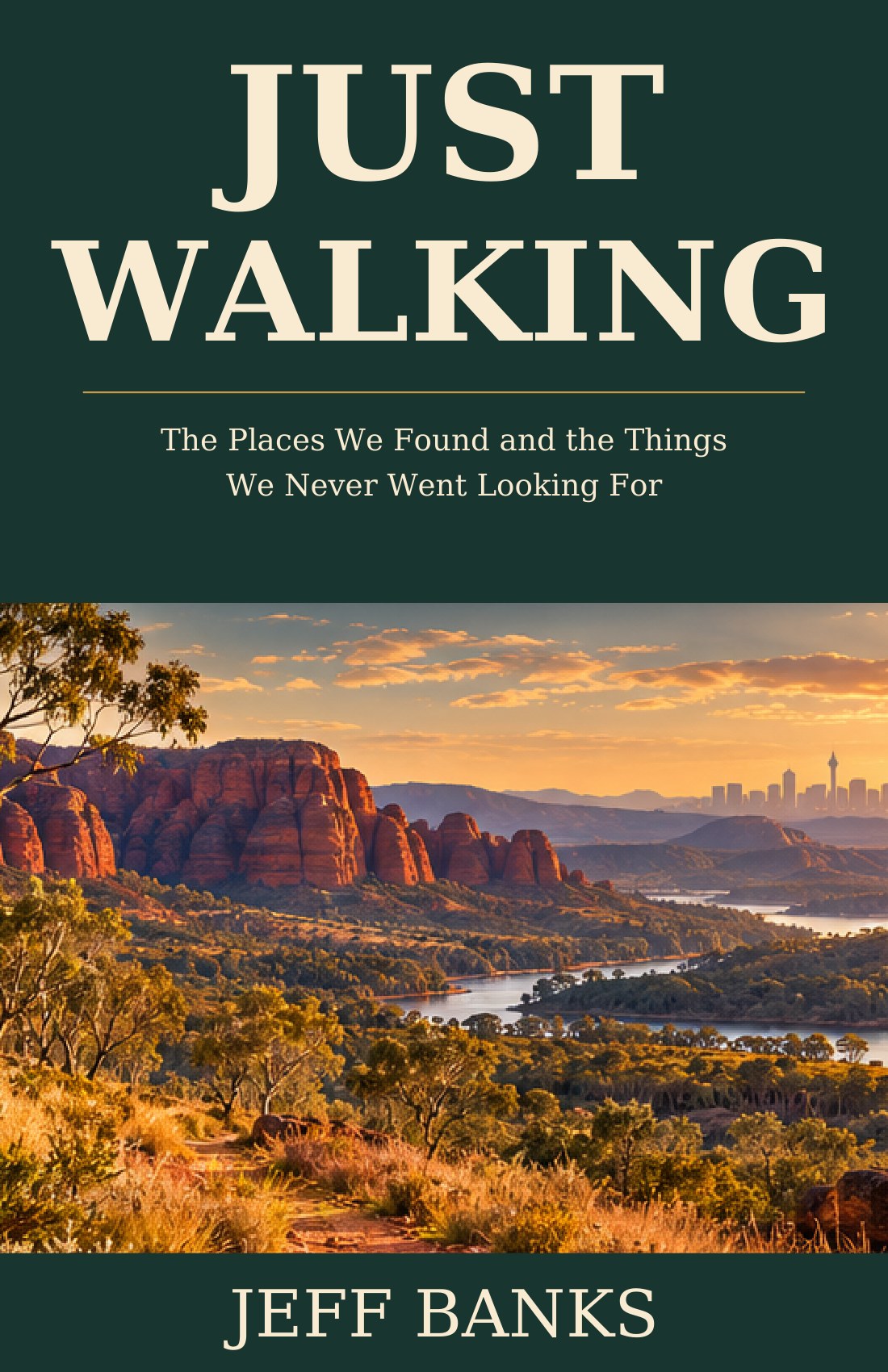
JUST WALKING - Chapter 18 - Purnululu - A Question of Belonging

JUST WALKING - Chapter 18 - Purnululu - A Question of Belonging | Travelling Around Australia with Jeff Banks

There had been people moving through this country long before our route could be traced on a road map. I cannot supply the stories of particular footsteps through the places we visited, but I can recognise how briefly ours entered the picture. Our walking was fitted between camps and the next stage of a holiday. For those whose families belonged here, movement through country was part of a continuing life which our arrival neither began nor explained.

JUST WALKING

The Places We Found and the Things We Never Went Looking For

Chapter 18 – Purnululu – A Question of Belonging

Our introduction to the people of Frog Hollow began with a question about the stars. Children at Purnululu School wanted to understand why the Milky Way changed across the seasons, and their question found its way onto Q&A, where our daughter Kirsten was sitting alongside Brian Cox and a panel of eminent scientists. Robyn and I had plenty of reasons to watch that programme, although the particular pleasure of seeing our daughter in such company would have been sufficient on its own.

There is something slightly disorienting about watching your child take part in a discussion you would struggle to join. You remember the schoolgirl discovering an interest, then there she is on television explaining something about the universe with people whose work she has admired for years. Brian Cox was a particular hero of hers, which made the occasion all the more special. We were proud, of course, but the exchange with those children was about to lead somewhere none of us could have plotted from the television schedule.

Kirsten continued the conversation after the programme. A question about the sky became an ongoing connection with the students, including reading bedtime stories to them over a period of time. I rather like that progression, from the scale of the Milky Way to the companionship of a story before bed. The young woman they had seen on television was giving them her time, and familiarity grew through those occasions together despite the considerable distance between them.

When our travels were bringing us through that part of the Kimberley, Kirsten suggested we call in. We were simply her parents, passing nearby with a caravan behind us, but she thought we should meet the children and the people she had come to know. I emailed the school to arrange a visit, perhaps a photograph and an internet conversation with Kirsten while we were there. Our daughter had already made the friends; Robyn and I were about to benefit from the introduction.

We were coming from El Questro towards Spring Creek, where we intended to camp near the turnoff into Purnululu National Park. Along the highway, bursts of telephone reception allowed me to check for an answer to my email, but none had arrived. We passed what we thought might be the school and considered dropping in, then continued to the camp. There was still time to make arrangements, and the Bungle Bungles themselves were waiting for us the following day.

Photographs had made their shapes familiar long before we reached them. Those great domes had become one of the recognisable images of the country we were travelling through, although a photograph gives very little indication of what it will require of you to get among them. In particular, it leaves out the relationship between soft sand, increasing heat and a pair of legs which have already expressed reservations about the proposed activity. After my difficulties at Emma Gorge, I had good reason to take that relationship seriously.

The advice was to walk to Cathedral Gorge first, before the day became too hot, then visit Echidna Chasm, where the tall, narrow walls would offer more shade. We planned an early start, subject to the usual qualification that work sometimes followed us to places where we would have preferred it to lose our address. Robyn had things to attend to before we could leave, so I used the time to clean the caravan’s solar panels. Dust had settled over them, and improving their access to the sun seemed a useful contribution to our electricity supply.

My first attempt, standing on a Cruiser tyre and reaching across without being able to see properly, achieved considerably less than I had imagined. Inspection revealed that most of the panels remained untouched, so I wound down the window and stood on the sill for a better attempt. The batteries would later demonstrate that enthusiasm with a cleaning implement did not necessarily amount to a solution. For the moment, however, there was better news from the school: they would be delighted to see us, and we could visit the next morning.

With that settled, we set off into the park, leaving the caravans at Spring Creek. Fifty-three kilometres to the visitor centre might sound like a modest introduction to a day’s sightseeing, but the bends, dips and loose surfaces kept the drive interesting. Crests could conceal an immediate change of direction, and the shape of the track repeatedly confirmed the wisdom of leaving the vans behind. There was plenty around us to admire, provided I remembered to give most of my attention to what the road intended doing next.

We reached the visitor centre before it opened and spent the interval looking at the information outside. Once inside, we received the same advice about doing Cathedral Gorge first, then headed towards the Piccaninny parking area. We had also heard about an orchestral performance in the gorge, an intriguing addition to what we expected to find. A week earlier and we could have experienced the music there ourselves, although at that stage I was still some distance from understanding what sort of auditorium the landscape had supplied.

The track took us through forms which deserved much more attention than my feet were inclined to allow. Sand made the going hard, and the heat was increasing as we followed the path and creek bed towards the gorge. Part of me wanted to stop and look at everything, while another part was developing a practical interest in how much farther away our destination might be. Both had reasonable arguments, but the scenery was having to compete with an increasingly persistent submission from my legs.

Around us, the rock seemed to have been shaped according to rules borrowed from somewhere else. Rounded masses gathered together, their bands following surfaces too large to take in without stopping, while passages opened between them and drew us farther into the landscape. At times it felt as though we had wandered onto the surface of another world. Our hats and water bottles were about the only things spoiling the possibility of a convincing photograph from a distant planet.

Yet Mother Nature had made it all from materials thoroughly belonging to this one. Elsewhere she painted with forests, worked water between mountains or spread grass across plains until the horizon became difficult to distinguish. Here sandstone had apparently offered an opportunity to try something different, and she had allowed herself sufficient time to pursue the experiment. No one seemed to have interrupted to suggest a simpler design or a more restrained use of curves.

Moving through it changed what we saw. A shape which appeared complete from one position became part of something larger a few steps farther along, and an opening revealed rock hidden from our previous view. We were inside the work, finding our way among its forms, rather than standing back where the whole thing might fit conveniently into a frame. The walking gave us that changing perspective, even when the sand made me wish the next useful viewpoint would come to us instead.

We stopped in shade for a drink, which allowed me to look around without simultaneously negotiating where to put my feet. The creek bed beneath us was part of the same continuing process, carrying water when the season supplied it and providing our route for the moment. For all the apparent strangeness of the place, ordinary forces had been working patiently with ordinary materials. I could understand that much without being remotely capable of imagining the result before it existed.

Then the track brought us into Cathedral Gorge, and for a while the effort of reaching it lost its place at the centre of my attention. Rock opened into a great chamber, with a pool towards the back and fissures showing where water could enter. After the exposed approach, we could stop and begin taking in the proportions of what surrounded us. The name Cathedral made immediate sense as a description of the space, although it could only begin to describe a place known far more deeply by its custodians.

The height drew my eyes upwards, and the sweep of the chamber made our little group seem appropriately small. There had been no architect’s drawing or committee meeting about how to achieve the effect. Water and time had attended to the construction, leaving something people could enter, admire and find their own comparisons for. Cathedral was one such comparison, and standing there I could see why it had persisted.

The symphony performed a week earlier now became much easier to imagine. The photographs and footage of the occasion showed musicians and instruments gathered within those immense surroundings, giving scale to the rock and a sense of the grandeur of the event. We had missed it by very little in travelling terms, and by practically nothing in the life of the gorge. Unfortunately, geological closeness was unlikely to secure us a seat after the orchestra had gone home.

An ordinary concert hall arranges itself around the performers, directing light and attention towards the music. Here the setting would have held its own part of the audience’s attention before anyone raised a bow. I tried to imagine sitting there as the musicians prepared to begin, with that great chamber around us and the anticipation of hearing what it would do with the sound. The media could show the occasion, but standing in the place supplied something a screen could not contain.

There was pleasure in thinking about the human effort which had been brought into it. Each instrument represented years of practice, and an orchestra depended on people listening to one another closely enough to make their individual parts belong together. Around them was the work of forces operating over a span of time against which even a lifetime of dedication became brief. For the duration of the performance, those very different undertakings had occupied the same space.

I also wondered about getting everything there. Carrying my water and phone had seemed sufficient responsibility for the approach, so the arrangements behind an orchestral performance deserved some admiration before a note was played. Photographs naturally favoured the finished occasion, with its grandeur and apparent ease. Somewhere behind them would have been a considerable amount of effort by people whose work was less likely to make the picture.

Our own activities began on a considerably smaller scale. I had my phone out experimenting with slow-motion pictures around the pool, while Silver Leader noticed that even footsteps on the gravel carried through the chamber. We had been told about the acoustics; now the simple sound of someone walking allowed us to hear something of them for ourselves. Naturally, once I began considering what the gorge might do with a voice, there was a danger that I would investigate.

My selection came from Oklahoma!, a geographical departure which did not seem sufficient reason to abandon the idea. I gave the opening of its cheerful morning song enough volume to test the surroundings, and Robyn picked up her phone and had me do it again for the camera. This ensured that the performance would survive any subsequent improvement in my recollection of its quality. Silver Leader offered an assessment involving the apparent strangling of a cat.

The orchestra and I were unlikely to receive equal billing, but the foolishness became part of our day. A place of such scale could accommodate our admiration without requiring us to become solemn for the duration of the visit. We had walked in hot and tired, found something extraordinary and still managed to bring our own company into the experience. Robyn’s recording would preserve both the acoustics and the limits of the material they had been given to work with.

The return walk brought the heat and sand back into consideration. I would have been happy to head directly to the car, but a sign appeared to suggest that including the Domes Walk would add very little to the journey. What I thought it meant and what we actually had to walk proved to be different propositions. By the time we finished, my water was nearly gone, what remained was warm, and I was ready to leave further interpretation of signs to someone else.

We had, however, moved among formations previously known to us only through pictures. Their size and the changing views between them now belonged to something we had done, with the sandy approach and the effort of returning attached. I appreciated that more fully once I had recovered. There are times when the mind must wait for the body to stop lodging complaints before it can give a place its due.

On the drive towards Echidna Chasm I wondered whether another walk was a sensible proposition. Lunch and cold drinks at the picnic area improved the outlook, as did the encouragement of a couple who had already been through. They spoke warmly about the experience, and the promise of shade was persuasive. I decided to join the others rather than remain behind with the car.

The difference was noticeable almost at once. Stones replaced the draining sand of the earlier creek bed, and sections of track beside it gave us easier going. Shade and a breeze made the walking more comfortable, allowing me to attend to where we were rather than constantly measuring what it was taking out of me. The earlier advice about the order of the walks was proving useful in a very practical way.

Inside the chasm, light reached us from high above. The walls drew the eye through dark surfaces and bright orange towards the blue overhead, then required it to return to the stony ground for the next few steps. Looking and walking became activities best undertaken in turns. Each change of position offered another arrangement of light and rock which seemed worth trying to fit into a photograph.

We reached a space with seating and information where it would have been easy to decide the walk was complete. Fortunately, we had been warned that the apparent end could be misleading, and Robyn had gone ahead to investigate. For a moment she was out of sight, then she appeared from a narrow opening and beckoned us on. What had looked like a wall now contained a way through.

Farther in, apparent obstructions kept revealing possibilities when we looked more closely. A way continued beside boulders, and ladders and a clamber took us into another chamber, more impressive again. We could so easily have stopped earlier and left believing we had seen what we came for. Instead we were benefiting from advice given by others, followed by Robyn’s willingness to see where the path went.

Silver Leader and Rosalie arranged a photograph to match one their grandchildren had taken on an earlier visit, and we made our own additions to the collection. On the way back we passed on the advice to people heading in, pleased to save them from missing the continuation. It was a modest exchange, but a useful one. Our contribution to their day required considerably less volume than my earlier contribution to Cathedral Gorge.

By then I had recovered sufficiently to welcome Robyn’s suggestion of ice creams. The visitor centre had run out, which seemed an unfortunate failure of supply after I had spent some time anticipating demand, but Zooper Doopers provided an acceptable alternative. Later, when we regained telephone reception, I confirmed the following morning’s arrangements with Zoe at the school. We returned to Spring Creek with the walks behind us and the visit still to come.

The caravan’s electricity supply then demanded the attention my panel cleaning had failed to spare us. During the night the battery reserves fell below their minimum and the power shut down, leaving us with more practical matters to attend to before setting off in the morning. Calls for advice did not produce a ready solution, and the generator required oil before it could help. Another camper supplied some, Forbsy lent a hand, and eventually we were able to leave for Frog Hollow.

We intended to arrive for the school’s morning meeting, but the directions had not come through. Once inside the community, our phones were of no assistance, and we were conscious of moving among people’s homes without knowing which building we needed. A large Brahman bull, dogs and play equipment gave us things to notice without directing us towards an office. Children in school uniform playing basketball finally provided a more reliable lead, and they showed us where to go.

Zoe O’Hara, the acting principal, welcomed us and remembered the directions she had meant to send. We had found our way, so that omission was already behind us, and she began showing us around the school and explaining something of the community. Being Kirsten’s parents proved to be an excellent introduction. The connection our daughter had made was there ahead of us, and we were welcomed into it with a generosity we had done very little to earn ourselves.

I have described it as being treated like royalty, although the pleasure lay in how comfortably we were included. People gave us their time and made room for the visit among the ordinary activities of the school. Kirsten had spent time with the children through their questions and bedtime stories, and now her parents had turned up to meet them. We were receiving the warmth of a friendship she had already established, which was a lovely position for a mother and father to find themselves in.

Zoe spoke with enthusiasm about the school working alongside its community and the children taking part in the morning meeting. What interested me was the encouragement to find opportunities while keeping home and community part of the conversation. I was seeing only a small portion of the work, but it was being explained by someone involved in its daily realities. That gave the discussion a substance which broad pronouncements about what children ought to be doing can easily lack.

One of the community directors spoke about the long process of seeking recognition of their connection to land. I was hearing his account and could not pretend to untangle a case which had occupied years, but the time involved made an impression. We had been measuring our stay by the hours required for walks and the distance to our next camp. He was speaking about home through a process which had stretched across decades.

Zoe told us that the court had visited the community, with the judge seeing the school and joining in with the children. I was pleased that those making decisions had come to meet some of the people whose lives lay behind the documents. Even our brief visit was giving faces and particular experiences to a place previously represented by a name on our route. There seemed every reason for people with much greater responsibilities to see it for themselves as well.

The intended connection with Kirsten took a little longer to establish. My computer would not connect as it should, and the guest wi-fi brought her onto the screen without supplying a dependable conversation. After a television question had travelled across the country and helped sustain an ongoing friendship, it seemed unreasonable that the last connection should prove so difficult. Zoe solved it by joining the call through the more reliable staff network.

With Kirsten on her laptop, Zoe could carry her around the school, introduce us to classrooms and let the children say hello. Our daughter received much the same tour we had, although she had been spared the drive and the search for the office. The children knew her and were delighted to speak with her, while parents came through as part of the life around the school. By the time we left, every student had had an opportunity to say g’day.

The student who had asked the question on Q&A was away in Tasmania with her brother, trying out a school offering further opportunities. Her absence fitted with what Zoe had been telling us about helping the children discover where their interests might take them. A question had already carried something of her home onto national television. Now she was doing some travelling of her own, while we had arrived at the place from which the question had come.

I thought about Kirsten returning home from her first day at Davidson High School. Her principal, Mr Cawsey, had encouraged the new students to try the opportunities available to them, and she had taken the invitation seriously. An excursion to an IMAX theatre, where she saw images from the Hubble telescope, helped give that curiosity a direction. The young woman on the laptop had once needed someone to open a possibility for her too.

There was no need to expect every child speaking with her to become a scientist. The value was already there in the welcome given to their curiosity and in someone making time to keep the conversation going. We discussed another session in which the students could prepare questions about the stars, continuing a connection which had found room for both astronomy and bedtime stories. Robyn and I had been fortunate to stand inside it for a little while.

We were given a school shirt as a memento, and the kindness extended to the Cruiser before we left. Zoe noticed the problem with my driving lights and explained that her husband, a mechanic home from his work at a local mine, could have a look. He attended to them and offered advice about the problem. The visit had begun with our daughter’s friendship and ended with practical help for her travelling parents, a generous range of hospitality by any measure.

Leaving Frog Hollow, I had people to place alongside the previous day’s images of rock and sky. The walks had given us our own experience of the Bungle Bungles, complete with effort, laughter and discoveries along the way. The school visit added something which looking at the formations alone could never have supplied. We had been welcomed by people for whom this district was home, and our short stay now belonged to a wider recollection than the scenery.

Purnululu is the country of Gija and Jaru people, and our time on its marked trails gave us only the briefest acquaintance with it. The day before, I had been absorbed in reaching a gorge, finding a view and working out how much water I had left. Meeting people nearby made me more conscious of the lives and histories extending beyond the limits of that excursion. The landscape we had found so unfamiliar was already known, named and held within relationships we had barely begun to understand.

There had been people moving through this country long before our route could be traced on a road map. I cannot supply the stories of particular footsteps through the places we visited, but I can recognise how briefly ours entered the picture. Our walking was fitted between camps and the next stage of a holiday. For those whose families belonged here, movement through country was part of a continuing life which our arrival neither began nor explained.

The children’s question seems especially fitting within that recollection. It began with attention to the sky above their own home, noticing its changes and wanting to understand them, then travelled outward and brought people into conversation. Kirsten made time for that conversation to continue, and eventually suggested that her parents call in while passing. A place we expected to remember for its formations had acquired people who would remember us as well.

I still think of Robyn appearing from that opening in Echidna Chasm and beckoning us farther in. At Frog Hollow, our daughter had provided another way into the experience, opened long before our caravan reached the turnoff. Neither required us to know everything about where we were going. We needed to follow the invitation, give it some time and see what lay beyond the part we could already see.

Author

Menu