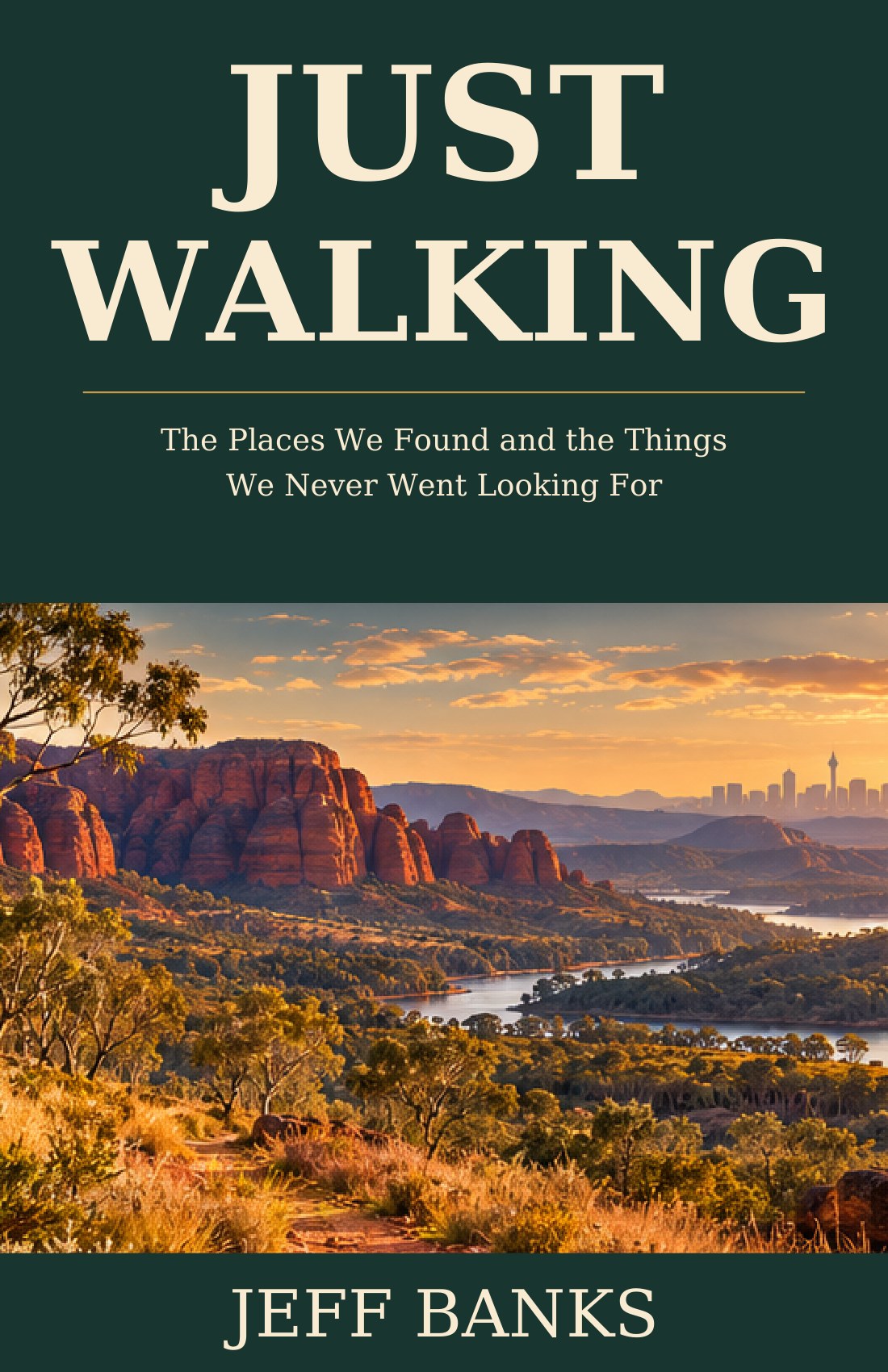
JUST WALKING - Chapter 17 - What the Wind Had to Say

JUST WALKING - Chapter 17 - What the Wind Had to Say | Travelling Around Australia with Jeff Banks

That later visit gave me more time with a place I had continued to carry in my thoughts. It also brought me back to the difference between sharing an experience and knowing exactly what it has meant to someone else. I had walked through Kata Tjuta with my daughter, but the journey that followed belonged to her.

JUST WALKING

The Places We Found and the Things We Never Went Looking For

Chapter 17 – What the Wind Had to Say

We went to Uluru to celebrate Robyn’s birthday. A significant birthday deserved a significant setting, and there was something particularly appealing about beginning it beside a rock that made the years any of us had accumulated seem rather modest.

There would be another birthday there five years later, when our caravan travels brought us back to the centre. On that occasion we deliberately returned to the bus car park for breakfast, recreating part of the earlier celebration with the sort of attention to location usually reserved for archaeological work. If we were going to repeat the experience, apparently the correct car park mattered.

By then, however, the first visit had acquired a significance beyond the birthday that took us there. Among the memories we carried away was an encounter involving our daughter, Kirsten, that I have continued to think about ever since. We had travelled to see a remarkable part of Australia, and somewhere between the rocks of Kata Tjuta she began a journey that was much harder to mark on a map.

Uluru deserves the attention it receives. Its presence is extraordinary, and there is ample reason to get out of bed at an unreasonable hour to watch the light arrive upon it. Robyn’s birthday gave us a reason to be there together, but even a celebration has to make room for the place in which it is being held.

For me, though, Kata Tjuta holds a different significance. When I think about that family visit, my thoughts keep returning to the wind moving through the rocks and to what Kirsten found there. The birthday remains part of our family history, while that walk has continued to gather meaning.

The road towards Kata Tjuta has its own way of introducing the place. It bends across the landscape, changing direction as you approach, giving you time to consider where you are going. In a country where so much road seems intent on proving that the shortest distance between two points is a straight line, those changes of direction invite a question.

The explanation I remember being given concerned the sacred importance of Kata Tjuta to Aṉangu men and the restrictions governing how Aṉangu women could look towards or approach it. I understood the winding road as an accommodation of those responsibilities, a recognition that engineering a route across Country involved more than finding a convenient strip of ground. That was the explanation I carried with me, although I have since come to understand that the rules concerning particular places, access and knowledge are more specific than a visitor’s brief account can convey.

There was already something to consider in that approach. We were travelling through a landscape in which other people’s knowledge and responsibilities mattered, whether we understood them fully or not. The road could carry us to a public walking track, but it could not deliver everything there was to know about the place.

Our family is Wiradjuri, and this was Aṉangu Country. That distinction matters to me in remembering what followed, because Kirsten’s experience did not make the place ours or give us knowledge of its restricted stories. She was a young woman encountering something about her own heritage while walking respectfully through a place belonging to another people.

We took the Walpa Gorge walk, entering between the great walls of rock. Of all the walks we might have undertaken on a family trip, this one became lodged in our lives in a way I could never have included in the arrangements beforehand. There are things you can book, provision for and put on a list, and then there are the things that happen once you arrive.

The wind moved through the gorge, finding its way between the rocks. To say Kirsten heard the Elders speaking in it is the closest I can come to describing the encounter as I understood it. I thought of the generations who had listened before her, of gatherings and corroborees where knowledge passed through stories, song and dance, taught by people who carried responsibilities for its telling. I could not know what had taken place within those particular walls, but standing there made me consider how much a place might hold beyond what a visitor could see.

Our written histories had hardly prepared me to understand that inheritance. Here was knowledge carried in memory and language, in relationships and journeys across Country, with some of its expression visible in pictures on rock in places held sacred. The people entrusted with it gave those expressions their meaning, teaching what could be shared and with whom. I found myself imagining the wind carrying fragments of those long conversations, seeking another listener, another memory in which something precious might find a home.

That was my way of understanding what I saw happening to our daughter. We were Wiradjuri visitors on Aṉangu Country, and whatever reached Kirsten there belonged to an encounter I could witness without fully knowing. It seemed to me that heritage was becoming something she wanted to listen to, question and understand for herself. A connection whose beginnings lay generations beyond her own life was finding a place in the life she was still shaping.

I cannot supply a transcript of what passed between Kirsten and that place, and I would not put words into the mouths of Elders whose knowledge I did not possess. What I can say is that the encounter became part of a continuing search, reaching into her understanding of herself and the work she would go on to do. We had entered the gorge as a family, sharing the same path, but our daughter had found questions there that would travel much further with her.

As a parent, you become accustomed to introducing your children to things. You teach them what you know, take them where you can and hope that somewhere in the mixture they find interests and abilities that belong to them. Then comes an occasion when you realise you have brought your child to the beginning of something you cannot teach.

I could share the walk with Kirsten and recognise its importance. I could listen, remember and watch what developed afterwards, but the understanding she was beginning to seek would have to become her own. Parenthood offers plenty of opportunities to give directions, and an equal number to discover the limits of doing so.

It is here that I find myself considering the word “walkabout”. I have heard it used lightly often enough, attached to someone who has wandered away or cannot be found when another person wants them. Used that way, it leaves little room for the possibility that the person travelling has reasons, obligations or a purpose the observer has failed to understand.

I do not pretend there is one explanation that I can apply to every Aboriginal person or community. Nor would I describe a family walk through Walpa Gorge as a ceremony simply because something profound happened there. What interests me is what the idea of a journey towards understanding might mean to a young person learning how her Indigenous heritage belongs within her life.

For Kirsten, that life includes science. Her education in physics and her work in astrophysics would involve careful observation, difficult questions and the disciplined effort of trying to understand what lay beyond an immediate impression. Her growing interest in heritage opened further questions about knowledge, belonging and the ways people have understood the world around them.

Watching those interests develop, I could see that she had a great deal to explore. There was her scientific training, there was her Wiradjuri identity, and there was the work of understanding how she wanted to bring those parts of her life together. A father can be proud of a qualification, but there is another kind of pride in watching his daughter decide what she wants to do with what she knows.

Her journey has continued into efforts to bring science to others, particularly girls, and to explore the relationship between Western science and Indigenous knowledge. I would not attribute everything she has achieved to one walk, as though a person’s life could be traced back to a single gust of wind. Yet Kata Tjuta has remained an important part of how I understand the beginning of that search.

Perhaps that is why the idea of walkabout has stayed with me. In considering her experience, I think about making time to seek, to listen and to learn where one belongs, while recognising that the meaning of such a journey must come from the person undertaking it and the people whose knowledge guides them. I cannot define it for Kirsten, but I can recognise that her questions did not end when we reached the car.

Five years later, Robyn and I returned to Kata Tjuta. This time we chose the Valley of the Winds, carrying provisions left from the previous morning’s birthday breakfast in the Cruiser fridge. Whatever the day might offer in the way of inspiration, we had at least made some arrangements for lunch.

We began with the intention of reaching the first lookout and deciding how much further our bodies were prepared to negotiate. The full circuit was more than we intended to undertake, and the climb gave us sufficient opportunity to assess the wisdom of that decision. There is nothing like an uphill track to establish an honest relationship between ambition and fitness.

Beyond the first lookout we continued downhill towards a junction, knowing that every comfortable step down was adding something to the return journey. We found somewhere to sit and take in the place, and I listened for what I had come hoping to hear. Kirsten’s encounter was very much in my mind, although remembering another person’s experience does not provide instructions for having one yourself.

A family passed us, and I asked the father whether they had found any inspiration on their walk. He suggested their conversation had been such that they would have had little chance of hearing it. It was an answer I appreciated, partly for its honesty and partly because talking our way through an experience is something most of us have managed at one time or another.

While we sat there, a gust of wind came through from left to right. I took it as encouragement to continue, and we followed the track towards a drinking station and then along a creek bed where water was flowing. There were tadpoles in the pools, a small and absorbing detail among surroundings of quite a different scale.

Eventually the marked route led up a rockface. Robyn decided she would wait while I climbed, looked ahead and took photographs, an arrangement that allowed us both to exercise our judgement. I reached the top and sat considering the rocks and crevices before me, wondering what had brought me to that particular spot.

I had come seeking something of what I remembered from our earlier visit. Sitting there, I wondered whether there might be encouragement for members of our family still working through their relationship with their heritage, or whether the value lay in coming, looking and giving the questions some time. No complete answer presented itself, and eventually I climbed down to rejoin Robyn.

The return walk required more water stops and rather more attention to our legs. By the time we reached the Cruiser, the day had registered more than eight thousand steps, and the cold drinks waiting in the fridge possessed considerable appeal. Listening to the land and listening to one’s knees can occupy the same afternoon.

We ate our lunch and continued with the practical business of the day. There were photographs to take, website videos to make and, at the Cultural Centre, tea for Robyn accompanied by a mini quandong muffin and banana bread. These details belong in the memory too, because even a day spent considering large questions has room for the pleasure of sitting down with something to eat.

That later visit gave me more time with a place I had continued to carry in my thoughts. It also brought me back to the difference between sharing an experience and knowing exactly what it has meant to someone else. I had walked through Kata Tjuta with my daughter, but the journey that followed belonged to her.

Robyn’s birthday was the reason we gathered at Uluru, and I remain glad that we chose it. A family celebration took us into that landscape together, with no way of knowing which part of the visit would continue to speak to us years afterwards. We could arrange the travel and the breakfast, but there was no planning what Kirsten would encounter between those rocks.

When I remember her at Kata Tjuta, I think about a young woman beginning to listen for a connection she wanted to understand. I think, too, about the woman she has become and the work she continues to do, exploring questions whose reach extends well beyond that gorge. The wind passed through the rocks on a family walk, and her journey is still unfolding.

Author

Menu