

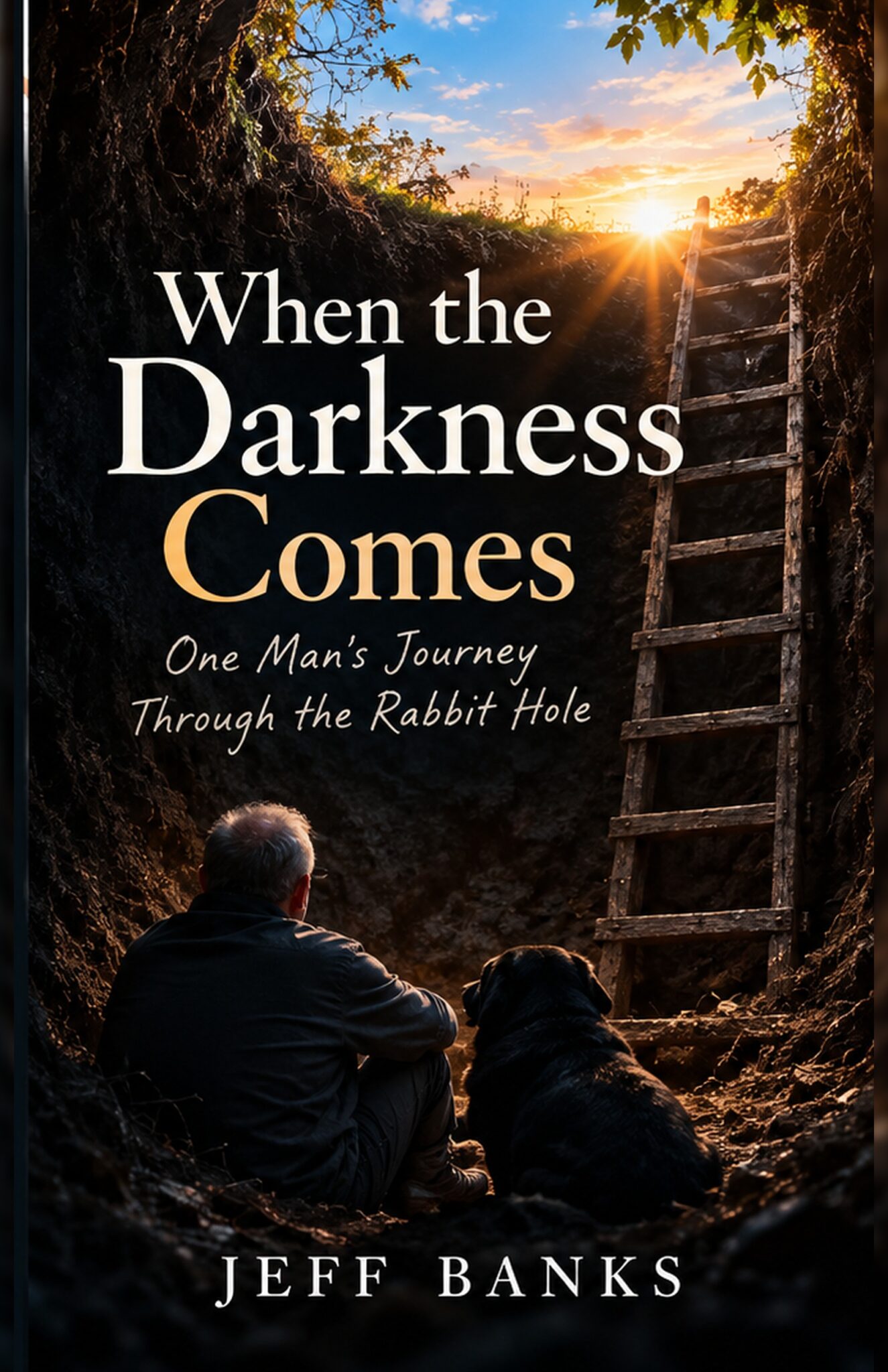
WHEN THE DARKNESS COMES - Chapter 21 - Forecasting the Black Dog

WHEN THE DARKNESS COMES - Chapter 21 - Forecasting the Black Dog | Travelling Around Australia with Jeff Banks

I have remembered things I didn't particularly want to remember. I have also discovered that things I thought I remembered clearly have become surprisingly difficult to retrieve, while other moments apparently filed decades ago can walk straight back into the room without bothering to knock. That creates its own weather, although once again I cannot forecast precisely what that weather will be. There are days when writing gives me a sense that I am finally putting words around something that has existed without adequate language for most of my life, and there are days when I wonder whether repeatedly opening the door to see if the Black Dog is still outside is a particularly intelligent thing to be doing.

WHEN THE DARKNESS COMES

One Man’s Journey Through the Rabbit Hole

Chapter 21

Forecasting the Black Dog

There has been blood on my pillowcase lately. Not enough to have anybody calling an ambulance or summoning the forensic squad, but enough to remind me each morning that the CPAP mask I have worn faithfully for years has begun rubbing against my cheek and has managed to open the skin.

Robyn and I have taken measures to mitigate the damage, which is the sort of expression an accountant might use when discussing something as mundane as his face being slowly attacked by the machine designed to keep him breathing during the night. The CPAP remains attached because the alternative is not particularly sensible, but the small wound has joined the growing list of things my body apparently believes require my attention now that I am in my sixties.

On a good morning it is simply an irritation, something requiring a dab of whatever we are using on the cheek and perhaps another adjustment to the mask before getting on with the day. On another morning it can become one more piece of evidence that my body isn’t working as it should, and that leaves me wondering whether the difference is simply the mood I was already in when I noticed the blood, or whether something so physically minor can actually help send the pendulum in the wrong direction.

That is another part of forecasting the Black Dog that I cannot reconcile neatly. If the same blood on the same pillowcase can be dismissed on Tuesday and become disproportionately important on Wednesday, was Wednesday already going to be a bad day, with the damaged cheek merely providing something for the Dog to work with, or did noticing it become a trigger that helped turn what might otherwise have been a perfectly ordinary morning into something else? I don’t know that there is any way of separating cause from effect after the event, particularly when the pit and the weight can arrive without explaining themselves.

Perhaps that is the more unsettling alternative to calling it a good morning or a bad one. There may be mornings that begin perfectly neutrally until some small irritation, disappointment or reminder gives the pendulum a nudge, and I have no way of knowing whether it would have started swinging without it. The blood on the pillowcase may be nothing more than blood on a pillowcase, but once my head decides it belongs in a larger ledger headed Things That Aren’t Working Properly Anymore, something physically minor has begun rubbing against considerably more than my cheek.

The mask comes off, the blinds get opened and the light comes into the house. There is a routine to all of this, just as there is a routine to getting ready for golf, opening the computer, checking what needs doing and moving through another day that from the outside probably looks remarkably similar to the one before it.

Somewhere among those routines there may also be a pit in my stomach and a weight sitting on my chest. Those two have become about the closest thing I possess to a reliable Black Dog weather report, except calling them a forecast gives them far more predictive value than they deserve. By the time the pit and the weight are there, there isn’t much forecasting involved because the weather has already arrived.

After decades of living with what somebody else might call depression, I should probably be better at this. Even that description requires considerable qualification because I didn’t spend those decades consciously thinking of myself as somebody living with depression, and I certainly wasn’t walking around with the Black Dog conveniently identified and wearing a name tag. There were periods of darkness, anger, withdrawal and reactions that seemed disproportionate even to me, but I didn’t necessarily join them together and call the resulting collection depression.

For a long time, anger was the part I could see. More importantly, it was the part that frightened me because anger already had a face from my childhood, and that face belonged to my father. I had spent a significant part of my adult life determined not to become the father I remembered from mine, particularly the man capable of allowing anger to become physical punishment and of making a child understand that the safest response was sometimes to get out of the way.

I had already drawn an absolute line around my own children. I had told my father that if he ever laid a hand on them he would never see them again, and there was no negotiation hidden inside the statement. I could protect them from his anger, but there was a much more frightening possibility that took considerably longer to confront: what if the thing I was protecting them from had somehow found its way into me?

That possibility carried a darkness of its own because I didn’t want my father to be part of me in that way. I could accept the obvious inheritance of genetics, mannerisms, habits and perhaps even some ways of looking at the world, but I did not want to discover that the anger I had feared as a child had been passed from father to son and was now waiting for its opportunity to emerge from the next generation of Banks.

I wasn’t suggesting that I had become my father, and I wasn’t looking backwards and blaming him for every occasion on which I lost my temper. The frightening part was much less certain than that. I could see something in my own reactions that reminded me enough of something I had spent my life rejecting to make the resemblance impossible for me simply to dismiss.

That was what eventually drove me into the doctor’s surgery. I wasn’t arriving with a carefully considered suspicion that I was suffering from depression, and I certainly wasn’t preparing to disclose some sinister darkness I had finally identified inside myself. I wanted an anger inhibitor because anger was the symptom I understood, the behaviour I could recognise and, most importantly, the part of myself I was frightened might connect me to a man I had spent much of my life determined not to become.

In my mind the request was almost mechanical. Something inside me was occasionally producing too much anger, so perhaps medicine had something capable of turning down the output before it escaped and affected the people around me. I wasn’t asking the doctor to explain Jeff Banks to Jeff Banks; I was effectively asking whether he had something on the shelf that could put a governor on one particular part of the machinery.

What happened next was considerably more confronting because the doctor was apparently looking at a much larger machine. The questions he asked and the conclusions that followed took me somewhere I had not intended to go, because I had walked through his door asking about anger and discovered that somebody else might place what I was experiencing beneath a considerably darker heading.

That distinction matters when I now look backwards across decades and casually use the word depression. I possess the word today, along with the Black Dog, the pendulum, the pit in the stomach, the weight on the chest and all the other descriptions I have accumulated while trying to understand what happens inside me, but the bloke living through much of the earlier history did not have that vocabulary.

He had anger. He had periods when things didn’t feel right, reactions he couldn’t always justify and darkness he didn’t necessarily understand as darkness because he had nothing useful against which to measure it. Most frighteningly, he had begun to wonder whether something he had desperately not wanted from his father might nevertheless have travelled with him into adulthood.

Looking backwards now, I can see cycles, troughs, withdrawal, heaviness and all sorts of things that might fit comfortably beneath somebody else’s definition of depression. I remain wary of retrospectively stamping that diagnosis across every one of them, though, because knowing the eventual description doesn’t mean the bloke experiencing the earlier events understood them in those terms.

What I can say is that I have accumulated enough historical data to satisfy most accountants, lived through enough cycles to establish some trends and spent enough time examining myself to expect that somewhere along the way I would have developed an internal early-warning system. The irony is that the first warning system I ever really trusted wasn’t looking for depression at all; it was watching for my father in me, and what finally frightened me into the doctor’s surgery was the possibility that one day I might find him there.

I haven’t developed one, at least not one I would be prepared to rely upon. I recognise more than I once did, but recognition and prediction are very different things, and neither should be confused with control.

There are things I know can take me somewhere dark. The thinking rock is one of them, and the circus episode is another, because deliberately returning to those memories can be followed by periods of darkness that go well beyond simply feeling uncomfortable about something that happened a long time ago.

I avoid thinking about them whenever possible, which has generally seemed a fairly sensible response when experience tells me where they can lead. That avoidance becomes rather less practical when you decide to write a book about depression and then discover that the research material for the bloody thing is stored inside your own head.

Writing When the Darkness Comes has therefore been both a revelation and an absolute disaster at times. I have been deliberately opening doors that experience has taught me are sometimes better left closed, walking into rooms I don’t particularly want to revisit and then sitting at the computer trying to find words for what is in there.

Sometimes the words fail me, and sometimes the memory fails me as well. Occasionally I suspect the failure of memory is not entirely unwelcome because there are things I don’t particularly enjoy being asked to examine closely, even when the bloke doing the asking is effectively me.

That has become one of the peculiar contradictions of writing this book. I am trying to understand something better by deliberately remembering experiences that I know can make me feel worse, and there are occasions when the bloke doing the research and the bloke being researched could probably benefit from occupying different bodies.

Unfortunately, they occupy the same one and have to negotiate the consequences between them. Logical Jeff can understand why the memories matter to the book while the other Jeff gets to carry whatever arrives after we have finished excavating them.

There are therefore a few circumstances in which I can see something coming. If my mind begins spending too much time around particular memories, I know there may be a price to be paid afterwards, although even there I cannot reliably tell you how large the bill will be or precisely when it will arrive.

Most of the time it is nothing like that orderly. The pit appears, the weight settles on the chest and the pendulum is already moving before anybody has thought to consult the forecast.

Logical Jeff wants to stop the pendulum. He can see where it is heading, knows it is going further than where it presently is and understands perfectly well that allowing it to continue is unlikely to improve the next few hours or days, but understanding the trajectory does not provide the strength required to grab the bloody thing and hold it still.

That distinction has taken me a long time to appreciate. We are brought up with the comfortable little adage that knowledge is power, and Logical Jeff would normally be one of its strongest supporters because most problems become considerably less intimidating once enough facts are assembled around them. Give me the information, let me understand what is happening, identify the variables and there is at least a reasonable chance I can work out what to do next.

The difficulty comes when the knowledge is incomplete. Half an answer can sometimes be more dangerous than no answer at all because it creates the impression that I understand something when what I really possess is just enough information to know that something is wrong. I can recognise the pendulum swinging, feel the pit in my stomach and the weight on my chest, and even know from experience that I may be heading somewhere I don’t particularly want to go, but none of that automatically tells me why it is happening, how far it will travel or what I am supposed to do to stop it.

There is another complication that has followed me through much of this story: knowledge requires language if I am going to do anything useful with it. A feeling can be completely real inside me and still remain extraordinarily difficult to explain to somebody else, and sometimes even to myself, because I don’t possess the words that make it tangible enough to examine. The pit and the weight are descriptions I have acquired because I needed something to call them, but they describe the physical sensation far better than they explain whatever is happening underneath it.

Perhaps that is why finding the words has mattered so much throughout this book. Until I can describe a feeling, there is a strange sense in which Logical Jeff struggles to admit it into evidence, because something that cannot be defined, measured or explained sits uncomfortably in a mind accustomed to dealing with things that can. The other Jeff doesn’t require that standard of proof because he is already feeling the bloody thing, but knowing something emotionally and being able to make it intellectually real are not the same process.

That creates an extraordinary conundrum when the darkness comes. I can know that something is happening while simultaneously being unable to say precisely what that something is, and without the words there is nothing particularly solid for Logical Jeff to grab hold of. The feeling is real enough to affect the day, change the weight of ordinary things and alter where the pendulum seems to be heading, yet it can remain sufficiently undefined that trying to explain it feels like describing an object I can touch in a completely dark room.

Knowledge may well be power, but incomplete knowledge can also be frightening because it illuminates just enough of the room to show me that there is something else in there. Perhaps the words are part of the light, not because naming the darkness makes it disappear, but because being able to say what I am experiencing at least turns an unnamed sensation into something I can acknowledge as real.

That may also explain why the idea of forecasting the Black Dog bothers me. Forecasting assumes not only that something is approaching from a distance but that I understand enough about what I am observing to interpret the signs: some gathering cloud visible on the horizon while there is still time to bring in the washing, put the car under cover and decide whether playing golf in the afternoon remains a sensible proposition.

The problem is that I am sometimes standing there looking at the cloud without knowing whether it means rain. I can recognise that the sky has changed, but if I don’t possess the words for what I am seeing, don’t know what caused it and cannot tell whether it will pass in ten minutes or settle in for a week, calling that knowledge a forecast seems rather generous. Sometimes all I really know is that something has changed, and the most disturbing part is that the feeling can become completely real long before I have found the language that allows me to say what it is.

My depression doesn’t necessarily work that way because quite often there is no approaching. The distinction matters because looking for warning signs assumes there will be a period during which I am warned, whereas sometimes the first reliable sign that the Dog is coming is discovering that the bastard has already arrived.

There can be little annoyances around the edges, certainly, and I can look backwards now and wonder whether some of them were more significant than I understood at the time. I have always been capable of anger, particularly when confronted with something I regard as unfair, stupid or inconsistent, and sporting contests can provide a magnificent supply of all three without anybody having to leave the lounge room.

A supposedly fifty-fifty decision goes one way, followed by another, and suddenly I am not merely watching football. I am prosecuting an inquiry into the collapse of natural justice while some bloke with a whistle who has never met me continues completely unaware that his decision has apparently become a matter of national importance.

There have been nights when I have gone to bed at halftime because watching the game has stopped being entertainment. That raises an awkward question about whether I actually enjoy watching football at all when something I supposedly do for enjoyment is capable of making me sufficiently angry that leaving the room becomes preferable to seeing the second half.

For most of my life I would simply have called that anger. I don’t suffer fools easily, perceived inequity can set me off very quickly and the simplicity of right and wrong has always had an attraction for the part of my brain that would prefer the world to reconcile properly.

Now I am less certain, although uncertainty does not give me permission to rewrite the past. I am not prepared to retrospectively blame the Black Dog every time I became angry at a referee, an umpire, a television commentator or some other unfortunate person who failed to organise the universe according to the Banks Consultancy accounting standards, but I do wonder occasionally whether the Dog had his paw on the volume control.

That is one of the problems with looking backwards through the lens of what I know now. There is a temptation to reclassify transactions that may have been perfectly correctly posted the first time, and I don’t want to rewrite an ordinary bad temper as depression merely because it makes the accounts easier to reconcile.

Some things remain easier to see, although even then I am not sure precisely what they mean. It has been a long time since I went fishing, despite fishing having occupied an important part of my life, and golf continues largely because golf has acquired obligations that don’t particularly care whether I feel like playing.

I am the secretary and treasurer. There are things to set up, things to reconcile and responsibilities that arrive because I agreed to accept them, which means golf can still get me through the gate even when enjoyment alone might not.

Do I enjoy it? Probably not in the way I once did, and even writing that forces me to wonder whether the activity changed, I changed, or whether enjoyment itself has become something more difficult to identify from inside the tunnel. There is another possibility as well, because perhaps part of my enjoyment has always depended upon movement, upon something happening and upon the people around me being prepared to push with something approaching the same drive that I bring to it.

That has been part of me for as long as I can remember. If there is something to be done, my natural inclination is to get on with it, and once I have decided that something needs doing I find it difficult to understand why everybody else isn’t already reaching for the same starting gun. I don’t necessarily expect everyone to move at precisely my speed, but I do expect movement, interest and some indication that the thing we have collectively decided matters actually matters to the other people involved.

Golf provides a wonderfully ordinary example. Last night I created the draw for the Match Play event and sent it around to the committee, having done what I thought needed to be done so that everybody could look at it, comment, identify any problems and allow us to keep moving. By the time this morning had gone well past what I regard as up and at ’em, there had been no response.

There is nothing objectively remarkable about that. Other people have lives, different routines, different priorities and, quite possibly, a definition of morning that doesn’t require them to be mentally operational at the same ridiculous hour as Jeff Banks. Logical Jeff knows all of that and could mount a perfectly adequate defence on their behalf without requiring any of them to appear in court.

The other Jeff is considerably less interested in representing the defence. He has already done the work, sent it around and expected somebody else to pick up the other end, so silence can begin to feel less like they haven’t looked at it yet and more like apparently nobody else gives a shit. Somewhere between those two interpretations sits a question that can become surprisingly dangerous when the pendulum is already heading the wrong way: why bother?

That question reaches much further than a Match Play draw. If I am always the one pushing, organising, setting up, reconciling, following through or making sure something actually happens, there comes a point when the absence of matching urgency from somebody else can make my own effort feel faintly ridiculous. Why am I charging down the road if everybody else appears perfectly comfortable standing at the bus stop?

The difficulty is that my measurement system is hardly independent. I am judging somebody else’s commitment against a level of drive that has pushed me through businesses, clients, committees, projects and responsibilities for most of my life, and it may be entirely unreasonable to expect other people to operate at the same pace. Their failure to answer me by the time I have gone well past up and at ’em may say absolutely nothing about their commitment and rather more about the fact that I have been up and at ’em for long enough to have completed half the bloody day before they have checked their messages.

Logical Jeff understands that perfectly well. He knows that sending something does not create an obligation for everybody else to rearrange their morning around the moment I pressed the button, and he knows that different levels of urgency do not automatically equate to different levels of care.

Inside the tunnel, however, that distinction can become much harder to maintain. Silence leaves an empty space, and the Black Dog has never shown much reluctance to fill one. They haven’t responded yet can become they aren’t interested, which can become you are carrying this again, which can eventually arrive at why are you bothering? without anybody on the committee having done anything more offensive than not replying quickly enough.

Perhaps that is another reason golf has become difficult to classify as something I enjoy. I still play, still organise, still set things up and still reconcile the things that need reconciling because responsibility continues to get me through the gate, but responsibility and enjoyment are not interchangeable. The very drive that keeps me involved can also create the disappointment that makes involvement less enjoyable when I expect other people to push with me and discover that they have chosen their own pace.

The danger lies in what happens next because why bother? can be either a perfectly reasonable question or something much darker wearing the same clothes. Sometimes it may simply mean that I should stop doing a job nobody actually asked me to carry, lower my expectations of other people’s urgency or accept that a Match Play draw can survive until somebody gets around to answering the email. At other times the same two words can become part of the tunnel, quietly questioning not merely why I bothered creating the draw last night but why I bother with golf, committees, projects or any of the other things that once generated enthusiasm without requiring me to interrogate their purpose.

I am not sure I can always tell which version is asking the question. That may be the part worth watching, because the committee eventually responding to the Match Play draw will tell me nothing about depression, but the distance my head travels while waiting for them might.

Responsibility has always been useful to me because it does not ask whether I am enthusiastic. A client needs an answer, a BAS has a deadline, accounts have to reconcile and somebody waiting for Jeff Banks to do something creates a reason for Jeff Banks to get up and do it.

For most of my working life there were very few empty spaces in which to ask whether I felt like participating. The practice had clients, staff, telephone calls, appointments, deadlines and problems that had the good manners to arrive with something concrete attached to them.

That made my long-held proposition that there is no such thing as stress considerably easier to maintain. When there is something in front of me, I can deal with what is in front of me rather than manufacture a perception of everything that might possibly be required later.

So-called retirement changed the amount of space around those things. I say “so-called” because describing what happened to me as retirement remains one of those propositions that sounds reasonable until somebody bothers looking at the evidence.

The accounting practice still exists, albeit at perhaps ten per cent of what Banks Consultancy once was. At one point not so long ago we were operating five businesses from this house, which would be an interesting definition of retirement even by my standards.

Golf has become a regularity of its own, the garden has received considerably more attention, and I now have much more opportunity to grow vegetables and herbs than I did while running the practice at full tilt. My mind, however, has not retired, and I am not sure it received the memorandum advising it that it was supposed to.

What has changed is the number of gaps, and that may be considerably more important than whatever label I attach to this stage of my life. Retirement, or whatever name we eventually decide to give this change in direction, has left many more gaps for the Dog to play in.

When the day is full, the next requirement presents itself before I have much opportunity to contemplate whether I want to meet it. An empty afternoon can sit there looking perfectly innocent while providing a great deal of room for a mind that has never needed much encouragement to wander, and perhaps that is more significant now because the accounting practice that once consumed so much of my life operates at something like ten per cent of what Banks Consultancy once did.

Which leaves an interesting question about the other ninety per cent. Percentages make it sound wonderfully precise, as though selling the practice simply removed nine-tenths of one activity and left behind a clearly labelled space into which retirement could be neatly inserted, but lives don’t reorganise themselves with the same courtesy as a spreadsheet. The work reduced dramatically, but the part of me that had spent decades getting up, getting on with it, solving problems, answering questions, creating things and needing to know what came next did not reduce by the same percentage.

Perhaps that is why I write. I have tended to think of the books as stories that found me, subjects that interested me or things I wanted to put somewhere before memory decided to dispose of them altogether, but I have written an extraordinary amount since the old working structure began disappearing. Maybe somewhere inside all those words is an attempt to fill part of that ninety per cent, not consciously and certainly not according to a business plan, but because an unfinished chapter can perform much the same structural function as an unanswered client question once did.

A chapter gives me something that happens next. There is another paragraph to write, another memory to chase, another contradiction to interrogate and another bloody sentence that refuses to say what I want it to say until I have attacked it from six different directions. A book can occupy hours without asking whether I am retired, and it can turn an otherwise empty afternoon into a problem requiring an answer.

That doesn’t necessarily mean I write simply to keep the Black Dog occupied. I would be suspicious of any explanation that neat, particularly when writing When the Darkness Comes has demonstrated that writing can just as easily invite him into the room by forcing me to revisit memories I would normally prefer to leave alone. If writing were merely a remedy, I have chosen a strange version of it because some days the words fill the empty space and on others they seem to excavate underneath it.

There may nevertheless be something important in the sheer act of having something to do. Banks Consultancy spent decades supplying structure without ever needing to call it structure, because there were clients waiting, deadlines approaching, staff requiring decisions and problems that had to be solved whether Jeff Banks woke up enthusiastic about solving them or not. Writing can manufacture some of that architecture without anybody else imposing it upon me, although the person setting the deadlines, doing the work and complaining about the quality of the result is now inconveniently the same bloke.

Perhaps that also explains the volume. One book might have been a project, two or three might have been an interest, but eventually even I have to look at the amount I have written and ask whether something else is going on. Am I simply somebody who discovered late in life that he enjoys writing, or am I trying to fill a space that became visible only when the practice stopped occupying nearly all of it?

I don’t know that the two possibilities need to compete. I can genuinely love writing while also using it to create purpose, structure and forward movement, just as I could genuinely enjoy parts of running an accounting practice while also depending upon that practice to tell me who needed me and what I had to do next. The danger would be pretending that because the replacement activity is creative rather than commercial, it cannot be serving some of the same psychological purpose.

That doesn’t mean busyness cures depression, and I spent enough of my working life depressed while being extraordinarily busy to know better than to make that claim. Structure and cure are not the same thing, but structure does tell me what happens next, and perhaps writing is one of the ways I have unconsciously tried to replace the next thing that disappeared when the telephone stopped ringing quite so often.

The other ninety per cent was never going to remain empty because I am not particularly good at empty. Maybe the books, the garden, golf, the remaining accounting work and the ridiculous collection of projects that still find their way into this house are not evidence that I have failed to retire at all; perhaps they are evidence that I am still trying to construct a life in which there is enough waiting for me tomorrow that the empty spaces never become entirely available to the Dog.

Even with all this accumulated experience, I cannot reliably predict the ups and downs. I know there is a cyclic quality to them, and the pendulum remains the best description I have found for something that moves despite my preference that it stay where it bloody well is.

The rut and the tunnel complicate the picture further. At times it feels less like travelling into and out of depression and more like remaining inside the tunnel while the pendulum swings from one side to another, which makes forecasting the arrival of darkness slightly absurd because I am not convinced I have entirely left it.

There can still be enormous variation inside that tunnel. There are days when the light is visible and days when I can move towards it, work, write, garden, play golf, laugh and function in ways that would make any outside observer reasonably conclude that everything is fine.

There are other days when the pit and the weight are simply there. I don’t necessarily wake, conduct an emotional stocktake and formally acknowledge their presence because acknowledging that they are there is less important than what happens from that point.

The radio in my head is no help whatsoever. I have occasionally wondered whether the song already playing when I wake might know something about my mood before I do, but experience has provided very little evidence that whoever runs the station possesses any forecasting qualifications.

This morning was a Thursday and the internal DJ greeted it with Saturday Night at the Movies (The Drifters – Our Biggest Hits Album – 1964 – Atlantic Records). If he does have access to some deeper psychological intelligence, he could perhaps start by purchasing a calendar, although that assumes a level of programming discipline for which decades of evidence provide very little support.

The repertoire itself is ridiculous. If somebody asked me to nominate the songs I love, the songs that have mattered at particular stages of my life or the music I would deliberately choose to accompany the important moments, I could produce a perfectly respectable list. There would be songs connected to Robyn, family, memories, places and periods of my life, along with music I simply love because I love it, and I could probably explain why many of them earned their place.

The bloke running the internal station appears to have no interest whatsoever in my list. He has access to an extraordinary back catalogue of songs I haven’t consciously listened to for years, songs I would never nominate among my favourites, fragments whose lyrics I can barely remember and tunes that seem to have been stored somewhere in my head without anybody first seeking permission. Apparently my brain has devoted valuable storage capacity to preserving musical material I would never deliberately retrieve while becoming increasingly casual about where it put information I might actually like to remember.

That is what makes the temptation to attach significance to the radio slightly ridiculous. If I wake with a song I love, particularly one carrying an obvious emotional association, it is easy to wonder whether something inside me selected it for a reason, but that theory becomes considerably harder to sustain when Thursday morning begins with Saturday Night at the Movies. Whatever subconscious intelligence we might like to credit with choosing the playlist would have to explain why it so regularly ignores the songs I regard as meaningful in favour of something apparently dragged at random from the bargain bin of my musical memory.

Perhaps the strangest part is the sheer breadth of what remains available to it. Songs can appear that I would struggle to nominate if somebody offered me money to produce their titles, yet give the internal DJ half a bar and apparently the rest has been sitting there waiting for decades. There is something mildly insulting about a brain capable of retrieving an insignificant song from fifty years ago while occasionally refusing to tell me what I walked into the next room to do.

That doesn’t make the radio entirely insignificant because there have been songs that connected powerfully with particular mornings, and some have inevitably made me wonder whether the selection preceded my conscious understanding of how I was feeling. The danger is giving every selection the same status, because once I start treating Saturday Night at the Movies on a Thursday as a coded communication from the depths of my psyche, I am probably entitled to ask whether I am analysing the Black Dog or merely reviewing the programming standards of a very peculiar radio station.

Perhaps the radio matters most because I cannot decide when it matters. A song I love may carry decades of association and emotion, while tomorrow morning some completely inconsequential tune I haven’t consciously thought about since the seventies may arrive with equal confidence and considerably less explanation. The internal DJ makes no distinction between the soundtrack of my life and musical clutter that happened to survive inside my head, which makes him an entertaining companion but a bloody unreliable meteorologist.

I don’t see any significance in that particular song rattling around inside my brain. Sometimes a song is apparently just a song, and I would be doing exactly what I have spent much of this book trying not to do if I manufactured a profound explanation merely because one would fit nicely on the page.

The radio appears to be random, but the pit isn’t. Neither is the weight on the chest, although even those signs don’t tell me where the pendulum will stop because they tell me where I am more reliably than they tell me where I am going.

Perhaps that is the closest I have come to forecasting after all these years. I can keep the binoculars firmly planted against my face, recognise some of the terrain and sometimes see that the path ahead is not particularly inviting, but binoculars don’t steer anything.

They certainly don’t stop the pendulum, and recognising the movement does not give me the strength to control it. At best the binoculars allow Logical Jeff to say that he recognises what is happening while the other Jeff continues experiencing it.

There is an uncomfortable relevance in all of that to the book sitting on the computer in front of me. Writing it has required me to examine the thinking rock, the circus, doctors’ rooms, medications, anger, childhood, work, retirement, Robyn, my children and parts of myself that I have spent years becoming quite proficient at walking around rather than through.

I have remembered things I didn’t particularly want to remember. I have also discovered that things I thought I remembered clearly have become surprisingly difficult to retrieve, while other moments apparently filed decades ago can walk straight back into the room without bothering to knock.

That creates its own weather, although once again I cannot forecast precisely what that weather will be. There are days when writing gives me a sense that I am finally putting words around something that has existed without adequate language for most of my life, and there are days when I wonder whether repeatedly opening the door to see if the Black Dog is still outside is a particularly intelligent thing to be doing.

Yet I continue writing because, for whatever combination of reasons, this has become another thing in front of me to be done. Perhaps that is responsibility again, except this time the person waiting for Jeff Banks to finish the job is largely Jeff Banks.

Tomorrow morning the CPAP will most certainly still be attached to my face. Hopefully we will have stopped it drawing blood, although at my age I have learned not to underestimate the capacity of apparently helpful machinery to find another way of becoming irritating.

I will take the mask off, open the blinds and let the light into the house. Depending on the day, I may get ready for golf, walk into the office, work in the garden or sit at this computer and reopen another memory that common sense might have suggested leaving alone.

The radio will probably already be playing something, although whether it bears the slightest relationship to the day ahead is anybody’s guess. The bloke programming the station apparently thinks Thursday is Saturday, so relying on him for a psychiatric weather forecast would seem unnecessarily ambitious.

Somewhere in those first movements I may discover the pit in my stomach and the weight on my chest. If they are there, I will recognise them, which is more than I could once have said, but I won’t pretend that recognising them means I know how far the pendulum will swing or when it will begin travelling back the other way.

After decades with the Black Dog, that may be the most accurate forecast I can make. I know some of his habits, I recognise some of his footprints and there are a few places where experience tells me not to wander unnecessarily, but sometimes there are no footprints to follow because the bastard isn’t approaching at all; when I finally think to look down, he is already there beside me.

Author

Menu