

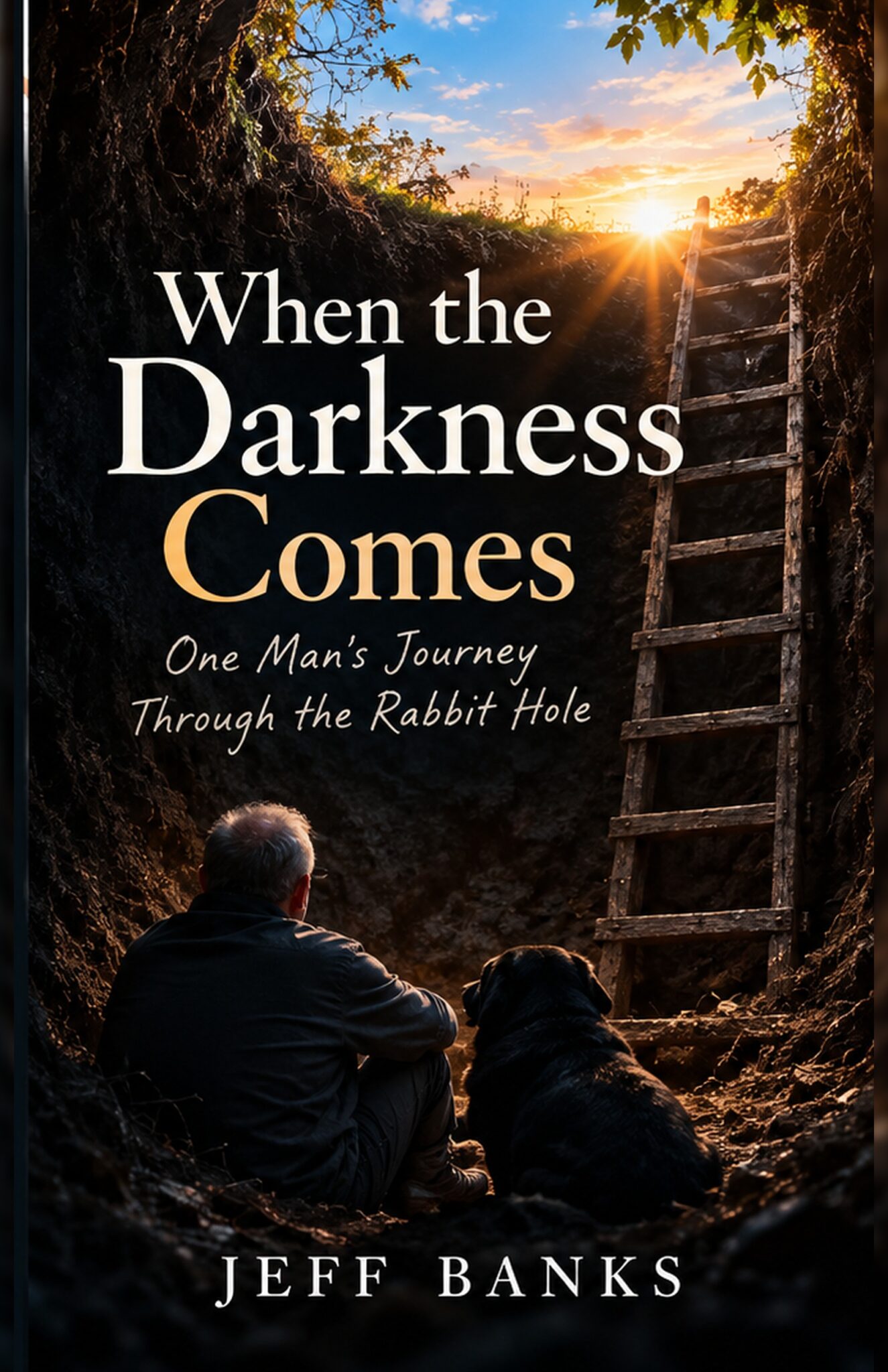
WHEN THE DARKNESS COMES - Chapter 20 - The Good Day Problem

WHEN THE DARKNESS COMES - Chapter 20 - The Good Day Problem | Travelling Around Australia with Jeff Banks

The irony is that the positive end isn't much easier to describe. I can tell you when something has gone well, when I have laughed, when I have enjoyed myself, when I have completed something worthwhile and when I have looked at one of my children and felt a pride that requires no definition whatsoever. What I cannot reliably tell you is whether the collection of those experiences adds up to this thing called happiness or whether I have spent a lifetime using a word without ever being entirely sure what everybody else means by it.

WHEN THE DARKNESS COMES

One Man’s Journey Through the Rabbit Hole

Chapter 20

The Good Day Problem

On the southern wall of our house are photographs of my three children taken at various stages towards the end of their educational lives. There is nothing particularly remarkable about the photographs themselves, and I doubt anybody visiting the house would stop in front of them and recognise some profound statement about parenthood hanging there among the other accumulated evidence of a family. They are simply photographs of Kirsten, Julian and Justin at points when each of them was becoming whoever they were going to become, although I suspect parents never entirely stop waiting to see what that might be.

I sometimes stop and look at them, though, and they are inspirational to me in a way I still find difficult to explain. There are photographs all around our house from different periods of our lives, and perhaps that distinction matters because they are not really photographs of my life at all; they are photographs of our life, moments when one or more of us happened to be standing somewhere worth remembering while somebody else had the presence of mind to point a camera at us.

New experiences still add photographs to the collection, and I have no objection whatsoever to finding another patch of wall, another shelf or another space where a new moment can join everything that is already there. What I struggle with is the idea that adding something new should require taking something old down, as though there is a finite amount of history we are permitted to display and yesterday must surrender its place to make room for today. There is something almost abhorrent to me about that proposition because taking down the photograph does not merely feel like redecorating; somehow it feels as though I have decided that the moment it contains has served its purpose and can now be put away.

I don’t want those moments put away. I don’t particularly want them rearranged into some more fashionable or orderly display either, because they have gradually claimed their places around the house in much the same way that the events themselves claimed their places in our lives. The photographs of the children when they were younger don’t become less important because there are newer photographs of them as adults, just as a photograph of Robyn and me from decades ago isn’t superseded because there are more recent versions of the same two people with considerably more miles on the clock.

Perhaps there is something revealing in the fact that I am quite comfortable adding to the walls but deeply reluctant to subtract from them. Our life has accumulated rather than replaced itself, and I seem to want the house to do the same, allowing another photograph to squeeze into the available space without requiring some earlier version of us to be removed. The result may eventually offend somebody with a better eye for interior design, but they don’t have to live here and, more importantly, they weren’t there when the photographs were taken.

The three photographs on the southern wall are particularly ordinary examples of that accumulated history. They show Kirsten, Julian and Justin at various stages towards the end of their educational lives, and there is nothing about the photographs themselves that would explain to a stranger why I sometimes stop and look at them. They are simply three moments that remain on the wall because those moments remain part of us, and I have no desire to decide that something newer has earned the right to take their place.

Ask me whether I am proud of my children and I don’t have to search for the word. I am proud of them all the time, not because everything they have ever done has been perfect or because they followed some course I mapped out for them, but because they are our children and Robyn and I have watched them become adults with lives, achievements, disappointments and directions of their own. The photographs capture particular moments, but the pride isn’t trapped inside the frames; those moments simply give me somewhere physical to stop occasionally and remember parts of the journey we all made together.

Ask me whether I am proud of Robyn and the answer comes just as easily, particularly when I consider what she has put up with after deciding all those years ago that Jeff Banks was apparently a reasonable proposition for the rest of her life, even though at the time he was acting as the head of the camel she was riding at a Cub Scout Leaders Camp. She is in those walls as much as anybody, even when she isn’t actually in a particular photograph, because the children whose achievements are hanging there and the family history accumulating around them belong to both of us.

Perhaps that is why taking one down feels so different from putting another one up. Adding a photograph says there has been another moment worth keeping, while removing one seems, irrationally perhaps, to ask me to choose which part of us is no longer entitled to remain on the wall, and that is a choice I have absolutely no enthusiasm for making.

Turn the question around and ask whether I am proud of myself and the vocabulary becomes considerably less cooperative. There have certainly been achievements, businesses built, clients helped, books written, children raised and all the other entries I could put into the credit column if somebody insisted upon preparing the accounts, but apparently very little of that has qualified Jeff Banks for a place on his own walls.

Other than the obligatory wedding photographs, there are remarkably few photographs of me hanging anywhere around the house. The children are there, Robyn is there, family occasions are there and all those moments I am reluctant to take down continue accumulating as new ones are added, but the bloke who has spent so much time protecting their places on the walls is largely missing from them. I don’t remember making a conscious decision that photographs of me were somehow less worthy of display, and there has certainly never been a household decree banning my face from the premises; it has simply worked out that way.

Perhaps that makes the southern wall even more interesting. I can stand in front of those photographs of Kirsten, Julian and Justin and immediately recognise something worth preserving, just as I can look around the house at reminders of Robyn and our life together and have no difficulty understanding why I don’t want any of them taken down. There is no corresponding gallery of Jeff through the ages demanding the same protection, apart from those wedding photographs where tradition apparently required the groom to appear alongside the bride.

I could probably construct all sorts of psychological explanations for that absence if I wanted to, but that would take me straight back into the habit of answering a question that hasn’t actually been asked. The simpler observation is that I have never felt much need to put myself on the wall, just as there has never been some long period during which I have wandered around feeling enormously proud of Jeff Banks and congratulating myself on what a splendid fellow he turned out to be.

That doesn’t mean I believe I have achieved nothing, because the evidence would make that proposition ridiculous. It means achievement and pride in myself have never seemed to form the same uncomplicated relationship that exists when I look at my children or Robyn, and perhaps the walls have quietly reflected that without anybody intending them to. Everyone else seems naturally entitled to their place in the frames; when it comes to me, apart from the wedding photographs, apparently being there when the camera was pointed has never seemed reason enough to put the result on the wall.

Ask whether I have ever been ecstatic for a sustained period and I would say no. Ask whether I have ever been at peace and that answer is easier still, because I don’t remember peace being part of the arrangement at all. Somewhere among those questions sits the word happy, and that one causes considerably more trouble because before I can tell you whether I have been happy, somebody is going to have to explain precisely what happy is supposed to feel like.

I know when I am not it. That probably sounds ridiculous coming from somebody who has spent a professional lifetime demanding definitions, reading legislation and occasionally pointing out that words are supposed to mean things, but I don’t have a reliable definition for this one. I know excitement, satisfaction, laughter, enjoyment and pride in other people, and I know there have been countless experiences in my life that I would willingly have again, but whether some combination of those qualifies as the thing everybody calls happiness is beyond my capacity to audit.

Perhaps that is where the idea of a good day starts becoming troublesome. Calling something a good day suggests that it can be separated neatly from a bad one, as though midnight closes one emotional ledger and opens another, with yesterday’s balance conveniently carried forward. My experience doesn’t work like that because the pendulum can travel from one end of whatever spectrum I am on towards the other within a day, and sometimes within an hour.

There doesn’t have to be an announcement. There doesn’t have to be an event sufficiently important to justify the movement, and there certainly isn’t always an opportunity for Logical Jeff to call a meeting and ask everybody to explain what the hell is going on. Sometimes a scene in a movie is enough to push the pendulum towards the darkness, while much less frequently something equally unexpected can push it back again.

That is one of the reasons I have struggled whenever anybody, including myself, tries to make the process neater than it is. The temptation is to ask what happened, identify the trigger, measure the reaction and then construct some pathway back towards wherever I was before, because that is the sort of process that makes sense to the accountant in me. Sometimes there is a trigger and sometimes there isn’t, while at other times something happens so quickly that trying to establish cause and effect afterwards would require more imagination than evidence.

The Black Dog doesn’t even seem to maintain a consistent grip, and perhaps that is because the tools available to a dog are different from those available to a crocodile. I imagine a crocodile getting hold of something with the enormous force of its jaws and knowing that this is its opportunity; once it has you, the whole exercise depends upon not letting go and bringing its most frightening weapon into play, the dreaded death roll. There is something horribly direct about the proposition because the crocodile has made its move, committed itself to the attack and intends to finish the job while it still has hold of you.

The Dog seems to operate differently. He can bite, release, circle and come back, and letting go does not necessarily mean the encounter is over because he has another tool available to him that the crocodile doesn’t need in quite the same way: he can chase. If he releases me for a moment and I manage to put some distance between us, there is no particular comfort in looking over my shoulder because the bastard can run faster than I can.

That makes those moments when his grip loosens particularly deceptive. There can be enough relief to recognise that the pressure has changed, perhaps even enough to move the pendulum considerably in the other direction, but the Dog hasn’t necessarily gone anywhere. He may simply have released his jaws for long enough to draw breath, knowing that whatever head start I have managed to establish can disappear remarkably quickly once he decides to come after me again.

Perhaps that helps explain how the movement can occur within a day or even within an hour. The crocodile comparison suggests one terrible encounter with an outcome determined by whether you escape the initial grip before the death roll begins, whereas the Dog can turn the whole thing into a series of encounters: grip, release, distance, pursuit and grip again. I can be travelling reasonably well after apparently breaking free and discover that he has covered the distance between us much faster than I could ever have run away from him.

The frustrating part is that I cannot necessarily identify anything clever I did to make him loosen his grip in the first place. Nor, when he catches me again, can I always identify some mistake that allowed it to happen, because sometimes I haven’t stopped running, changed direction or invited him back; he is simply faster. That leaves me with the particularly irritating possibility that the periods of relief I would like to record as victories may occasionally be nothing more than the Black Dog coming up for breath.

It also changes what escape means. With the crocodile, escape would seem to have a satisfying finality to it: you got away before the animal could use the tool designed to finish the encounter, and whatever injuries remain can at least be assessed from somewhere other than inside its jaws. With the Black Dog, getting out of his mouth doesn’t necessarily mean getting out of his reach, and perhaps that is why I have become wary of treating every release as evidence that I have finally discovered how to beat him.

Sometimes he lets go and I run. Sometimes I don’t even realise I am running because the weight has simply lifted enough for the day to continue, and sometimes I manage to get far enough ahead to forget temporarily how quickly he can close the distance. None of that means the running is pointless, but it does mean that when the bastard appears beside me again, I shouldn’t automatically assume that whatever freedom existed an hour ago was proof that the chase had ended.

It just happens, which is a thoroughly unsatisfactory explanation for a bloke who has spent much of his life looking for explanations. If I had discovered some particular sequence of actions that reliably produced the release, I would presumably have turned them into a procedure by now, put them on a checklist and followed them whenever necessary. Instead, sometimes the Dog loosens his jaws and sometimes he doesn’t, while I continue trying to describe something that refuses to behave consistently enough to deserve a procedure manual.

The tunnel is probably closer to what happens when he doesn’t let go. I have used that image before because there are times when depression seems to put me into a rut running through a tunnel with hard boundaries on either side, and the important thing is not necessarily understanding how I arrived there. The immediate job is travelling through it without spending too much time crashing into the walls.

I imagine putting binoculars to my eyes, but the point of the binoculars isn’t really to see the destination more clearly. Their greater value is in restricting what I can see around me, because the hard walls of the tunnel are still there and indulging in them by bouncing repeatedly from one to the other is only going to hurt. Narrow the field of vision, concentrate on whatever is ahead and keep moving.

There is always a light at the end of the tunnel, which sounds suspiciously like something that belongs on an inspirational poster until I add the qualification that has always accompanied it in my mind. There remains the nagging possibility that the light is attached to a freight train coming the other way, and experience has taught me not to dismiss that possibility merely because the first interpretation sounds more optimistic.

The light does not have to be happiness anyway. Sometimes it is the end of the day, a set of financial statements that needs completing, a budget somebody is waiting for, an appointment, a deadline or simply tomorrow. The objective isn’t necessarily to emerge from the tunnel dancing in the sunshine; sometimes it is enough to keep the binoculars pointed forward and continue travelling.

That may explain something about my relationship with work that I have probably never properly understood. A set of financials completed during a day when the weight has been sitting on my chest still exists at the end of that day, and a budget that somehow sneaks through the fog and lands on a client’s desk provides evidence that something was achieved while the rest of me was busy enduring whatever was happening. Self-imposed deadlines can help because they put something at the end of the binoculars that is more useful to focus upon than the walls.

The difficulty comes when I realise that I am travelling particularly well and decide I had better make use of it. A good period can carry its own demand because if the fog has lifted, the concentration is working and things are actually getting done, there is an understandable temptation to get as much through the opening as possible before it closes again. Somewhere in that process the opportunity to enjoy feeling better can become another obligation to perform.

Perhaps that is the real Good Day Problem. A good day isn’t necessarily something I sit inside and enjoy because recognising it can immediately turn it into a resource that ought to be exploited. If the pendulum happens to be travelling through the useful part of its arc, there are things to be done before it decides to head somewhere else.

I can see something similar when I look back at the sale of Banks Consultancy. Our mentor Dale Crosby suggested at one point that the business we had built could be worth more than a million dollars, and for a while there was the extraordinary realisation that all those years of work had created something with substantial value. I had built a business around principles that mattered enormously to me, and somebody looking from outside was effectively confirming that what we had built amounted to considerably more than a job I happened to own.

You might reasonably expect that to have produced some prolonged period of satisfaction. Perhaps it did for a while, but eventually the firm we sold to proved not to be what we thought it was, and instead of sitting somewhere admiring what I had achieved, I effectively joined their ranks and started trying to drag them towards what I believed they could become. I could see the possibility of taking the pillars of Banks Consultancy into the big time, and apparently the obvious response to having successfully built and sold one business was to find another bloody business that needed fixing.

For a little while I made some progress. In the longer run I failed miserably because the organisation was so staid in what it was doing, so committed to the direction in which it believed it needed to travel, that the remonstrations of the newbie eventually became water off a duck’s back. The potential I could see was irrelevant if the people controlling the business had no desire to travel towards it.

There is probably something in that experience that goes well beyond MWL. Achievement has rarely caused me to sit still for very long because reaching something tends to expose whatever is sitting behind it, and the next target appears in the binoculars before I have spent much time considering the one just reached. The light at the end of one tunnel has an unfortunate habit of revealing the entrance to another.

That doesn’t mean I spend a good period terrified that depression is about to return. Even that would impose too much orderly thinking upon something that isn’t experienced in an orderly way, because I am not normally sitting there remembering yesterday’s darkness and carefully calculating how long today’s improvement might last. Yesterday frequently has remarkably little authority over today.

Once something has happened, particularly once I have written it down, it can almost be gone from the part of my memory I use to negotiate the present. I can struggle to tell you what we wrote in earlier chapters of this very book even though I was there for every bloody event and have been sitting at the computer while we reconstructed them. Reading those chapters again and remembering writing them can feel like two entirely different jobs, which becomes stranger when I compare that with the bloke I remember being.

There was a time when I believed I could recall virtually everything I read. Perhaps that is a misnomer and age has added a little generosity to my assessment of the younger Jeff’s abilities, but the test and examination results from those years would suggest that I wasn’t imagining all of it. Information went in, stayed there and could apparently be retrieved when somebody put a question in front of me and required an answer, which was an extremely convenient arrangement for somebody who would eventually make a living from absorbing legislation, rules, numbers and other people’s financial affairs.

That makes the present arrangement difficult to dismiss as simply the way my memory has always worked. I can spend hours reconstructing an episode from my own life, finding the words for it, moving those words around until they say what I believe happened and eventually producing a chapter that feels unmistakably mine, yet not long afterwards I may need to read the chapter again to remember precisely what we wrote. The experience itself may remain somewhere inside me, particularly if it is an old one with sufficiently sharp edges, but the recent act of dragging it into the light and putting it onto the page doesn’t necessarily remain readily available.

Therein lies another conundrum, and conundrums provide particularly fertile territory for the Black Dog. If I once relied upon my memory as one of the tools that allowed me to function particularly well, what am I supposed to make of occasions when that tool doesn’t seem to be working as it once did? Logical Jeff can point towards age, the enormous amount of information accumulated over a lifetime, changing priorities and any number of perfectly ordinary possibilities, but the Dog doesn’t require a diagnosis before beginning work on the alternative explanations.

He can take a forgotten conversation, a name that refuses to arrive or a chapter I cannot immediately remember writing and turn the absence itself into evidence. The bloke who once thought he remembered everything can very quickly become the bloke wondering why he cannot remember this, and from there the tunnel offers plenty of hard walls to bounce against if I allow the question enough room. What was merely something I couldn’t retrieve a moment ago can become another opportunity to wonder what else I am losing, whether something is changing and where that particular road might eventually lead.

The particularly irritating part is that worrying about the failure to remember doesn’t make the memory return. It simply gives the Dog something else to carry around in his mouth, and he has never demonstrated much reluctance to collect additional material. The conundrum therefore becomes self-feeding: I notice that I cannot remember something I believe the younger Jeff would have remembered, become conscious of the difference, and risk turning an ordinary failure of recall into another wall inside the tunnel.

My memory now seems far less interested in maintaining a convenient short-term filing system than I remember it being. It deals readily in dreams and in experiences from long ago, particularly experiences that hurt more than they help, while yesterday can disappear with remarkable efficiency and something from fifty years ago can arrive without being invited. There is an absurdity in being unable to recall precisely what I wrote last week while some ancient embarrassment, disappointment or hurt can apparently locate its file instantly and present itself without even being asked.

Perhaps there is some perfectly sensible explanation for that and perhaps there isn’t, but I am not going to diagnose myself simply because another unanswered question has appeared. I have enough experience of the Black Dog to know that uncertainty is one of the tools he can use particularly well, and handing him a frightening explanation merely because I cannot find a more reassuring one would be another version of answering a question that hasn’t actually been asked.

That makes the suggestion that I should remind myself how good yesterday was almost meaningless. When the weight is on my chest, my attention isn’t occupied by assembling evidence from happier occasions and presenting it to the depressed Jeff in the hope that he will concede the argument. The focus is the weight itself and the immediate requirement to endure it, put the binoculars back to my eyes and continue down the tunnel.

The photographs around the house don’t function as evidence in some internal court case either. Sometimes I wander among them and they bring what I am prepared, for want of a better word, to call joy, but they don’t provide a reliable antidote to whatever else might be happening. They are moments from a life, and the fact that those moments existed does not oblige the Jeff looking at them today to recreate whatever emotion the bloke in the photograph may have been experiencing.

Robyn has her own ways of filling those spaces. She reads, which is something I have never been particularly capable of doing for long periods, and she can disappear into a book while I disappear into whatever I am doing. I hope the movements of my pendulum don’t rub off on her, although I know she withdraws as well and finds things to occupy the time when I am not particularly available.

Even committing to something in the future has its own peculiar process. I can agree in principle to golf, fishing, dinner or some other activity, but there is generally another step where I cover it with Robyn before the final agreement is made. Whether that has become a handbrake I allow to operate when part of me would prefer to remain behind the veneer and stay away from everybody, or whether it is simply the sensible operation of a marriage, I genuinely don’t know.

Not knowing should probably be allowed to stand more often than it does. Depression seems to attract explanations in the same way that an unanswered university assignment attracts a group of students determined to discuss what the lecturer must really be asking, even when the question is sitting perfectly clearly on the piece of paper in front of them. I remember those discussions and my frustration with people who seemed more interested in interpreting some imagined question behind the question than simply reading the words they had actually been given.

There is a line of thought in The American President (1995 – Colombia Pictures) that has stayed with me for much the same reason. Towards the end, Andrew Shepherd finally confronts the difference between having an answer and being able to sell one, and it is the selling part that interests me here. An explanation can be simple, confident, emotionally satisfying and completely persuasive without necessarily being the right explanation, while something much closer to the truth can struggle to get out of the starting blocks because it comes burdened with qualifications, uncertainty and the deeply unattractive words I don’t know.

That is a conundrum I understand particularly well because I have spent much of my professional life trying to explain complicated things in ordinary language. One of the pillars of Banks Consultancy was that we would speak in the client’s language, which meant there was no virtue in being technically correct if the person sitting on the other side of the desk couldn’t understand what I was telling them. The answer still had to be right, though; speaking in somebody’s language was supposed to make the truth understandable, not replace it with something easier to sell.

Depression creates a much nastier version of the same problem because the answer I keep arriving at is almost commercially unsaleable. Why did the pendulum move at ten o’clock this morning when I was travelling perfectly well at nine-thirty? I don’t know. Why did a scene in a movie send me towards the wall of the tunnel while something equally innocuous occasionally releases me from it? I don’t know that either, and telling somebody that the Black Dog sometimes seems to loosen his jaws for no identifiable reason before catching me again because he can run faster than I can is hardly the sort of explanation likely to satisfy anybody searching for cause and effect.

There are much more saleable answers available. It was stress, retirement, workload, childhood, disappointment, ageing, brain chemistry, lack of purpose, the sale of the business, some unresolved event from fifty years ago or whatever other explanation happens to fit sufficiently well around the facts available at the time. Some of those things may genuinely have played a part on particular occasions, and I would be equally foolish to dismiss them merely because they produce a neat story, but their ability to explain one episode doesn’t automatically give them the franchise for every other one.

That is where the inability to sell I don’t know becomes dangerous for me. Human beings seem to prefer an explanation with a beginning, middle and end, and I am hardly exempt from that preference; the accountant in me particularly dislikes an unreconciled balance sitting at the bottom of the page. Give me two numbers that don’t agree and my instinct is to keep looking until I find the transaction that explains the difference, because somewhere there should be a number entered twice, a number left out or something posted to the wrong bloody account.

The emotional ledger doesn’t offer the same courtesy. Sometimes I can identify the transaction and sometimes I can’t, yet there remains an enormous temptation to keep searching because there must be something feels much more intellectually respectable than accepting that I don’t know. Worse still, once somebody offers an explanation that sounds plausible, the temptation is to make the evidence fit it because at least we finally have something we can sell.

That takes me straight back to those university discussions where a group of us would sit around talking about an assignment question and somebody would inevitably begin speculating about what the lecturer really wanted. I could never understand why we needed to invent another question when there was already one sitting on the page in front of us. Read the bloody words, work out what they ask and answer that, rather than constructing an elaborate response to something the lecturer might conceivably have been thinking when he wrote them.

The same discipline ought to apply here, except it is considerably harder when the question concerns my own head. If the question is What happened?, the answer on some occasions is that the pit arrived, the weight came down, the pendulum moved and I entered the tunnel. If the next question is Why?, there are occasions when the most accurate answer available to me is I don’t know, and adding another three paragraphs of theory merely because that answer is difficult to sell doesn’t make the theory true.

Perhaps that is what I take most strongly from Shepherd’s dilemma. The person with the neat explanation enjoys an enormous advantage over the bloke standing there saying that reality is complicated, the evidence is incomplete and he refuses to manufacture the missing pieces merely to make the story easier to understand. The first bloke has something he can sell; the second has uncertainty, qualifications and an audience understandably wondering why, after all this thinking, he still hasn’t managed to come up with a bloody answer.

Depression has repeatedly left me in the position of that second bloke. I can describe the tunnel, the pendulum, the pit, the weight, the Black Dog and the binoculars, and I can tell you with considerable confidence what each of them feels like when it arrives, but ask me to package all of that into one coherent explanation of why it happens when it happens and I am left with something Andrew Shepherd would immediately recognise as a marketing problem. I have an answer of sorts; I simply can’t sell it, because too often the answer remains that nothing happened, I don’t know why the Dog came back, and anything more definite would require me to invent certainty I don’t possess.

Perhaps I have been guilty of doing exactly that with depression. Perhaps doctors have occasionally done it, people around me may have done it, and I certainly did it when I began trying to understand why the pendulum behaved as it did. Find the trigger, identify the cause, remember the good day, challenge the bad thought, define happiness and eventually the numbers ought to reconcile.

Except the question in front of me may be much simpler and much more irritating. What actually happens when the pendulum moves, the pit arrives, the weight settles onto my chest or the Black Dog tightens his jaws? Whatever explanation somebody might eventually sell me, my lived answer remains that I narrow the field of vision, try not to hit the walls and keep travelling.

That is not a philosophy for dealing with depression and I wouldn’t recommend it to anybody else as one. It is simply the closest description I currently have of what happens to me, and even that description requires a tunnel, binoculars, a pendulum, a dog and occasionally a crocodile to explain something for which ordinary language has repeatedly proved inadequate.

The irony is that the positive end isn’t much easier to describe. I can tell you when something has gone well, when I have laughed, when I have enjoyed myself, when I have completed something worthwhile and when I have looked at one of my children and felt a pride that requires no definition whatsoever. What I cannot reliably tell you is whether the collection of those experiences adds up to this thing called happiness or whether I have spent a lifetime using a word without ever being entirely sure what everybody else means by it.

That uncertainty can itself turn a good day into work. Once I notice that the weight has lifted enough to move freely, there is another set of financials that could be completed, another chapter that could be written, another problem that could be solved and another destination that can be placed at the end of the binoculars. There is always another target available to a bloke who has spent most of his life finding targets.

The three photographs are still there on the southern wall. I can look at those children and know what pride feels like without conducting an inquiry into its definition, and perhaps that is why the photographs remain more useful to me than any attempt to manufacture a definition of happiness they are supposed to prove.

Tomorrow the pendulum might move and this afternoon it might move twice. I may know why on one occasion and have absolutely no idea on the next, but trying to invent the missing explanation would leave me back at university with everybody discussing what the lecturer secretly meant instead of dealing with the question actually sitting in front of us.

For the moment, the question isn’t whether yesterday was good enough to prove that today should be good as well. The question is what is happening now and what is required to keep moving through it, because sometimes there is no deeper answer available to me than the one I have spent years finding so unsatisfactory: the pendulum moved, the tunnel narrowed, the Dog arrived, and I kept travelling towards the light while keeping one eye open for the possibility of a freight train.

Author

Menu