

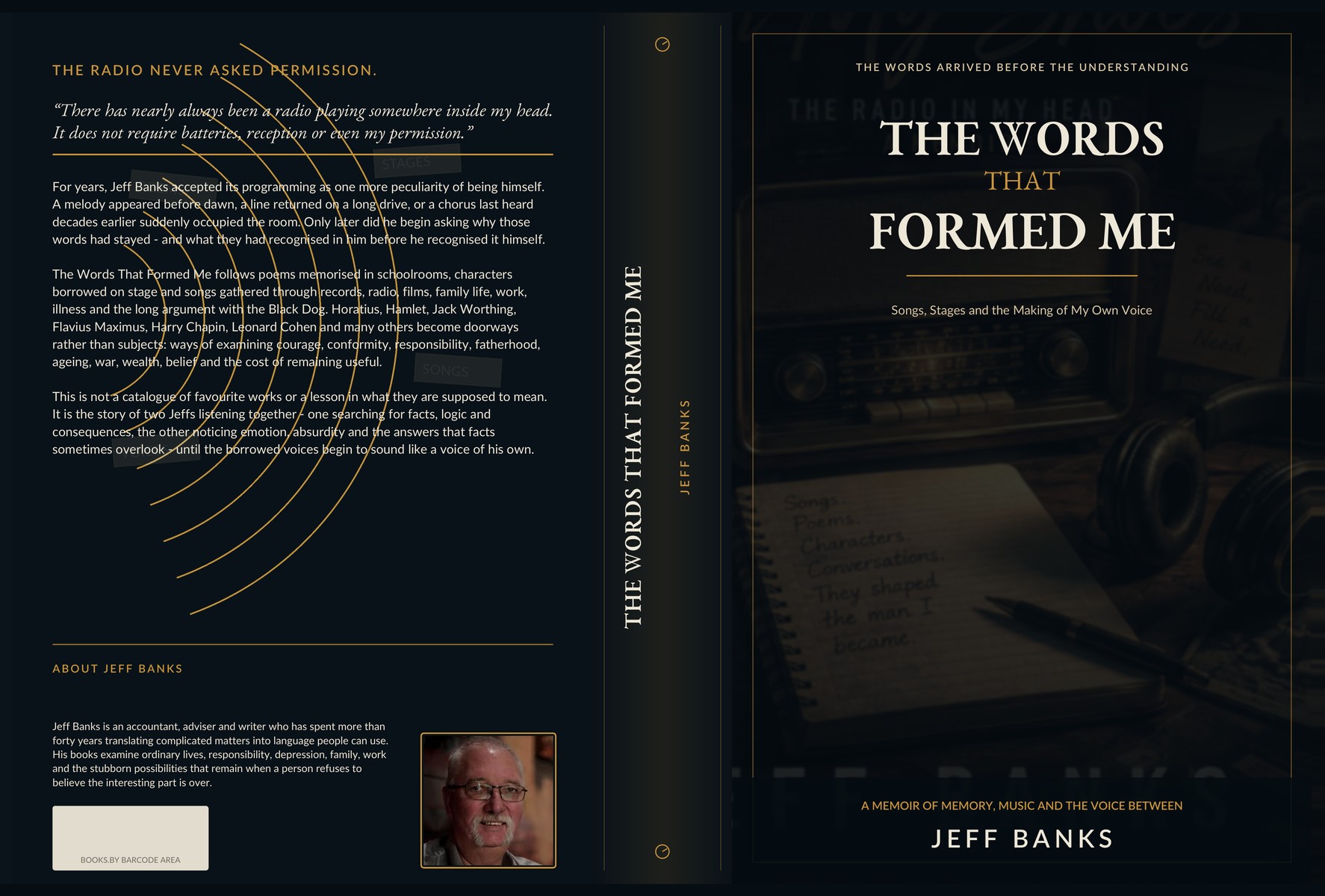
THE WORDS THAT FORMED ME Chapter 30 - The Two Jeffs at the Microphone

THE WORDS THAT FORMED ME Chapter 30 - The Two Jeffs at the Microphone | Travelling Around Australia with Jeff Banks

The two Jeffs are not enemies, despite the tone of some internal meetings. The analytical one protects me from being swept away by every emotion, promise or fashionable certainty that wanders past with a confident brochure. The human one protects me from becoming a machine that values only what can be measured, reconciled or entered in the correct column. Each has rescued the other from a different form of stupidity. Their quarrel is not evidence that I am divided beyond repair; it may be evidence that I have refused the easier comfort of becoming only one thing.

THE WORDS THAT FORMED ME

CHAPTER 30

The Two Jeffs at the Microphone

There are mornings when I sit at the desk and the cursor seems to know that I have arrived before I do. It blinks with the steady patience of something that has no opinion about whether I am ready, capable or even particularly willing. Somewhere between the first sentence and the third, the meeting begins, although there is no agenda and certainly no minutes. The analytical Jeff takes the chair because he always assumes somebody must, while the human Jeff wanders in carrying a memory, an irritation, a joke and something he would rather not admit has hurt him. The Black Dog does not bother knocking, because he has been attending these meetings for years and has never once brought anything useful.

The analytical Jeff likes the idea of a microphone because a microphone suggests order. Somebody speaks, somebody listens, and the equipment performs the modest technical miracle of making the voice louder without asking whether the voice deserves it. He wants the levels checked, the background noise reduced and the argument placed in a sequence that might survive contact with another person’s logic. The human Jeff suspects that the background noise may be where the truth is hiding. He knows that the crack in the voice, the pause before an answer and the sentence abandoned halfway through can sometimes say more than the polished conclusion that eventually replaces them.

I have lived most of my life with both of them, although I did not always recognise that there were two. For many years I assumed the analytical one was simply me and the other was an inconvenience that arrived at unsuitable times. The first could solve problems, explain consequences, find the missing number and ask the question everybody else had managed not to ask. The second noticed that the person across the desk was frightened, embarrassed or trying not to cry. One was useful in the way the world likes usefulness to be measured, while the other kept interrupting to ask whether usefulness without kindness was merely efficiency wearing a better suit.

The analytical Jeff was easy to employ because he understood systems and believed, perhaps too generously, that systems were designed to achieve the purpose printed on the front of the folder. He could follow the money, trace the decision, identify the weakness and explain why the result was not an accident but the predictable consequence of what had been done. When people said something had come from nowhere, he often found that nowhere had a filing cabinet, a board meeting and several warnings that had been ignored. This did not always make him popular, but popularity has never been a reliable test of whether a bridge will remain standing. It merely tells you how many people were enjoying the view before the collapse.

The human Jeff was harder to place on an organisational chart. He understood that people sometimes ignored advice because they were ashamed, tired, frightened or still hoping that reality might become more cooperative if left unopened for another month. He could see that a technically correct answer might still be delivered at the wrong speed, in the wrong language or with such ceremonial importance that the listener felt too stupid to ask the question that mattered. He was the part of me who knew that telling someone what they should have done was not the same as helping them decide what to do next. He also knew that compassion could become an excuse if it removed every consequence, and this was usually the point at which the analytical Jeff cleared his throat and reached for the microphone again.

That exchange became the rhythm of much of my working life. I would identify the facts, arrange them, test them and decide what they meant, then another part of me would ask what those facts felt like from the other side of the desk. Occasionally the answer required softness, occasionally it required bluntness, and sometimes it required the peculiar combination of both that became Not Your Ordinary Accountant. I did not want to speak like a tax manual, partly because nobody should be punished twice for needing accounting advice. The numbers mattered, the law mattered and the deadline certainly mattered, but the person remained in the room after the paperwork had been filed.

The trouble with being driven is that the engine does not always recognise the difference between a road and a brick wall. It sees resistance and assumes the answer is more pressure, more effort and perhaps a longer run-up. There is something admirable in persistence until the persistence begins to resemble a personal argument with masonry. I have pushed against systems, businesses, clients, expectations and versions of myself that were never going to move simply because I had proved they should. The analytical Jeff called this perseverance, while the human Jeff occasionally suggested that blood on the forehead was not necessarily evidence of progress.

Life throws brick walls at all of us, although some arrive with better signage than others. There are the obvious walls of illness, loss, age and endings, and there are the quieter ones built from indifference, bureaucracy, fear or the decisions of people who will never have to live with the consequences. Some walls can be climbed, some can be walked around and some genuinely need a hole knocked through them. The danger is assuming that every wall is a challenge personally addressed to me. I have spent too much of my life believing that seeing the obstacle created an obligation to remove it, even when the people standing behind me had not actually asked to go through.

That is where the logical bystander enters, although he is not much of a bystander once he gets started. He watches life produce a result that makes no sense, traces the result back through the choices that created it and becomes increasingly annoyed when everybody else calls the outcome unfortunate or unexpected. He is not without compassion, but he has little patience for surprise that has been carefully constructed over several years. When a system rewards the wrong behaviour, discourages the right one and then announces concern about the result, the logical bystander in me begins rearranging the furniture in his head. He wants to stand up, point at the obvious and ask how many more committees are required before somebody admits the door is painted on the wall.

The human Jeff understands why that anger exists, but he also worries about what it can become. Anger is useful when it illuminates the absurdity, names the injustice or gives enough energy to refuse another quiet surrender. It becomes less useful when it assumes that anyone who cannot see the problem is stupid, weak or morally defective. I have not always avoided that trap, because being right can be intoxicating when one has spent enough time being unheard. The older I become, the more I suspect that intelligence is tested not by how quickly I can identify the flaw, but by whether I can explain it without making another person smaller.

This is not a comfortable conclusion for the analytical Jeff, who prefers a test with measurable answers. He would like to know how much patience is enough, when persistence becomes compulsion and at what precise point compassion turns into indulgence. The human Jeff cannot provide a formula because people keep refusing to behave like predictable variables. They arrive with history, pride, fear, love, fatigue and the irritating habit of saying one thing while needing another. The argument continues because both are correct often enough to distrust the other and wrong often enough to require him.

I once thought that maturity might mean bringing the two into agreement. There would be a final meeting, a sensible motion and perhaps a unanimous resolution that from this point forward logic and feeling would operate as a cooperative enterprise. That has not happened, and I no longer believe it should. Agreement can be useful, but friction produces heat, movement and sometimes the question that neither side would have reached alone. My voice did not emerge because one Jeff defeated the other; it emerged because neither could completely silence the other.

Writing gave them the first room large enough to remain together. In conversation, the analytical Jeff can move too quickly and the human Jeff can arrive too late, usually somewhere on the drive home with the sentence I should have said. On the page, I can stop, return, qualify and allow the first certainty to be cross-examined by what it forgot. I can write the sharp sentence and then ask whether sharpness is serving the truth or merely enjoying itself. I can also write the tender sentence and ask whether tenderness has become another way of refusing to name what happened.

The page is not neutral territory, because the analytical Jeff still likes to organise it. He wants a beginning, a consequence and a conclusion that does not wander off into the shrubbery looking for a metaphor. The human Jeff keeps finding connections that were not on the original map and insists that some detours are where the chapter is actually hiding. Between them, the writing moves forward in the same way I have moved through much of life: deliberately, unexpectedly and with occasional concern that nobody has checked the fuel gauge. What sounds like my voice is often the sound of one Jeff making a claim and the other refusing to let it remain uncomplicated.

This may explain why the words borrowed from poems, songs and performances stayed with me for so long. The analytical Jeff heard structure, argument, consequence and the satisfaction of a line that knew exactly where it was going. The human Jeff heard longing, fear, absurdity and the things people could only say after placing them inside music or another character’s mouth. One remembered the words because they were well made, while the other remembered them because they had entered somewhere below explanation. Decades later, they meet again in the writing and discover that memory had been storing evidence for a case neither knew was underway.

The microphone in this chapter is therefore not a symbol of final authority. It is the place where the two Jeffs take turns, interrupt, revise and occasionally discover that they have been describing the same thing from opposite ends. The analytical Jeff may begin with the system and arrive at the person, while the human Jeff begins with the person and eventually asks what system keeps producing the pain. Neither route is complete on its own. A heart without consequence can become sentiment, while logic without humanity can become cruelty with tidy paperwork.

The Black Dog understands the division and has always tried to use it. He tells the analytical Jeff that the evidence is conclusive, the pattern established and the future merely a continuation of what has already failed. He tells the human Jeff that the tiredness is permanent, the hurt is proof and the emptiness should be trusted because it feels more honest than hope. Depression is skilled at presenting opinion as fact and emotion as verdict. It is less a beast charging through the door than a barrister who has had too much time with the file and no obligation to disclose evidence that might assist the defence.

The analytical Jeff is sometimes vulnerable because the Black Dog speaks his language. He produces lists, precedents, comparisons and carefully selected results, all arranged to show that effort has not been rewarded in the manner promised. He points to the brick walls, the wrong turns, the businesses that could not be saved, the people who did not listen and the body that no longer obeys every instruction issued by the mind. He does not need to invent everything because depression is more persuasive when it begins with something true. The trick lies in pretending that the true thing is the only thing.

The human Jeff is vulnerable for a different reason. He feels the weight before the analytical Jeff has decided what it means, and sometimes the feeling arrives with such force that explanation becomes irrelevant. On those days the room narrows, the future shortens and even ordinary tasks acquire the unreasonable dimensions of a public works project. The Black Dog does not need to convince me that tomorrow does not exist; he only needs to make today feel too heavy to cross. He sits between the living room and the office, a distance of only a few steps, and offers a detailed argument for why those steps can be postponed.

Yet he has never won, which is not the same as saying he has gone away. Victory would require him to persuade both Jeffs at the same time, and that has proved beyond even his considerable talent. When the analytical Jeff accepts the bleak evidence, the human Jeff remembers someone he loves, something unfinished or the possibility of an extraordinary thing not yet seen. When the human Jeff is too tired to imagine tomorrow, the analytical Jeff reduces the problem to the next movement, the next hour or the next small task that can still be completed. Neither produces a triumphant cure, but together they keep refusing the final conclusion.

Tomorrow matters to me, although not as a slogan printed above a sunrise. It matters because tomorrow contains information not yet available, and the analytical Jeff objects to closing a case before all the evidence has arrived. It matters because the people I love keep doing extraordinary things, often without notifying me in advance, and the human Jeff wants to be present when the next one occurs. It matters because a sentence may arrive, a memory may open or some ridiculous selection from the radio in my head may change the weather before breakfast. Hope does not always appear as confidence; sometimes it appears as professional irritation at an argument that has not been properly proved.

There is also the driven part of me, the one that the Black Dog has never entirely managed to switch off. Being driven has caused damage, because an engine that keeps running can carry a man past exhaustion and call the distance an achievement. It has also kept me moving when movement was not elegant, inspiring or visible to anybody else. I do not romanticise that drive, because some of it came from fear, inadequacy and the need to remain useful enough to justify my place. Even so, I cannot dismiss the force that kept asking what might still be built from the pieces left on the floor.

The analytical Jeff would like to separate healthy drive from unhealthy compulsion and issue each with a coloured label. The human Jeff knows they often share the same face and may exchange places without warning. The desire to help can be generosity or a hiding place, just as responsibility can be love or a refusal to admit that others are capable of carrying their own load. I have stood at brick walls because somebody needed a way through, and I have also stood there because I did not know who I would be if I stepped aside. The distinction matters, but it is rarely visible at the moment the forehead meets the brick.

Retirement has not ended this argument; it has merely changed the room. The professional microphone is no longer switched on by the same timetable, and the applause of usefulness is quieter when there is no invoice, deadline or crisis demanding an answer. The analytical Jeff asks what the new system is meant to produce, while the human Jeff wonders whether a life must produce anything before it is permitted to matter. Both are suspicious of idleness, although for different reasons. One fears waste, and the other fears the silence in which the Black Dog becomes easier to hear.

Writing has become the workbench on which that suspicion can be examined. It allows the driven part of me to continue without pretending that every day must be a commercial transaction or public achievement. It gives the logical bystander somewhere to place his questions other than directly in the path of people who did not request an inquiry. It gives the human Jeff permission to admit that the questions are not always intellectual and the anger is not always about the system. Sometimes the system is simply the respectable coat worn by an older wound.

That admission does not invalidate the argument. A brick wall remains a brick wall even when my reaction to it has been shaped by every earlier wall I was unable to move. A foolish system does not become wise because my anger contains something personal, and injustice does not become acceptable because I am imperfect in opposing it. The analytical Jeff is right to insist upon that distinction. The human Jeff is right to add that the wound affects how loudly I knock, how long I remain and whether I can still hear the people standing beside me.

The two Jeffs are not enemies, despite the tone of some internal meetings. The analytical one protects me from being swept away by every emotion, promise or fashionable certainty that wanders past with a confident brochure. The human one protects me from becoming a machine that values only what can be measured, reconciled or entered in the correct column. Each has rescued the other from a different form of stupidity. Their quarrel is not evidence that I am divided beyond repair; it may be evidence that I have refused the easier comfort of becoming only one thing.

There are days when I wish the quarrel would quieten. I would like certainty without hardness, compassion without exhaustion, drive without compulsion and hope without the requirement to manufacture it from scraps. I would like the Black Dog to recognise that the case has been dismissed and remove his papers from the table. None of this appears likely, and perhaps that is why the microphone remains useful. It does not eliminate the noise, but it gives the noise shape, sequence and a chance of becoming language.

Language has been the compromise I did not know I was seeking. It allows logic to remain exact while admitting that exactness is not the whole truth. It allows emotion to remain real without granting it automatic authority over every conclusion. It can hold anger and affection in the same paragraph, which is where much of my life seems to have occurred. It can also hold the ridiculous beside the painful, because solemnity has never been proof of seriousness and laughter has often been the breath required before the next difficult sentence.

Perhaps this is what speaking in my own voice finally means. It does not mean that I have stopped borrowing words, hearing old songs or remembering the roles through which I once practised being somebody else. It means those words now pass through an argument that is recognisably mine. The analytical Jeff tests them, the human Jeff feels where they land, and the writer decides neither is entitled to the last word merely because he spoke first. What reaches the page is not a merger but a negotiated broadcast from a station that has never employed a competent program director.

The Black Dog remains somewhere near the microphone, and I would be lying if I wrote him out for the sake of a satisfying chapter. He will return with old evidence, new fatigue and the suggestion that the future has already been adequately sampled. I will not always answer with courage, because courage is too grand a word for some mornings. Sometimes the answer will be curiosity, obligation, irritation, love or the simple suspicion that tomorrow may contain something extraordinary and I would be annoyed to miss it.

The brick walls will remain as well. Some will yield, some will outlast me and some will eventually reveal that they were never mine to break. The driven Jeff will still lean forward, the logical bystander will still ask who approved the design, and the human Jeff will still notice the person sitting in the rubble. None of them is sufficient alone, and none is leaving. The microphone is open, the argument continues, and somewhere within that unresolved exchange is the voice I kept.

Author

Menu