

There was no conversation about feelings, no reflective pauses, no shared vulnerability.

Diary of a Child Sniper – Chapter 12 – Where Has the Sniper Gone
- Diary of a Child Sniper
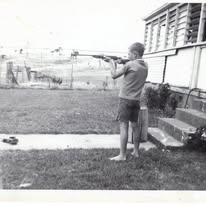
There was no conversation about feelings, no reflective pauses, no shared vulnerability.
Diary of a Child Sniper
Chapter 3 – A .22 at 13
Chapter Three begins two Christmases later, though the space between those mornings feels far greater than twenty-four months.
The ritual was unchanged. The waiting. The rules. The quiet insistence that nothing important happened until the ordinary obligations of the day were honoured first. Breakfast. Family. The slow, deliberate unwrapping that made patience part of the gift itself.
But what lay beneath the paper this time carried a different gravity. Longer. Heavier. Purpose-built.
A Winchester .22 calibre repeating rifle.
By today’s standards, thirteen would be considered far too young for a weapon of that capability. That’s the sentence that would lead any modern discussion. And perhaps it should. But in that place, at that time, it didn’t arrive as a rupture or a provocation. It arrived as a continuation.
Natural. Logical.
The slug gun had come at eleven. This wasn’t escalation in the way people imagine it now. It was progression. The same lesson, extended slightly further downrange.
For me, and apparently for my father, this wasn’t about danger. It wasn’t about power. It was about distance. And distance, on a working farm, translated into usefulness.
The slug gun was precise, but it was limited. It asked you to be close, and closeness takes time. Time you don’t always have when rabbits are breaking cover at the edge of a paddock or birds are lifting just beyond the reach of certainty. The .22 didn’t change the task. It changed the efficiency of it.
That mattered.
By thirteen, expectation had quietly shifted. Not announced. Not discussed. Just assumed. I wasn’t being given a rifle to learn anymore, I was being given one to contribute. Vermin weren’t a concept or a moral argument. They were a line item in the daily reality of keeping a property viable. Crops eaten. Feed spoiled. Damage done incrementally, quietly, relentlessly.
The rifle simply made me more effective at a job that already existed.
I don’t remember my father framing it as responsibility, but it was there all the same. The implication was simple: if you had the capacity to help, you helped. The range of the rifle extended the range of what I could reasonably be expected to do. A rabbit spotted further out wasn’t someone else’s problem anymore. It was mine.
And so the paddocks became not just space to roam, but territory with purpose.
There was no romance to it. No speeches about stewardship or balance. Just an understanding that usefulness was measured by outcomes. Fewer rabbits. Less damage. Work done quietly and without fuss.
The .22 fitted into that logic perfectly.
It didn’t make me braver. It made me more practical. I could sit further back. Cover more ground. Take shots that made sense rather than shots that were merely possible. The task became less about stalking endlessly and more about observation, watching patterns, learning where rabbits broke cover, where they fed, where they paused just long enough to make stillness pay off.
In that way, the rifle wasn’t a symbol of trust so much as an assumption of competence.
My father didn’t need to say, You’re ready for this now. The gift itself said it. And with it came the unspoken expectation that it would be used, not admired. That it would earn its place by doing work.
That distinction mattered. This wasn’t a toy. And it wasn’t a rite of passage in the ceremonial sense. It was a tool introduced at the moment when it could deliver more value than the one before it. Same principles. Same rules. Just greater reach.
And with that reach came a subtle shift in how I was seen. Not older. Not tougher. Just more useful. Which, in that world, was the only metric that counted.
If the air rifle had given me freedom measured in tens of metres, the .22 simply stretched that measurement. Same discipline. Same stillness. Same requirement to read the world before acting within it. Just a little more space between me and the target.
The paddocks didn’t change. I did.
The slug gun had demanded intimacy. You needed to be close enough to smell grass and hear your own breathing. It taught me precision through proximity. The .22 loosened that constraint, but it didn’t abandon it. It asked for judgment instead.
Range changes how you think. Not dramatically. Not philosophically. Practically.
You stop reacting and start anticipating. You read wind with far greater intent, rather than ignore it. You learn that distance magnifies mistakes rather than forgiving them. A poor decision doesn’t vanish just because you’re further away, it becomes more obvious.
And so the learning continued, uninterrupted. There was no sense that I had been handed authority, or that I was being invited into adulthood prematurely. It didn’t feel like trust being conferred so much as trust being assumed. As if the previous steps had already proven enough.
The safety briefing came, of course. The mechanics were explained. The action demonstrated. The first rounds handled slowly, deliberately. Nothing theatrical. Nothing dramatic. Just calm repetition until familiarity replaced novelty.
Then the paddocks opened up.
Not in some cinematic way. No swelling music. No moment of revelation. Just a quiet understanding that I could go further now. Walk longer. Sit further back. Take shots that required thinking instead of closing distance.
The farm became wider without becoming louder. And with that came solitude. Not enforced solitude. Chosen solitude.
I could leave for hours without explanation. Follow fence lines until they curved out of sight. Sit under trees with nothing happening and no requirement that something should happen. The rifle didn’t demand action. It allowed restraint.
That mattered.
Looking back, it would be easy to retrofit meaning onto that freedom, to suggest it filled an emotional gap, or compensated for some absence. But at the time, it didn’t feel like compensation.
It felt like normal. This was simply how life unfolded where we lived. Responsibility wasn’t introduced with speeches. It arrived disguised as capability. If you were given something, it meant you were expected to know how to use it. And if you didn’t yet, you would learn. Quietly. On your own. With the world itself providing feedback.
Misses were still more common than hits.
And like before, they didn’t frustrate me. They educated me. Each miss added to a private ledger. Wind misjudged. Distance underestimated. Timing off by a fraction. The paddocks remained my classroom. No lessons. No corrections spoken aloud. Just outcomes.
The .22 didn’t make the experience more dangerous in my mind. It didn’t flip a switch. It didn’t hard-wire risk awareness into my character. It simply extended the same logic I already understood. Same rules. Same restraint. Same quiet accountability. Only now, the horizon was a little further away. And that was enough.
There was no sense yet of mythology. No heroes. No cinematic overlay. That would come later, when the machines grew larger and the stories louder. For now, this rifle wasn’t symbolic.
It was practical. A continuation of the same conversation between boy, land, and consequence, just spoken across a longer distance.
What the increased range revealed to me — in a way the air rifle never could — was consequence beyond the theatre of the immediate.
With the air rifle, the world was tight. Contained. Consequences lived close to the muzzle. If you missed, you missed. The pellet fell away quickly, the energy spent, the mistake contained. The paddock absorbed it without comment.
The .22 didn’t behave that way. Distance gave the bullet somewhere to go after the decision had already been made.
What the increased range revealed to me, in a way the air rifle never could, was consequence beyond the theatre of the immediate. With the air rifle, the world was tight. Contained. Consequences lived close to the muzzle. If you missed, you missed. The pellet fell away quickly, its energy spent, the mistake absorbed by grass, dirt, or distance. The paddock took it without complaint.
The .22 didn’t behave that way. Even the ammunition told you so, if you paid attention.
Printed plainly on the side of the box, in language that felt almost exaggerated at the time, were the words: Dangerous to a mile.
As a boy, I’d read that as warning theatre. Legal language. Something written by people who didn’t know our paddocks, our distances, our sense of space. A mile felt abstract. The land around me was familiar, measured in fence lines and knolls and gullies, not in warnings.
But distance gives a bullet somewhere to go after the decision has already been made. And that is the part no one really explains to you.
I learned that the hard way.
A fox broke cover along the ridge line in front of me, running hard, quartering away. Everything about the shot felt right in the moment, the lead, the timing, the calm confidence that comes from repetition. The rifle cracked. The fox kept running.
I remember instinctively tracking the miss, not with my eyes but with my mind, following the imagined line of flight out beyond the point where my attention should have stopped.
Then movement on the next knoll. A sheep staggered. It wasn’t dramatic. No collapse. No sudden stillness. Just a wrongness, the way it stood, the way it tried to rejoin the others and couldn’t quite make its legs agree with the idea.
In that moment, the warning on the ammunition box ceased to be theoretical. The distance between action and outcome suddenly closed, collapsing a mile into a single instant of understanding.
We didn’t argue about it. There was no anger. No raised voice. My father looked once, took it in, and nodded. That was enough.
The sheep was brought back to the shed. There was no attempt to save it. No effort to soften what had happened. The work simply changed shape. What had been alive that morning became meat. Cut. Divided. Bagged. Set aside for dog food.
Nothing was wasted. And that, more than anything he could have said, was the lesson.
This was consequence that didn’t live in theory, or in the printed warnings on a cardboard box. It lived in weight, in smell, in the physical act of breaking down something that had not been part of the intention but was now part of the responsibility.
The rifle hadn’t just extended my range. It had extended my obligation beyond what I could immediately see.
Only then did my father speak. Not to scold. Not to dramatise. Just to remind.
A longer range meant a longer responsibility. You were accountable not only for what you aimed at, but for everything beyond it. Every fence line. Every knoll. Every animal that might intersect with a decision already released into the world.
That understanding stayed with me. By then, foxes had joined the list.
They weren’t sport. They weren’t trophies. They were vermin of a different order, smarter, faster, more destructive. And unlike rabbits, they came with a price attached. Skins could be sold. Not for much, but enough to matter. Enough to turn time and effort into something tangible.
The work now carried return. A fox taken cleanly wasn’t just fewer lambs lost. It was money. Not indulgent money. Purpose money. Money that justified ammunition used wisely, shots taken carefully, and decisions thought through before the trigger was touched.
And with that came another kind of freedom. Not freedom from rules. Freedom within them.
Saving for a telescopic sight became possible. Not as a gift. Not as entitlement. As consequence turned into currency. The idea that the rifle could be made more precise through my own effort felt entirely consistent with how everything else worked. If you wanted improvement, you earned it, and you earned it by reducing risk, not increasing it.
The sight wasn’t about power. It was about clarity. Seeing further didn’t excuse mistakes. It exposed them. The margin for error narrowed even as the range expanded. And by then, I understood that misses weren’t just personal failures anymore.
They carried weight. Sometimes literally. That day on the knoll changed how I thought about distance. Not as freedom alone, but as reach. And reach, once extended, could not be taken back.
The paddocks were still my classroom. But now the lessons travelled further than I did.
From the outside looking in, it is confronting. A thirteen-year-old boy, alone for hours at a time, carrying a .22 rifle across open land, methodically honing the skills required to end life efficiently. Even writing it now, stripped of context, the sentence carries weight it never did at the time.
Today, it would raise alarms. Questions would come first, explanations later. Morality would be interrogated before practicality was even allowed into the room. And perhaps that is not wrong, but it is incomplete.
Because morality without context is just abstraction. What I was becoming, through repetition and exposure, could be described uncomfortably as a killing machine of sorts. Not in the cinematic sense, no rage, no drama, no bravado, but in the colder, more precise meaning of the phrase. I was learning how to remove life efficiently. Cleanly. With as little waste, movement, or hesitation as possible.
And that fact deserves examination.
The unsettling truth is this: if the mindset had been even slightly different, the outcome could have been profoundly so. The mechanics were there. The capability was real. The distance the rifle allowed removed immediacy, softened empathy, and replaced it with calculation.
That combination, in the wrong emotional environment, could have built something dangerous. But it didn’t. Because the purpose was never violence. It was function.
Every shot existed within a narrow frame: vermin, necessity, outcome. There was no exploration beyond that boundary. No curiosity about what else the rifle could do. No experimentation with power for its own sake. No thrill in the act itself.
The only failure that registered emotionally was a poor shot. Not because something had died, but because it hadn’t died properly.
That distinction matters more than it first appears. Emotion didn’t attach itself to the taking of life. It attached itself to precision. To correctness. To whether the job had been done as it should have been. A clean hit meant the system worked. A miss meant the system needed refinement.
And so the emotional landscape narrowed. I wasn’t hardened in the way people fear. I was focused. The world simplified into variables: distance, wind, timing, outcome. Success brought no elation. Failure brought no guilt, only analysis.
That neutrality, viewed now, is the part that unsettles. Because neutrality is powerful. It removes friction. It allows action without hesitation. And when paired with capability, it can become something formidable very quickly.
But on the farm, neutrality was not cruelty. It was containment. The work had limits. Clear ones. The rifle existed for a purpose, and only for that purpose. Outside of it, it may as well not have existed at all. There was no bleed-over into imagination or identity. I was not becoming something. I was doing something.
That difference held everything in place. Morality didn’t arrive as a discussion. It arrived as a boundary. As expectation. As a consequence. You were allowed to do this because you did it correctly, quietly, and without deviation.
The moment that changed, the permission would have evaporated. And I knew that. Which may be the most important part.
I was never free in the way people assume freedom to be. I was constrained by usefulness, by outcome, by the unspoken understanding that capability without discipline would not be tolerated.
So yes, from the outside, it looks alarming. It should. But from the inside, it felt contained. Structured. Almost sterile.
For now, there was no larger narrative. No ideology. No heroism. No moral grandstanding. Just a boy, a rifle, and a narrowing focus on doing one thing well, and nothing else.
Everything beyond that would come later. And when it did, it would not arrive quietly.
But for now, functionality meant something else entirely. It meant there was time for Dad to have time with me.
Not the incidental time of instructions shouted across a paddock. Not the clipped exchanges that accompanied chores already decided. But shared time, purposeful, side-by-side, directed at the same task rather than delegated down a hierarchy.
The rifle made that possible.
With the range and effectiveness the .22 afforded, joint forays became practical. Spotlighting at night. Walking fence lines together. Pausing, listening, scanning, speaking in half sentences because full ones weren’t required. Armed pursuits, yes, but not in the way that sounds when written cold. They were structured evenings with a reason to exist, rather than orders issued and executed separately.
This wasn’t bonding in the modern sense. There was no conversation about feelings, no reflective pauses, no shared vulnerability. But there was proximity. Alignment. A rare sense that we were working with each other rather than in sequence.
That mattered more than either of us would ever have acknowledged. In those moments, Dad wasn’t the distant figure issuing tasks from a place already decided. He was present. Watching the same shadows. Assessing the same movement. Waiting for the same right moment. When he spoke, it was instructional rather than corrective. When he was silent, it wasn’t absence, it was concentration.
The spotlighting trips in particular carried a different texture to daylight work. The farm changed at night. The familiar became uncertain. Boundaries dissolved into darkness. And in that uncertainty, there was an unspoken reliance. He drove. I scanned. Or we walked, one slightly behind the other, each responsible for part of the whole.
No one needed to say, pay attention. Attention was the point.
The rifle sat between us as a shared tool, not a symbol. Sometimes it was mine. Sometimes his. Sometimes passed back without comment. The act of handing it over carried more trust than words ever could. It was understood that whoever held it would do the job properly.
And when something moved in the beam, there was no rush. Just a tightening of focus. A slight shift in posture. A shared decision that didn’t need announcing.
These were the moments where usefulness translated into belonging. Not because I was praised. Not because anything was said at all. But because I was there, not sent ahead, not left behind, but included. Functionality earned proximity. Capability earned access.
That was the economy we lived in.
In hindsight, it’s easy to see how narrow that pathway was. How conditional. How easily it could have vanished had the outcomes changed. But at the time, it felt solid. Reliable. Enough.
This was togetherness without warmth, but not without meaning. And for a boy who measured connection through action rather than language, it was everything that was available.
For now, that was sufficient. Later, the machinery would grow larger. The distances longer. The narratives louder. Purpose would begin to blur with identity, and function with mythology.
But here, in the half-light of a spotlight beam, boots crunching quietly beside mine, it was simple.
We were doing something together.
And for a while, that was enough to hold the world in place.
Author