

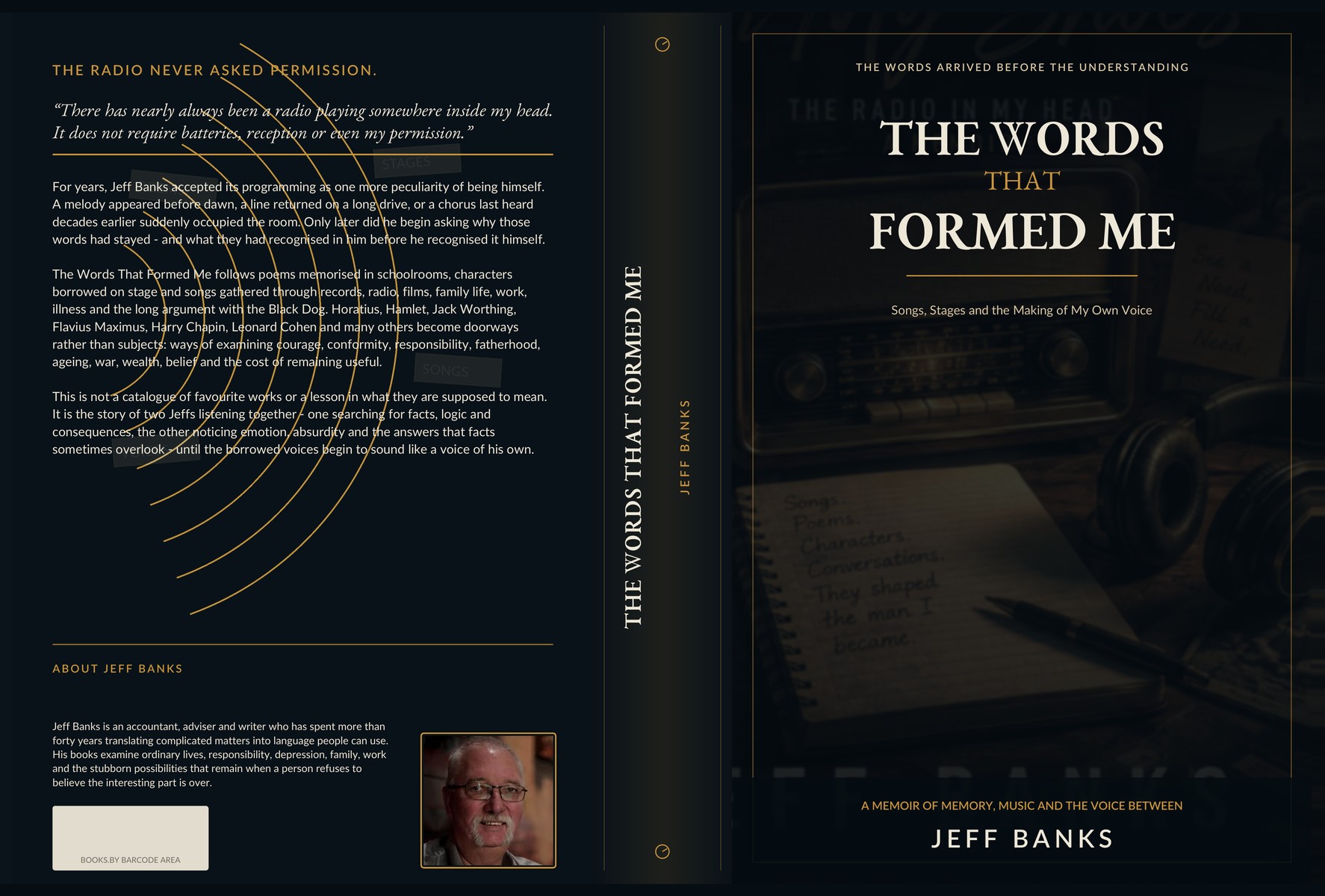
THE WORDS THAT FORMED ME Chapter 31 - The Words I Borrowed and the Voice I Kept

THE WORDS THAT FORMED ME Chapter 31 - The Words I Borrowed and the Voice I Kept | Travelling Around Australia with Jeff Banks

I cannot claim that the words have finished forming me. Retirement did not close the library, and age has not persuaded the radio station to adopt a limited playlist suitable for mature audiences. There will be more songs, more remembered lines and more moments when something heard fifty years earlier suddenly explains what happened last Tuesday. The voice will change because I will change, assuming tomorrow continues to offer the opportunity. What remains constant is the willingness to listen for what the words recognise next.

THE WORDS THAT FORMED ME

CHAPTER 31

The Words I Borrowed and the Voice I Kept

I was sitting in the Cave with two quite different documents open on the computer. One contained words about tax, compliance, business structures and the consequences that follow when somebody does something clever without first checking whether it is legal. The other contained poems, songs, actors, Roman detectives, Venetian gondoliers and a Black Dog that had wandered through far too many pages without ever being invited. At first glance, they appeared to have been written by two different people, although both documents had my name attached to them and neither could reasonably be blamed on anybody else. When I read them again, I began to hear the same voice moving beneath both.

The subject matter changed, but the intention did not. In one document, I was trying to explain something complicated without making the person reading it feel stupid. In the other, I was trying to explain something painful without pretending that I had solved it merely because I had found a sentence capable of describing it. Both required accuracy, but neither could survive on accuracy alone. A technically correct answer that leaves another person frightened, diminished or unheard may satisfy the person giving it, but it does not necessarily help the person who asked the question.

That may be what remained after all the poems, songs and theatrical characters had passed through me. They did not leave behind a collection of quotations that I could pull out whenever conversation became dull, although I have probably been guilty of doing that as well. They left patterns of thought, turns of phrase, questions and ways of looking at the person standing behind the apparent problem. Some of the words gave me courage, some gave me permission to be flippant and some warned me what could happen when certainty became more important than humanity. I borrowed their language for a while, but what survived was not imitation.

I did not become Macaulay, Shakespeare, Harry Chapin or Leonard Cohen, which was probably fortunate for all of us. I did not remain Jack Worthing, Giuseppe Palmieri or Flavius Maximus after the curtain came down, although parts of them may have failed to return their costumes. They had been given access to the building, and once inside they discovered rooms that I had not yet entered myself. By the time I developed a voice that sounded recognisably like mine, it already contained traces of theirs. That did not make the voice less authentic, because perhaps authenticity is not created from nothing but assembled from everything that stays.

Flavius Maximus may have left the most obvious fingerprints. In Rinse the Blood Off My Toga,¹ he investigated the murder of Julius Caesar as though Roman history had been waiting patiently for a private detective with a weakness for puns. The facts were serious, the manner was ridiculous and the ridiculousness made the facts easier to approach. Flavius understood that authority could survive a joke, provided the joke did not replace the thinking. Years later, without any conscious plan to honour a Roman gumshoe, I would build the first pillar of Banks Consultancy around much the same principle: We will speak in your language.

That pillar was never meant to promise that every answer would be easy. Tax law does not become simple because an accountant avoids long words, just as financial danger does not disappear because it has been described in a friendly tone. Speaking in another person’s language means accepting responsibility for whether the explanation arrives, not merely whether it leaves my mouth. It means noticing the moment when the listener’s eyes begin to glaze over and understanding that repeating the same sentence more loudly is not an advanced communication technique. It also means remembering that confusion is not evidence of stupidity and that technical knowledge does not grant permission to humiliate somebody who does not possess it.

I suspect the songs understood that long before I did. They rarely began with definitions, legislative references or a summary of the argument to follow. They began with a person, a place, an absence, a burden, a dream or something that had gone wrong while nobody was paying sufficient attention. Even when I disagreed with what a song appeared to be promising, I could usually understand what the person inside it wanted. The song had entered through feeling and then invited the analytical Jeff to examine what had just happened.

That sequence mattered when I became an adviser. Accountants are trained to start with numbers because numbers appear dependable, and in many cases they are. The difficulty is that the person sitting across the desk rarely arrives as a number, even when the documents spread between us attempt to make that case. There may be fear hiding behind a tax debt, shame hiding behind an unopened envelope or exhaustion hiding behind a set of accounts that should have been reconciled six months earlier. Speaking in the client’s language means finding the human question before demonstrating how efficiently I can answer the technical one.

There is a danger in this, particularly for someone who spent a considerable part of his life feeling that he had been required to dumb himself down to fit the room. Clarity can become another form of reduction if it strips away every qualification and leaves only the answer the listener hoped to hear. I have no wish to replace professional fog with cheerful nonsense, because both can lead a person over the same cliff. The task is not to make complexity disappear but to make it possible for another human being to walk through it without feeling abandoned. That distinction has shaped both the accountant and the writer.

The first pillar therefore did not begin as a marketing slogan. It began in schoolrooms where words remained after the lessons had vanished, on stages where timing mattered as much as the line and through songs that entered without asking whether I understood their formal meaning. It began with the discovery that people listen differently when they do not feel they are being spoken down to. It also began with my own need to be heard, because a child who has repeatedly watched his words fail to reach the room may become unusually determined to make sure his later words arrive. Flavius supplied the absurdity, but life supplied the reason.

The second pillar sounds more conventional: We will reduce your tax liability legally. The word legally might appear unnecessary, rather like a restaurant promising that the meat has been obtained without livestock theft, but experience suggests otherwise. People sometimes want the result without the qualifying conditions, particularly when the result involves keeping more of their own money. If I Were a Rich Man² may have been delivered with humour, longing and a certain amount of theatrical arm waving, but underneath it sat the ancient suspicion that money purchases freedom from rules that remain compulsory for everybody else.

My response to tax has never been that people should pay the largest amount available merely to demonstrate civic virtue. Tax legislation contains choices, concessions, structures, thresholds and timing rules, and there is nothing noble about ignoring them through laziness or incompetence. A person is entitled to arrange affairs within the law, and an adviser who fails to recognise legitimate opportunities is not morally superior because the client paid too much. Yet the legal qualification matters because ingenuity without boundaries can become theft wearing a tailored suit. There is a difference between challenging the system and pretending it does not apply.

That second pillar owes something to If I Had a Hammer.³ A hammer is a tool, and the morality does not reside entirely in the handle. It may build, repair, signal danger or land with enthusiasm on something that would have been better left unstruck. Tax knowledge operates in much the same way, although accountants usually cause less concern when carrying briefcases than hammers. The knowledge can help a business retain the resources needed to employ people, invest, survive or provide for a family, but it can also be used to disguise greed as cleverness.

The song’s hammer of justice and bell of freedom always felt larger to me than protest. They raised the uncomfortable question of what should happen after somebody recognises that a tool is available and that another person needs help. I have rarely been content merely to observe the need, which may be admirable on a good day and interfering on a bad one. The urge to step forward became part of my professional identity, particularly when a client was about to wander into a problem that seemed obvious from my side of the desk. Sometimes the task was to build something; sometimes it was to ring the bell loudly enough to stop them walking.

The logical Jeff can explain tax planning in terms of legislation, risk, timing and commercial consequence. The human Jeff sees what the retained money might mean to the person involved: another employee, a child’s education, breathing room after a difficult year or simply one night without waking at three o’clock to calculate whether the bank account will last until Friday. Neither interpretation is sufficient by itself. Numbers without people become an exercise, while empathy without numbers can become expensive sentimentality.

There is anger in that pillar as well, although I have learned not to let the anger draft the advice unsupervised. I become angry when systems are deliberately made too difficult for ordinary people to understand, then punish those same people for failing to navigate them correctly. I become equally angry when somebody refuses sensible advice, ignores every warning and later expects another person to perform a miracle before lunch. Somewhere between those two frustrations sits the work of a responsible adviser. The anger provides energy, but it cannot be permitted to choose the destination.

The third pillar is more obviously mine: We will drag you kicking and screaming to compliance. It is not language usually approved by committees specialising in tasteful corporate statements. It contains no soothing promise of a seamless journey, and it leaves open the possibility that the client may not enjoy every part of the relationship. That was deliberate, because compliance is often valued only after the consequences of ignoring it have arrived. By then, the kicking and screaming tend to be directed at the government, the accountant or anybody else conveniently standing within range.

There is an apparent contradiction between that pillar and Flowers Are Red.⁴ Harry Chapin’s child sees colours and possibilities while the institution insists that there is one authorised answer. Much of my life has been spent resisting the demand to become the same colour as everybody else, particularly when conformity has been presented as evidence of competence. Yet there I was, promising to drag people towards rules and deadlines with all the tenderness of a stockman loading a reluctant beast into a truck. The difference lies in what the rule is protecting and whom it diminishes.

Compliance and conformity are not the same thing, although authority frequently confuses them for convenience. A tax return deadline does not prevent imagination, and maintaining records does not require a person to abandon originality. There are rules that allow a system to function and rules that exist largely to ensure that nobody paints a flower purple. My objection has never been to every boundary; it is to boundaries that cannot explain why they are there, except that somebody in authority prefers the paddock to look orderly from a distance.

The third pillar grew from years of watching capable people damage themselves through avoidance. The unopened letter remained capable of containing bad news whether or not anybody broke the seal, and the unlodged form did not become less overdue because it had been placed beneath a more urgent pile. I could understand the fear, embarrassment and exhaustion that produced the delay, but understanding did not make the consequences disappear. Sometimes compassion required listening, while at other times it required putting the form in front of the person and refusing to join the pretence that tomorrow would solve it automatically.

The dragging language also revealed something about me that I could not entirely applaud. I liked being useful, and usefulness could become permission to take control of a problem that still belonged to somebody else. The hammer in my hand did not always wait to be asked whether a nail actually required attention. There were times when helping up slipped quietly into helping out, and helping out became rescuing, and rescuing made it difficult for the other person to develop the strength that the next problem would require. Good intentions do not receive an automatic exemption from examination.

Perhaps the third pillar should always have carried an invisible second sentence. We would drag the client towards compliance, but we also had to let go once they were capable of walking. The aim was not to manufacture dependence on the accountant or create a permanent audience for my competence. It was to place the business owner in a position where better choices became possible, even if the better choice was occasionally to ignore my advice for reasons they could explain. A silent partner may argue, but he does not seize the company and declare himself emperor.

That brings me to the fourth pillar: We will act like a silent partner in your business. Of the four, this may contain the greatest amount of the person I was trying to become and the greatest risk that I would misunderstand the role. A partner has a stake in the outcome, notices danger and is prepared to say something unpopular before the damage becomes irreversible. A silent partner, however, does not need to occupy every conversation or make the business owner feel like a passenger in their own enterprise. Silence does not mean absence, but neither does partnership mean domination.

The Weight⁵ and Handle with Care⁶ had already explored the territory. One carried burdens that seemed to transfer themselves from person to person, while the other admitted that apparently capable people could still be damaged goods requiring care. I heard both through the ears of somebody who had built an identity around being able to carry things. The ability to take the load became proof of worth, and proof of worth became a reason not to admit when the knees were beginning to buckle. A silent partner who never reveals strain may appear dependable while quietly becoming useless.

What About Me⁷ supplied the complaint that often remained hidden beneath that usefulness. The competent person answers the questions, solves the problems and appears not to require anything in return, until one day he discovers a small and resentful voice asking whether anybody noticed him standing there. I did not always like that voice, because resentment is unattractive when observed in somebody else and rather worse when found at home. Yet denying it did not make it disappear. The song recognised the part of me that wanted to serve and the part that wanted the service to prove that I mattered.

The fourth pillar was therefore not merely about understanding cash flow, tax structures and the direction of a business. It was about remaining close enough to notice what the financial statements could not say. A declining margin might indicate poor pricing, but it could also sit beside a marriage under pressure, a body running out of energy or a business owner who had forgotten why the enterprise existed. The accountant could not repair every part of that life, nor should he attempt to do so. He could, however, avoid treating the human evidence as irrelevant simply because it did not appear in the general ledger.

The same question had already followed me through Cat’s in the Cradle⁸ and The Living Years.⁹ Provision could become an alibi for absence, and words postponed until later might discover that later had closed without notice. In business, as in family, it was possible to be busy on another person’s behalf while failing to be present with them. I had spent years believing that responsibility justified the hours required to carry it. The songs did not accuse me of failing to provide; they asked whether provision had sometimes been allowed to answer a different question.

A silent partner should know when to speak and when the other person needs room to find the answer. That is more difficult than it sounds, particularly for somebody whose mind often arrives at a conclusion before the conversation has completed its opening formalities. The analytical Jeff wants to save time by presenting the answer immediately, while the human Jeff suspects that the answer may not be accepted until the other person has travelled some of the road towards it. Writing taught me the same discipline. A reader cannot be dragged through an idea merely because the writer has already reached the other side.

That may be where the professional voice and the memoir voice finally reveal their relationship. Both are attempts to make ordinary lives meaningful without talking down to the person living them. The business owner with the overdue return is not merely a compliance failure, just as the capable man visited by the Black Dog is not merely a diagnosis waiting to be summarised. Each has a history, an explanation, a share of responsibility and a future that has not yet been completely decided. Respect requires seeing all of that without pretending that seeing it removes the consequences.

The phrase ordinary lives can sound faintly patronising, as though somebody has divided humanity into those worthy of biography and those expected to remain in the supporting cast. I do not use it that way. Ordinary lives contain bankruptcy, recovery, marriage, children, illness, work, service, failure, humour, resentment, generosity and mornings when getting from the recliner to the office can feel like crossing a continent. They contain battles fought without bands, speeches or anybody writing down the names of those who stood on the bridge. The absence of public grandeur does not mean the life lacked fearful odds.

Macaulay’s Horatius¹⁰ reached me before I possessed enough life to understand why defending a bridge might become a personal image. As a boy, I heard courage, glory and the willingness to stand against overwhelming force. The older man hears the quieter question of who selected the bridge, who decided it must be defended and who remained after the cheering to count the cost. Yet the words still work inside me, because some mornings contain a bridge no wider than the distance to the next necessary task. Courage becomes less theatrical with age, but it does not necessarily become less real.

Hamlet¹¹ arrived with another question, although I was quite capable of reducing it to “To be, or perhaps not today” when solemnity threatened to become unbearable. The flippancy was not disrespect; it was a way of approaching a thought that became more dangerous when treated as abstraction. The Black Dog has often spoken in language that sounded calm, logical and almost considerate, as though disappearance were merely an administrative option worth reviewing. Hamlet’s uncertainty did not give me an answer, but it recognised that the question existed long before I was ready to admit how often it might visit.

The Black Dog has not been defeated by any poem, song, theatrical role, business pillar or burst of intelligence. He has not been reasoned into retirement, frightened by Flavius Maximus or persuaded that his services are no longer required. There are days when he remains far enough away for me to work, write, laugh and notice extraordinary things, and there are days when he lies across the path as though he has acquired the property. The words do not make him vanish. They sometimes give me enough language to recognise that his voice is not the only one broadcasting.

That is why Hallelujah¹² mattered without becoming religious for me. The song allowed praise to exist without victory and continuation without the dishonest claim that everything had been repaired. My hallelujah might be writing a paragraph, answering a message, riding the exercise bike or remaining in the room long enough for the emotional weather to change. None of those actions is a cure, and I distrust the tidy stories in which persistence is rewarded immediately because the universe admires good behaviour. Sometimes the achievement is simply that the day did not receive everything it demanded.

Keeping the Black Dog at a workable distance is not the same as winning. The distinction is important because the language of victory can make every return feel like failure. I may be able to close the gate, strengthen the fence and recognise the sound of him moving through the scrub, but I cannot guarantee that he will not find another entrance. What I can do is maintain enough distance to hear the other voices as well. The songs, memories, family, work, absurdities and unfinished books help occupy frequencies he would prefer to control.

The rage of life is part of that resistance. I do not mean uncontrolled anger directed at every person who moves too slowly through a doorway, although retirement has not made humanity noticeably more efficient. I mean the refusal to surrender curiosity, involvement, argument, affection and the expectation that tomorrow may contain something worth seeing. Rage in that sense is not destruction but insistence. It says that the Black Dog may remain, but he does not receive exclusive broadcasting rights.

Some of the rage came from the same place as the four pillars. I wanted people to understand because I knew what it was like not to be heard. I wanted them to pay no more tax than the law required because I had seen how money, fear and authority could distort a life. I wanted them compliant because preventable disasters made me angry, particularly when pride or avoidance had been allowed to disguise themselves as strategy. I wanted to stand beside them because the person behind the business mattered more than the elegance of the advice.

Those intentions were not always pure, and the voice I kept must admit that. Speaking another person’s language could also prove how clever I was at translation. Saving tax could earn gratitude, dragging somebody to compliance could reinforce my authority and acting as a silent partner could provide access to decisions that were not mine to make. The analytical Jeff can justify each action, while the human Jeff keeps asking what I needed from the relationship in return. That question does not invalidate the work, but it prevents the story becoming a testimonial written by its own subject.

The two Jeffs have not merged into a single calm narrator. One still wants structure, evidence, consequence and an answer that can survive inspection. The other notices the tremor behind the question, the ridiculousness inside the solemn room and the silence that follows when the technically correct answer has missed the person entirely. Writing gives them a place to argue without requiring either to leave. Perhaps the voice sounds like mine because the disagreement remains audible.

I once thought finding my voice would mean removing the borrowed parts. There would be a process of purification in which Shakespeare, Macaulay, Chapin, Cohen, Gilbert, Sullivan, Wayne, Shuster and the various members of the internal radio orchestra were thanked for their contribution and shown politely to the door. What remained would be original, unmistakable and entirely mine. That now seems both impossible and unnecessary. A voice is not made authentic by having no ancestors.

The words I borrowed became mine through use, misunderstanding, resistance and the slow accumulation of experience. A line remembered from school changed when business failed; a comic character changed when clients needed frightening information explained without ceremonial fog. A song about fathers changed after I became one, while a song about being rich changed when enough began to look more valuable than excess. The words did not remain fixed while I moved past them. They moved as well, because memory kept rewriting the room in which I heard them.

Perhaps that is what they recognised before I did. They found the boy who wanted to be heard, the performer who discovered that timing could carry truth, the accountant who would refuse to speak like a tax manual and the writer who would eventually turn towards the darkness instead of hiding it behind competence. They found the two Jeffs before either had been formally introduced. They found the anger, the humour, the need to be useful and the dangerous suspicion that usefulness might be the price of belonging. They waited until life supplied the meanings I had been too young to understand.

The four pillars of Banks Consultancy were therefore not separate from the poems, characters and songs in this book. They were a professional expression of the same voice struggling to emerge: speak so the person can hear, use knowledge responsibly, confront what cannot safely be avoided and stand beside people without taking their lives away from them. I did not write the pillars by placing the songs on a table and assigning one to each business principle. Their origins were less orderly and more honest than that. The songs had already entered the bloodstream, and the principles arrived carrying traces of them.

The voice I kept can explain tax law, challenge business orthodoxy, question capitalism, write about depression and find meaning in lives that may never trouble the historians. It can be angry without assuming the reader is the enemy, and it can be funny without using the joke to flee the room. It can say that I have been wrong, that I remain uncertain and that some of the systems I challenged also kept me safe. Most importantly, it can speak about the Black Dog without allowing him to become the author. He may contribute material, but he does not receive final editorial approval.

I cannot claim that the words have finished forming me. Retirement did not close the library, and age has not persuaded the radio station to adopt a limited playlist suitable for mature audiences. There will be more songs, more remembered lines and more moments when something heard fifty years earlier suddenly explains what happened last Tuesday. The voice will change because I will change, assuming tomorrow continues to offer the opportunity. What remains constant is the willingness to listen for what the words recognise next.

The words found me before I knew what they were looking for. They entered through classrooms, radios, stages, records, films, country roads and the strange early-morning programming decisions of a mind that has never accepted ordinary office hours. For years I thought I was merely remembering them, when perhaps they were patiently waiting for me to catch up. I borrowed their voices long enough to discover the sound of my own. The radio remains on, the Black Dog remains outside the door for now, and there is still far too much worth saying to hand him the microphone.

Notes

  1. Rinse the Blood Off My Toga is a comedy sketch by the Canadian comedy team Wayne and Shuster, first performed on television in 1958. The sketch parodies Shakespeare’s Julius Caesar through the investigations of the private Roman detective Flavius Maximus.
  2. If I Were a Rich Man was written by composer Jerry Bock and lyricist Sheldon Harnick for the musical Fiddler on the Roof, first produced on Broadway in 1964. The song was introduced on Broadway by Zero Mostel in the role of Tevye.
  3. If I Had a Hammer (The Hammer Song) was written by Pete Seeger and Lee Hays in 1949. It was later widely popularised by Peter, Paul and Mary through their 1962 recording.
  4. Flowers Are Red was written and recorded by Harry Chapin and released in 1978 on the album Living Room Suite.
  5. The Weight was written by Robbie Robertson and recorded by the Band for the 1968 album Music from Big Pink.
  6. Handle with Care was written and recorded by the Traveling Wilburys—George Harrison, Jeff Lynne, Roy Orbison, Tom Petty and Bob Dylan—and released in 1988 on Traveling Wilburys Vol. 1.
  7. What About Me was written by Garry Frost and Frances Swan. The version remembered here was recorded by Moving Pictures and released in 1982 on the album Days of Innocence.
  8. Cat’s in the Cradle was written by Harry Chapin, based upon a poem by his wife, Sandy Chapin. Harry Chapin recorded the song for his 1974 album Verities & Balderdash.
  9. The Living Years was written by Mike Rutherford and B. A. Robertson. It was recorded by Mike + the Mechanics and released in 1988 on the album Living Years.
  10. “Horatius” appears in Thomas Babington Macaulay’s Lays of Ancient Rome, first published in 1842. The poem recounts the legendary defence of the Sublician Bridge by Horatius Cocles and his companions.
  11. Hamlet by William Shakespeare was probably written around 1599–1601 and first performed in the early seventeenth century. Hamlet’s “To be, or not to be” soliloquy appears in Act Three, Scene One.
  12. Hallelujah was written and recorded by Leonard Cohen and released in 1984 on the album Various Positions. Numerous later recordings brought the song to a wider audience.

Author

Menu