

I wasn’t just walking anymore. I was moving with intent.

Diary of a Child Sniper – Chapter 12 – Where Has the Sniper Gone
- Diary of a Child Sniper
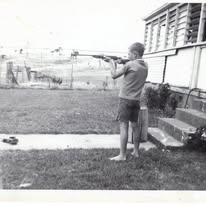
I wasn’t just walking anymore. I was moving with intent.
Diary of a Child Sniper
Chapter 2 – Freedom With a Sight Picture
What the rifle really gave me wasn’t power. It was range.
Not range in the ballistic sense, though I learned that too, but range from supervision, from voices, from the domestic gravity of the house. With the rifle in my hands, the paddocks opened up in a way they never had before. I could wander. Not roam aimlessly, but hunt. There is a difference, and even then, I understood it instinctively.
The boundary fences stopped being borders. They became reference points. The creek line wasn’t just where the grass thickened, it was cover. Wind direction mattered. Foot placement mattered. Time mattered.
I wasn’t just walking anymore. I was moving with intent.
At first, the prey was small. Anything that came within twenty metres was fair game, wrens flitting low through the grass, magpies too confident in their ownership of the air, sparrows foolish enough to pause. The rifle taught me something brutal very quickly: proximity equals consequence. At that distance, death was almost guaranteed if I did my part.
And I took pride in doing my part.
The ritual mattered. Spot. Pause. Control the breath. Feel the resistance in the trigger. That final fraction of pressure where intention becomes irreversible. The shot itself was almost anticlimactic, a brief crack of sound, a recoil absorbed into shoulder and certainty.
The result was immediate. Final. Clean. There was no cheering. No celebration. Just a quiet internal nod that said: Yes. That worked.
That nod mattered more than I would have admitted then.
Because in a world where so much felt beyond my control, adults, expectations, rules that arrived without explanation, the rifle offered a simple equation. If I was patient, precise, and disciplined, the outcome was predictable.
That predictability was intoxicating.
Rabbits were different.
Birds were opportunistic kills. They appeared suddenly, moved impulsively, and vanished just as quickly. You reacted to birds. If the moment aligned, the result followed. There was skill involved, yes, but it was momentary.
Rabbits demanded something else entirely. They required stillness before movement, patience before intent. You couldn’t chase a rabbit into submission. You had to let the world slow to its pace, not yours. Every footstep became a negotiation. Every blade of grass a potential betrayal. The rabbit didn’t need to see you to know you were there, it only needed to sense that something had changed.
To get close enough, you had to become part of the paddock.
You learned quickly that rushing was self-defeating. The urge to act, to close the distance, to take the shot before the opportunity evaporated, was the very thing that guaranteed failure. Rabbits punished impatience instantly. A flick of movement, a shift of shadow, the wrong angle into the wind, and they were gone. No second chances. No warning.
In the early days, I missed more rabbits than I hit.
Each miss carried its own sting, but not the kind that sent me into anger. There was no one to curse, no unfairness to rail against. The miss was clean. It belonged to me. And because it belonged to me, it also taught me.
Every failure lodged somewhere inside, not as frustration but as information. Too far. Too early. Wrong angle. Breath rushed. Breath held too long. Finger impatient. Body visible when I thought it wasn’t.
I didn’t write any of this down. I didn’t need to. The paddocks had a way of engraving lessons more deeply than paper ever could. Over time, those fragments of experience began to assemble themselves into something coherent. Not a formal system, nothing you could explain easily, but a growing internal reference guide.
My own version of a textbook.
It wasn’t organised by chapters or rules. It was built from anecdotes. From moments that went wrong and moments that went less wrong. From patterns emerging slowly enough that you didn’t notice them forming, only that you began to trust them.
Distances stopped being guessed and started being felt. Timing became instinctive rather than deliberate. Stillness stopped feeling like waiting and started feeling like work.
The misses became fewer, not because the rabbits became easier, but because I became quieter, more deliberate, more attuned to the small signals that mattered. The scales tipped slowly, almost imperceptibly, until success stopped feeling accidental.
That was the real honing of the sniper. Not the killing, but the calibration. The constant adjustment between intention and reality. The willingness to accept correction without resentment. The discipline to let skill accumulate at its own pace, without shortcuts or excuses.
I wasn’t becoming more aggressive. I was becoming more accurate.
And accuracy, I was learning, had nothing to do with speed or force. It came from restraint, from observation, from accepting that the world would not bend to impatience, only to understanding.
The paddocks became my classroom. No bells. No lessons. No marks handed back with red ink. Just immediate feedback from the world itself. The grass would part. The bird would fall. Or it wouldn’t.
And either way, the lesson was mine alone.
The slug gun ensured that learning stayed intimate. By its very nature, it refused distance. It wasn’t a weapon that allowed detachment or abstraction. You couldn’t dominate the paddock from afar. You had to be close, close enough to hear movement before you saw it, close enough to feel when the moment was right rather than calculate it.
Twenty metres wasn’t a range. It was a boundary. Inside it, everything mattered. Outside it, nothing did.
That constraint shaped the way I moved long before I understood it as training. You didn’t scan the landscape broadly; you read it locally. You learned the texture of grass underfoot, the difference between cover and concealment, the way shadows behaved at different times of day. You noticed how animals paused before moving, how they listened before committing themselves to exposure.
To be effective, you had to enter their world without disturbing it.
That closeness created a kind of honesty. At that distance, there were no heroic gestures, no dramatic recoveries. You couldn’t correct a mistake after the fact. If you were careless, the opportunity simply evaporated. The paddock didn’t scold you. It didn’t explain itself. It just withdrew cooperation. And that withdrawal was instruction enough.
The intimacy demanded restraint. You couldn’t rely on force or speed. You had to earn proximity, step by step, breath by breath. The slug gun forced you to slow down, to let observation do the work that impatience wanted to rush.
In that sense, the weapon wasn’t teaching me how to shoot. It was teaching me how to approach. Every encounter unfolded at ground level. Grass eye-high. Wind readable only by feel. The world reduced to small variables that had to be noticed and respected. And because the range was short, the margin for error was narrow. You didn’t get to pretend skill you didn’t have.
That closeness sharpened everything. Not just aim, but awareness. Not just timing, but judgement. Not just patience, but humility.
The paddocks didn’t allow theory. They only allowed practice. And practice, repeated enough times without commentary or correction, began to shape something durable. Something that didn’t feel learned so much as absorbed.
Long before the distances extended, before power increased, before anything felt technical or impressive, the fundamentals were already being laid down here, at grass height, within arm’s reach of consequence. Quietly. Individually. Without witnesses. And because the lesson belonged only to me, it stayed with me.
What strikes me now isn’t the violence of it, though that’s impossible to ignore with adult eyes, but the freedom of consequence. Out there, away from the house, away from family dynamics and expectations, I was responsible for everything that happened. Success belonged to me. Failure belonged to me.
There was no one to blame. No one to impress. Just me, the rifle, and the quiet agreement between intention and outcome.
If I rushed, the world punished me without malice. If I waited, it rewarded me without praise. There was no moral overlay to it, no commentary. The paddocks didn’t care who I was or what kind of day I’d had. They only responded to what I did.
That was the freedom. Not triumph. Not dominance. Just clarity.
Out there, competence was not celebrated, it was simply acknowledged. A clean hit wasn’t an achievement; it was confirmation that I had done what was required. Misses weren’t failures either. They were information. Adjustments waiting to be made.
I learned quickly that the world could be honest if you approached it honestly. No raised voices. No shifting rules. No penalties delivered later for reasons you couldn’t name.
When I did everything right, the result made sense.
That kind of certainty doesn’t announce itself as important when you’re young. It just settles in quietly, like a reference point you don’t yet know you’ll measure everything else against. But once you’ve experienced a place where discipline and focus are enough, where effort connects directly to outcome, it becomes difficult to tolerate worlds that don’t work that way.
Places where rules move. Where authority is opaque. Where consequences arrive divorced from action. I didn’t think about any of that then. I didn’t need to. The paddocks asked nothing of me beyond attention, patience, and control. I gave them that, and they responded accordingly.
It felt fair. And without realising it, I began to trust fairness over people. Systems over voices. Outcomes over explanations.
The rifle didn’t create that belief. It merely revealed it.
That belief, not the rifle, would stay with me long after the paddocks changed, and the distances stretched, and the tools grew more powerful.
I just didn’t know it yet.
Author