

What had once been essential became unnecessary. What had once been sharpened by purpose dulled into memory.
And memory, unlike steel, doesn’t rust.
It just waits.
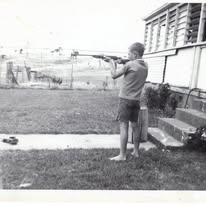
What had once been essential became unnecessary. What had once been sharpened by purpose dulled into memory.
And memory, unlike steel, doesn’t rust.
It just waits.
Diary of a Child Sniper
Chapter 12 – Where Has the Sniper Gone?
What happened to the child sniper?
Life did.
Not with drama. Not with betrayal. Just with momentum.
What had once been a necessity of survival on a working farm slowly dissolved into memory as the geometry of my world changed. Paddocks gave way to streets. Fence lines became kerbs. Distance collapsed. Noise multiplied. The rifle, once an extension of responsibility, lost its reason to exist.
There were, of course, echoes.
Wide-eyed city boys would come out for a weekend, dazzled by space and darkness and the novelty of a spotlight slicing across a paddock. We would go vermin shooting. There was laughter, bravado, stories exaggerated by beer and distance. But it was never the same thing. Never the singular ideology of the sniper. Never the quiet, internal discipline of being a toter of a weapon because the land demanded it, not because the moment allowed it.
Those weekends were theatre. What came before had been purpose.
Cousin Phil would visit sometimes. So would his mate Tarras. They carried with them fragments of my past, shared shorthand, familiar silences, the muscle memory of rural life. But even those visits were reminders, not continuations. They pointed backward, not forward.
National Service was still very much in vogue when my cousin Darryl was conscripted. It wasn’t theoretical. It wasn’t political. It was simply there, a background constant of the era, like uniforms in shop windows or war films on Sunday afternoon television. It carried with it an assumption of inevitability. That if you were male, and of a certain age, the state might one day call your number.
During my school years, that certainty fractured.
The repeal came not as a dramatic rupture but as a quiet removal of expectation. One more pivot point in a childhood already shaped by other forces. Suddenly the pathway that had seemed pre-drawn, service, training, rifle, parade ground, was no longer compulsory. Choice replaced obligation, even if no one quite knew what to do with that freedom yet.
In the vacuum, stories rushed in. The death or glory boys. Kelly’s Heroes (1970 – Metro Goldwyn Mayer). A parade of glorified protagonists who made war look like clarity and purpose distilled into two hours of film. For a young and impressionable mind, emotionless on the surface, disciplined underneath, those narratives offered a way to imagine identity without context. Skill without consequence. Action without aftermath.
They shaped expectations more than reality ever did.
So when, under Gough Whitlam, National Service was finally abolished, it didn’t feel like a revolution. It felt like confirmation. The track I was on had already shifted sideways.
The passing-out parade of my cousin Darryl should have been momentous. It was ceremonial proof of something once assumed to be waiting for all of us: order, direction, consequence neatly arranged into rank, uniform, and instruction. A life where purpose was externally supplied and obligation preceded choice.
Instead, it landed oddly. Formal. Precise. Immaculate. And somehow disconnected.
The machinery of that world was still turning, perfectly engineered, well rehearsed, but it was no longer turning toward me. I stood adjacent to it, close enough to recognise its discipline, far enough away to know it no longer defined the path ahead.
That was the contradiction of the time.
National Service represented a life of enforced structure. A single, unavoidable fork in the road that removed ambiguity by brute certainty. You didn’t have to wonder who you were becoming; the system told you. In contrast, what replaced it was not freedom in the romantic sense, but choice surrounded by impossibilities.
The new world did not arrive with marching orders. It arrived bounded by marks on an examination paper. Percentiles. Rankings. Gatekeepers disguised as opportunity. You were told you were free to choose, so long as you chose within the narrow corridors permitted by performance, timing, and luck. And there was no plan.
At least not at first. The absence of a prescribed path didn’t create clarity; it created pivots. Monumental ones. Decisions made without models, without rehearsal, without any science of structure to support them. This was not engineering. It was improvisation. Abhorrent to logic. Hostile to prediction.
Life, stripped of inevitability, became an artform.
Each move was a brushstroke laid down without knowing the final image. Choices weren’t optimised; they were survived. You didn’t design a portrait of who you would become, you compiled it, one reaction at a time, responding to circumstance more than ambition.
By then, I had already begun making a different life. Not as an act of defiance. Not as a statement. Simply because necessity had changed shape.
City life didn’t arrive with a plan either. It arrived quietly, through opportunity and work. Through relationships that mattered and rent that had to be paid. Through routine, repetition, and one small accommodation after another. Adjustments made not because they were ideal, but because they were required.
The rifles didn’t come with me. Not because it was rejected. Not because it was feared. But because, in this new geometry of living, it no longer had a role.
What had once been essential within a system of necessity had no function in a life assembled through choice, constraint, and consequence. And without function, even the most defining tools fall silent.
That, perhaps, is the quiet truth National Service never had to confront: structure gives purpose, but absence forces becoming. And becoming, unlike service, is never uniform.
And the guns themselves?
They faded in the way tools do when the job is finished.
After Port Arthur, the automatic shotgun was surrendered. The recompense exceeded its original cost, which felt oddly transactional for something that had once been so embedded in function. It left without ceremony.
The Tikka went to a cousin still farming locally, passed on to where it still made sense.
The Winchester, as far as I know, still sits at the family home of my youngest brother.
Present, but dormant. A relic more than a tool.
And the slug gun? That one simply rusted away. No handover. No policy change. No reckoning.
It stayed where it was left and surrendered slowly to time and weather, as if even the metal understood that its work was done.
That, perhaps, is the most honest ending.
The child sniper didn’t stop being because of guilt, or fear, or ideology. He wasn’t cured or corrected. He was simply outgrown.
What had once been essential became unnecessary. What had once been sharpened by purpose dulled into memory.
And memory, unlike steel, doesn’t rust.
It just waits.
Author