

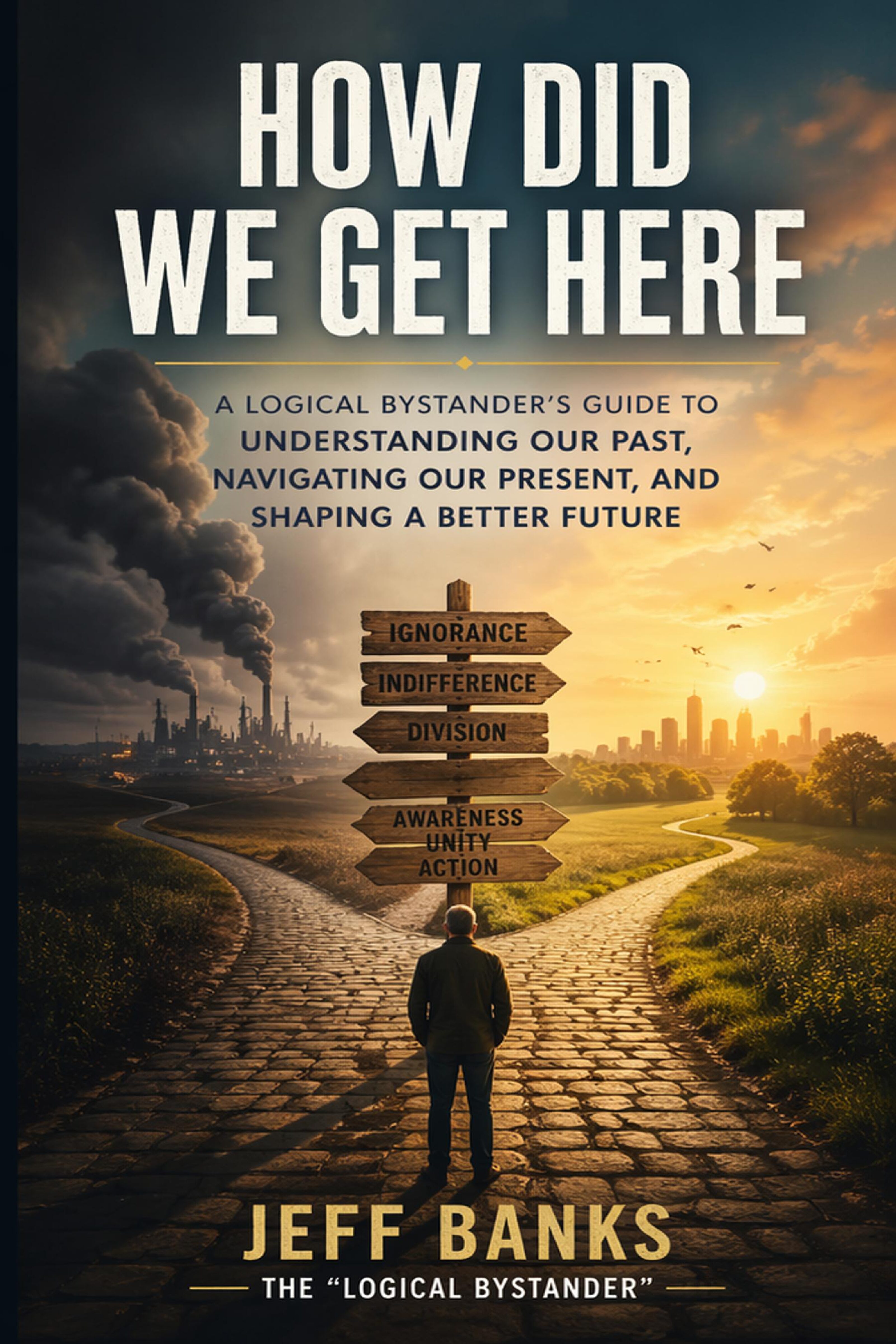
How Did We Get Here Chapter 10 - The Demon Smoke

How Did We Get Here Chapter 10 - The Demon Smoke | Travelling Around Australia with Jeff Banks

The logical bystander does not stand apart from this with a sense of superiority, but with a sense of curiosity, and with the backdrop, in my case at least, of never being a smoker. What would it have taken, at that moment in the doctor’s office, for the conversation to pause? Not to reject outright, but simply to question. What is this doing? Why is this being suggested? What evidence supports it? Small questions, asked early, have a way of preventing larger problems from embedding themselves later.

HOW DID WE GET HERE


Chapter 10 – The Demon Smoke


There was a time when the ashtray sat as comfortably on the table as the salt and pepper. It wasn’t an accessory; it was part of the setting. Meetings began with the scrape of chairs and the flick of lighters. Cars carried that faint, stale fog that clung to the upholstery long after the windows had been wound down. Even waiting rooms, places supposedly dedicated to health, held the quiet hum of cigarettes burning between fingers that had long since stopped questioning why they were there.


In one such room, a young mother sat, the mother of a school mate, tired in the way that comes from a thousand small demands rather than one large one. The doctor, authoritative in tone and confident in manner, offered advice that seemed, at the time, entirely reasonable. A cigarette, it was suggested, might calm the nerves. Not as indulgence, but as remedy. The exchange was brief, almost procedural, and it passed without resistance. There was no raised eyebrow, no pause to consider the contradiction of prescribing harm as a form of relief. It simply became part of the routine, another small instruction absorbed into the broader understanding of how life was managed.


That moment, ordinary as it appeared, carried within it the quiet shift where logic begins to give way to momentum. The idea did not need to be proven. It only needed to be repeated, accepted, and reinforced by those seen to know better. Once it passed that threshold, it ceased to be questioned and instead became part of the fabric.


From there, the pattern unfolded in a way that, in hindsight, feels almost choreographed. Smoking was not merely tolerated; it was woven into identity. It was sophistication in advertising, rebellion in youth, stress relief in adulthood. To abstain was not a neutral act. It was a deviation. It marked a person as different in a way that required explanation. The absence of the habit carried more weight than its presence, which, on its own, tells a story about how deeply embedded the behaviour had become.


The curious part was never the act itself, but the collective agreement that surrounded it. People did not wake each morning and decide, independently and rationally, that inhaling smoke was beneficial. Instead, they inherited the decision. It arrived pre-packaged, supported by images, reinforced by conversation, and validated by authority. The individual did not so much choose as they complied, stepping into a narrative that had already been written.


This is where the notion of “think it therefore it is” begins to take hold. Enough people accept an idea, and it starts to resemble truth. Enough repetition, and the question fades. The mind, seeking efficiency, stops revisiting what appears settled. It becomes easier to continue than to reconsider, and in that ease, the original logic quietly dissolves.


The role of authority in this process cannot be understated. When those positioned as experts participate in the behaviour, or worse, endorse it, the need for scrutiny diminishes further. The doctor in the room was not seen as careless or uninformed. The advice was not weighed against evidence because the presence of authority acted as a substitute for evidence. It created a shortcut in thinking, one that bypassed doubt in favour of trust.

Overlay that with the influence of industry, and the picture sharpens. Tobacco companies did not invent the desire for belonging or relief, but they understood it with precision. They positioned their product not as a substance, but as a solution. Stress, identity, confidence, social acceptance, all wrapped neatly in a single, consumable act. The messaging was consistent, persistent, and, most importantly, aligned with what people already felt they needed. It did not challenge behaviour; it validated it.


Governments, meanwhile, occupied a curious space within this ecosystem. There was awareness, at least at some level, of the harm being done. Yet the response often leaned toward moderation rather than confrontation. Warnings were introduced, taxes applied, campaigns launched, but the underlying structure remained intact. The product was still available, still marketed, still embedded in daily life. The approach suggested a desire to be seen to act without fully disrupting the system that allowed the behaviour to continue.

This is where the farce begins to reveal itself, not as comedy, but as contradiction. On one hand, there is acknowledgement of harm. On the other, there is continued participation in the mechanisms that perpetuate it. The smoker is told the habit is dangerous, even as the pathways to maintain it remain open and, in some cases, economically beneficial to those providing the warnings.


For those caught within the cycle, the concept of choice becomes increasingly blurred. Addiction does not operate within the neat boundaries of rational decision-making. Once the dependency takes hold, the conversation shifts from whether to engage to how to sustain. Pricing strategies, no matter how well-intentioned, often serve only to increase the cost of participation rather than reduce it. The behaviour adapts. Alternatives are found. The underlying pattern persists.


From the perspective of the logical bystander, the question is not why individuals smoke. That answer, in many ways, has already been explored and understood. The more compelling question is how a behaviour so clearly at odds with long-term wellbeing was allowed to become so deeply entrenched in the first place.


Part of the answer lies in the gradual nature of the shift, and it becomes clearer when viewed through the quiet, unremarkable decisions that played out across ordinary households. There was no single moment where the collective paused and agreed to adopt a harmful practice. It arrived in fragments, in habits formed without ceremony, in choices made not out of recklessness but out of routine. A cigarette after a meal. One during a break. Another in the car with the window slightly down, as though the act of letting the smoke drift away somehow lessened what remained. Each of these moments carried no sense of consequence in isolation. They were simply part of the day.


In one household, the pattern unfolded with a kind of consistency that only becomes visible in hindsight. A father, still young by any reasonable measure, moved through life with the same assumptions that surrounded everyone else. Smoking was not an exception; it was an expectation. It sat alongside work, alongside responsibility, alongside the quiet pressures that came with trying to hold things together. There was no dramatic beginning, no conscious crossing of a line. It was there, already accepted, already normal. The first heart attack did not arrive as a revelation so much as an interruption. A moment where the body pushed back against what the mind had long since accepted. And yet, even then, the system held. One event became two, two became three, and then four, all before the age of forty. Each one should have been enough to break the pattern, to force a reconsideration, to introduce doubt into something that had previously gone unquestioned. Instead, they became part of the narrative, absorbed and rationalised in the same way the habit itself had been.


In another corner of that same environment, the pattern took on a different form but followed the same trajectory. A mother, surrounded by similar influences and guided by similar advice, found herself moving deeper into the same system. The presence of emphysema within the family was not hidden. It was visible, tangible, etched into the experiences of siblings and relatives who had walked the same path. There was an awareness, at least in a broad sense, of where it could lead. Yet awareness, on its own, proved insufficient to disrupt what had already been established. The habit did not present itself as a decision each day. It presented itself as a continuation. Something already in motion, requiring effort not to maintain, but to stop.


This is where the incremental nature of the shift becomes most apparent. It is not driven by a series of deliberate, harmful choices, but by the absence of interruption. Each acceptance made the next one easier, not because it was right, but because it was familiar. Each lack of challenge reinforced the position, not through argument, but through silence. The environment did not demand explanation. It did not require justification. It simply carried on, and those within it carried on with it.


By the time the consequences became undeniable, the framing had already changed. What might once have been seen as a choice had transformed into something else entirely. The habit was no longer evaluated in terms of whether it should exist, but in terms of how it could be managed. The conversation shifted from prevention to coping, from questioning to enduring. Medical events became markers along a timeline rather than turning points. Illness became something to navigate rather than something to trace back to its origin.


At that stage, the behaviour was no longer a choice in the traditional sense. It was a system, reinforced by routine, supported by history, and sustained by the quiet momentum of everything that had come before. The individuals within it were not blind to the consequences, but they were bound by the structure that had been built, piece by piece, over time. And like most systems, once it reached that level of entrenchment, it proved far easier to continue within it than to dismantle it entirely.


There is also the matter of narrative, and nowhere does it reveal itself more clearly than in the quiet arithmetic that sits behind the public conversation. Once a story takes hold, it resists change, particularly when it serves multiple interests, and the numbers have a way of reinforcing that resistance. The smoker finds comfort, the company finds profit, and the government finds revenue, not as an abstract concept, but as a predictable and reliable stream that arrives without the need for innovation, without the need for expansion, and without the uncertainty that accompanies most other sources of income.


It rarely presents itself as a conscious trade-off, and part of the reason lies in the way information itself is shaped, presented, and contested. There is no meeting where the long-term health of a population is weighed openly against the short-term certainty of taxation receipts and resolved in favour of the latter. Instead, the conversation is filtered through competing streams of evidence, each carrying its own emphasis, its own framing, and, at times, its own intent. Independent research continues to point in one direction, drawing clear lines between smoking and long-term harm, mapping out the burden placed on health systems, and reinforcing the case for reduction. Alongside it, often less visible but no less persistent, sits the body of work historically supported or influenced by those with a commercial interest in a different outcome, work that has, over time, sought to introduce doubt, to question causation, or to reframe the narrative in ways that soften its edges.


The effect is not necessarily to overturn the established understanding, but to slow the momentum of change. Certainty becomes harder to communicate when it is continually challenged, even if those challenges do not ultimately hold. The public conversation shifts from clarity to debate, from action to consideration, and in that shift, time is created. Time for habits to continue, for revenues to flow, and for the existing structure to remain intact a little longer.


Against that backdrop, the language of policy begins to take on a careful balance. Excise increases are framed as deterrents, positioned as measures designed to reduce consumption, to price the habit out of reach. At the same time, those increases are forecast, budgeted, and relied upon. They are built into forward estimates with a level of confidence that suggests the behaviour they are intended to discourage will, in fact, continue. It is here that the tension becomes more pronounced, not through contradiction in intent, but through the quiet alignment of expectation. If consumption were to fall sharply, if the deterrents worked to their fullest extent, the corresponding revenue would decline, and with it, a portion of the funding that has already been allocated elsewhere.


This is where pressure begins to accumulate, not in a single moment, but across the layers of government that depend on stability in their planning. Revenue streams, once established, become embedded. They support services, underpin commitments, and contribute to the broader sense of fiscal balance. The prospect of those streams diminishing introduces a different kind of challenge, one that is less visible in public messaging but no less significant in internal consideration. The question shifts from how quickly a behaviour can be reduced to how the consequences of that reduction will be managed.


It is not that the objective of reducing smoking disappears. It remains present, reinforced through campaigns, regulation, and ongoing public health messaging. But it operates within a framework that must also account for the financial implications of success. The better the policy works in behavioural terms, the more it disrupts the assumptions built into the economic model. That disruption does not invalidate the policy, but it complicates its execution. It introduces a secondary layer of planning, one that must consider how to replace what is lost even as it seeks to remove what is harmful.


The logic, under these conditions, begins to bend under its own weight. If the goal is elimination, the reliance on continuation creates a tension that is never fully addressed. The system finds itself encouraging decline while preparing for persistence, speaking in terms of reduction while operating on the assumption of endurance. It is a position that can be maintained for a time, particularly when the changes are gradual, but it carries within it an inherent instability.


From the perspective of the logical bystander, the issue is not that governments are unaware of the contradiction. It is that they are required to operate within it. The competing pressures, health outcomes on one side, fiscal realities on the other, do not lend themselves to simple resolution. What they do allow, however, is a gradual adjustment of expectations. The ambition of complete elimination gives way to the management of reduction, and the narrative adapts accordingly.


In that adaptation, the original question becomes harder to ask. Not because it has been answered, but because the framework within which it sits has shifted. The focus moves to what can be achieved within the constraints that exist, rather than what might be possible if those constraints were reconsidered entirely. And so the pattern continues, not through deliberate choice, but through the accumulation of decisions that, taken together, maintain the balance, even as they leave the underlying tension unresolved.


The result is a system that speaks in two voices. One voice communicates risk, harm, and the importance of cessation. The other quietly counts the proceeds, allocating them across the machinery of government as though they were no different to any other form of income. It becomes possible to campaign against smoking while simultaneously depending on it. Not in a way that is overtly contradictory, but in a way that is sufficiently separated to avoid direct confrontation. The messaging sits in one space, the accounting in another, and the connection between the two is left largely unexamined.


From a distance, the pattern carries a familiar rhythm. Immediate revenue is tangible. It arrives within the current cycle, visible, measurable, and able to be deployed against present needs. The long-term cost, particularly in health care, unfolds differently. It is distributed across years, across departments, across parliamentary terms, across individuals whose circumstances vary in ways that make the aggregate difficult to grasp in a single moment. Hospital admissions, chronic disease management, lost productivity, the quiet strain on systems that were never designed to carry that weight indefinitely. These costs are real, but they lack the immediacy of a line item on a balance sheet. They do not arrive as a single figure that demands attention. They accumulate, gradually, in the same way the habit itself once did.


This creates a subtle distortion in decision-making. What is immediate is prioritised because it is visible. What is delayed is managed because it is diffuse. The narrative adjusts accordingly. Smoking is discouraged, certainly, but within parameters that allow the structure to remain intact. The objective becomes reduction rather than removal, management rather than elimination. It is a position that appears balanced, even reasonable, until the underlying incentives are brought into focus.


Each participant, knowingly or not, becomes invested in the continuation of the pattern. The smoker, navigating dependency, operates within the boundaries that have been set. The company, responding to demand, refines its approach to maintain relevance. The government, tasked with both protecting public health and maintaining fiscal stability, occupies a position where the two do not always align as neatly as the narrative might suggest. To disrupt this arrangement requires more than individual will. It requires a willingness to examine the structure itself, to question whether the benefits being realised in the present justify the costs that are being deferred into the future.


That is where resistance tends to emerge, not because the issue is misunderstood, but because it is understood too well. The system works, in the narrow sense that it produces outcomes that are immediately useful. Changing it introduces uncertainty, and uncertainty is rarely embraced when the current model, for all its flaws, continues to deliver. And so the story holds. Adjusted at the edges, refined in its presentation, but largely intact, sustained by the same forces that allowed it to take hold in the first place.


The question of why figures like Sir Walter Raleigh are not cast as villains is, in many ways, a reflection of this narrative protection. History tends to simplify, to celebrate exploration and overlook consequence. The introduction of tobacco is framed as discovery rather than disruption. The downstream effects, spread across generations, are too diffuse to attach to a single point of origin. Responsibility becomes diluted, and in that dilution, accountability fades.


Similarly, the pursuit of restitution from tobacco companies encounters the same complexity. The harm is evident, the link established, yet the path to meaningful accountability is tangled in legal frameworks, economic considerations, and the ever-present argument of personal choice. The system defends itself, not through denial, but through complication.

And so, the cycle continues. People smoke, despite knowing better. Companies profit, despite the cost. Governments regulate, but rarely dismantle, again as those elected to serve seek the perception of doing their jobs, as opposed to what they are really doing, which is attempting to save them. The behaviour persists, sustained by a network of incentives and assumptions that have, over time, become difficult to separate.


The logical bystander does not stand apart from this with a sense of superiority, but with a sense of curiosity, and with the backdrop, in my case at least, of never being a smoker. What would it have taken, at that moment in the doctor’s office, for the conversation to pause? Not to reject outright, but simply to question. What is this doing? Why is this being suggested? What evidence supports it? Small questions, asked early, have a way of preventing larger problems from embedding themselves later.


The same applies at every level. In the meeting where the ashtray is placed without thought. In the advertisement that equates smoking with confidence. In the policy discussion that prioritises incremental change over structural reform. Each moment offers an opportunity, however small, to interrupt the pattern.


It does not require perfection. It does not demand complete foresight. It simply asks for a willingness to examine what is being accepted and why. To resist the comfort of momentum long enough to reintroduce logic into the conversation.


Because once momentum takes over, it rarely corrects itself. It continues, often long after the original justification has disappeared, carried forward by habit, by narrative, and by the quiet agreement of those involved.


Which brings the question back, not as an accusation, but as a reflection.


How did we get here, and what would it take to not end up here again?

Author

Menu