

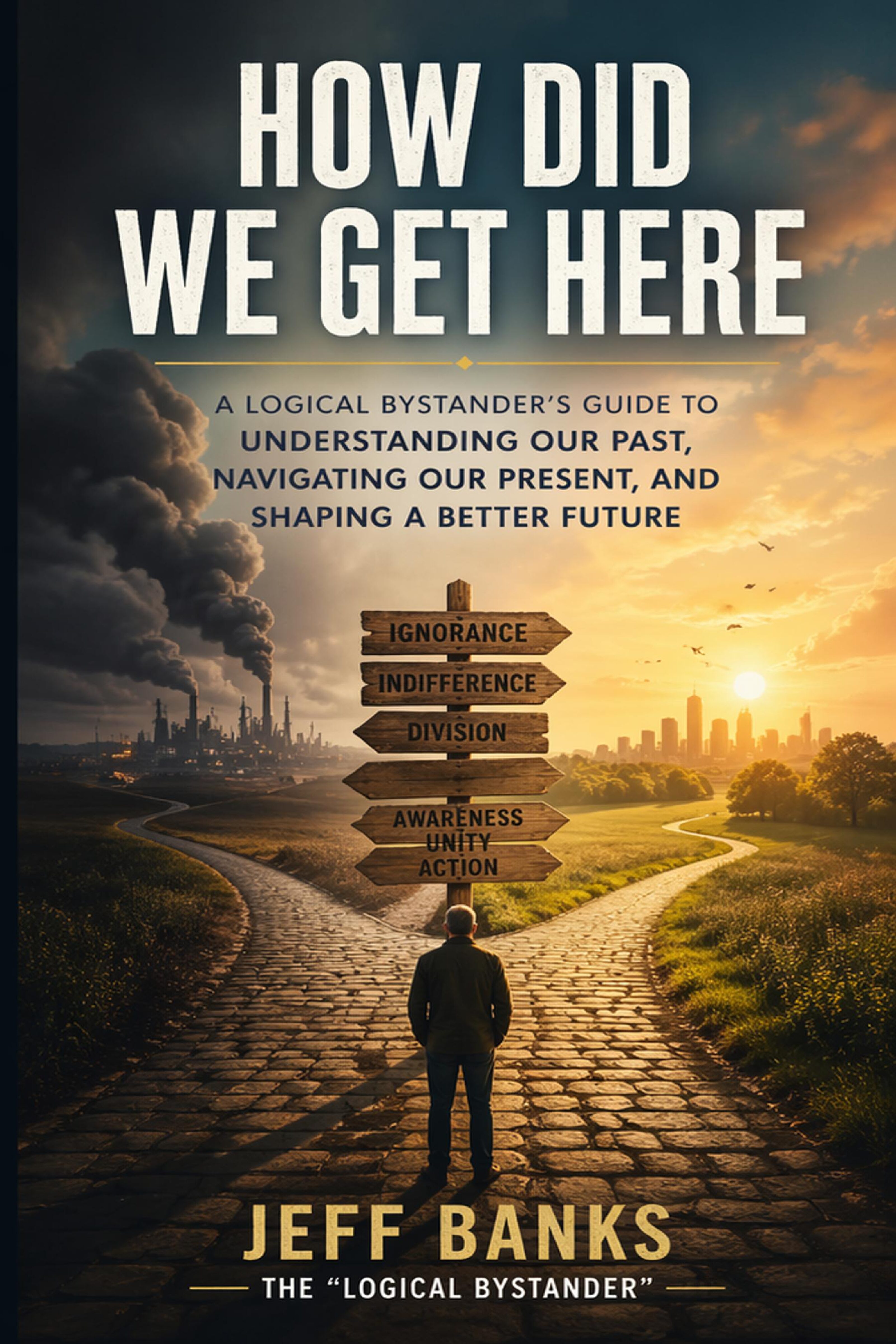
How Did We Get Here Chapter 9 - Consuming the Locusts

How Did We Get Here Chapter 9 - Consuming the Locusts | Travelling Around Australia with Jeff Banks

The assumption that widespread behaviour equates to sound reasoning rarely faces challenge, particularly when it is supported by shared experience and reinforced through conversation. Breaking that pattern does not require a rejection of the environment or a retreat into extremes, but it does require a willingness to introduce a pause where none currently exists.

HOW DID WE GET HERE


Chapter 9 – Consuming Like Locusts


It starts, as these things often do, with a conversation that feels harmless enough, unfolding around a table where the purpose is loosely defined and the tone is comfortably familiar. There is talk of rising costs, of pressure points that seem to be appearing everywhere at once, and of a system that feels increasingly difficult to navigate. Fuel is too high, groceries are out of control, insurance has crept up again, and wages, somehow, have not followed with the same enthusiasm. Heads nod in agreement, not just at the facts being shared, but at the quiet understanding that sits beneath them, that something is not quite working the way it is supposed to.


The rhythm of the conversation builds in a way that feels almost rehearsed, with each participant adding a layer that reinforces the collective view that things are tight and becoming tighter. There is no need for anyone to argue the point because the conclusion has already been reached before the discussion even began. It is within that shared certainty that the shift occurs, not as a deliberate pivot, but as a natural progression that seems to bypass scrutiny altogether.


What follows is not a contradiction that is announced, but one that emerges quietly through behaviour and justification. The same voices that have outlined the difficulty of managing day-to-day expenses begin to introduce decisions that move in a different direction. A new phone is mentioned, framed as necessary but spoken about with enthusiasm. A holiday appears, not as something carefully planned, but as something that simply felt deserved. Furniture is replaced, subscriptions are added, and each choice is accompanied by a soft qualifier that seems to close the door on any deeper examination.


The language that carries these decisions forward is familiar, almost comforting in its simplicity, and powerful in its ability to remove friction from the conversation. Phrases like “you only live once” or “you have to enjoy it while you can” move easily through the group, not as arguments to be tested, but as truths to be accepted. They provide a form of social permission that allows the tension between financial pressure and discretionary spending to exist without being resolved.


Saving for a rainy day is not dismissed outright, but it is repositioned in a way that makes it easier to ignore, shifting from something that once sat at the centre of financial behaviour to something that now lingers at the edges. It becomes an idea that is acknowledged as sensible, spoken about in general terms, but rarely translated into consistent action. The present, by contrast, becomes immediate and demanding, offering experiences that are tangible and easily justified, particularly when those around the table are making similar choices and reinforcing the same reasoning.


It is here that the mob mentality becomes a bad thing. Something that is not there to save us but to lead us to oblivion. 


Into that space steps the quiet presence of forced saving, most visibly through superannuation, and with it comes a subtle but powerful shift in thinking. Contributions are made without decision, deducted before the money is ever seen, accumulating in the background with a level of detachment that is both reassuring and dangerous. Reassuring, because there is comfort in knowing that something is being set aside. Dangerous, because that very comfort creates the illusion that the job has already been done.


Superannuation becomes, in many minds, the answer to a question that has not been fully asked. It is treated as the modern equivalent of saving for a rainy day, despite being designed for something far more specific and far more distant. The long-term nature of it, the preservation rules, the inability to access it when needed, are all understood at a surface level, yet they are rarely integrated into day-to-day decision making. The existence of that growing balance allows other forms of saving to be deprioritised, as though the presence of one eliminates the need for the other.


There is a quiet assumption embedded in that behaviour, one that rarely faces scrutiny because it feels supported by the structure itself. If money is being set aside automatically, then the future is being taken care of. The complexity of what that future might actually require is simplified into a single mechanism, and the distinction between long-term retirement planning and short-term financial resilience becomes blurred.


There was a time when saving was less about discipline and more about necessity, and that distinction carries weight when viewed against the current environment. Access to credit existed, but it was not as readily available or as seamlessly integrated into everyday transactions as it is now, and the effort required to obtain it created a pause, a moment where decisions had to be considered rather than simply acted upon. That pause shaped behaviour in ways that are easy to overlook in hindsight, because it forced a different kind of thinking, one that did not rely on future structures to absorb present decisions, but instead required those decisions to be anchored in what was already available.


In that same space, the concept of protection sat alongside saving, not as a replacement for it, but as a companion to it, quietly reinforcing the idea that risk could be managed, but not eliminated. Life insurance, income protection, health cover, and a range of other products emerged as buffers against the unknown, each one offering a form of reassurance that if something went wrong, there would be a mechanism in place to soften the impact. They were, in many respects, an acknowledgement that the rainy day would eventually come, even if its timing and nature could not be predicted.


Over time, those mechanisms have evolved, becoming more accessible, more varied, and more deeply embedded in financial decision-making, yet they have also become more complex in how they are perceived. Insurance, in its simplest form, is a transfer of risk, a way of exchanging a known cost in the present for protection against an uncertain cost in the future. The logic remains sound, but the environment in which that logic operates has shifted in ways that make the decision to engage with it less straightforward than it once was.


The cost of maintaining those protections has become another line item in a budget that is already under pressure, and in an environment where wages struggle to keep pace with inflation, each additional expense demands justification. Premiums rise, coverage terms adjust, and the value of the protection begins to be weighed not just against the risk it mitigates, but against the immediate demands on available income. What was once seen as a necessary safeguard can begin to feel like a discretionary expense, particularly when the risk it addresses has not yet materialised.


This creates a tension that is not always resolved in a logical way, because the absence of an event can be mistaken for the absence of a need. Insurance, by its nature, operates in the background, providing no visible return until the moment it is required, and in that invisibility it competes poorly with expenses that deliver immediate and tangible outcomes. The decision to maintain cover becomes an exercise in faith, not in the product itself, but in the likelihood of a future that justifies the ongoing cost.


At the same time, the presence of these protections can subtly alter behaviour, in much the same way that other safety nets do. The knowledge that there is coverage in place can create a sense of security that influences decision-making, sometimes appropriately, sometimes less so. It can reinforce the belief that risk has been adequately addressed, even when that coverage is partial, conditional, or subject to limitations that are not fully understood at the time the policy is taken out.


Layered on top of this is the broader economic environment, where the shrinking sense of abundance begins to shape priorities in ways that are both rational and reactive. When the gap between income and expenditure narrows, choices become more immediate, more focused on what must be addressed now rather than what might occur later. Saving competes with spending, insurance competes with both, and the hierarchy of needs begins to shift in response to the pressure being felt.


In that environment, the combination of forced saving through superannuation, the availability of credit, and the presence of insurance and social support systems creates a complex web of perceived security. Each element plays a role, but none of them operate as a complete solution on their own, and yet the collective presence of them can create the impression that the bases have been covered. The reality is more fragmented, with each piece addressing a different aspect of risk, leaving gaps that are not always visible until they are tested.


The logical bystander observing this does not dismiss the value of insurance, nor the necessity of the structures that support it, but recognises that it exists within a broader pattern of behaviour that is increasingly shaped by competing demands. The decision to insure is no longer made in isolation, but as part of a series of trade-offs that reflect the tension between present capacity and future uncertainty.


The question that begins to surface is not whether insurance should exist, but how it fits into a system where every form of protection comes at a cost, and where that cost must be balanced against an environment that feels less forgiving than it once did. When wages lag behind inflation and the sense of financial progress becomes harder to sustain, the willingness to allocate resources toward unseen risks diminishes, even as those risks remain unchanged. What begins to creep into that space, almost without invitation, is a broader question about the role of government and whether it should step further into that gap as a provider of safety rather than merely a provider of structure.


That question is rarely asked directly in everyday conversation, but it sits just beneath the surface of many of the frustrations being expressed. There is an expectation, sometimes unspoken, that if the individual cannot reasonably carry the full burden of risk, then something larger must absorb part of it. The logic feels intuitive at first glance. If the environment has become more complex, more volatile, and less forgiving, then surely the systems designed to support it should evolve in response.


What becomes less clear is where that responsibility begins and where it should reasonably end.


Government already occupies a significant position in the landscape of safety nets, through healthcare systems, welfare support, age pensions, and various forms of assistance that are designed to prevent hardship from becoming unmanageable. These structures are not incidental; they are foundational to how modern economies function, providing a level of stability that allows individuals to participate without the constant fear of catastrophic failure. The presence of those systems has, in many ways, reshaped expectations, creating a baseline from which people operate rather than a last resort that is reluctantly approached.


The tension arises when that baseline begins to shift from support to substitution.


If insurance feels expensive, if saving feels difficult, and if credit feels like the only accessible option, then the natural question becomes whether the government should do more to bridge the gap. Should it subsidise insurance more heavily, expand social security, increase pension entitlements, or provide broader forms of income protection that reduce the reliance on private systems? Each of these options carries its own logic, and each appears to offer a way to relieve the pressure that is building at the individual level.


Yet each also carries a consequence that is less immediately visible.


The expansion of government support requires funding, and that funding is drawn from the same economy that is already under strain. Increased support in one area often necessitates increased taxation or reallocation in another, creating a cycle where the attempt to solve one pressure point introduces another. The question then becomes whether the system is being asked to solve a problem that is, at least in part, behavioural rather than purely structural.


There is also the matter of expectation, which has a way of adjusting itself over time.


What begins as support can become assumed, and what is assumed can become insufficient, not because it has changed, but because the environment around it has shifted. The safety net, once appreciated, becomes part of the baseline, and any shortfall is felt more acutely as a result. This is not a failure of the system so much as a reflection of how quickly expectations adapt to what is available.


At the same time, it would be overly simplistic to suggest that the responsibility should sit entirely with the individual.


The environment has changed in ways that are not easily controlled at a personal level. Global economic pressures, policy decisions, market dynamics, and structural inequalities all play a role in shaping the conditions in which people operate. To ignore that reality is to reduce a complex system to a simple narrative that does not hold up under scrutiny. There is a role for government in providing stability, in smoothing out extremes, and in ensuring that participation in the economy does not come with disproportionate risk.


The difficulty lies in defining that role with clarity.


Should government act as a backstop for those who cannot prepare, or as a broader insurer of last resort for a population that finds preparation increasingly difficult? Should it incentivise personal responsibility through structures that encourage saving and protection, or should it intervene more directly to provide those protections itself? These are not abstract questions; they sit at the centre of how societies choose to balance individual agency with collective responsibility.


From the perspective of the logical bystander, the answer is unlikely to sit at either extreme.


A system that relies entirely on individual preparation risks leaving too many exposed, particularly in an environment that does not offer equal opportunity to all participants. A system that assumes responsibility for all outcomes risks diminishing the incentive for personal preparation, creating a different kind of imbalance that may not be sustainable over time. The challenge is to find a point of equilibrium where support exists without replacing responsibility, and where responsibility is encouraged without becoming unrealistic.


What remains consistent, regardless of where that balance is struck, is the need for awareness at the point of decision-making.


The presence of government support does not eliminate risk; it redistributes it. The availability of assistance does not remove the value of preparation; it changes the context in which that preparation occurs. Understanding that distinction becomes critical, particularly in an environment where assumptions about support can quietly shape behaviour in ways that are not always aligned with reality.


Which brings the question back, not as a critique of government or of individuals, but as an examination of how the two interact within a system that is evolving faster than the habits that underpin it.


How much of the safety net should be expected to come from outside, how much should be built from within, and what happens when both are assumed to be stronger than they actually are when the rain finally arrives?


The question of where the safety net should sit does not unfold in a vacuum, and it rarely takes long before another layer enters the conversation, one that carries a different kind of weight. It appears in the tone rather than the words at first, in the slight tightening of expression when the subject of support becomes more specific, and in the quiet acknowledgement that not everyone engages with these systems in the way they were intended.


There are stories, some verified, some repeated often enough to feel real, of individuals who have learned how to navigate the system in ways that maximise benefit while minimising contribution. Claims that stretch credibility, circumstances that are presented in a particular light, arrangements that appear to exist just inside the boundaries of compliance. The details vary, but the underlying theme remains consistent, that the system can be worked, and that some have become adept at doing exactly that.


It does not need to be widespread to have an impact.


The perception alone is enough to shape behaviour and influence opinion, because it introduces a question of fairness that is difficult to ignore. For those who are making genuine efforts to save, to insure, to contribute, the idea that others may be extracting from the same system without a corresponding effort creates a tension that sits beneath the surface of broader discussions about support. It becomes less about whether assistance should exist, and more about whether it is being applied as intended.


That tension rarely resolves itself neatly, because the line between need and misuse is not always as clear as it appears from a distance.


Life does not present itself in clean categories, and circumstances can shift in ways that are difficult to assess from the outside. What looks like avoidance may in some cases be a response to genuine limitation, just as what appears to be hardship may occasionally be framed in a way that benefits the individual. Systems designed to provide support must operate across that spectrum, and in doing so they inevitably create opportunities for both legitimate assistance and unintended exploitation.


The challenge is that the presence of one begins to influence the perception of the other.


When examples of misuse circulate, they have a way of overshadowing the quieter, less visible cases where support is genuinely needed and appropriately applied. The narrative shifts, not always consciously, toward a more sceptical view, where assistance is seen less as a necessary component of a functioning society and more as a potential avenue for avoidance. That shift carries consequences, not only in how systems are designed, but in how they are received by those who rely on them.


From a structural perspective, the response is often to tighten controls, to introduce additional layers of verification, to reduce the scope for manipulation. These measures are logical, and in many cases necessary, but they also introduce complexity that affects everyone within the system, not just those who would seek to exploit it. The process of accessing support becomes more demanding, more time-consuming, and in some cases more intimidating, particularly for those who are already navigating difficult circumstances.


There is a cost to that complexity, and it is not always measured in financial terms.


It appears in the form of friction, in delays, in the quiet discouragement of those who might otherwise seek assistance but choose not to engage with a system that feels too burdensome. The attempt to prevent misuse can, in some cases, make legitimate use more difficult, and in that trade-off the system begins to shift again, balancing not just fairness and support, but accessibility and control.


At the same time, the existence of those who actively seek to avoid contribution while benefiting from support raises a more uncomfortable question about behaviour and expectation.


If the system is perceived as something that can be navigated rather than something that exists to provide assistance in times of need, then the relationship between the individual and the structure begins to change. It becomes less about participation and more about optimisation, where the goal is not to contribute and receive in balance, but to extract as much as possible within the rules, or just beyond them.


That mindset does not develop in isolation, and it is rarely the result of a single decision.


It is shaped by observation, by stories shared, by examples seen or believed, and by the gradual normalisation of behaviour that once might have been questioned. When the idea takes hold that others are doing the same, that the system allows for it, and that the consequences are limited, the barrier to entry lowers, not dramatically, but incrementally.


The logical bystander does not need to make broad accusations to recognise the pattern.


The presence of misuse, whether isolated or more widespread, introduces a level of uncertainty into the system that affects how it is perceived and how it is used. It raises questions about sustainability, about fairness, and about the balance between support and responsibility. It also complicates the broader discussion about what role government should play, because any expansion of support must also account for the potential for it to be used in ways that were not intended.


The response cannot simply be to withdraw support, just as it cannot be to ignore the possibility of misuse.


What it requires is a level of clarity in both design and expectation, where the purpose of the system is understood, and the boundaries within which it operates are respected. It also requires a willingness to engage with the more nuanced reality that not all cases are easily categorised, and that the presence of some misuse does not invalidate the need for support as a whole.


The difficulty lies in maintaining that balance in a way that does not drift too far in either direction.


Too much emphasis on misuse risks eroding the very support structures that provide stability, while too little attention to it risks undermining confidence in the system and encouraging behaviour that may not align with its intent. The space between those positions is where the conversation needs to sit, not as a resolution, but as an ongoing examination of how systems are used and how they evolve.


Which brings the discussion back to the underlying question, now carrying an additional layer that cannot be ignored.


How did a system designed to provide a safety net become one that must also defend itself against those who would use it differently, and what would it take to ensure that it continues to serve its purpose without being stretched beyond what it was ever designed to hold?


What remains, sitting beneath the decisions about saving, spending, and insuring, is the same underlying uncertainty that has always been present, now filtered through a lens that makes it more difficult to prioritise. The tools to manage risk have expanded, but so too have the pressures that influence how those tools are used, and in that intersection lies the quiet complexity of the choices being made.


Which brings the question back into focus, not as a criticism, but as an observation that seeks to understand rather than judge, because the behaviour being examined is not confined to those who receive support, but extends equally to those who design and deliver it. There is a parallel conversation that unfolds in boardrooms, in parliamentary chambers, and in policy briefings, where the intent to act is rarely in question, yet the nature of that action often reveals a different kind of tension.


The pressure to be seen to respond can become as influential as the need to respond effectively, and in that space the distinction between appearance and outcome begins to blur. Measures are introduced, announcements are made, and assistance is rolled out in forms that are immediate and visible, providing relief that can be pointed to, measured, and communicated. The cycle becomes familiar, particularly in times of economic strain, where each new pressure point is met with a corresponding intervention designed to ease it.


What emerges from that pattern is a series of stopgap measures that address symptoms rather than causes, offering a form of “help out” that stabilises the moment without necessarily strengthening the future.


Cash injections, subsidies, rebates, and temporary relief programs provide breathing space, and for those under pressure that space is both real and necessary. The difficulty lies in how those measures interact with the broader system, particularly in an environment where inflation is already exerting upward pressure on costs. The introduction of additional money into the economy, even with the intention of support, does not operate in isolation. It enters a system that responds to increased demand in ways that are predictable, even if they are not always acknowledged in the moment.


Prices adjust, sometimes subtly, sometimes more overtly, and the relief that was intended to ease pressure can, over time, contribute to its persistence. At its simplest, this still sits within the mechanics of supply and demand, but not always in the neat, textbook sense of goods being scarce or abundant. There is another layer that begins to emerge, particularly when larger players dominate a market, where the adjustment is less about the physical availability of a product and more about the perceived capacity of the consumer to pay.


When additional money enters the economy through subsidies, rebates, or support measures, it does more than increase demand in a traditional sense. It sends a signal, sometimes faint, sometimes quite clear, that there is more cash circulating, more ability to absorb price increases without immediate resistance. Large businesses, operating with scale, data, and a far broader view of market behaviour, do not need a shortage of product to adjust pricing. They need only the confidence that the market will tolerate it.


In that environment, the concept of supply and demand shifts from being about units of product to being about units of willingness. The question is no longer just how much of something exists, but how much the consumer base can be stretched before behaviour changes. Pricing becomes less reactive to cost and more responsive to capacity, particularly where competition is limited or where differentiation between providers is minimal. The adjustment does not need to be dramatic. It can be incremental, layered, almost invisible in isolation, yet significant in aggregate.


This is where the presence of additional money in the system takes on a different role. It becomes less about enabling transactions that would not otherwise occur and more about redefining what is considered an acceptable price. Businesses observe patterns, test boundaries, and refine their approach based on response. If volumes hold, prices hold. If resistance is muted, adjustments continue. The process is not personal, nor is it necessarily malicious. It is commercial, driven by an understanding that pricing is as much about perception as it is about cost.


The difficulty is that this form of adjustment is less visible than a straightforward supply constraint, and therefore less likely to be challenged in real time. There is no empty shelf to point to, no obvious shortage to explain the increase. Instead, there is a gradual shift that feels disconnected from any single cause, making it harder to identify and easier to accept. The relief that was introduced into the system becomes part of that acceptance, cushioning the immediate impact and reducing the incentive to push back.


Over time, the effect compounds. The additional money supports spending, the spending supports higher pricing, and the higher pricing resets expectations. What was once considered expensive becomes normal, not because the underlying cost structure has fundamentally changed, but because the market has demonstrated a capacity to carry it. The pressure that prompted the initial support begins to reappear, not as a direct consequence of scarcity, but as a byproduct of how pricing behaviour adapts to the presence of that support.


From the perspective of the logical bystander, the distinction matters, because it shifts the focus from what is being supplied to how behaviour is being interpreted. The question is no longer just about whether there is enough product, but about how the signals being sent through the system are being received and acted upon by those with the ability to influence pricing at scale.


Which leads back to the same underlying consideration, now viewed through a slightly different lens.


If increasing the amount of money in the system changes not just demand but expectations, and if those expectations become embedded in pricing decisions, then the cycle becomes more complex than a simple imbalance of supply and demand. It becomes a reflection of how markets respond to perceived capacity, and how quickly that perception can be translated into outcomes that feel, to those on the receiving end, as though the pressure never truly eased at all.


This is not an immediate effect, nor is it always directly attributable to a single decision, which makes it easier to overlook. The connection between short-term assistance and longer-term inflationary pressure is diffuse, spread across multiple transactions and behaviours, yet it remains present. The very act of providing support, when repeated and expanded, can begin to reinforce the conditions that made that support necessary in the first place.


The intention behind these measures is rarely flawed, and in many cases it is driven by a genuine desire to assist those who are struggling. The challenge lies in the framework within which those decisions are made, where the urgency of the present often outweighs the complexity of the future. Immediate relief is tangible and visible, while structural reform is slower, less certain, and more difficult to communicate in a way that resonates with those seeking immediate answers.


There is also the reality of political and institutional cycles, where the need to demonstrate action aligns more closely with short-term interventions than with long-term change.


Policies that take time to deliver results often extend beyond the horizon of those implementing them, while measures that provide immediate relief can be seen and felt within a much shorter timeframe. The incentive, whether acknowledged or not, leans toward actions that can be demonstrated rather than those that must be explained, and in that environment the focus shifts from building resilience to managing perception.


This is where the concept of “help out” versus “help up” becomes more than just a distinction in language.


Helping out provides immediate assistance, addressing the pressure that exists in the moment and offering a degree of relief that is both necessary and appreciated. Helping up, by contrast, requires a different approach, one that focuses on capability, structure, and the conditions that allow individuals to move beyond the need for ongoing support. It is less visible in the short term, more complex to implement, and often more difficult to measure in a way that satisfies the demand for immediate results.


The difficulty is that helping up does not always align neatly with the urgency of the moment, particularly when that moment is defined by rising costs and shrinking capacity.


For a society grappling with inflation, where the gap between income and expenditure feels increasingly difficult to bridge, the demand for immediate relief is both understandable and justified. The question is whether that relief, when delivered repeatedly and without corresponding structural change, begins to act as a form of maintenance rather than a pathway forward. It keeps the system functioning, but does not necessarily improve its underlying condition.


From the perspective of the logical bystander, the pattern is not one of failure in intent, but of limitation in approach, because the response to pressure continues to circle around relief rather than capability. The system intervenes when strain becomes visible, applying measures that ease the immediate burden, yet those measures rarely alter the underlying behaviours or equip individuals to navigate the same pressures differently the next time they arise. The result is a cycle that feels active, even responsive, but ultimately returns to the same point, waiting for the next injection of support to carry it forward.


It is within that limitation that a different path begins to present itself, one that does not rely on increasing the flow of money, but instead focuses on increasing the capacity to manage it. Education, not in the traditional academic sense, but in the practical, lived sense of how life actually unfolds, begins to take on a role that sits quietly outside the usual policy response. The kind of education that addresses decision-making, risk, delayed gratification, and the mechanics of money itself, not as abstract concepts, but as tools that can be applied in real time, becomes a form of “help up” that operates beneath the surface of economic intervention.


Projects such as EmpowerU provide a glimpse of what that might look like when it is allowed to develop outside the confines of traditional systems. The focus is not on theory for its own sake, but on equipping young people with an understanding of how the world they are entering actually works. It introduces concepts that are often learned the hard way, if they are learned at all, and places them in a context where they can be understood before they become consequences.


The significance of that approach is not immediate, and that is precisely why it sits so uncomfortably alongside the urgency that defines most economic responses. Education does not provide instant relief, it does not reduce this month’s expenses or offset next quarter’s increases, and it cannot be rolled out in a way that delivers visible results within a political cycle. What it does instead is alter the starting point, shifting the baseline from which decisions are made so that the patterns being observed today are less likely to repeat themselves tomorrow.


There is a quiet contrast here that becomes more apparent the longer it is considered. Flooding money into an economy provides immediate capacity, but it does not necessarily change how that capacity is used. Education, by contrast, may not increase capacity in the short term, but it has the potential to change behaviour in a way that compounds over time. One addresses the symptom, the other the structure, and the difference between the two is often only visible when viewed across a longer horizon.


The challenge, of course, lies in the patience required to allow that horizon to exist.


In a system that is conditioned to respond quickly and visibly, the idea of investing in something that may take years to demonstrate its value sits uneasily. It requires a level of trust that the outcome, though delayed, will be more sustainable than the immediate relief that can be provided through direct intervention. It also requires an acknowledgement that the problem is not solely economic, but behavioural, shaped by decisions that are made long before the consequences appear.


From the perspective of the logical bystander, this does not suggest that immediate support should be withdrawn or that those in need should be left to navigate the system unaided. It suggests that alongside that support, there must be a parallel effort to build capability, to provide the tools and understanding that reduce reliance on that support over time. It is not a replacement, but a complement, one that shifts the balance gradually from dependency toward autonomy.


Which brings the question back into focus, not as a rejection of what currently exists, but as an expansion of what might be possible.


If the goal is not simply to help people through the moment, but to reduce the number of moments that require that help, then what would it take to prioritise the kind of education that equips individuals to navigate complexity before it becomes crisis, and how might that change the way the system responds when the pressure inevitably returns?


The reliance on stopgap measures reflects a system that is responding within its constraints, balancing competing pressures and attempting to manage outcomes that are influenced by factors both within and beyond its control. The issue is not that assistance is provided, but that it is often provided in a way that addresses the immediate need without altering the conditions that give rise to it.


The introduction of more money into an environment already experiencing inflationary pressure becomes part of that pattern, not as a deliberate attempt to exacerbate the problem, but as a response that prioritises relief over recalibration.


The longer that pattern continues, the more it begins to shape expectations on both sides of the equation. Those receiving support come to rely on its availability, while those providing it become conditioned to respond in similar ways when new pressures emerge. The cycle reinforces itself, not through deliberate design, but through repeated behaviour that feels effective in the short term.


Which brings the question back, now carrying an added layer of complexity that cannot be ignored.


How did a system designed to provide support and stability become one that risks sustaining the very pressures it seeks to relieve, and what would it take to shift from a model of continual assistance toward one that creates the conditions for fewer people to need it in the first place?


How did a system designed to provide layers of protection become one where each layer competes for attention, and what would it take to bring clarity back into the decisions that sit between what is needed now and what may be needed later?


Superannuation, by contrast, removes the need for that kind of thinking in one very specific area, and in doing so it introduces a broader behavioural consequence. The act of saving becomes externalised, something that happens to a person rather than something that is actively done by them. It sits outside the everyday flow of decision making, disconnected from the small choices that accumulate over time to create either resilience or fragility.


The question that begins to emerge is whether that form of forced saving is perceived as enough, and more importantly, whether it actually is enough when viewed in the context of how life tends to unfold.


Superannuation is designed for the long term, for a point in life that sits decades away for many, and while it plays a critical role in providing for that stage, it does little to address the periods in between. It does not step in when income is interrupted, when unexpected expenses arise, or when the ordinary pressures of life compound into something more difficult to manage. Those moments require a different kind of preparation, one that cannot be accessed through a system designed to be locked away.


And yet, the existence of superannuation often creates the perception that preparation has already occurred, reducing the urgency to build anything alongside it.


This is where the reliance begins to extend beyond the individual and into the broader system. If superannuation is not accessible when needed, then the expectation quietly shifts to what sits outside it. The pension system, social security, and various forms of government support begin to take on a role that was not necessarily intended to replace personal preparation, but increasingly becomes viewed as a fallback position.


There is a belief, sometimes stated, often implied, that if things become difficult enough, something will be there to provide support. That belief is not entirely unfounded, as systems do exist to assist, but it carries with it an assumption about capacity and sustainability that is rarely examined in detail. The safety net is treated as a certainty rather than a contingency, and in that subtle shift it begins to influence behaviour in the present.


The question then becomes whether that safety net can, or should, carry that weight.


As populations age and the demands on these systems increase, the pressure on them grows, and the idea that they can provide a universal solution begins to look less certain. The balance between those contributing and those drawing from the system shifts, and with it the capacity to maintain the same level of support without adjustment. These are not immediate concerns for many, which is precisely why they are so easy to ignore, but they sit there nonetheless, shaping the environment in ways that will eventually become more visible.


There will be days, not just in retirement but long before it, where the gap between what is needed and what is available becomes apparent. Days where superannuation cannot be touched, where credit has reached its limit, and where the expectation of external support meets the reality of its constraints. Those days do not arrive with warning, and they do not align themselves neatly with the structures that have been put in place.


The logical bystander, observing this pattern, does not question the value of superannuation or the importance of social support systems, because both serve essential roles within a functioning society. The concern lies in how those systems are perceived and how that perception shapes behaviour. When forced saving is treated as a complete solution rather than a component, and when safety nets are assumed to be sufficient rather than supplementary, the space for personal preparation begins to shrink.


The challenge is not to dismantle these systems, but to understand their limits and to recognise what sits outside them. Superannuation addresses a specific future, and it does so effectively when allowed to operate as intended. What it does not do is remove the need for resilience in the present, nor does it eliminate the uncertainty that exists between now and that distant point in time.


The question that sits beneath it all remains unchanged, even as the structures around it evolve.


How did we come to treat preparation as something that can be outsourced entirely, and what would it take to bring it back into the decisions that are made every day, before the rainy day arrives and asks a question that cannot be answered by long-term promises alone?


That pause has largely disappeared, replaced by systems that are designed to remove friction and accelerate decision-making. The ability to buy now and pay later is presented as a convenience, wrapped in language that emphasises flexibility and control, and structured in a way that reduces the immediate impact of spending. The decision becomes easier because the consequence is deferred, spread across time in a manner that makes it feel less significant in the moment it is made.


The underlying obligation does not disappear, but it becomes less visible, and in that reduced visibility lies the shift in behaviour. Spending is no longer anchored solely to what is available, but to what can be arranged, and that arrangement is often based on an assumption about the future that feels reasonable at the time. The boundary between capacity and desire becomes less defined, and decisions begin to operate within that blurred space.


This shift does not occur in isolation, and it is supported by a broader environment that changes the way risk is perceived. There are systems in place that provide assistance when things go wrong, whether through government support, charitable intervention, or other forms of structured help. These systems serve an important role, particularly for those who genuinely need them, but their presence influences behaviour in ways that are not always acknowledged.


When the consequences of decisions are softened, the urgency to avoid those consequences diminishes, and the need to prepare for uncertainty becomes less immediate. Saving for a rainy day begins to feel like something that can be addressed later, particularly when the expectation exists that support will be available if needed. The rainy day itself is reframed from something that must be prepared for in advance to something that can be managed when it arrives.


At the same time, there is a reality that complicates the picture and cannot be ignored. For many, the capacity to save is constrained by factors that sit well beyond individual control. Wages have not kept pace with costs, housing has moved further out of reach, and the gap between those who have and those who do not has widened in ways that are both visible and persistent. In that environment, the concept of saving can feel less like a practical strategy and more like an abstract ideal.


The question shifts from whether saving is important to whether it is even achievable, and that shift alters behaviour in ways that feel rational within the context of the environment. If progress appears limited despite effort, the incentive to prioritise the future diminishes, and the present becomes the focus, not out of recklessness, but out of a sense that the alternative may not deliver a different outcome.


The behaviour that follows does not resolve the tension between these competing forces, and in many cases it amplifies it. Reliance on credit and future capacity allows life to continue in a way that feels manageable in the short term, but it does so by shifting pressure forward. Each decision adds to a structure that must eventually be supported, and when that support is tested, the absence of a buffer becomes evident.


The rainy day does not announce itself in advance, and it rarely arrives at a convenient time. It appears without warning, and in that moment the assumptions that supported earlier decisions are replaced by a more immediate reality. The question becomes practical rather than theoretical, focusing not on what might be arranged, but on what is available.


From the perspective of the logical bystander, the pattern is both understandable and concerning. The pressures are real, and the responses to those pressures are not without reason, but the cumulative effect of those responses creates a level of fragility that is not always visible until it is tested. The influence of the group plays a significant role in reinforcing behaviour, with each decision validated by the observation that others are making similar choices.


The assumption that widespread behaviour equates to sound reasoning rarely faces challenge, particularly when it is supported by shared experience and reinforced through conversation. Breaking that pattern does not require a rejection of the environment or a retreat into extremes, but it does require a willingness to introduce a pause where none currently exists.


That pause creates space for better questions, not as a means of preventing action, but as a way of understanding it more clearly. What happens if the assumptions about the future prove incorrect, and what if the support systems that are expected to provide assistance are not as accessible as believed? These questions are not designed to induce fear, but to restore a sense of balance that has been eroded by convenience and consensus.


The answer is unlikely to be found in a single approach, and it does not require a return to rigid austerity or the abandonment of enjoyment. It sits somewhere in the middle, in a space where the present can be lived without entirely disconnecting from the future, and where preparation is viewed not as pessimism, but as a practical response to uncertainty.


Beneath the conversation, beneath the justifications, and beneath the quiet reinforcement of shared behaviour, the question remains, waiting to be asked with genuine intent rather than rhetorical curiosity.


How did we get here, and what would it take to ensure that the next time the rain arrives, the answer is not left to chance?

Author

Menu