

It wasn’t a faceless body. It wasn’t an outcome. It wasn’t a necessary loss absorbed into a tally. It was sudden, silent, and unfair.

Diary of a Child Sniper – Chapter 12 – Where Has the Sniper Gone
- Diary of a Child Sniper
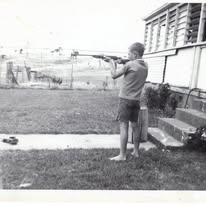
It wasn’t a faceless body. It wasn’t an outcome. It wasn’t a necessary loss absorbed into a tally. It was sudden, silent, and unfair.
Diary of a Child Sniper
Chapter 8 – Kiacatoo Year 2
A year later we were back at Kiacatoo, and I was in my final year of school, carrying none of the knowledge that would soon rearrange my life. The place itself had changed more than I had. That bushland we had walked the year before—measuring distance by feel, tracing invisible circles back to the ute—was gone. In its place sat a wheat crop, newly planted, impossibly green, stretching out in a soft, disciplined order that the bush never bothered with. It made the country easier to cross, deceptively so. No scrub to push through, no timber to read. Just open ground, sheep dotted through it, and the vermin that followed them like shadows.
This trip felt different before anything had happened. Dad brought the truck this time, not just the ute, and with it two staghounds bred on our farm. Big, rangy animals, built for speed and endurance rather than affection. They had been bred to hunt—rabbits, foxes, kangaroos—and they carried that purpose in the way they moved, even when lying still. Here, the idea was to use them as retrievers. A fox would be dropped in the beam, and the dogs would track along the line of light, find it, and bring it back. Or at least that was the theory. On paper it sounded neat, efficient, almost elegant. In practice, it was another layer of variables in a world that already demanded attention.
Uncle Peter wasn’t there.
He had become persona non grata for reasons I didn’t understand at the time, and no one explained it to me. They rarely did. Absence was just something you noticed and then adjusted around. But his absence mattered, because it shifted something onto me without ceremony. The responsibility to provide—to deliver results—landed squarely on my shoulders. And the uncomfortable truth is that I relished it. I liked being the one counted on. I liked the quiet elevation that came from being necessary. It felt like recognition without praise, and at that age, that was enough.
There was a new threat on the place too. Feral goats had started to push into the area. They weren’t as attractive to foxes as pig meat, but they were still useful as bait, still part of the broader equation of control. The dogs, however, had never seen goats. And there was no intention of setting them on them. A goat mistaken for a sheep was a mistake you couldn’t undo, and that line was not to be crossed. Even so, the dogs came with me during the day on my lone expeditions, padding along at a distance, alert but obedient. It was the first time I truly felt accompanied rather than supervised.
That mattered more than I realised.
There is something intoxicating about moving through country with animals that trust your direction. Not affection—trust. They didn’t look to me for reassurance, only for intent. Where I went, they went. Where I stopped, they stopped. It felt like an extension of the rifle itself: another instrument responding to clarity of purpose.
Until the night we lost one. The dog was simply lost one night.
There was no drama in it. No sudden chaos. The two of them were moving exactly as they had been trained to move, working down the light beam, bodies slipping easily over fallen timber, confidence born of repetition. I remember watching them vault a log, fluid and unthinking, and then noticing that only one landed on the far side.
At first, it didn’t register as anything more than timing. Dogs don’t always move in sync. One lags, one loops, one doubles back. We kept going for a few seconds before the absence announced itself properly. One shape where there should have been two.
We stopped. Called. Whistled. Nothing.
There was no panic in those first moments, only procedure. Names spoken at a normal volume. Then louder. The whistle that usually cut through everything. The beam swept wider arcs, searching the shadows for movement, for reflection, for anything that would resolve the uncertainty. It was easy to tell ourselves a story: he’d seen something flicker in the dark, taken off after it, followed instinct just a little too far. Dogs do that. They always have.
But the bush stayed quiet.
We waited. We walked back over ground we’d already covered. The beam traced the same paths again and again, as if repetition might conjure a different outcome. Eventually, without saying it aloud, we accepted what the night was telling us, that whatever had happened wouldn’t be solved in darkness. That daylight might offer answers the beam could not.
Morning didn’t soften the task. It sharpened it.
The search the next day wasn’t hopeful. It was deliberate. A journey aimed at answers rather than rescue. We followed the line they had taken, slower now, eyes lowered, reading the ground the way you do when you’re no longer expecting movement. And then we found him.
The dog had jumped a log and been impaled on a twig in the dark. A simple thing. A fraction of an angle. Bad luck measured in inches. Death had been quick and clean. No yelping. No flailing. No drawn-out suffering. Just a sudden stop.
That detail mattered to everyone. Especially to me.
Up until that point, death in the bush had been abstracted by process. Animals were outcomes. Tallies. Rows of bodies stretched out on boards, later converted into cash, into justification, into proof of usefulness. Even when I was the instrument, even when my hands were responsible, there was distance. The fox was a problem solved. The rabbit was practice. The numbers were neat, comprehensible, almost comforting in their order.
This wasn’t that.
Standing there, looking at him, I felt something I hadn’t felt before in the bush, not grief exactly, but a kind of recalibration. A shifting of internal weights. Loss, until then, had always been noisy. A missed shot cracked the silence and demanded adjustment. A wounded animal ran, leaving behind urgency, pursuit, resolution. Noise implied agency. Noise implied error. Noise implied that if you were good enough, careful enough, you could avoid the cost.
This was different. This was silent. Final. It hadn’t asked anything of us. It hadn’t presented a moment to intervene, no second chance, no correction to be made. It had simply happened. One second there, the next not. No warning, no drama, no theatre. Just absence.
What unsettled me wasn’t the accident itself. Accidents were already familiar territory. What unsettled me was the fairness of it, or rather, the lack of it. The dog hadn’t been careless. He hadn’t disobeyed. He hadn’t broken training or instinct. He had done exactly what he was bred, trained, and expected to do. And that had been enough to kill him.
For the first time, a casualty had a face. Not a pelt. Not a carcass. Not a weight estimate or a price per skin. A body I recognised. An animal that had moved with me, trusted my direction, followed my intent without question. This wasn’t a number reduced to currency. This was a loss that couldn’t be justified by utility or outcome.
In that moment, hunting stopped being clean in my mind.
Not wrong. Not immoral. But no longer abstract. The faceless victims of nights past, stacked, counted, rationalised, shifted slightly toward reality. Toward consequence. Toward the understanding that every system, no matter how disciplined, produces casualties. And sometimes those casualties are not the enemy. Sometimes they are simply part of the machinery that makes the mission possible.
It was, in the sternest sense, a casualty of war. And like most real casualties, it didn’t arrive with heroics or meaning attached. There was no lesson offered upfront. No redemption arc. Just the quiet, brutal truth that participation carries risk, and leadership, however small, creates exposure for others as well as yourself.
I didn’t stop hunting after that. I didn’t lose my nerve or my skill. But I lost something else that day: the luxury of pretending that outcomes were always deserved, or that discipline alone could insulate you from cost.
From that point on, the numbers never quite stayed faceless. And I think that was the beginning of something else entirely, not guilt, but awareness. The understanding that responsibility isn’t proven by success alone, but by how you carry the weight of those who don’t come back.
We recovered him. There was no ceremony. No speeches. Just the quiet efficiency that the bush demands when sentiment doesn’t change outcomes. And yet something shifted in me that day. A subtle understanding that responsibility isn’t just about intent or competence. That leading, even in something as small as guiding a dog down a light beam, carries consequences that don’t always correlate with effort or skill.
The bush hadn’t punished us. It hadn’t warned us either.
It had simply reminded me that control is never absolute, and that sometimes the cost of being relied upon arrives without sound, without spectacle, and without anyone to blame. And I carried that lesson forward, long after Kiacatoo faded into memory, even when I didn’t realise I was doing it.
It didn’t happen with drama. No frantic barking, no obvious moment of error. Just an absence that announced itself slowly, like the realisation that a sound you’ve been hearing has stopped. One dog came back. The other didn’t. At first there was assumption, he’d looped wide, caught a scent, would reappear. Dogs do that. They always have. But as minutes stretched and the beam swept uselessly across the paddock, assumption gave way to something colder.
Search replaced confidence.
What that moment also did, though I couldn’t have articulated it then, was crack open the fiction I’d been absorbing alongside the training.
Comics first. Then movies. The death or glory boys. The ones who charged machine-gun nests without hesitation. The panels filled with bodies tumbling forward, heroic silhouettes frozen mid-stride, faces anonymous, interchangeable. Death stacked like cordwood, meaningful only in aggregate. The individual didn’t matter. The count did. Victory was measured by what lay behind you, not what you left behind.
It wasn’t propaganda in the formal sense. There was no ideology attached. No flag being waved inside my head. That’s the dangerous part. It didn’t need one.
Because the skills I was building in the paddocks, the patience, the stillness, the mechanical separation of intent from outcome, slid perfectly into those narratives. Fox skins on the floor. Bodies in the panels. Numbers replacing names. Outcome replacing process. It all aligned too easily.
At school, many of my friends from farms were doing the same quiet training, whether they named it or not. Rifles. Slug guns. Dogs. Work that required calm, emotional distance, precision. None of us talked about feelings because there was nothing to discuss. You didn’t need hatred to kill vermin. You didn’t need anger. You didn’t even need justification. You needed competence.
That’s what made it clean.
No ideology polluted the vision. No rhetoric perverted the id. There was no “enemy,” only targets. No moral charge, only utility. That absence of narrative felt like safety. Like honesty. We weren’t being whipped into frenzy. We weren’t being taught to despise. We were being taught to execute. And that’s where the comics and films slipped in unnoticed.
They didn’t ask me to feel anything either. They rewarded efficiency. They celebrated resolve stripped of doubt. Bodies piled up not as tragedy, but as confirmation that the system worked. The hero never paused to count the fallen. He advanced. Always forward. Always justified by momentum.
That mirrored the bush more than I was comfortable admitting later. Because in both worlds, the lesson was the same: emotion interferes. Hesitation costs. Distance protects. And if you can keep the work clean, technically, mechanically, procedurally, you don’t have to examine what accumulates behind you.
The night the dog died interrupted that loop.
It wasn’t a faceless body. It wasn’t an outcome. It wasn’t a necessary loss absorbed into a tally. It was sudden, silent, and unfair. And it didn’t fit the framework I’d been unconsciously assembling, where skill equalled safety, and competence equalled control.
For the first time, a casualty refused to stay abstract.
And in doing so, it exposed something unsettling: that the emotionless training of self, while powerful, while effective, while even admirable in its discipline, carries a cost when carried too far. Not because it creates cruelty, but because it creates blindness. A narrowing of vision where outcomes matter more than what is consumed to produce them.
I didn’t reject the skills. I never did. I refined them.
But from that point on, the comics rang slightly hollow. The films felt flatter. Bodies piling up, whether on a page, a screen, or a shearing-shed floor, no longer read as neutral. They carried weight, even when the narrative pretended they didn’t.
And that awareness didn’t make me softer. It made me quieter. More careful about what stories I let justify efficiency. More suspicious of any system, fictional or real, that required casualties to remain nameless in order to function.
That was the real shift. Not a loss of nerve. A loss of innocence about what skill alone can excuse.
Author