

What was lost wasn’t access to tools. It was respect for the people who knew how, and why, to use them.

Diary of a Child Sniper – Chapter 12 – Where Has the Sniper Gone
- Diary of a Child Sniper
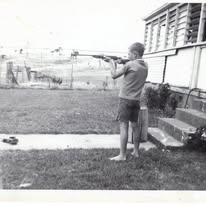
What was lost wasn’t access to tools. It was respect for the people who knew how, and why, to use them.
Diary of a Child Sniper
Chapter 11 – Being Shot At
There are moments in life where everything you believe about order, authority, and restraint is tested not in theory, but in seconds.
I have been shot at a couple of times. Not in war. Not in crime. Not in chaos. But in places where rules existed, or were supposed to. And in both cases, what ended the moment wasn’t escalation, bravado, or panic. It was clarity.
The first time, the shot came from someone who should have known better. An off-duty policeman. Out of uniform. Under the influence. Armed not with responsibility, but entitlement. He believed, wrongly, that I was encroaching on his land. That belief, untethered from fact and amplified by alcohol, became a round fired in my general direction.
What followed was not anger. It was not fear. It was correction.
What struck me most, even at the time, was the absence of emotion, not numbness, not shock, but something closer to a physiological narrowing. A cognitive constriction. The kind of mental state described more often in research papers than in novels.
From my position on the wing of the drive, I could see them clearly. Two figures, not one. The shooter and a companion, standing together with the casual geometry of people who believed themselves unobserved. That mattered. Lone actors behave differently to paired ones. Responsibility diffuses. Confidence inflates. Decision-making becomes performative.
I watched them with intent, not suspicion. Intent is quieter. It gathers data.
Angles. Distance. Posture. The orientation of the firearm relative to my position. The line of fire was not at me so much as around me, a warning shot in intent if not in consequence. But intent is irrelevant once energy is released. Ballistics don’t negotiate. A projectile does not care whether it was meant to intimidate or to kill. It obeys only physics.
At that moment, the mind does not dramatise. It calculates.
There was no spike of fear because fear requires narrative, a future imagined. This was present tense only. Sensory input stripped of story. Wind. Distance. Sound delay. The recognition that the shooter had no comprehension of what weaponry I was carrying, nor of the asymmetry that existed between his assumption of dominance and the reality of it.
That asymmetry was decisive. I did not consider whether to respond, only how. Escalation was a variable to be managed, not an impulse to be indulged. A return shot directed at flesh would have solved nothing and created everything. So the response was engineered, not emotional.
I placed a round into the ground adjacent to his feet, not close by chance, but close by design. Enough kinetic energy transferred into earth to create eruption rather than impact. Dirt and stone lifted violently, unmistakably. A visible demonstration of capability, not threat. The message was delivered by physics, not language.
In that instant, the system reset.
There was no conversation afterwards because none was required. Words are inefficient once understanding is achieved. The human brain is remarkably fast at recalculating odds when presented with incontrovertible evidence. Silence followed, not awkward, not tense, but settled. A problem solved.
What prevented further escalation was not my action alone, but the presence of quieter minds closer to the shooter. People whose authority came not from bravado or entitlement, but from context. Leaders. The landholder. Individuals capable of absorbing volatility and neutralising it before it metastasised.
They took over seamlessly, the way competent systems do. There was no ceremony to it. Just containment.
What was said to him afterward did not need refinement. It was not diplomatic because diplomacy would have implied equality of position. It carried its own corrective force: the next shot, if provoked, would not be demonstrative. It would be self-preservation.
That distinction matters.
Instruction ends where risk becomes intolerable. What occurred that day remained on the instructional side of the line, narrowly, deliberately. It could just as easily have tipped the other way had emotion been allowed to enter the equation.
It didn’t. And that, more than the gunfire itself, is what stayed with me.
The second time was different. More casual. More careless. In some ways, more disturbing.
My brother and his mate fired jokingly in my general direction, convinced I had interrupted their moment, their kill. It was play, in their minds. Noise without thought. Action without consequence.
The response was immediate and decisive. A .222 Tikka raised, steady, pointed. On hundred and fifty yards. No shouting. No theatrics.
The laughter stopped instantly. They understood, not intellectually, but viscerally, the difference between noise and intent. Between a shotgun slung casually over a shoulder and a rifle already aligned with purpose. It wasn’t about threat. It was about reality asserting itself.
In both cases, what mattered was not dominance. It was restraint.
I did not fire at people because that line, once crossed, does not uncross. Power was never the objective. Control was. Precision. Ending a moment before it metastasised into something irreversible. And it is that understanding which makes another contrast impossible to ignore.
Schoolmates would return from weekends of so-called “war games.” Buckshot exchanged for fun. Mock battles that blurred into something else entirely. They would proudly show the metal lodged beneath their skin, arms, backs, souvenirs of recreation.
I never joined them. Never wanted to. Because I already understood something they didn’t: violence treated as sport is not bravery. It is erosion. Of judgement. Of discipline. Of respect for consequence.
Firearms demand a mindset. Strip that away, and what remains is chaos wearing the costume of fun.
For a long time, there was a place for people who understood that distinction. Where skill, restraint, and responsibility coexisted. Where authority was earned through competence, not uniform. Where clarity mattered more than ideology.And then it ended.
Not because the skills disappeared. Not because the discipline failed. But because policy replaced understanding. Because a change in government mistook control for safety and regulation for morality. The purpose, clear, structured, bounded, was dismantled not by misuse, but by distance from reality.
What I still don’t know, and perhaps can’t know, is whether those actions belong to the mythology of boys raised on death or glory stories, or whether they were simply conditioned responses learned long before I had language for them.
The comics came first. The films followed. Pages and screens crowded with men who never hesitated, never flinched, never doubted. Violence resolved cleanly. Consequence arrived neatly framed, if it arrived at all. Bodies fell. Credits rolled. Order was restored by decisive action, and the morality of that decisiveness was never interrogated, only admired.
It would be easy to say that shaped me. But the evidence across these pages suggests something less romantic and far more mundane.
What I learned didn’t come from spectacle. It came from repetition. From routine. From environments where mistakes carried cost, not applause. From adults who did not explain themselves theatrically, but acted consistently. From systems where rules existed not to be enforced loudly, but to be understood quietly.
When something went wrong, no one reached for glory. They reached for containment.
Across the anecdotes, the hunting, the accidents, the near-misses, the silences, a pattern emerges. Not bravado, but calibration. Not heroics, but correction. The response was almost always proportional, measured against outcome rather than ego. The goal was never to win the moment, only to end it without spillover.
That doesn’t fit neatly into the mythology.
The death or glory boy seeks recognition. The actions I describe, seem to avoid it entirely. There are no boasts afterward. No retellings designed to inflate. In fact, the moments recede almost immediately, absorbed back into routine, as though they were administrative rather than exceptional.
That suggests learning rather than fantasy. And yet, I can’t entirely dismiss the influence of stories. They provide archetypes. They normalise decisiveness. They frame restraint as strength rather than weakness, at least in their better moments. Perhaps they supplied the scaffolding onto which lived experience later attached itself. Or perhaps they merely echoed what was already being trained.
What was lost wasn’t access to tools. It was respect for the people who knew how, and why, to use them.
That distinction matters. Because respect implies judgement, trust earned through demonstrated restraint. When that evaporates, the response is not nuance but prohibition. Not evaluation, but blanket removal. The assumption shifts from competence to risk, from capability to liability.
That is the quiet ruin at the heart of it. Not the end of a practice, but the end of trust. And with it, the displacement of a code that had governed behaviour long before legislation attempted to formalise it.
A code that was never written down because it didn’t need to be. It lived in repetition. In expectation. In consequence delivered calmly, not theatrically.
Whether that code was reinforced by stories of heroes or formed in opposition to them remains unresolved. The book does not answer that question because it can’t. It can only present the data points. The patterns. The outcomes.
This is not nostalgia.
It is an accounting.
And like all honest accountings, it leaves some balances deliberately unresolved.
Author