

The first shot didn’t announce a beginning. It confirmed one.

Diary of a Child Sniper – Chapter 12 – Where Has the Sniper Gone
- Diary of a Child Sniper
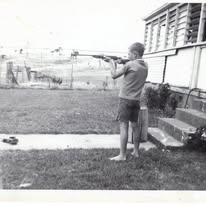
The first shot didn’t announce a beginning. It confirmed one.
Diary of a Child Sniper
Chapter 1 – The Slug Gun at 11
It was the smell that fixed it in me.
Not pine needles or wrapping paper or the sugary dust of Christmas baking, but the sharp, oily tang of metal and grease that didn’t belong to the morning. It cut through the familiar warmth of the house like a wrong note in a hymn. Even before I fully understood what my hands were touching, my senses knew this thing didn’t fit the rules of the day.
I woke early, as eager children do, hands already fishing in the dark for the shapes Santa had left behind. The room was still wrapped in night. My breath fogged faintly. My fingers brushed cardboard, then paper, then something solid. Heavier than it should have been. Longer. Colder.
I remember stopping. Even at eleven, some instincts arrive fully formed.
I peeled the paper back slowly, quietly, as though sound itself might undo what was happening. The shape emerged in pieces: straight lines, hard edges, weight that resisted the casual squeeze of a child’s hand. Wood. Steel. Oil. Not plastic. Not pretend.
A slug gun.
I hadn’t asked for it. I hadn’t hinted. Santa Claus wasn’t meant to think this way. And yet there it was, lying across my thighs as I sat up in bed, the blankets pooled around my waist. It wasn’t wrapped with the careless optimism of a train set. It didn’t announce itself. It didn’t apologise. It waited.
Outside, the farm lay quiet in that particular Christmas way, no engines, no voices, just the wind worrying at corrugated iron and a single crow calling somewhere beyond the sheds. The world felt paused, as if even it understood something had shifted.
I ran my thumb along the stock and felt the grain of the wood. Smooth in places where other hands had already worn it. This wasn’t new. It had a history. And now, inexplicably, it had me.
What I didn’t feel first was excitement. That came later, diluted and complicated. What I felt was weight. Not just in my hands, but somewhere deeper. A gravity that said this object expected something of me.
I knew, without being told, that this wasn’t about play.
Why this gift, on this morning, at this age? That question has followed me far longer than the gun itself ever did.
It vexes me still because there was never an explanation. My father didn’t offer one, and I didn’t ask. Decisions in our house didn’t arrive as conversations. They arrived as facts. Fully formed. You adapted to them. You learned their meaning later, by living inside them.
Eleven is an awkward age. Old enough to be useful. Young enough to still be shaped. On a farm, that matters. Childhood doesn’t end when innocence fades; it ends when competence begins to be expected. A slug gun isn’t a toy, it’s a threshold object. It marks a crossing, from observer to participant.
But why Christmas?
That’s the part that still feels loaded. Christmas is meant to soften things, to wrap intent in ritual and goodwill. If the gun had been handed to me on an ordinary day, after school, after chores, it would have felt instructional. Practical. Almost bureaucratic.
Christmas made it symbolic.
Which raises the uncomfortable possibility that my father wasn’t just equipping me.
He was marking me. To understand that, I have to walk backward into a childhood that bore little resemblance to mine, not softer, not gentler, not safer. A childhood shaped by absence as much as presence. By necessity rather than nurture.
My father left school at Grade 6.
Not because he lacked intelligence. Not because education was unvalued in some abstract sense. But because life intervened early and without negotiation. There was work to be done. Land to be broken. Animals to be tended. Younger mouths to be fed. In his world, childhood wasn’t a protected phase, it was a brief apprenticeship.
Nature was not something to be admired. It was something to be endured, resisted, bent into usefulness. Drought didn’t care about your age. Cold didn’t soften for sentiment. Hunger didn’t wait until you were ready.
And the family unit itself was no refuge, especially with the death at such a young age of a younger brother, succumbing to the elements
It was functional. Hierarchical. Demanding. Affection existed, but it travelled indirectly, through responsibility, through expectation, through being relied upon. You proved your place by carrying weight. Emotional literacy was a luxury. Competence was currency.
In that world, boys didn’t become men through ceremonies or conversations.
They became men when they stopped needing to be watched.
Weapons arrived early not as symbols of aggression, but as acknowledgements of responsibility. A gun was not about power, it was about trust. About being counted on not to waste a shot. Not to panic. Not to miss when missing had consequences.
So when my father looked at me at eleven, he wasn’t measuring innocence. He was measuring usefulness. And perhaps more confronting still, he was measuring continuity.
If he had been expected to shoulder weight early, to grow up fast because the land and the family demanded it, then giving me that slug gun wasn’t a rupture. It was an inheritance. A passing on of a worldview where worth was demonstrated, not declared.
If Christmas wrapped that inheritance in ritual, it may have been the only way he knew how to soften the blow.
Who decided I was ready, and ready for what?
The answer sits squarely inside the contradictions of my father’s mind.
He had known hardship early. He had known responsibility without reassurance. He had been shaped by a life where preparation wasn’t optional and softness was risky. In that context, delay wasn’t kindness, it was danger.
So readiness, to him, wasn’t about age. It was about capacity. About whether a boy could be relied upon when no one was watching.
If he had been trusted with a weapon young, then in his mind this wasn’t escalation, it was continuity. Tradition masquerading as judgement. A belief system so ingrained it didn’t announce itself as belief at all. It simply was.
But this is where the tension tightens. Because I wasn’t growing up in his childhood.
The land was still demanding, yes, but different. Mechanised. Buffered. Less brutal in its daily negotiations. The family unit, too, had shifted. There was more room. More protection. More delay before consequence.
So was he preparing me for the farm? Or was he correcting for a fear that the world had become too soft, that I might drift away from the kind of resilience he believed mattered?
“Useful” becomes the pivot point again. Because useful doesn’t just describe a skillset. It describes a moral position.
To be useful is to justify your place. To earn belonging. To carry your share without complaint. To be necessary.
Perhaps the slug gun wasn’t about teaching me to shoot. Perhaps it was about teaching me how he understood love. Not spoken. Not comforting. But demonstrated through trust placed early and without safety nets.
If that was the case, then the gift wasn’t neutral at all.
It was an attempt to mirror his own initiation, to compress time, to collapse generations, to make my childhood rhyme with his.
And Christmas, with all its ritual and silence, became the moment where that mirroring could occur without explanation.
He didn’t ask whether I wanted it. He didn’t ask whether I was ready. He told the story he knew how to tell, with weight, with steel, with expectation. And in doing so, he wasn’t just handing me a tool.
He was asking me, without words, to step into a lineage defined not by tenderness, but by capability. Whether I wanted to, or not.
“Useful” is a dangerous word. It sounds practical, but it carries anxiety underneath. Useful means dependable. Predictable. Capable under pressure. It also means not soft, not idle, not ornamental.
The slug gun may not have been about what I could now do. It may have been about what he didn’t want me to become. And that distinction matters.
Was this about trust, control, tradition… or belonging?
The truth is, all four lived inside the same gesture. Tradition explained the object. Control explained the timing. Trust explained the silence. Belonging explained why it was never framed as a test.
I wasn’t asked if I could handle it. I was assumed to be able to.
That assumption is powerful. It can feel like faith. It can also feel like expectation closing in around you. There was no instruction manual, no lecture, no warning. Just an unspoken understanding that I would work it out.
Belonging, in this context, didn’t come wrapped in warmth. It came wrapped in alignment. I was being folded into the logic of the place, into the rhythms of the farm, into a hierarchy where tools defined roles and competence defined value.
I didn’t join by choice. I joined by readiness. And then there’s the question that matters most.
When I held that weight in my hands, did I feel chosen, or changed?
The honest answer is neither.
I felt ready.
By then, I’d already shot air rifles at sideshow alleys at agricultural shows. I’d taken prizes. I’d stood under watchful eyes and performed, calmly, accurately. Those moments had already written a private ledger of proof. I wasn’t surprised by my own capability.
So when the slug gun rested across my thighs on that Christmas morning, it didn’t awaken something new.
It confirmed something already there. That is perhaps the most unsettling truth of all.
The moment didn’t change me. It revealed me.
I didn’t see danger. I didn’t see power. I saw function. I saw purpose. I saw the next logical step in a progression I hadn’t consciously planned but instinctively understood.
The room smelled different after that.
So did I.
And somewhere, without words, a line had been crossed, not away from childhood entirely, but toward a version of myself my father recognised, and perhaps needed, long before I understood why.
If he feared anything that morning, I suspect it wasn’t that I might misuse the gun. It was that without it, I might never fully belong to the world he knew how to build.
So as the light filtered into the bedroom, the excitement grew.
Not the sharp, sugar-hit excitement of toys and surprises, but something slower, heavier, more deliberate. The kind that builds in the chest and settles there, humming quietly, waiting its turn. The gun stayed where it was, propped carefully, deliberately untouched, as though even I understood instinctively that this thing did not belong to impulsive hands.
Before any chance to use the rifle could occur, the recognised traditions of the time had to be observed.
Tradition mattered in our house. Not sentimentally, but structurally. Traditions were anchors. They ordered the day. They prevented things from tipping too far, too fast. And so Christmas morning unfolded as it always had, regardless of what waited just out of reach.
There was the Christmas breakfast first. Porridge, lamb chops and eggs. Toast. The clatter of plates. The low murmur of voices that hadn’t yet fully woken. The smell of cooking drifting through the house, grounding everything back into the ordinary. It was almost jarring, sitting at the table knowing what waited beyond the walls, knowing that something had already shifted before the day had properly begun.
Then came the tree. The ritual of it was unchanged. The presents were handed out. Paper was torn. There were smiles, small jokes, nods of approval. Familiar shapes revealed familiar things. Clothes. Books. Practical gifts. Things that could be explained without words.
But all the while, the slug gun hovered in the room like a held breath.
The excitement of the gift, and its meaning, began to rise toward something close to fever pitch. Not just in me, but in the air itself. There was interest now. Curiosity. A subtle shift in how I was being watched.
This wasn’t private anymore.
The rifle had become communal property in a way no toy ever was. It drew the attention of the entire family, each person orbiting it with their own interpretation. For some, it was nostalgia. For others, novelty. For my father, I suspect, it was confirmation.
And for me, it was restraint. That surprised me then, and it still does now. I didn’t rush it. I didn’t demand to take it outside. I didn’t beg for ammunition or plead for permission. Somewhere inside me, I understood that the first shot mattered. That it would be witnessed, remembered, perhaps even measured.
Before the first safety session could even take shape, before instructions, before rules, before the formal passing on of knowledge, the meaning of the gift had already swollen beyond the object itself. It had become an event. A marker. A quiet ceremony unfolding without speeches or acknowledgements.
The interest of the family tempered the urgency. Not because it diminished the desire to fire that first shot, but because it reframed it. This wasn’t about release anymore. It was about sequence. About waiting until the moment was correct. About proving, perhaps to myself as much as to anyone else, that I could hold anticipation without spilling it.
That restraint, I now realise, was part of the initiation too.
The gun wasn’t asking to be fired immediately. It was asking to be respected. And so I waited, the excitement coiled tightly inside me, not diminished by the delay, but sharpened by it. The morning stretched on, rich with ritual and observation, each tradition honoured in turn, each minute adding weight to what would come next.
The first shot had not yet been fired. But the boy who would fire it was already being quietly assessed.
The first shot didn’t come quickly.
It came after permission, not spoken, but granted through process. Through sequence. Through the quiet choreography that followed breakfast and presents, as though everyone understood there was an order to these things and that breaking it would diminish the moment.
Eventually, the time arrived.
We moved outside, away from the house, away from the warmth and noise, into the open air where things could happen without echoing back on themselves. The light was stronger now, the sun higher, the day properly awake. The farm breathed differently out here, wider, less forgiving, more honest.
There was a safety briefing of sorts. Not a lecture. Not a list. Just statements. Calm. Direct. Delivered without flourish. Where to point it. Where not to. What mattered. What didn’t. A reminder that this wasn’t a toy, followed by the unspoken assumption that I already knew that.
The target came next. A piece of paper. Plain. Unassuming. Pinned carefully to a backing. Someone, I no longer remember who, drew a circle, then another inside it. A bull, simple and imperfect. Not measured. Not precise. Just enough to give the eye something to work toward.
Ten metres. Not far. Not close. Far enough to matter.
The rifle was handed back to me.
I remember the feel of it now more than anything else. The weight had changed. It felt different outside, in daylight, in open space. The stock pressed into my shoulder, unfamiliar but not awkward. Solid. Honest. The metal cool against my hands.
Then the loading mechanism. That moment stands out with almost absurd clarity.
The deliberate break of the barrel. The resistance. The mechanical certainty of it. This wasn’t like the air rifles at the sideshow alley, dressed up for entertainment, smoothed over for crowds. This was functional. It required intent. Strength. Commitment.
The first slug sat in my palm. Small. Heavier than it looked. Perfectly shaped for its singular purpose. No decoration. No apology. Just potential.
I placed it carefully into the breach.
That simple act carried more meaning than I could have articulated at eleven. It was the point of no return. The moment where anticipation turned into consequence. The rifle closed with a sound that felt final, even though nothing had yet happened.
I raised it.
There was a brief, almost ceremonial pause. Not dramatic. Just a stillness where the world narrowed down to front sight, rear sight, paper. Breath slowed. Noise fell away.
I remember thinking how quiet it was. Then I squeezed the trigger.
The sound was sharper than I expected. Not loud, but decisive. A short, clean report that cut the air and then vanished. The recoil was there, but manageable. Firm rather than violent.
The paper jumped.
We walked forward together. And there it was.
A simple hole in a piece of paper ten metres away. Not in the centre of the bull. But close enough.
Close enough to bring nods of satisfaction. Close enough to prompt quiet approval. Close enough to resolve something that had been hanging unspoken in the air all morning.
This was the time.
No cheers. No clapping. No exaggerated praise. Just a collective understanding that the decision had been justified. That the judgement had been sound. That whatever had been feared, or hoped for, had landed within acceptable margins.
I didn’t feel triumph. I felt alignment
.
The hole in the paper wasn’t the point. It was evidence. Proof that the weight I’d felt earlier had been earned. That the readiness I’d sensed hadn’t been imagined.
And in that moment, standing there with the rifle lowered, the paper marked, the adults quietly satisfied , something settled.
Not excitement. Not pride. Certainty.
The first shot didn’t announce a beginning. It confirmed one.
Author