

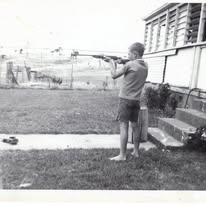
Diary of a Child Sniper - Chapter 9 - When Luck Needs Witnesses

Slug Gun Me

A willingness to act without narrating the act to oneself. Those things don’t announce themselves as skills. They don’t look like training. But when opportunity presents itself sharply enough, they behave exactly like preparedness

Diary of a Child Sniper


Chapter 9 – When Luck Needs Witnesses


By the time I turned 17 just before the second trip to Kiacatoo, I didn’t realise it then, but I was already standing near the edge of something. It was not the end of shooting. Not the end of rifles, or accuracy, or the quiet competence that comes from knowing how to do a thing properly. But it was almost the last time I went shooting in anger, when the act itself still carried heat, purpose, urgency.


Luck is a convenient word. It smooths the edges of discomfort. It absolves both admiration and unease. It allows people to marvel without interrogating what they are really responding to.


The old saying, that luck is the point where opportunity meets preparedness, is closer to the truth than most people realise, but even that version feels too tidy. Too symmetrical. As though the two arrive at the same moment, shake hands, and politely step aside for applause.


They don’t.


Preparedness is science.


It is methodical, repeatable, and largely indifferent to drama. It is built in controlled conditions through measurement, correction, failure, and adjustment. It favours margins over moments. It accumulates quietly, often invisibly, and it does not care whether anyone is watching.


Preparedness is the notebook no one sees. The missed shots logged mentally. The understanding of trajectory, behaviour, distance, light, wind. The muscle memory that exists not to impress, but to remove error.


Opportunity, by contrast, is art.


It is irregular. Asymmetrical. Unreliable. It does not arrive on schedule or announce its intentions. It presents itself half-formed, often briefly, sometimes disguised as inconvenience or doubt. It resists rules. It cannot be summoned, only recognised.


Opportunity is timing without permission. It is movement instead of stillness. A pause that may never repeat itself.


Most people misunderstand this relationship because they want luck to be spontaneous, a gift rather than a convergence. They imagine the shot as instinct, as courage, as something pulled from thin air. But instinct without preparation is guesswork, and courage without judgement is noise.


The shots people later described as “lucky” were never blind. They were not bravado.

They were not instinct unmoored from thought.


They were the brief alignment of two very different forces. Science held the rifle steady. Art decided whether it should rise at all.


What looked like luck from the outside was simply the moment where structure met chaos and neither overwhelmed the other. Preparedness ensured that error was minimised. Opportunity ensured that the moment mattered. And even then, the most important part of the equation was invisible.


Because the same science that made a shot possible also made many shots unnecessary. The same preparedness that allowed action also permitted restraint. The art was not only in recognising when to take the shot, but in recognising when letting the moment pass was the more accurate outcome.


Luck, in that sense, was never the cause. It was the description applied afterward, by those who only saw the result, not the convergence.


From inside the scope, it never felt like luck at all. They were preceded by assessment. Distance. Wind. Movement. Backstop.  And, most importantly, consequence. What never makes it into the retelling is the decision not to shoot. The pause. The recalibration. The moment where the rifle remains still and the opportunity passes without ceremony. That silence is invisible to anyone not standing behind the sights.


This is where lived experience separates cleanly from mythology.


On screen, the shooter is an instrument of inevitability. The rifle comes up. The scope settles. A number is spoken, eighteen hundred yards, and the distance itself becomes the achievement. In films like Lethal Weapon (1987 – Warner Bros), delivered with effortless confidence by Mel Gibson, the shot exists because the story demands it. Process is invisible. Doubt is edited out. Consequence dissipates into spectacle.


Real shooting is nothing like that.


There is no distance that matters more than the decision made before the trigger tightens. No calculation more important than whether the outcome justifies the act at all. The discipline is not in making the shot, it is in recognising when the shot should never exist.


The mind of the shooter is not cinematic. It does not swell with music or certainty. It narrows. It strips away everything except what matters. It is governed less by confidence than by clarity.


Luck does not pull the trigger. Judgement does. And judgement leaves evidence. Not always visible, not always celebrated, but present nonetheless. It shows up in the restraint that goes unnoticed, in the missed opportunities that were never mistakes, in the quiet tapering of urgency that signals a change in identity long before it is acknowledged.


Looking back now, those later shots, the ones labelled lucky, sit differently. They feel less like peaks and more like punctuation marks. Moments that closed a chapter rather than defined it. The skills were still there. The preparedness was intact. But the demand for action was fading.


The heat was going out of it.


What remained was competence without hunger, ability without need, and the first sense that this particular version of myself no longer required opportunity to prove it existed.

The anecdotes will come. They deserve their place.


But the story underneath them is this: Luck was never the point.  And by then, neither was the shot.


I had my Lethal Weapon moment.


Not the cinematic version, not the declaration, not the certainty, not the crowd-pleasing impossibility, but the lived equivalent, with witnesses to provide proof. A day that sits in my memory with a clarity that has not dulled, even as everything around it has softened with time.


It had been a weekend of frustration. We were chasing kangaroos, and they seemed to know it.


All day, they held themselves just beyond expectation, not impossibly far, just far enough. Outside the comfortable envelope of the weaponry at hand. Close enough to tease competence, distant enough to deny it. Every opportunity arrived slightly misshapen, refusing to conform to the range the rifle was built for.


The .222 Tikka was, by design and by doctrine, a two-hundred-yard instrument. Beyond that, its certainty eroded quickly. Drop increased. Time to target stretched. Wind mattered more than it should. The science began to fray. And yet, late in the day, one moment arrived differently.


The kangaroo was moving, not charging, not stationary, but travelling with that deceptive efficiency they have. Ground disappearing beneath it in long, economical bounds. There was no clean pause, no invitation. Just motion, direction, and the narrowing window that opportunity so often presents.


The shot was taken in its general direction, a phrase that sounds reckless when written down, but felt precise in the moment. Not aimed at where it was, but where it would be. Not anchored to distance, but to trajectory.


When the animal dropped, immediately, cleanly, there was no celebration. Just stillness. A quiet disbelief that settled in before comprehension caught up.


We paced it out. Seven hundred paces.


Far beyond the rifle’s expected range. Far beyond what doctrine would allow. A distance that, on paper, should have rendered the shot improbable at best, irresponsible at worst.


And yet, every variable had aligned. The drop. The time to target. The angle of movement.

The absence of wind worth naming. The familiarity of the trigger. The understanding, not hope, of where that bullet would be when the animal arrived there.


This is where the mythology would usually take over. This is where the story becomes about luck. But luck wasn’t what made that shot possible.


Preparedness was the science, the accumulated understanding of ballistics, behaviour, delay, gravity. The thousands of unremarkable repetitions that taught my body what my mind no longer needed to calculate explicitly. The discipline that had already rejected dozens of earlier shots that day because they didn’t meet the same criteria.


Opportunity was the art. The brief, imperfect alignment of motion and space. The moment that refused to hold still or ask permission. The recognition, not the forcing, of a window that existed only because both shooter and target were already in motion.


What married the two was judgement. Not bravado. Not frustration. Not the desire to end a difficult day with a story worth telling. Just the quiet internal calculation that this moment, and only this moment, satisfied both halves of the equation.


Science said the shot was possible. Art said the moment was right. And even then, it was not inevitable.


That is what cinema never shows. The near-miss nature of everything that matters. The way even a “perfect” convergence still balances on uncertainty. How close success always is to becoming just another anecdote about restraint instead.


From the outside, it becomes a legend. From inside it, it remains a case study. A reminder that when opportunity and preparedness do align, truly align, the result feels less like triumph and more like inevitability earned the long way around.


It was my Mel Gibson shot.


But unlike the movies, it didn’t make me want another one. It made me understand just how rarely the marriage is supposed to occur.


Another shot of disbelief came early one morning, walking the hills with Uncle Peter at home at Mt Buffalo.


We had settled well back from a dam, the water still and clear enough to make the ducks look as though they were suspended rather than swimming. Morning light flattened everything, distance, scale, intention, and the place felt more like a painting than a hunting ground. Peter had brought his target rifle with him, the kind of instrument that spoke of discipline rather than need. Heavy. Precise. Built to turn intention into certainty. Not a weapon you carried for hours on a hunt


When he fired, it was surgical.


Heads removed cleanly from ducks that never knew they were part of a calculation. No drama. No wasted movement. Just the controlled outcome of a man who had long since merged preparation with execution. It was science in its purest form, repeatable, detached, exact.


I watched, absorbing more than I realised.


While Peter worked the water, my attention drifted. Across the dam, on the far side, a dead tree stood stripped of everything except function. On one of its upper boughs sat a sparrow hawk, patient and observant, waiting for its own opportunity to descend into the chaos below. A predator watching predators, insulated by height and distance.


I had my .22 calibre Winchester with me, a rifle that, by any sensible definition, was useful to fifty paces at best. Beyond that, it became an exercise in optimism rather than expectation. Light projectile. Rapid energy loss. Drop that quickly turned estimation into fiction.


The hawk was well beyond that envelope. Two hundred and fifty paces, as it turned out.


I don’t remember deciding to take the shot in the way people imagine decisions being made. There was no internal speech. No cinematic pause. Just the quiet alignment of things already known. Distance that could be felt rather than measured. The way the bird held itself. The stillness of the air. The accumulated understanding of how far a bullet could still matter if everything else agreed to cooperate.


The rifle came up. The shot broke.


From where we stood, it looked as though the bird had simply stepped off the branch. No flailing. No visible violence. Just a clean separation from the bough and a soft collapse into gravity, as though it had decided to wander off to its next victim and simply failed to arrive.


For a moment, even I wasn’t certain what I had seen.Then Uncle Peter stopped shooting.


That, more than anything, fixed the moment in place.


A man who removed heads from ducks without spectacle lowered his rifle and stared. Not at the bird, but at me. There was no congratulations, no noise, no embellishment. Just a pause, the kind reserved for moments that don’t fit the framework you thought you understood.


It was another “lucky” shot, by any outside retelling. A child. A .22. An impossible distance. A result that defied the tidy boundaries of equipment and expectation. But luck had very little to do with it.


Preparedness was already there, years of understanding what that small rifle could and could not do, how much arc it carried at the edge of relevance, how long the bullet would remain obedient to intention before physics reclaimed it. Opportunity was there too, a still bird, a quiet morning, air that held its breath.


What joined them was judgement. Not the desire to impress. Not the urge to compete with Peter’s mastery. Just the recognition that, in that singular moment, science and art had overlapped cleanly enough to permit the attempt.


The awe that followed was not the point. It never was.


What mattered was something quieter, the confirmation that preparation, once internalised deeply enough, does not announce itself when it acts. It simply waits, patient as a hawk, until opportunity wanders too close to be ignored.


There were times, too, when foxes were simply unlucky.


That is how the stories were told later, anyway, with a shrug, a grin, a suggestion that chance had leaned my way. As though the animal had drawn the short straw in some invisible lottery. But what looked like misfortune from the outside was usually something else entirely.


Competence has a way of changing the rules.


What begins as possibility, with enough repetition and understanding, becomes probability. Not certainty, never certainty, but something closer to inevitability than people are comfortable admitting. It shifts the boundary of what is considered reasonable. It redraws the map of what is allowed to happen.


One fox in particular comes back to me.


It had done everything right. Hugged the ground. Read the movement. Slipped through a ringlock fence cleanly and reached the scrub on the other side, that thin margin where most pursuits end, where the chase gives way to acceptance. Safety, by any conventional measure, had already been achieved.


Except it hadn’t.


The fence was there, yes, wire, posts, angles that supposedly fractured opportunity into impossibility. Most people would have let the moment go. Filed it away as a near miss. A good effort. A story that ended without punctuation. But competence has a way of seeing through obstacles rather than stopping at them.


The wire wasn’t a barrier. It was a variable. The movement wasn’t panic. It was pattern. The window wasn’t closed. It was narrow.


The shot threaded its way through that narrowness and stopped the fox in its tracks. An “impossible” shot, if you needed a word for it. But impossible only exists when skill is excluded from the equation.


What made that shot deserving wasn’t bravado or frustration or the desire to win. It was clarity. The calm recognition that everything required for the outcome was already in place. The fence did not negate the shot, it simply demanded more of it.


This is where belief enters the picture, and belief is often misunderstood. It wasn’t belief in luck. It wasn’t belief in being special. It wasn’t belief that rules no longer applied.


It was belief in process, in skills built far beyond what was officially contemplated as “right,” “safe,” or “expected.” Belief that the accumulated discipline had earned the right to stretch the envelope without tearing it.


Competence doesn’t announce itself loudly. It doesn’t seek permission. It quietly expands the definition of what is possible and waits for the moment when that expansion matters.


To an observer, at that time my father, the fox was unlucky. To me, the outcome was simply the logical conclusion of preparation meeting a moment that deserved precision rather than resignation.


That distinction mattered. Because once you understand that competence can turn the improbable into the repeatable, you also understand the responsibility that comes with it. The obligation to decide not just can I, but should I.


Those questions began to matter more than the shots themselves. And somewhere in that shift, without any ceremony at all, the hunger for impossible shots began to fade, replaced by something quieter, heavier, and far more enduring.


But I think by far the “luckiest” shot I ever made happened in full view of a crowd.


A fox drive on a neighbouring property. Organised. Noisy. Shotguns fanned out in a loose, uneven line, men spaced at hopeful intervals, each convinced their patch of ground was the one that mattered. Dogs working the scrub. Voices carrying further than they should. It had the feel of theatre more than craft, energy without precision.


The fox broke through anyway.


It slipped the line as foxes so often do, not with speed so much as timing. It found the gap between expectation and reality, between where the shooters thought danger lived and where it actually was. Shotguns barked behind it, pellets shredding air and grass but not outcome.


Freedom was already forming ahead of it.


My young neighbour saw his chance. He’d missed with his first shot, a clean miss, the kind that rattles confidence but inflates urgency. His single-shot gun came down, opened, reloaded with more hope than calculation. He was already lifting it again, preparing to fire well beyond the weapon’s effective range.


At the same moment he fired, I did too. No signal. No coordination. Just two very different understandings of what was possible occupying the same instant.


The fox dropped. From the outside, it looked uncomplicated. A body on the ground. Noise collapsing into chatter. Movement rushing forward to claim meaning.


The young neighbour got there first.


In his mind, the logic was unassailable. He had shot. He had arrived. Therefore, the kill was his. The crowd accepted it easily, proximity often masquerades as proof, and confidence fills gaps that evidence hasn’t reached yet.


I didn’t argue. There was nothing to gain by doing so.


Legends don’t care about accuracy. They care about momentum. It was only later, when the fox was skinned, that the story quietly unravelled. A single, neat hole through the heart. Clean. Unambiguous. Not the scattered violence of a hopeful second shot, but the signature of intention carried through to conclusion.


The truth had been there all along. It just hadn’t needed witnesses.


That moment lodged itself in me not because of the shot, I’d made harder ones, quieter ones, lonelier ones, but because of the disparity it revealed.


Between appearance and reality. Between belief and competence. Between who claims and who knows.


From the outside, the fox was unlucky. From the crowd’s perspective, the wrong story was told and accepted without resistance. From inside the skill itself, the outcome was never in doubt.


Competence doesn’t always win the narrative. It rarely even enters it. Sometimes it is overwritten by proximity, by volume, by confidence loudly asserted and weakly examined. Sometimes it is only revealed later, when the noise has moved on and the evidence is allowed to speak without interruption.


That mattered to me more than the accolade ever could.


Because in that moment, I learned something that reached far beyond shooting: that certainty does not require validation, that probability does not need applause, and that truth, when it finally surfaces, is usually quiet, and unconcerned with who got there first.


If luck existed at all that day, it wasn’t in the shot. It was in learning early that legends are often built by those closest to the body, not those responsible for its fall.


The last one I want to talk about sits differently again, not because of distance or difficulty, but because of who took the shot.


It was an ordinary enough day on the surface. My ex-wife and I were riding a motorbike around the paddocks of another Uncle and Aunt, but again not far from Condobolin, no plan beyond movement, no intent beyond being there. I was driving. She was on the back, arms loose around my waist, shotgun between us, just part of the occasion in the most literal sense, present, but not positioned.


We crested a rise and almost rolled straight into them.


A knot of piglets, sleeping hard in the grass, bunched together in that careless way animals only manage when they believe the world has momentarily forgotten them. It was the kind of moment that usually unfolds slowly, the internal shift from observation to action, the bike stopping, the rifle coming out, the familiar transition into process.


Except none of that happened.


Before I could even bring the bike to a halt, before I could dismount, let alone reach for the Tikka, she was already moving. Off the bike in one fluid motion, as though gravity had simply changed its mind about her. The shotgun was in her hands, coming up with an authority that did not match my understanding of her experience.


As far as I knew, she had never fired a weapon. Certainly not a shotgun. Certainly not in anger. There was no history to support what happened next.


Three shots. Three deliberate, economical reports that shattered the stillness and the assumption that competence requires rehearsal. Piglets scattered. Some didn’t make it far at all. By the time I slowed a couple of the runners with the rifle, the work had largely been done.


She hadn’t hesitated. She hadn’t asked. She hadn’t waited for instruction. She had simply acted.


We took four piglets back to the homestead and dressed them for the evening barbecue. The task was practical, unceremonious, almost domestic in its rhythm. No one spoke about the shots themselves. There was no debrief, no story-telling, no attempt to elevate the moment into something it didn’t need to be. And that is what lingered.


Because if luck is the explanation, then it has to stretch uncomfortably to accommodate that day. It has to explain how someone with no visible preparation stepped cleanly into a moment that rewarded decisiveness and accuracy without rehearsal or instruction.


So I’ve come to think about it differently. Maybe luck doesn’t attract luck. Maybe preparation doesn’t always look like preparation.


Perhaps what really happens is that the preparation curve moves up and down the opportunity curve in ways we don’t always recognise. Sometimes preparation is explicit, measured, trained, accumulated. Sometimes it is latent, a coefficient of another variable entirely.


Calm under pressure. Spatial awareness. The absence of hesitation. A willingness to act without narrating the act to oneself. Those things don’t announce themselves as skills. They don’t look like training. But when opportunity presents itself sharply enough, they behave exactly like preparedness.


That day taught me something important. Not all competence is rehearsed. Not all preparation is conscious. And not everyone who acts decisively has been practising the thing they appear to be doing.


Sometimes the curve simply crosses where it needs to. And when it does, the result looks indistinguishable from luck, unless you’re willing to question what preparation really means.

Author

Menu