

This was work. Work done quietly. Carefully. Without applause.

Diary of a Child Sniper – Chapter 12 – Where Has the Sniper Gone
- Diary of a Child Sniper
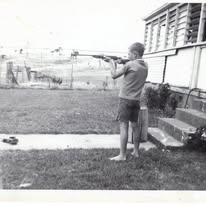
This was work. Work done quietly. Carefully. Without applause.
Diary of a Child Sniper
Chapter 6 – Booroma Trip 2
Chapter 6 returns us to Booroma, but the tone has shifted completely.
This time there are no families. No casual routines. No sense of holiday as escape. What arrives with us instead is something colder. Purposeful. Stripped of softness. The bush is the same, but we are not.
The Darling is in flood. Brown, swollen, impatient. It hasn’t spilled beyond its banks yet and erased the old rules. Fishing, at least the kind we knew, is impossible. The river isn’t offering itself to patience or technique. It’s a moving wall now. A thing to be respected, not worked. And that suits us, because we aren’t here for fish.
We arrive to discover we are not alone.
Sergeant John Baker is already in residence. The head of the Sniper Squad. He’s brought a mate with him, another policeman, but titles don’t matter here. Not really. Out here, they are just men on leave. That’s the unspoken agreement. No badges. No authority. Just holiday-makers with a purpose that mirrors our own.
They’ve taken two rooms. One for sleeping. One for the guns, and they have a lot of them.
The second room is laid out with a kind of reverence. Not ceremonial, exactly, but deliberate. Everything has its place. Confiscated weapons, collected over years, now temporarily liberated from evidence lockers and paperwork. Cleaned. Oiled. Ready. It’s not chaotic. It’s not boastful. It’s controlled. Which somehow makes it more intimidating.
They’re easygoing men. Relaxed in that way only people completely comfortable with power ever are. There’s no bravado. No need for it. They’re curious about us, about last year, about what we learned. Our familiarity with the land gives us standing. We’re not kids tagging along, we’re guides of sorts. That pleases them.
Reconnaissance becomes a shared exercise.
Walking fence lines. Scanning floodplains. Reading sign. Talking quietly about movement, patterns, likelihoods. It feels professional without ever being declared so. No one uses the word “hunt” with ceremony. It’s just what we’re doing.
We drive along in the jalopy Uncle Peter has constructed, no windscreen to allow the driver to assist should a wounded animal require quick relief.
At one point Dad pokes the shotgun out as we drive through a seemingly endless mob a large red kangaroos, felling one in its tracks. He does not fire again for fear of missing and blotting his then immaculate copy book in front of the establishment snipers.
And then there are the handguns.
Among the rifles and shotguns lie two objects that change the atmosphere of the room the moment you notice them. A Colt .45. A .357 Magnum. Handguns with weight not just in steel, but in story. They carry mythology with them. Cinema. Authority. Finality.
These are not tools we grew up around. They belong to another world. A harder one.
One where the violence is intimate. Where distance is removed. Where consequence is immediate.
Dirty Harry (1971 – Warner Bros) comes to mind, of course. Clint Eastwood. Squinting certainty. Moral clarity wrapped in brutal simplicity. The fantasy of righteousness delivered through calibre and confidence. You can feel that story humming beneath the surface, unspoken but understood.
The policemen are eager to demonstrate. And the youth, me included, is eager to fire.
That combination should probably trouble me more than it does.
We end up at the water’s edge.
The flood has drawn carp in close, sluggish and visible beneath the surface. Someone throws an empty Coke can into the river. The splash draws them in, curious, dumb, opportunistic. The can bobs, metallic and absurd, a floating target that means nothing to the fish and everything to us.
We watch them gather.
And in that moment, something important shifts inside me.
This isn’t marksmanship at distance. This isn’t patience stretched over paddocks. This is immediacy. Reaction. Power concentrated into a single movement of the hand. The margin for error is smaller, but the feedback is instant. Success or failure is undeniable.
I’m aware, dimly, that this is a threshold. Not just of weaponry, but of identity.
Up to now, skill has been about restraint. About knowing when not to shoot. About precision earned slowly. But here, with a handgun in my grip and adults encouraging the act, the line between discipline and indulgence blurs.
The river doesn’t judge. The carp don’t know. The men are watching, not to correct, but to observe. That is until I lift the weapon to shoot like Clint might.
Seargant John immediately takes control, intervening before the weapon can sit me on my behind. He quickly set me in a stance to best defend the recoil from such powerful weapons.
And I realise something that will take years to fully understand: The danger isn’t the gun. It’s the quiet approval and the stereotypes the media purvey at us on their screens. The way competence invites escalation. The way trust, once granted, asks what else you can be trusted with.
Standing there, floodwater sliding past, Coke can drifting, finger learning weight and resistance, I am not thinking about death. Or morality. Or consequence. I am thinking about control. About whether I have it. And whether, once tasted, it ever really lets you go.
Baker and his mate, never felt like police out there.
That mattered more than any rank ever could.
There were no uniforms, no clipped language, no institutional distance. No sense that authority was being exercised. If anything, they felt closer to us than different from us. Men who had simply carried their purpose with them into the bush, the same way we had. Their weapons weren’t symbols of power or enforcement, they were tools. Familiar ones. Handled without ceremony. Spoken about without weight.
And that casualness did something important. It flattened the hierarchy.
They weren’t watching from above. They were alongside. Not instructing, not unless they could see glaring errors of youth. Not correcting. Observing often in awe. Sharing space. Sharing intent. Whatever they were in town, out here they were hunters with time on their hands and access to better toys. That equality dissolved any sense of borrowed authority. What remained was competence, and the expectation that competence would be matched.
That was the first quiet shift.
The second came when learning stopped being the point.
By now, I wasn’t rotating through rifles or being handed something “to try.” The Tikka was mine. Not in ownership perhaps, but in identity. It fit me. The balance. The trigger. The way it came up without thought. That matters in the bush. When you stop thinking about the mechanics and start thinking about the moment, the environment, the outcome.
With that came rules. Not spoken loudly. Not formalised. But understood.
We had two genuine marksmen in the crew, myself and Uncle Peter, so the rules were set, I shot until I missed. Then Uncle Peter took over, same rule. Same expectation. Control passed cleanly, without debate. Miss, and you relinquished the spot on the buggy. No frustration. No embarrassment. Just an acknowledgment that the rhythm had broken.
It wasn’t punishment. It was accountability. And suddenly, I wasn’t learning how to shoot anymore. I was being evaluated.
Not by the policemen, though they were watching, but by the structure itself. The system didn’t care how old I was. Or how keen. Or how proud. It only cared whether I delivered. Hit after hit meant continuity. A miss meant the privilege moved on.
That clarity sharpened everything.
The stakes weren’t high in consequence, but they were high in meaning. Every successful shot extended trust. Every succesful shot meant more money in the pocket. Every miss shortened it and reduced the weight. You could feel the responsibility settle into your shoulders, not heavy, but present.
Then came the second evolution of the rule. The eye shot.
Uncle Peter put one through the eye rather than between the eyes. Cleaner, not. Less precise, yes, and the only way I got the position back on the top of the buggy. A statement disguised as refinement. It changed the rules without announcing itself. A dead fox had been acceptable. Effective. But now, that wasn’t the standard anymore.
The bar moved. And with it, control shifted again.
From the second night on, I drove and I drove for three nights straight before the eye event.
It was, not because I was being sidelined, but because the mission had escalated. Precision was no longer enough. It had to be surgical. Unarguable. Perfect. And if that was the expectation, then roles had to adapt. The shooter needed stillness. The driver needed patience. Both carried responsibility. Just in different forms.
What’s striking, looking back, is what wasn’t there. Fear.
Not the absence of awareness, but the absence of anxiety. That distinction matters. This didn’t feel reckless. It felt earned. Each progression had been gradual. Each responsibility layered on top of demonstrated control. There was no thrill-seeking here. No bravado. No sense of “let’s see what happens.”
This wasn’t recreation. That’s why the families weren’t there.
This wasn’t a holiday that happened to include guns. It was a purpose that happened to be carried out during school holidays. Everything about it reflected that. The early starts. The quiet conversations. The way meals were functional rather than social. The absence of laughter at the wrong times.
There was, technically, a holiday in the middle of all this.
A day out, almost. We drove out to the Cumbora Opal Fields, not far from Booroma Station. Close enough to be reachable, far enough to feel like another country entirely. It should have felt like a diversion. A break. Something to remind us that we were, in theory, on holidays.
But even there, the language was the same. Gates were locked. Some chained. Some watched. And the men who watched them did not pretend otherwise.
Sidearms were worn openly. Not tucked away. Not half-hidden. Heavy pistols sat on hips with the quiet confidence of tools that had been used before and would be used again if required. It was a vicious form of protection in what should have been the not-so-wild west, yet here it was, alive and unapologetic.
Menacing in shape, but not in fact.
That distinction mattered.
There was no confrontation. No challenge. No threat. The weapons weren’t waved or referenced. They simply were. Part of the uniform. Part of the landscape. As normal to the wearer as boots or a hat. The discomfort came not from intent, but from visibility.
It unsettled without frightening. And that was the telling part.
There was no real fear. No sense of imminent danger. Just an awareness that this was a place where ownership, livelihood, and survival blurred together. Where protection wasn’t symbolic, it was practical. Necessary. Boring, even, to the men carrying it.
Normality for them. And suddenly the idea of a “holiday” felt thin. Artificial. Like a word that didn’t quite apply to places shaped by extraction and isolation. The opal fields weren’t romantic. They were transactional. Everyone there understood exactly why they were present. There was no theatre in it.
Which brought the contrast into sharper focus.
The policemen at Booroma were there to use the confiscated weapons. To try them. To experience them. There was curiosity in their handling. Interest. A quiet excitement that came from access rather than requirement. A testing of boundaries that grew out of familiarity, not necessity.
They didn’t need the guns. They wanted to feel them. For us, the rifles weren’t novelties. They were instruments. Tools assigned to a task, carried with expectation rather than interest. We didn’t admire them. We relied on them. They weren’t extensions of fantasy—they were extensions of responsibility. The difference is subtle, but profound. One invites play. The other demands restraint.
That’s where the absence of fear came from. Not bravado Not ignorance.
But structure. Clarity. Knowing exactly why you were there and what was expected of you. Purpose stripped away noise. Left no room for hesitation. No space for fantasy. No indulgence in story.
This wasn’t Dirty Harry. This wasn’t cinema. This was closer to the men at Cumbora than to the myths on the screen. Weapons worn or carried not to intimidate, not to perform, but because the environment demanded readiness. Because consequence existed whether acknowledged or not. And once you see weapons that way, once you understand them as instruments rather than symbols, fear stops being useful. It dissolves into focus. Into process. Into the quiet discipline of doing what you came to do and nothing more.
That, more than anything else, defined this “holiday.” Not escape. Alignment.
This was work. Work done quietly. Carefully. Without applause.
And in that environment, I wasn’t a child pretending at adulthood. I was simply someone doing his job and the almost $1,500 I earned for the fortnight a filip to the exercise.
That realisation, more than any calibre, any kill, any compliment, lodged itself deep. Because once you’ve been trusted with purpose, it’s very hard to go back to play. And somewhere in that shift, without announcement or ceremony, the boy who came for holidays gave way to someone else entirely.
Author