

We arrived thinking we were there to take. We left understanding we were there to participate.

Diary of a Child Sniper – Chapter 12 – Where Has the Sniper Gone
- Diary of a Child Sniper
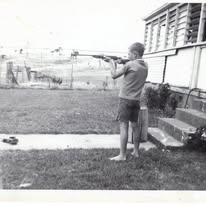
We arrived thinking we were there to take. We left understanding we were there to participate.
Diary of a Child Sniper
Chapter 5 – Booroma Trip 1
Up until this point, everything had been preparation.
Up until now everything largely occurred inside the fences of the farm, physical ones, yes, but also emotional and psychological. They are about learning control before consequence. About sight pictures and stillness. About borrowing authority before earning it. About a boy discovering that precision could quiet the noise inside him, long before he understood why that mattered.
But skill, left untested, is just theory.
That first trip of the “Fab 4” marked the moment when the rifle, and the boy behind it, left the paddock and entered the world. Not the imagined world of films or fantasies, but a harsher, wider one governed by distance, necessity, and unspoken contracts. A world where competence had currency, where usefulness determined belonging, and where mistakes travelled further than you expected.
The stories that follow are no longer instructional. They are experiential.
They belong to a period when shooting stopped being something I practised and became something I did, alongside men whose expectations were never stated but always felt. These trips were not holidays in the conventional sense. They were apprenticeships disguised as family time. Expeditions dressed up as school-break escapes.
We would later refer to ourselves, half-jokingly, as the “Fab Four” even before Marvel postualted the strange beings affected by cosmic radiation. At the time, it didn’t feel like a name so much as a configuration, an alignment of capability, trust, and opportunity that allowed us to move beyond home ground.
I didn’t yet own the rifle that would come to define the next phase of my life. That came later, paid for by what happened here. But what mattered more was that this was the first time my shooting left the realm of personal discipline and entered the economy of exchange.
I was about to learn that accuracy could buy access. That reliability could earn silence. And that skill, once noticed, is never neutral.
The trip to Booroma was the beginning of that education. This was the first time the rifle left the paddock and entered a wider world.
Up until then, my shooting had been domestic. Functional. Bound by fences I knew, distances I could almost feel in my bones, and rules that were rarely spoken but always enforced by proximity. Home was a known quantity. The misses fell into familiar grass. The hits were absorbed by land that already understood us.
Booroma was something else entirely. We arrived after hours of driving that felt like weeks, the bitumen slowly surrendering to dirt, the horizon flattening and stretching until distance lost meaning. Condobolin had been the last place that felt like a town. After that, everything thinned out, people, landmarks, reassurance. What replaced them was scale. We passed the sign to Come By Chance on the road between Conamble and Walgett so corrugated the bitumen bebneath the vehicles seemed to shake with a force that would shortly dismantle everything.
The sheep station sat heavy in the landscape, not dominating it so much as submitting to it. Buildings were low, practical, almost apologetic. The shearers’ quarters weren’t accommodation in any modern sense. They were shelter. Walls that held the wind back just enough. Floors that had absorbed decades of boots, sweat, lanolin and silence.
To me, it was paradise.
There were no schedules beyond daylight and dark. No school bells. No one asking what day it was. Mornings began when someone stirred. Evenings ended when the night had taken everything it wanted from you. Time wasn’t measured in hours but in tasks, lines checked, ground covered, lamps cooled.
During the day we learned the country. Not formally. No one lectured. You absorbed it by walking it, by standing still long enough to feel how open space presses back against you. The Darling River wasn’t a feature so much as a presence, slow, brown, patient. It carried a sense of permanence that made everything else feel temporary, including us.
Reconnaissance wasn’t called that, but that’s what it was. Learning fence lines. Learning where pigs moved. Learning where foxes skirted the edges of light and cover. Learning how far sound carried. Learning how small you were.
At night, the work began. Spotlighting here, was different to anything I’d known. At home, night shooting was cautious, contained. Here, darkness stretched forever, broken only by the cone of light and the red or green glint of eyes suspended in blackness. The rifle felt heavier at night, not in weight but in consequence. Shots travelled further. Misses mattered more. There was no familiar fence to stop a bullet. Only trust.
Trust in the land. Trust in the people beside you. Trust in yourself.
Foxes were clean work. Professional, almost. Pigs were something else. They demanded decisiveness. Hesitation wasn’t just a mistake; it was disrespectful. To the animal. To the people who’d asked us to do the job. To the unspoken contract that allowed us to be there at all.
That was my first real understanding of exchange.
We weren’t tourists. We were tolerated because we were useful. Our holiday existed because it solved a problem. The pigs were costing the station money. The foxes were costing lambs. Our rifles weren’t recreational; they were tools.
Payment came the next morning.
The hundred-stand shed was cavernous, even empty. Pegging out pelts across that wooden floor felt ceremonial. Repetitive. Almost monastic. Each skin was stretched, cleaned, aligned. Mistakes were obvious. Sloppiness showed. You learned quickly that pride wasn’t about how many animals you’d shot the night before, but how well you treated what remained.
That stayed with me.
The families blurred together in those days. Adults moved between roles without announcement, cook, driver, skinner, storyteller. Kids drifted in and out of responsibility, pulled forward when needed, released when not. There was no hierarchy explained, yet everyone knew where they stood.
And always, the land pressed in.
The house paddock alone was larger than our entire farm back home. That fact rattled me. At home, every acre was argued over. Managed. Known. Here, sheep grazed because sheep grazed. Wool was grown because wool grew well. Not for fineness. Not for awards. For volume. For resilience. For survival.
It was the first time I saw success defined differently. At home, precision mattered. At Booroma, endurance did.
Somewhere in that fortnight, something shifted. I didn’t articulate it then, I couldn’t have. But the ability to shoot, stopped being just a skill of mine. It became a passport. An entry fee. A reason for inclusion.
And the money that came later, the pelts sold, the cash counted, split 5 ways with one portion going to the house, wasn’t pocket money. It was proof. Proof that skill could convert to independence. That competence had a currency in the form of almost $1,000.
I didn’t own the Tikka yet.
But standing in that shed, hands stiff with cold and work, I knew I would.
The adults called it a holiday.
That was the word used when packing was discussed, when leave was arranged, when the school calendar was consulted and lines were drawn through ordinary routines. It was said lightly, almost casually, as if what we were doing sat comfortably beside beach trips and caravan parks and lazy afternoons.
In truth, it was a holiday with a purpose.
All the families came. That alone changed the texture of it. This wasn’t a boys’ run or a covert mission wrapped in silence. It was communal. Shared meals. Kids underfoot. Stories repeated until they settled into folklore. The presence of wives and children softened the edges, but it didn’t remove them. If anything, it sharpened the contrast. By day, it felt like family. By night, it became something else entirely.
During daylight hours, we were explorers. Or at least, we thought we were.
There was a kind of naivety in how we moved through that country, driving from dam to dam, stopping to glass paddocks, pointing out tracks with the confidence of people who believed observation equalled understanding. We spoke in half-formed theories. This looks promising. That corner holds pigs. They’ll be moving through here at night.
We were learning, but without yet knowing how much we didn’t know. The land tolerated us. That was about it.
The encounter with the boar came out of that naïveté.
We pulled up near a large bush, thick and dark at its base, the sort of place that swallowed light and returned nothing. Uncle Peter was the first to speak, casual as if commenting on weather. “There’s a pig under there.” No drama. No build-up. Just a statement of fact.
The instruction that followed was equally unceremonious. Shoot the bush.
Dad took the first shot. What emerged bore no resemblance to anything I’d imagined, wounded in the other end to the headshot he intended.
It wasn’t a pig in the farm sense of the word. It was a presence. A mass. A surge of muscle and fury that seemed to tear itself out of the scrub rather than step free of it. In that instant, every half-remembered image from Razorback (1984 – Greater Union Film Distributors) came flooding back, not as cinema, but as scale. As threat. As something that didn’t recognise us as dominant, or even relevant.
Uncle Peter reacted instantly. He launched from the driver’s seat, large Bowie knife in hand, closing the distance with the kind of confidence that comes from believing decisiveness is enough. He stuck the pig cleanly, expecting, perhaps hoping, that the encounter would end there.
It didn’t. All it did was make the boar angrier.
The next seconds collapsed into chaos. The pig wheeled, faster than something that size should move, and Uncle Peter barely had time to register the mistake before survival took over. He dove, not climbed, not scrambled, dived back through the driver’s side window, abandoning dignity and pride in favour of breath and bone.
Inside the vehicle, time fractured.
I fumbled. Hands suddenly useless. The shotgun shells I’d brought for exactly this purpose refused to cooperate, fingers thick and clumsy as adrenaline erased fine motor skills. Outside, the boar tore into the vehicle with an intensity that felt personal. Metal screamed. Rubber shredded. In moments, the tyre was off the rim, the car crippled not by distance or terrain, but by raw force. This was not control. This was consequence of the worse kind in a setting as unforgiving as the movie itself.
When the pig finally went down, it did so reluctantly, as if conceding rather than surrendering. Even in death, it demanded effort. It took half an hour just to make the vehicle roadworthy again. Longer still to dress the animal, a brute well over 350 kilos, its sheer mass an education in itself.
Nothing about it felt triumphant.
By the time we finished, daylight had shifted. Shadows stretched. The mood sobered. The boar, now reduced to purpose once again, was portioned and prepared as fox attractant, to be laid along the night’s intended trail. Even then, utility reasserted itself. Nothing wasted. Nothing celebrated.
That was the real lesson of that day. This wasn’t adventure as entertainment. It was engagement with a world that did not care about intention. The land didn’t reward enthusiasm. Animals didn’t behave according to expectation. And decisiveness, without respect for scale and consequence, was just another kind of mistake.
That night, when the spotlight came on and the rifles were lifted again, everything felt heavier. Not just the gear. The understanding.
The bush wasted no time reminding us that it also decides what happens after the drama.
By nightfall, the boar had already been absorbed back into the landscape, not as a threat, not even as a trophy, but as function. The carcass pieces we’d dragged and laid out along our intended trail did exactly what they were meant to do. Foxes came in early. Too early. Too confidently.
They appeared at the edges of the beam almost immediately, eyes burning bright, movement casual in a way that told you this wasn’t their first time. The bush had reset the balance quickly. Where chaos had reigned only hours earlier, now there was order again, predator answering opportunity, instinct answering smell.
And this time, everything felt different. The shots were clean. Deliberate. Measured.
There was no rush, no bravado. Each fox taken felt like a quiet correction rather than a victory lap. The rifles were steadier. The voices lower. Even the spotlight seemed more disciplined, sweeping slower, lingering just long enough.
Success returned, but it returned tempered.
I remember noticing how close some of the foxes were to the carcass, how unconcerned they seemed by the day’s violence. They hadn’t witnessed the boar’s fury. They hadn’t felt the tyre tear free or heard metal buckle. They only knew that the land had provided, as it always does, and that opportunity favours those who arrive prepared.
That contrast stayed with me. The boar had been all scale and rage, an eruption. The foxes were precision problems, solvable with patience and restraint. Same tools. Same hands. Entirely different moral weight.
Earlier that day, fear had arrived uninvited. Not panic, something colder. A flash of understanding that size rewrites rules. That confidence collapses quickly when it meets mass and intent. Watching Uncle Peter abandon the vehicle in a headlong dive stripped the moment of mythology. This wasn’t bravery. This was survival. And the line between the two was thinner than I’d ever realised.
What surprised me later was what followed the fear. Awe, yes, at the animal, at the power, at how close we’d come to paying a higher price. But underneath that was something quieter. A recalibration. The sense that the bush had allowed us to stay, but only after extracting its lesson.
The lesson wasn’t don’t do this. It was do this properly.
Restraint isn’t hesitation. It’s respect informed by experience. The bush doesn’t reward speed. It rewards accuracy, preparation, and knowing when not to act. The boar incident didn’t make us reckless. It did the opposite. It sharpened the edge that mattered.
Later, when foxes dropped cleanly under the beam, it felt earned again. Not because we’d conquered anything, but because we’d listened.
That was the unspoken education Booroma offered.
The land didn’t care that we were on holiday. It didn’t care that families were camped in the shearers’ quarters, that kids slept while men worked the night. It cared only about balance. About response matching scale. About tools being used with understanding rather than entitlement.
We arrived thinking we were there to take. We left understanding we were there to participate.
And that difference, subtle at first, would shape everything that followed.
Author