

Still, they stand. Because someone decided they should. Because someone calculated the risk.

Centre to the Dish – Chapter 14 The Arrival Isnt an End
- Centre to the Dish
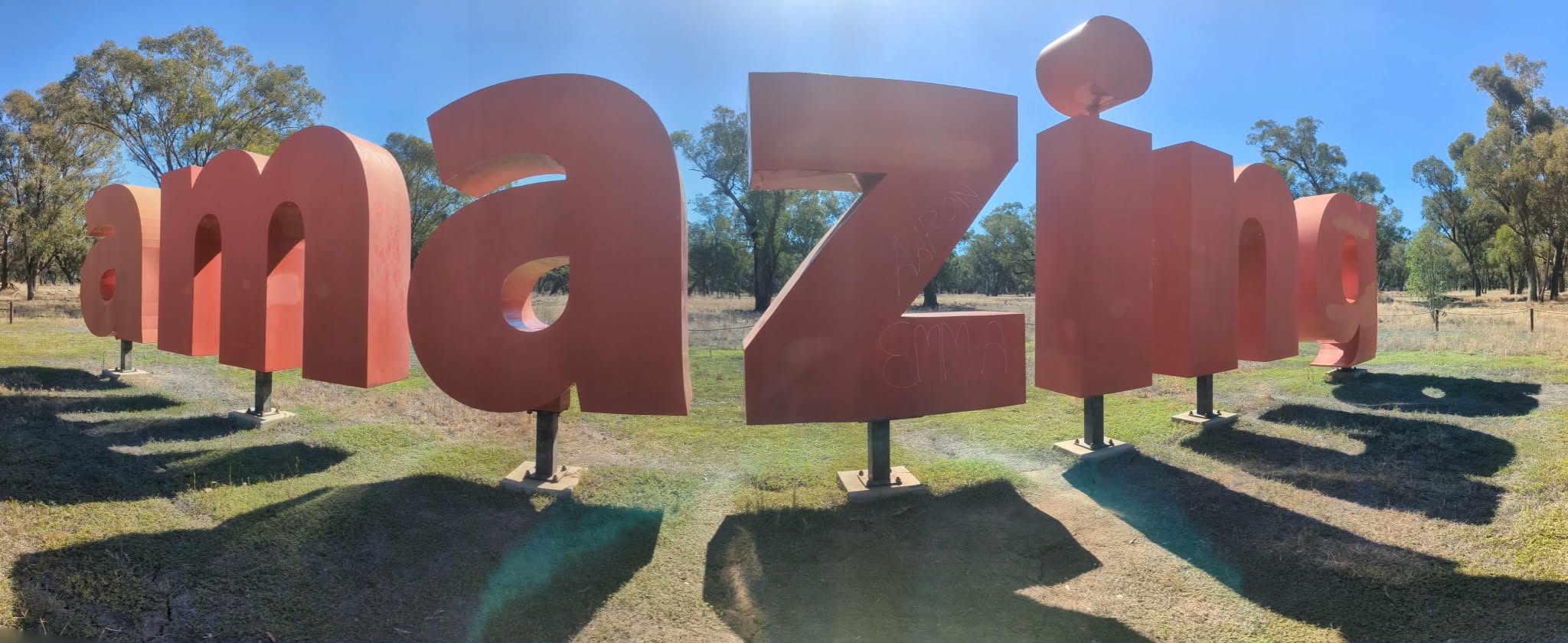
Still, they stand. Because someone decided they should. Because someone calculated the risk.
FROM THE CENTRE TO THE DISH
Signs Signs Everywhere Signs
Signs, signs, everywhere signs… Blocking out the scenery, breaking my mind.
The chorus from Signs drifts in uninvited somewhere between Condobolin and Ootha, as these things often do on long country roads. Songs don’t arrive politely out here. They surface. They rise through the rhythm of tyres on bitumen, through the sameness of scrub and sky, through that peculiar mental quiet where memory and observation start sharing the same space.
Out here, signs are unavoidable. Not because there are so many of them, but because there is so little else willing to interrupt the view. They stand at attention, reflective aluminium, standardised fonts, precise angles, fabricated somewhere far from the red dirt they are planted in. Designed to be legible at speed. Designed to remove ambiguity. Designed, above all, to manage risk. They are the clinical voice of authority in a place that otherwise does not speak in warnings.
The land doesn’t caution you. The land doesn’t explain consequences. It simply waits.
The first sign usually announces restraint: Speed Limit. A number that pretends to be scientific, but is really philosophical. It assumes uniformity, of vehicles, of drivers, of conditions, in a place defined by difference. Corrugations yesterday, rain tomorrow, kangaroos always. The sign doesn’t care. It offers certainty where none truly exists.
Then come the others. Stock Crossing. Unsealed Road. Next Services 140km.
Each one a reminder that this is not an environment that bends itself to convenience. They do not invite you in. They simply acknowledge that you are passing through. And that, perhaps, is their most honest function.
There is a tension here, between the official and the improvised, that mirrors the bush itself. For every professionally manufactured sign bolted neatly to a star picket, there is another hand-painted plank wired to a fence. Crooked lettering. Misspelt words. Arrows that suggest rather than instruct.
SLOW – STOCK, GATE AHEAD, PLEASE SHUT THE GATE
These signs are not about compliance. They are about conversation. They assume a shared understanding, or at least a willingness to participate in one. They trust you to interpret tone. To read intention. To act accordingly.
The government signs assume the opposite. They are written for the lowest common denominator. They shout where the land whispers. They warn of dangers the locals already understand and the inattentive may ignore anyway. Liability made visible. Responsibility outsourced to reflective paint. And yet, without them, the drive would become something else entirely.
The bush, for all its beauty, is relentless. Mile after mile of scrub, lignum, gum, sky. The hypnotic effect is real. The mind slips. Thoughts loosen their grip. The horizon barely changes, and that sameness can be as dangerous as any sharp bend.
Signs break that spell. A sudden yellow diamond announcing a curve that has not yet revealed itself. A brown tourist sign pointing to something you didn’t know existed. A distance marker that makes you recalculate fuel, time, patience.
They are punctuation marks in an otherwise unbroken sentence. Not destinations. Not stories. Just interruptions.
And perhaps that is why the song fits so well. Because the frustration in those lyrics isn’t really about signage at all. It’s about being told where you can and cannot exist. About invisible rules made visible through authority. About needing permission, a membership card, to pass beyond some arbitrary line.
Out here, no one asks for one. You are not required to belong. You are not required to explain yourself. You are not required to stay.
Movement itself is enough.
The road does not care whether you are local or visitor, farmer or accountant, wanderer or worker. It does not ask your purpose. It does not require a credential. It simply allows you to pass, provided you pay attention.
The signs, in that sense, are not barriers. They are acknowledgements. Quiet admissions that others have come this way before you, faced the same uncertainties, and left behind small markers of experience, some official, some improvised, in the hope that you might arrive safely somewhere else.
There is larrikinism in that too. In the way a hand-painted sign leans slightly, as if relaxed. In the humour that sometimes creeps in. In the assumption that the person reading it is capable, observant, and not entirely foolish.
That spirit is missing from the official versions. They are earnest to the point of sterility. Necessary, yes, but joyless. They do not reflect the people who live here so much as the systems that manage them from afar.
Still, they stand. Because someone decided they should. Because someone calculated the risk. Because someone, somewhere, believed order could be imposed on a landscape that has been quietly resisting it for tens of thousands of years.
And yet the land remains the constant. The signs fade. Paint peels. Reflective strips dull. Poles bend. Some vanish altogether, reclaimed by wind, weather, or machinery. The bush absorbs them eventually, just as it absorbs everything else.
You drive on. Past warnings. Past instructions. Past invitations you won’t take this time.
Not because you are excluded. Not because you lack permission. But because the simple act of passing through is enough.
The road continues. The scenery resumes. And somewhere behind you, another sign waits patiently, ready to interrupt the silence for the next traveller who needs reminding that they are not alone, even out here.
Author