

The bush absorbs sound as it always has. The paddocks sit patiently. The sky does the rest.

Centre to the Dish – Chapter 14 The Arrival Isnt an End
- Centre to the Dish
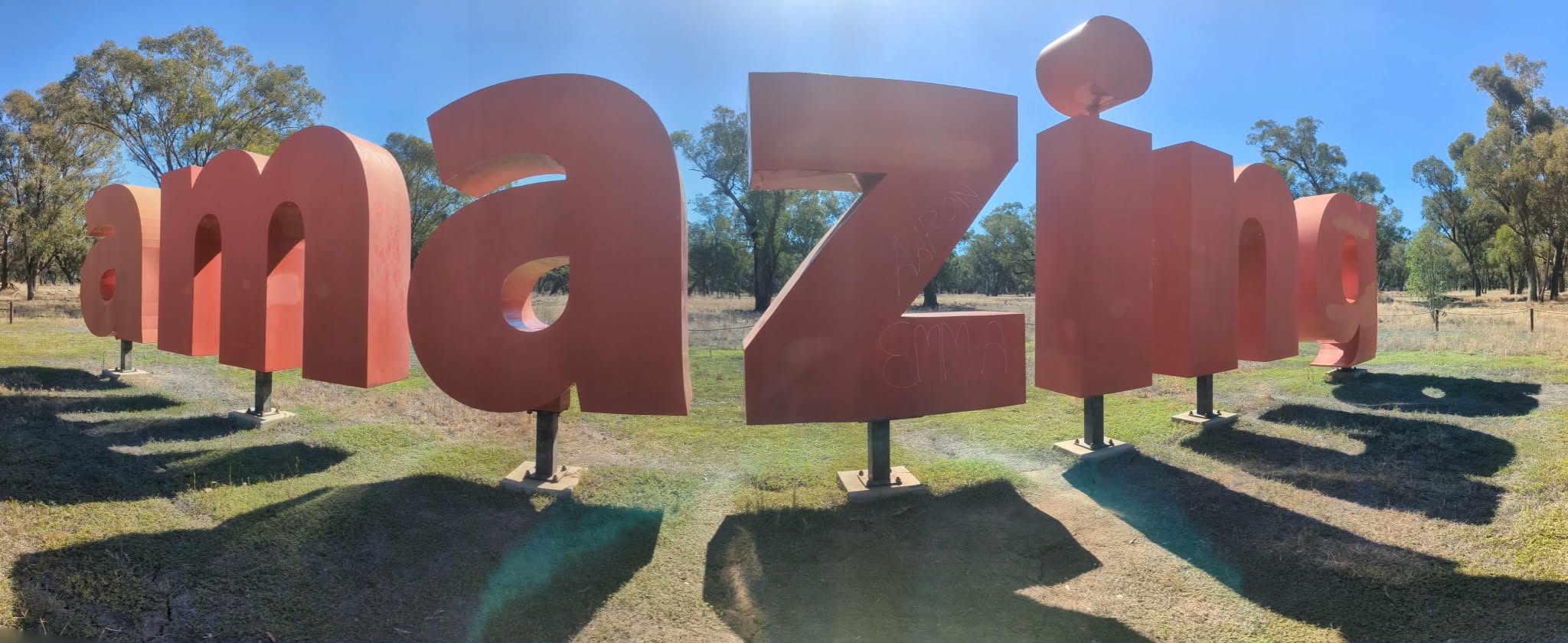
The bush absorbs sound as it always has. The paddocks sit patiently. The sky does the rest.
FROM THE CENTRE TO THE DISH
Finishing Point – Parkes
Every journey needs an end point, even if it is only temporary. Not an ending as such, more a pause, a place where momentum eases, where the road exhales and allows the traveller to do the same. For this drive, for this ribbon of bitumen that has carried us eastward out of red dirt, scrub, memory and silence, Parkes becomes that place.
Parkes is not the end of the story. It never pretends to be. It is, instead, a punctuation mark. A full stop that also hints at a new paragraph.
After the intimacy of Condobolin and the long, contemplative pull of the Henry Parkes Way, Parkes feels larger without being overwhelming. There is traffic here. There are roundabouts. There are franchises and traffic lights and the subtle sense that you have re-entered a different tempo of Australia. Not city fast, but no longer bush slow either. Parkes sits comfortably between worlds, much like the road that delivers you to it.
For us, it marks the completion of one leg of the journey. The centre loosens its grip. The horizon tightens. The land begins to organise itself again into blocks and boundaries that feel more negotiated than endured.
And yet, Parkes never lets you forget where you are.
Elvis has not left the building is one thing Parkes can lay a basis to. There is a week each year when Parkes refuses to behave like a sensible inland service town. When sequins outnumber Akubras. When white jumpsuits shimmer against red soil. When the King, long dead, endlessly resurrected, walks the streets in his hundreds.
The Parkes Elvis Festival is one of those things that should not work on paper. An outback town of modest size celebrating an American rock-and-roll icon with near-religious enthusiasm. And yet, it works precisely because it shouldn’t.
Elvis in Parkes is not irony. It’s not parody. It’s participation.
For a few days each January, Parkes becomes a destination rather than a waypoint. People plan their calendars around it. They drive long distances, some towing caravans, others arriving on buses or motorbikes, all drawn by the same improbable gravitational pull. Music spills out of pubs and halls. Street parades replace traffic flow. Cafés lean into the madness with themed menus and costumes that would be laughed out of Melbourne but are embraced here with straight-faced commitment.
There is something deeply Australian about that. The willingness to say, why not? To turn the ordinary into the extraordinary, not by changing what you are, but by amplifying it.
For those heading west on a longer pilgrimage, perhaps all the way to the Dish, the Elvis Festival becomes a potential detour worth planning for. A reminder that journeys are not only measured in kilometres, but in moments of surprise. In laughter where you didn’t expect it. In spectacle blooming in the dust.
And then, just as suddenly, it packs up and leaves. The jumpsuits vanish. The streets return to normal. Parkes exhales and resumes its role as a working town with bigger things on its mind.
Just outside town, rising from the land with a confidence that borders on arrogance, is the reason Parkes will always matter far beyond its postcode.
The radio telescope.
Officially known as Parkes Observatory, but properly named Murriyang, Skyworld, in the language of the Wiradjuri people. The name matters. It reframes the structure not as a machine, but as a bridge. Not a dish bolted to the earth, but a listening ear tilted toward something far older and far larger than ourselves.
Murriyang does not dominate the landscape so much as converse with it. From a distance it seems almost impossible, a perfect curve of steel rising out of paddocks and scrub. Up close, it humbles you. Not through size alone, but through purpose.
This is not a monument to human ego. It is a monument to human curiosity.
From here, signals have been received that have helped shape our understanding of the universe. From here, whispers from deep space have been translated into knowledge. During the Apollo missions, Murriyang played a critical role in relaying communications as humans took their first tentative steps on another world. While the moon hung above Australia, it was this dish, this Skyworld, that listened.
The land around it is quiet. Intentionally so. Radio silence is not a metaphor here; it is a requirement. The bush absorbs sound as it always has. The paddocks sit patiently. The sky does the rest.
There is something profoundly grounding about that. A reminder that the most advanced science still depends on stillness. That discovery often requires silence.
For many, Murriyang will always be linked to the film The Dish. A warm, affectionate retelling of the Apollo 11 story, filtered through humour, humanity, and a distinctly Australian lens. It is a film that captures something true without insisting on being precise.
And that’s where its genius lies.
The Dish simplifies. It compresses timelines. It creates characters who stand in for many. It turns technical complexity into narrative clarity. In doing so, it risks trivialising the science, and yet, somehow, it doesn’t.
Because the film is not really about space. It is about belief. About trust. About a small group of people in a small town being entrusted with a task of global significance. It is about the quiet competence that often goes unnoticed. The kind of competence that exists not to impress, but to deliver.
The real Murriyang did not need cinematic validation to justify its importance. Its legacy was already written in data streams and historical records. But the film gave it something else, cultural resonance. It anchored the telescope not just in scientific history, but in national memory.
For travellers arriving in Parkes, the dish often appears first as an image they recognise from a screen. Only later does its true weight settle in. The realisation that this wasn’t just a set. That this place mattered, and still does.
Parkes, then, becomes a fitting finishing point for this leg of the road. Not because it eclipses what came before, but because it gathers it. The land. The stories. The families. The straight roads and crooked memories. They all converge here, briefly, before fanning out again.
From Parkes, you can go almost anywhere. North. South. Back west. Further east. Toward the coast or deeper inland. Toward the Dish again, or toward something entirely different.
That is the quiet gift of a place like this. It doesn’t demand allegiance. It offers orientation.
As a point, Parkes does not close the book. It simply places a marker. A reminder that journeys are layered. That endings are provisional. That somewhere beyond the next horizon, the land is still listening, just as Murriyang does, waiting patiently for us to notice.
Author