

To be here was never about being on the land. It was about being part of it.

Centre to the Dish – Chapter 14 The Arrival Isnt an End
- Centre to the Dish
To be here was never about being on the land. It was about being part of it.
FROM THE CENTRE TO THE DISH
Home a Different Way
There is a habit in the country of not always going back the way you came.
Not because the distance is shorter. Rarely because it is quicker. But because there is something to be learned by choosing a different line through the land, a quiet understanding that return does not have to mean reversal.
Instead of turning straight back toward Condobolin, we angle east, toward Forbes. From there, the road folds back on itself along the Lachlan Valley Way, tracing the river’s long memory rather than cutting across it. It is a road with intention. A road that lingers.
This is not a shortcut. It is a conversation.
The sculptures come one by one, spaced like punctuation marks along the landscape. Ten of them in total, though counting feels like the wrong instinct. They are not exhibits. They are interruptions. Invitations to stop. To stand. To listen.
Some speak first to the oldest stories, those of First Nations people whose relationship with this land was never about ownership, but about responsibility. The forms are grounded, deliberate, sometimes abstract in a way that feels intentional rather than obscure. They do not explain themselves. They do not need to. They exist the way the land does: confident that meaning will come to those prepared to slow down.
These are not monuments to conquest or completion. They are acknowledgements, that the river was read long before it was mapped, that seasons were understood long before they were named, that movement across country followed patterns far more sophisticated than straight lines between points on a surveyor’s chart.
Then come the sculptures that speak of the next wave of stories, white pioneers, settlers, graziers, selectors. Not heroic in the Hollywood sense. Often weary. Bent. Working figures shaped by repetition and necessity rather than triumph. These are not statues of victory. They are studies of endurance.
You can feel it in the posture of the steel and stone. The way weight is carried. The way tools are held. The way faces, when there are faces at all, are turned not toward the horizon, but downward, toward the work still to be done.
What is striking is that none of the pieces shout. There is no attempt to dominate the landscape. Each sculpture seems to understand its place, present, but not presumptuous. The land remains the lead actor. The art simply gives it voice.
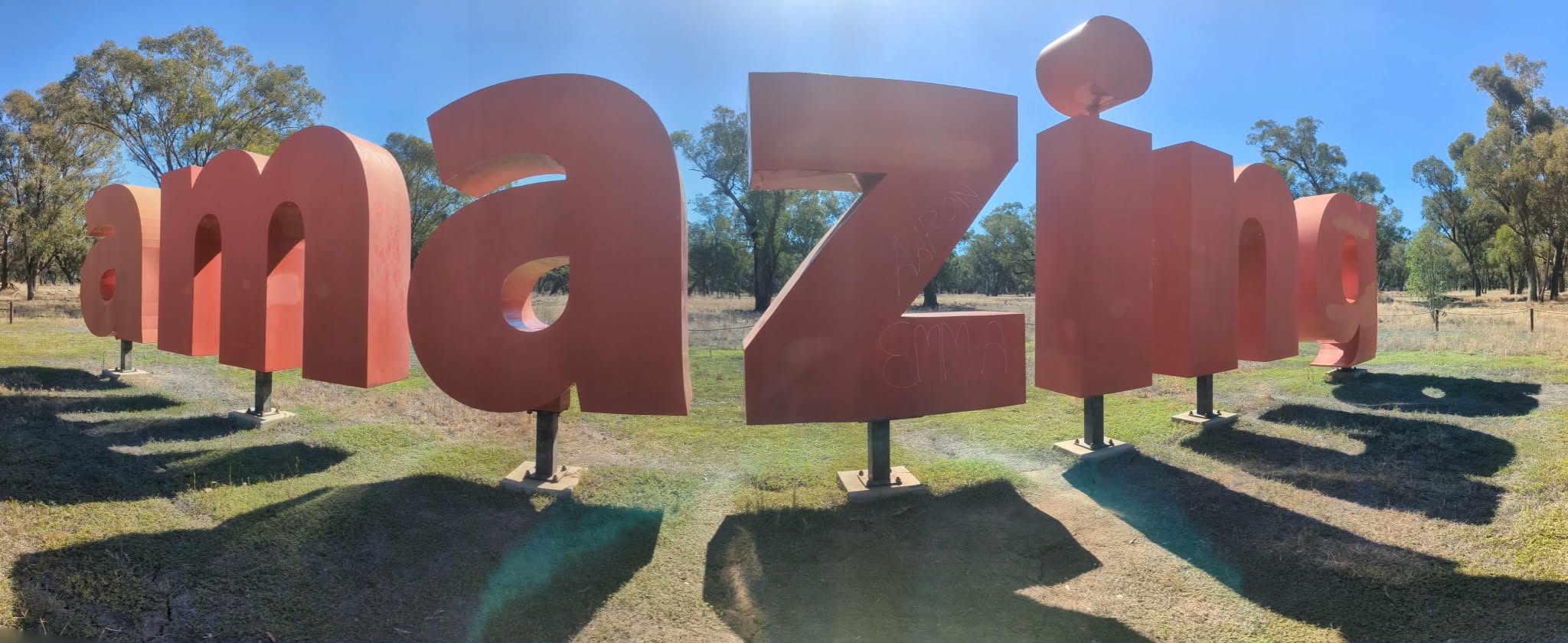
It all seems to gather itself in Amazing.
Not as a summary, not as a conclusion in the neat sense, but as a kind of deep breath taken by the road itself. If the other sculptures along the Lachlan Valley Way are sentences, or paragraphs, then Amazing is the pause between them, the moment where you realise the story has been speaking all along.
You feel it immediately in the way the form holds itself. The steel does not strain. The stone does not posture. There is weight here, but it is settled weight, the kind that comes from having carried things for a very long time and learning how not to complain about it. Nothing is lifted for effect. Nothing is exaggerated. Even the implied tools, the gestures, the angles of effort, feel secondary to something deeper: persistence.
Faces, if you look for them, are not raised to the horizon in search of promise. They are angled inward, downward, toward the work, toward the ground, toward the truth of what had to be done day after day whether hope was present or not. This is not the romance of arrival. It is the discipline of continuation.
And that is why Amazing feels less like a sculpture and more like a tribute to the entire drive.
Because the drive itself is exactly this, not loud, not declarative, not demanding to be noticed. The land does not shout its history. It does not need to. It has seen too much for that. First Nations stories etched in movement, not monuments. Settlers arriving with certainty, staying with doubt. Droughts that erased plans. Floods that erased fences. Generations learning, forgetting, relearning how small they really were.
What Amazing understands, and what it reflects back to you, is restraint.
There is no attempt here to dominate the landscape or even to stand apart from it. The sculpture knows its place. It is present, but not presumptuous. It does not compete with the paddocks, the river, the sky. It stands as if it has been allowed, not installed. As if the land agreed to it.
In that way, it lifts the story beyond art altogether. Beyond the ten sculptures. Beyond the deliberate stops and the plaques and the explanations. It folds everything back into the country itself, the things it has witnessed, absorbed, endured, and quietly carried forward without commentary.
The land remains the lead actor. Amazing simply nods in recognition.
And as you get back in the car and point it once more toward Condobolin, you realise that the return journey was never really about the road at all. It was about learning how to see what had always been there, waiting patiently, doing the work, not asking to be named. Among the ten, there are several that stop you longer than planned.
Ones that speaks quietly of loss, not dramatic, not loud, just a subtle reminders that not all stories here end well. Drought. Displacement. Loneliness. The long gap between hope and harvest. It is a piece that asks nothing of you except honesty.
Others lean into humour, a reminder that the bush has always used laughter as ballast. A larrikin note among the heavier themes, as if to say that survival here has always required the ability to see the absurd alongside the profound.
And there are others that sit somewhere between, works that do not resolve into a single message, but instead reflect the layered nature of this place. First Nations custodianship. Colonial ambition. Environmental consequence. Community resilience. All occupying the same ground, sometimes uncomfortably, sometimes in quiet balance.
Driving on, the Lachlan itself remains nearby, sometimes visible, sometimes only sensed by the shape of the land and the way the trees lean toward it. Rivers remember even when roads forget. This one has seen everything the sculptures hint at and more besides.
By the time the road finally bends back toward Condobolin, something has shifted, not because the destination has changed, but because its importance has quietly diminished. The return feels earned, rounded, complete in a way that straight lines never manage. It is the difference between arriving somewhere and understanding how you got there.
The fact of the journey begins to outweigh the fact of the place.
There’s a scene in Cars (2006 – Buena Vista Pictures) where Hudson Hornet tries to explain something to Lightning McQueen that speed alone can never teach. He talks about the old days, about Route 66, about the crowds that gathered not because they had somewhere else to be, but because this was the somewhere. People lingered. They watched. They waved. They belonged to the road as much as the road belonged to them.
It wasn’t efficient. It was meaningful.
Somewhere along the way, we traded that for the tyranny of seconds saved. We began to measure journeys not in memories, but in minutes. Detours became inconveniences. Slowing down became failure. The road stopped being a story and became a surface, something to be consumed, not engaged with.
Out here, the alternative route quietly resists that thinking.
It reminds you that movement was once relational. That travel meant passing through country, not over it. That knowing where you were mattered as much as knowing where you were going. The original custodians of this land understood that instinctively. Their pathways followed water, seasons, food, ceremony. They were not lines imposed on the land, but conversations held with it.
To be here was never about being on the land. It was about being part of it.
That knowing has not vanished entirely, but it has thinned. Smoothed down by bitumen. Edited by timetables. Lost in the modern urgency to be something, productive, efficient, impressive, rather than simply to belong. The push to arrive has overtaken the grace of moving well.
This alternative way home does not replace the direct one. It complements it. Like so much in the country, there is always another way, not better, not worse, just richer in story, heavier with memory, slower by design.
And perhaps that is the quiet lesson of this final leg. You don’t always go home the same way. But if you listen carefully enough, if you let the journey be the fact rather than the destination, the land will still recognise you when you arrive.
Author