

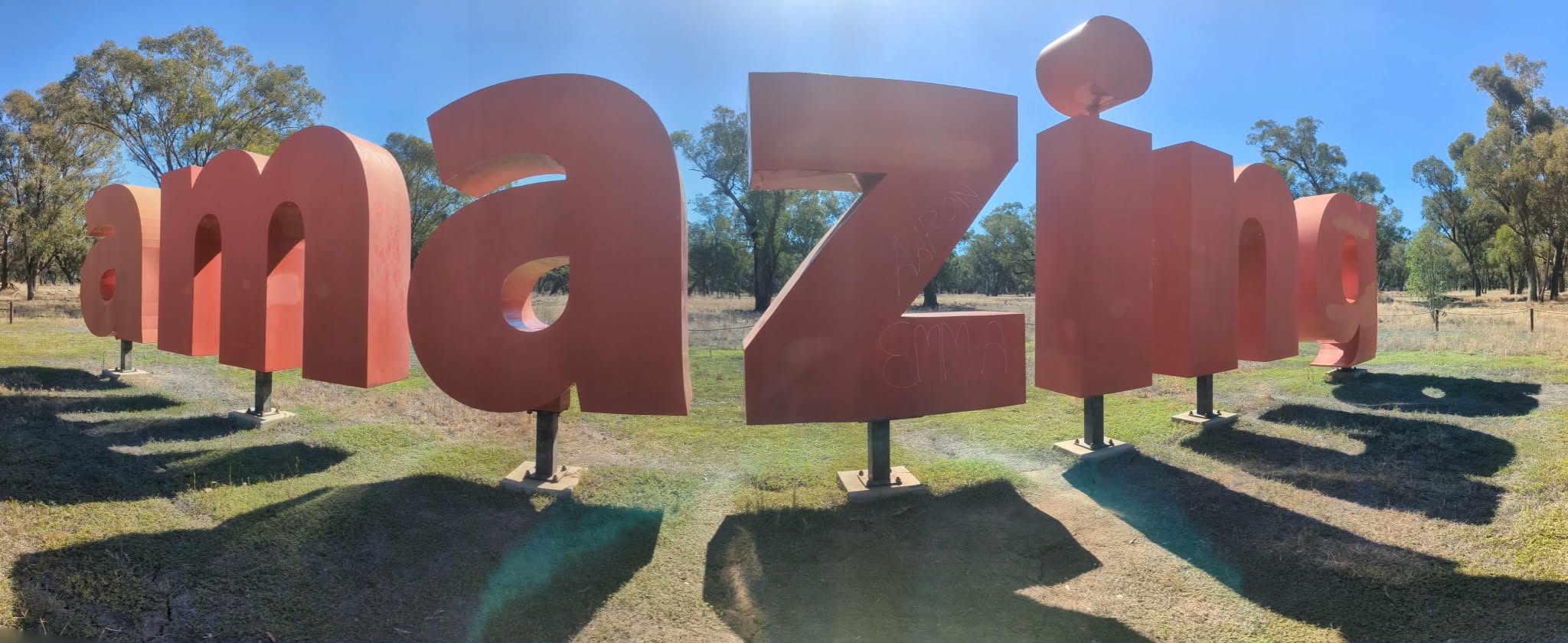
Darkness and distance, those twin enemies of childhood travel, hung heavy over these roads. “Are we there yet?” wasn’t impatience so much as hope. And still the road goes on

Complete the form below and get an email every time we post.

Darkness and distance, those twin enemies of childhood travel, hung heavy over these roads. “Are we there yet?” wasn’t impatience so much as hope. And still the road goes on
FROM THE CENTRE TO THE DISH
The “Endless Straight” – Ootha to Bogan Gate
More than 35% of the Henry Parkes Way between our destinations is a study in straightness. Not the theatrical straightness of Nyngan to Bourke, nor the mythic, horizon-devouring line of the early western stretches of the Nullarbor Plain, but something quieter. More domestic. A straightness that belongs to people who live beside it rather than travellers who conquer it.
At the Ootha end, the road still remembers how to bend. It sweeps left and right, politely negotiating the railway line as it drifts past the grain silos, swapping sides as if unsure where it belongs. These curves don’t demand respect from a modern car unless, of course, you choose, as we often do, to slow and turn off into Ootha itself.
Jeff once had family here. One of his mother’s sisters married and settled in Ootha. Uncle Arthur was a railway man, and that fact alone seems to explain the place, timetables, routines, permanence. There are memories of red dirt afternoons, of cousins playing without hats, without sunscreen, without much supervision at all. Cat heads lay in wait for bare feet, those nasty little burrs that taught pain quickly and permanently. It was a childhood of scuffed soles and laughter, of days that seemed to stretch longer than the road ever could. Nostalgia lingers, but this is a journey, and the road insists on moving forward.
Once past Ootha, the curves surrender. The road draws itself taut and aims directly at the wheat silos at Yarrabandi, daring you to believe it will never deviate. In truth, across this 35-kilometre stretch, there are only two concessions to imperfection, one to skirt the silos themselves, the other a gentle correction much further on, almost apologetic in nature.
To the left lies agriculture in its most honest form: paddock after paddock, broken only by the occasional fence line, the geometry of ownership etched lightly into the land. To the right, the railway runs in quiet parallel, sometimes close, sometimes distant, but always present, industry shadowing industry. This is not gun-barrel straight. The road rises and falls, two or three metres at a time, following the invisible logic of watercourses beneath the soil.
It is here the difference between road and rail becomes clear. Where the rail line is lifted on bridges, determined to continue regardless of flood, the road submits. In wet years, when the country breathes water back to the surface, this land can disappear beneath it. The river may be out of sight, trailing its way toward Forbes, but its influence is everywhere. Roads close. Journeys pause. Families wait.
Yarrabandi arrives almost reluctantly, a halfway point that could easily be missed if you weren’t looking. Turn right here and you can head toward Forbes through Gunningbland, assuming the river isn’t in one of its expansive moods. Bridges span the creeks, but when the country breaks, the road breaks with it. Jeff remembers his father, shire councillor for more than twenty years at Boorowa, telling stories of infrastructure ingenuity, of bridges here cut down from bridges replaced elsewhere. Nothing wasted. Everything repurposed. That, too, is a family story, and a rural one.
This stretch of road carries more than freight and fuel. It carries memory. Jeff drifts back to trips taken long before seatbelts were compulsory, when three children were plastered to the front dashboard, counting mice during a plague year, laughing until a bounding hare replaced a mouse and sent heads collectively into the windscreen. Other journeys involved mattresses laid out in the back of the station wagon, children asleep before the first bend, waking only when the car stopped. Distance then was something to be endured, not entertained.
Darkness and distance, those twin enemies of childhood travel, hung heavy over these roads. “Are we there yet?” wasn’t impatience so much as hope. And still the road goes on.
Like that Nyngan–Bourke illusion, you’d swear this one is destined to collide with the silos ahead, that it will simply run out of patience and drive straight through them. For a moment, imagination allows tunnels through grain, a cathedral of wheat and steel. At the last instant, reality intervenes and the road eases left, catastrophe avoided. A shame, really. Tunnels through silos would be something to talk about.
Blink and Yarrabandi is gone. Unlike Derriwong, there’s no enforced slowing, no reason to pause unless you choose to. If you’re lucky, a train will thunder past, briefly animating the landscape before silence returns.
Between Yarrabandi and Bogan Gate, progress, used loosely, has taken shape in the form of vast grain storage. Not traditional silos, but sprawling bins, iron-clad or tarpaulin-covered, born of necessity. Flooded harvests. Delayed exports. Grain waiting, patient as the families who grow it, for its next step.
Bogan Gate itself enforces a 60-kilometre-per-hour humility. You feel like you could walk alongside the car. There’s a police station here, a military presence, the railway weaving again from side to side as spurs from the north join in. It feels busy without being crowded, purposeful without being hurried.
This long, straight road is more than infrastructure. It is a metaphor the land understands well. Farming is much the same, an endless ribbon stretching forward, season after season, generation after generation. Minor deviations for weather, for markets, for life itself, but always the same direction. Families dotted along the way, each with their own silos of memory, their own bends and bridges, all tied together by a line that seems to promise continuity even as it tests endurance.
The road doesn’t rush you. It simply asks that you keep going.
Author
Complete the form below and get an email every time we post.