

The tragedy is not that the white man named the land, it is that in doing so, he stopped listening to what it was already called.

Centre to the Dish – Chapter 14 The Arrival Isnt an End
- Centre to the Dish
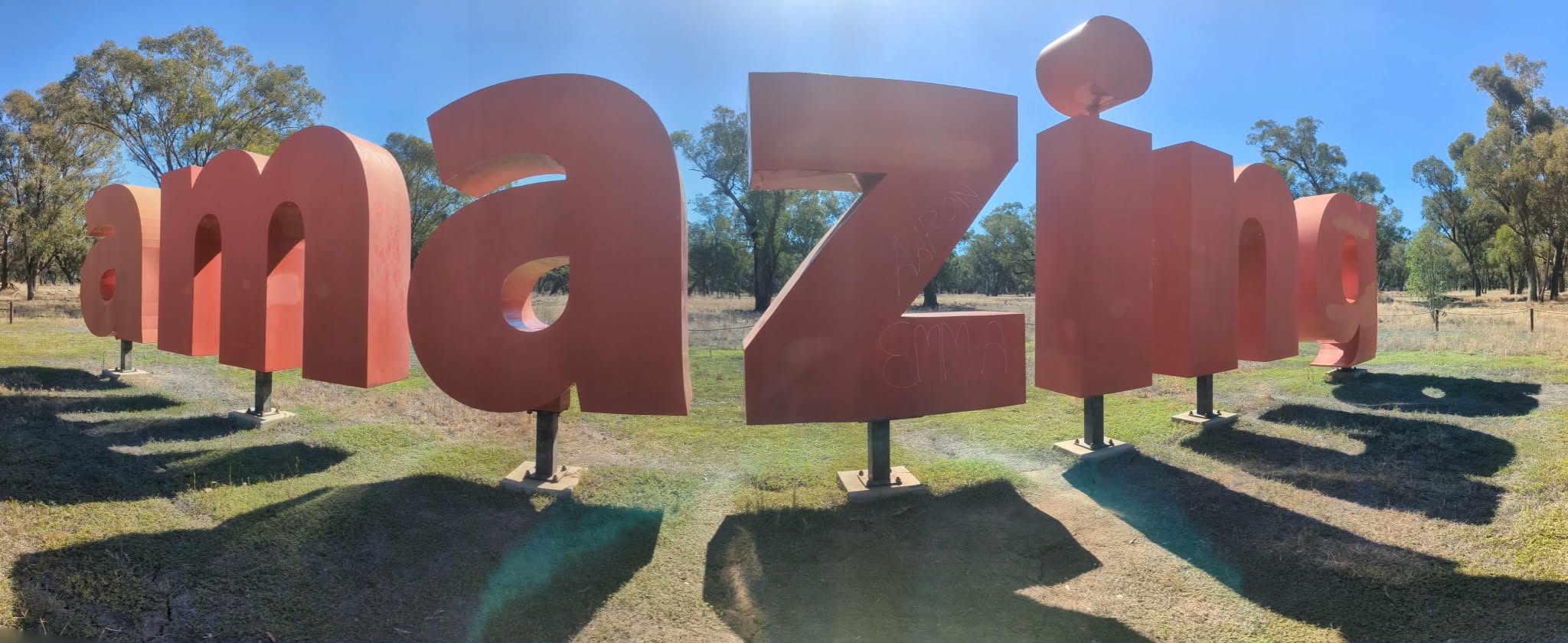
The tragedy is not that the white man named the land, it is that in doing so, he stopped listening to what it was already called.
FROM THE CENTRE TO THE DISH
Names on the Fence Line
Somewhere between Condobolin and Parkes, once the dust of departure has settled and the road has found its rhythm, the country begins to introduce itself.
Not with speeches. Not with monuments. But with names.
They sit quietly at the fence line, usually near a gate. Sometimes grand. Sometimes improvised. Letters welded from scrap steel, routed into timber, painted onto corrugated iron. Occasionally just stencilled, functional, unapologetic. You pass them at a speed that rarely allows more than a glance, yet somehow they linger longer than the paddocks themselves.
Weebolla. Wigmore. Borambil North. Whitegates.Waioma. Olaioma. Larchwood. Stony Crossing. Binaroo. Orchard Lea. Burrawang. Mulguthrie. Osterley. Monomie Downs. Braeside. Silent Downs. Gunningbland Station. Treweekes Gap. Wongalea. Shearbrook. Timaroo. Gundarimbah. Ponderosa. Allawah Park. Fairgrove. Mystery Grove. Benambra. Loloma.
Each one declares itself briefly, confidently, before slipping back into the land it claims to describe. A name, out here, is not decoration. It is a statement. It says: this place is known. And more quietly: this place is owned.
Some names try to describe what the land does.
Stony Crossing is not poetic, but it is honest. Somewhere nearby, water once met resistance. Rocks broke the flow. Wagons slowed. Stock hesitated. The name records a problem solved rather than a dream imagined. It is practical, born of use.
Shearbrook reads like a compromise, sheep and water, labour and relief. It suggests a place shaped as much by human routine as by geography. A creek that mattered because it intersected with work.
Orchard Lea leans in the opposite direction. It carries aspiration rather than fact. “Lea” , meadow, is a soft English word, imported gently, as if the land might be coaxed into compliance by vocabulary alone. Whether there were ever orchards there almost doesn’t matter. The name tells you what the owner hoped the land might become.
Fairgrove does something similar. It is less a description than a moral judgement. The grove is not just productive, it is fair. Balanced. Worthy. A reassurance written into the gate.
These names speak of improvement. They assume the land can be shaped into something better by effort and intention. They sepak of the “ordered woods and gardes” of the Dorothea MacKella England
Other names do not look at the paddock at all. They look backwards.
Osterley, Wigmore, Braeside, Benambra, these are echoes. Not of this country, but of another life. England. Scotland. Somewhere green, bounded, damp. Places where seasons behaved and fences stayed put. These names are not about ownership so much as comfort. They soften displacement.
To name a place after somewhere else is to say: I have been uprooted, but I will re-root here. It is an emotional act disguised as administration. A reminder to oneself, written large enough to be read from the road, that this land can be made familiar.
The land, of course, does not participate in this bargain.
Then there are the names that reach toward Aboriginal language, Weebolla, Binaroo, Burrawang, Gundarimbah, Wongalea, Timaroo, Loloma. Some are genuine survivals. Others are approximations. Some may be phonetic memories passed down imperfectly, altered by spelling, accent, convenience. In many cases, their original meanings have been thinned or lost entirely.
What remains is the sound.
These names sit differently on the tongue. They roll rather than land. They feel less final. Less absolute. Even when adopted as station names, they resist enclosure. They hint at older systems of knowing, of naming places for water, animals, movement, story.
There is an irony here. The white man adopts Aboriginal words to name what he now owns, while the Aboriginal system never required ownership to justify naming at all.
It is both homage and erasure, depending on how closely you look.
A few names stand apart because they don’t pretend to understand the land.
Mystery Grove does not claim mastery. It confesses ignorance. Something here resisted explanation, so the name records that resistance rather than overwriting it. Silent Dale listens more than it speaks. It suggests restraint. An acknowledgement that this place is not loud, not dramatic, not interested in performing for those who pass through. Monomie Downs and Everr feel incomplete, almost tentative. As if the naming stopped just short of certainty. As if the land declined to be fully explained.
These names feel closer, not to Aboriginal naming, but to humility.
And then there are the blunt ones. Donnelly Pastoral Co. No metaphor. No romance. No reference to landscape at all. This is land as enterprise. Land as balance sheet. The name exists for the mailman, the bank, the registry. It does not need poetry because its purpose is clarity.
There is nothing dishonest here. Just nothing hidden.
Seen individually, these names are just signs at gates. Seen together, they form a pattern.
Some name the land for what it gives. Some for what it reminds us of. Some for what came before. Some for what we hope it might forgive. All of them sit atop a deeper truth: naming is how the white man negotiates his relationship with country. It is how uncertainty is managed. How belonging is asserted. How absence is filled.
The Wiradjuri names were never about filling absence. They were about recognising presence. They didn’t need fences to make sense. They didn’t need signs to be remembered.
As the road carries on, past more gates, more paddocks, more carefully chosen words welded into steel, you begin to understand that the land has heard all of this before.
Names come and go. Country stays.
The white man names things as part of possession. Not always aggressively. Often lovingly. Sometimes poetically. But always deliberately. To name is to fix something in place, to anchor it to paper, to inheritance, to maps and memories that can be passed on.
Fences do the physical work. Names do the cultural work. They turn country into property.
That instinct runs deep. We name children. We name businesses. We name boats, houses, projects, phases of life. Naming is how we make sense of the world, how we reduce vastness into something we can hold. Out here, though, the scale fights back. No matter how lyrical the sign at the gate, the paddock beyond it remains stubbornly indifferent.
The land does not care what it is called. And that is where the contrast begins to hum beneath the tyres. Because long before these stations were named, long before they were fenced, surveyed, subdivided and titled, this was Wiradjuri Country. The land already had names, but they were not claims. They were descriptions. Stories. Instructions. Relationships.
The nearby towns still carry that older cadence in their syllables: Ootha, Yarrabandi, Bogan Gate, Derriwong, Gunningbland, Tullamore, Trundle, Berewombenia, Bedgerebong. These names do not announce ownership. They locate you within something larger.
They tell you what the place does, what it offers, how it behaves, not who controls it. They are relational rather than declarative. They don’t draw a line. They invite understanding.
Even Mount Tilga, often spoken of now as a geographic centre point, was never meant to dominate the landscape. It doesn’t loom or challenge. It sits. A marker rather than a monument. A reference rather than a prize. You don’t conquer Tilga. You orient yourself by it.
The same is true of the Murda State Forest. The word forest itself is imported, neat, bounded, managed, yet Murda predates all of that. The trees don’t acknowledge the signposts or the cadastral lines. They grow according to water, soil and seasons older than paperwork.
Driving past station after station, name after name, you begin to sense the layering.
Some names reach backward, Osterley, Braeside, Benambra, echoes of elsewhere, brought here to soften displacement, to recreate familiarity in unfamiliar country. Others reach sideways, borrowing Aboriginal sounds without fully grasping their meaning, perhaps as an unconscious nod to something older that cannot be erased. Some reach forward, corporate and efficient, like Donnelly Pastoral Co, telling you exactly what the land is for.
And some names simply confess humanity. Silent Downs. Mystery Grove. Fairgrove. They don’t pretend mastery. They admit uncertainty. They acknowledge that even with fences and titles, the land still holds secrets.
This is not a condemnation. It is an observation. Naming, in itself, is not violence. Forgetting is.
The tragedy is not that the white man named the land, it is that in doing so, he stopped listening to what it was already called.
The road, indifferent as ever, stitches all of this together. It doesn’t privilege one naming system over another. It passes through both without comment. Fence lines blur. Signs age. Letters rust. Paint flakes away.
Country remains. And as the kilometres roll on, a quiet realisation settles in: most of these names are not really for the land at all.
They are for us. They reassure us that we belong. That we have arrived. That we can pass this place on, labelled and accounted for. They are small anchors driven into vastness, an attempt to hold still something that has never truly stopped moving.
The Wiradjuri never needed names to claim this land. They needed names to understand it.
We needed names to convince ourselves it was ours.
Author