

You understand why they are there. You even admire many of them. Craft, humour, resilience welded into form. But appreciation does not erase accumulation.

Centre to the Dish – Chapter 14 The Arrival Isnt an End
- Centre to the Dish
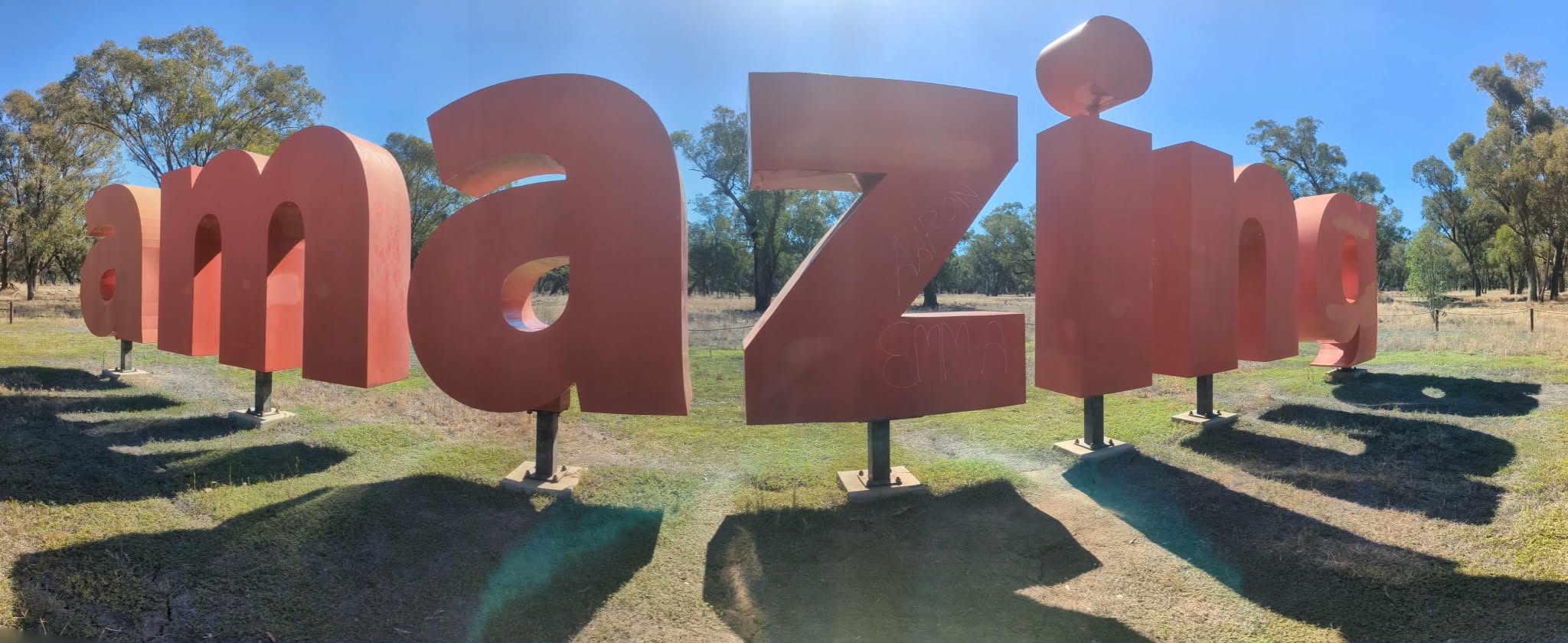
You understand why they are there. You even admire many of them. Craft, humour, resilience welded into form. But appreciation does not erase accumulation.
FROM THE CENTRE TO THE DISH
Road Art that is Mailboxes
The land can be a lonely place. The further you go from the city, the more the world stretches, not upward, but outward. Holdings expand. Horizons lengthen. Neighbours retreat to the edges of sight and sometimes beyond it. Distance becomes the quiet ruler of everything. In that space, where a knock on the door might be weeks away and a conversation months, the mail matters. Not just letters, parts, medicines, catalogues, seed orders, tools. The small, necessary things that keep a life functioning when the nearest shop is a long way down a road that doesn’t forgive haste.
Out here, the mailbox is not a courtesy. It is infrastructure.
It must hold more than paper and sentiment. It must withstand heat that softens plastic, wind that tests hinges, rain that arrives sideways and dust that arrives always. It must survive kangaroos, road trains, graders, fire fronts, and the casual cruelty of corrugations. It must be visible at speed and recognisable at dawn. It must endure absence. And so it becomes something else entirely, less a receptacle than a statement.
Ingenuity and time: two currencies the landowner understands intimately. The “cocky,” if we’re still allowed the word, trades in both when seasons permit. Between planting and harvest, between lambing and shearing, there are gaps where hands look for purpose and eyes look for problems to solve. When something breaks, and something always does, solutions arrive not from catalogues but from sheds. Offcuts. Old pipes. Fence posts. Discarded machinery given a second sentence. As John Williamson put it, they tie it up with wire, not because it’s crude, but because it works.
Mailboxes are where that philosophy meets the road.
Along the Henry Parkes Way, each property announces itself with one. Some are humble: battered steel cylinders, leaning slightly, numbers stencilled in fading black. Others are extravagant, welded animals, miniature windmills, tractors reborn as guardians of correspondence. There are mailboxes shaped like utes, cows, dogs, fish, rifles, helmets, boots. Some are painted loud enough to argue with the sun; others are raw metal, trusting patina to do the talking. They are practical first, big enough for parcels, strong enough to last, but they are also unmistakably personal.
This is where art and functionality shake hands.
Not art as gallery object or critique, but art as stake in the ground. A declaration that says: I am here. On land where boundaries are surveyed and ownership is signed and sealed, the mailbox becomes a marker more emotional than legal. It stands at the edge, the meeting point of private and public, where a road anyone can travel brushes against a life most never see. It is a small, defiant flourish against anonymity. And in that flourish is a shift worth noticing.
Indigenous thought worked with the land. It read signs rather than imposed them, followed patterns rather than fencing them. Place was understood through relationship, season, story, movement. White settlement, by contrast, required possession to be visible. Ownership needed edges. Names. Numbers. Titles. The mailbox belongs to that lineage. It is not the homestead, tucked away from view, but the outward face, the proof of claim, the interface with systems beyond the paddock.
Yet, curiously, the mailbox softens that claim.
For all its assertion, it is also an invitation. The postie stops here. News arrives here. The outside world pauses, briefly, to acknowledge the inside one. Bills and letters share space with parts and surprises. It is where bureaucracy meets bushcraft, where the impersonal systems of cities rely on something handmade to complete the loop. Satellites may now hover overhead and information may arrive invisibly, but the mailbox remains stubbornly physical. It demands to be seen. To be opened. To be maintained.
In that sense, it is a quiet resistance to disappearance.
Technology promises connection without presence, but the mailbox insists on a footprint. It says the battle with Mother Nature is ongoing and personal. It says weather still matters. Roads still matter. Hands still matter. Even as emails replace envelopes, the structure stays, because parcels still come, because medicines still need shelter, because some things refuse to be digitised.
And yet, seen from the driver’s seat, from the slow unwinding of kilometres and the quiet rhythm of tyres on bitumen, something else intrudes.
Art may live in the eye of the beholder, but so too does clutter.
You notice it now, not just the mailboxes, but everything that comes with them. Signposts leaning into sightlines. Reflective markers marching along fence lines. Gates, grids, culverts, cul-de-sacs of human intent. Each one sensible on its own. Each one justified. Together, they begin to crowd the view, breaking the long, clean conversation between road and horizon.
The land wants to run uninterrupted. To roll away until sky and earth negotiate their own terms. That is the promise of the interior: distance without punctuation. Space that allows the mind to drift, to settle, to breathe. But the modern roadside interrupts that promise again and again. Every mailbox is a pause. A reminder. A claim. Not loud, not aggressive, but persistent.
You understand why they are there. You even admire many of them. Craft, humour, resilience welded into form. But appreciation does not erase accumulation. One becomes two. Two become ten. Ten become a rhythm of obstruction. The eye no longer travels freely; it hops. From object to object. From statement to statement. The horizon fractures.
It begins to feel like a slow-growing cancer, not malignant in intent, but invasive in effect. A layering of necessity that gradually crowds out the thing that drew him here in the first place. The emptiness. The scale. The rare luxury of nothing demanding attention.
Where once the road offered immersion, it now offers commentary.
Mailboxes are only the most personal of these intrusions. Add advertising signs, tourist prompts, safety warnings, distance markers, commemorative plaques. Each one speaks. None of them listen. The silence thins. The land becomes annotated, footnoted, explained to death.
You wonder when the balance tipped, when working with the land quietly gave way to narrating it endlessly. When the need to mark, name, warn and announce overtook the confidence to let the country speak for itself. Indigenous presence left little trace because it trusted memory and movement. Modern presence leaves artefacts because it fears being forgotten.
And so the journey subtly changes.
The trip is no longer just about moving through space, but about negotiating it. Filtering. Editing. Choosing where to rest the eye. The mailboxes still stand proudly, still do their job, still earn their place. But they also stand as proof that even here, especially here, there is no such thing as untouched.
You drive on, aware of the contradiction. Grateful for the ingenuity. Irritated by the interruption. Admiring the art. Mourning the view.
Out here, nothing is neutral.
Everything that stands by the road asks to be seen. And everything that asks to be seen takes something, however small, from the horizon it replaces.
Author