

Standing there, between humour and mourning, invention and inevitability, it becomes clear that Condobolin isn’t hosting these stories so much as holding them

Centre to the Dish – Chapter 14 The Arrival Isnt an End
- Centre to the Dish
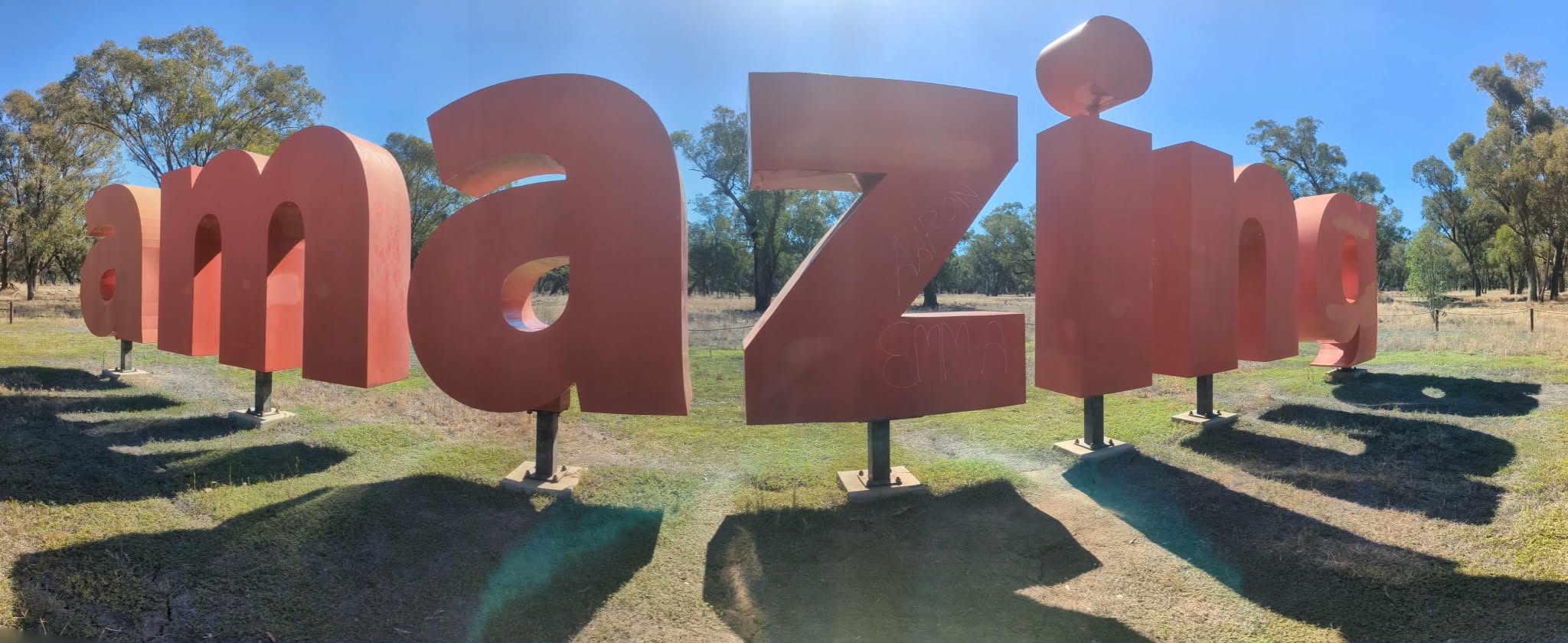
Standing there, between humour and mourning, invention and inevitability, it becomes clear that Condobolin isn’t hosting these stories so much as holding them
FROM THE CENTRE TO THE DISH
The Fallen Jockey Memorial
Built on the same stretch of land as the iconic utes, the Australian Jockeys Memorial sits quietly, almost defiantly, in the open space. Where the utes shout, this place speaks in a lower register. Where one celebrates invention, humour and the irreverent creativity of bush life, the other asks you, without ceremony, to slow down and read names.
This is a sobering memorial, if only by its sheer scale. Its physical presence alone is a testament to how many have fallen. You don’t take it in all at once. You can’t. It unfolds panel by panel, year by year, accident by accident, stretching back to the first recorded death of a jockey or horseman in a race and carrying forward relentlessly into the present day. It is not finished. That, perhaps, is the most unsettling thing about it.
Standing here after wandering through the utes feels jarring. The utes are loud in spirit even when silent, bright colours, exaggerated forms, satire welded into steel. They are declarations of individuality. Each plaque tells you who built it, what inspired it, what story it’s trying to tell. They invite laughter, curiosity, sometimes disbelief. You walk among them grinning, shaking your head, admiring the audacity of turning farm detritus into public art.
The jockeys’ memorial does none of that.
Here, the plaques are uniform. The names are the feature, not the artist. The stories are compressed into brutal efficiency: a date, a location, a brief description of what went wrong. Fall at the barrier. Clipped heels. Horse stumbled. Catastrophic injury. Sometimes the phrasing is almost clinical, which somehow makes it worse. No adjectives. No embellishment. Just fact.
And yet, within that austerity, there is an uncomfortable variety. There are entries that make you pause and frown, those moments where the circumstances are so strange or improbable that your first instinct is disbelief. You catch yourself thinking, surely not, or more bluntly, WTF? A saddle breaks. A stray dog. A loose rail. A moment’s chaos that costs a life. The absurdity of it doesn’t lessen the tragedy; it sharpens it.
Then there are others that land harder. The young ones. The experienced ones. The ones where you can almost feel the race unfolding before it stops being a race at all. These are the plaques that quiet you. They don’t invite commentary. They don’t need interpretation. They simply sit there, doing what memorials are meant to do, refusing to let you look away.
The contrast with the utes could not be sharper, and yet placing them together makes a strange kind of sense. Both are artefacts of risk. The utes glorify the bush instinct to push limits, to modify, to build something tougher or faster or stranger than the thing you started with. They celebrate the larrikin confidence that says, she’ll be right, even when it probably won’t be.
Racing lives in that same space of confidence and consequence. The “sport of kings” is an apt name, but it is kings who watch from shaded stands, not the ones who fall. This memorial is not for the owners, or the trainers, or the punters clutching tickets. It is for the warriors, the men and women who climb onto a thousand pounds of muscle and momentum and trust skill, instinct and luck to see them home.
Walking along the panels, you begin to sense the cumulative weight of that bargain. One fall is tragic. Two are unlucky. Hundreds become something else entirely: a ledger of risk paid in full. It stops being about individual accidents and becomes a broader accounting of a profession where danger is not an exception but a condition of entry.
And then, inevitably, the thought arrives, uninvited but persistent. If there were a similar memorial for the horses, how much larger would it be?
It’s not a question meant to diminish the jockeys. If anything, it enlarges the reflection. The bond between rider and horse is written into every race, every training run, every quiet moment in the stables. They share the same risks, but only one side gets a plaque. The other fades into statistics, breeding lines, race records. Standing here, you can’t help but imagine how many names would be needed to tell the whole story.
And then you start reading the individual entries more closely, and the abstraction collapses into moments.
Stories like that of Thomas John Fanning, who died in 1882. Nineteen years old. Barely more than a boy. His death is recorded with a line so blunt it almost feels flippant: “died after a drunken spectator rode onto the course knocking over three horses.”
It reads like farce. A pub yarn. The sort of thing that, told badly, might draw a laugh in a bar a century later. A drunk bloke. A horse he shouldn’t have been on. The chaos of it all. You can almost see the scene unfold in sepia tones, an unroped track, loose crowd control, alcohol doing what alcohol has always done when mixed with bravado and poor judgement.
But the laughter doesn’t last.
Because behind that absurdity sits a dead nineteen-year-old, doing what he did every other race day, trusting that the rules of the contest would hold long enough for skill and instinct to matter. He wasn’t beaten by another jockey. He wasn’t undone by his mount. He was taken out by randomness, by someone who was never meant to be part of the race at all.
That’s what gives the entry its strange power. It captures, in a single sentence, the fragile scaffolding that sport rests on. We like to imagine danger as noble, man versus beast, courage versus speed, but often it’s something far less poetic. A drunk spectator. A lapse in control. A moment where the boundary between participant and bystander dissolves.
In the 1880s, race meetings were rougher affairs. Tracks were open, crowds pressed closer, enforcement looser. Alcohol flowed freely. Horses were transport as much as athletes, and the idea of someone riding onto the course, while reckless, wasn’t unthinkable. It was a different world, but not a safer one. In many ways, it was worse, fewer rules, fewer barriers, fewer second chances.
Fanning’s death sits there on the memorial, understated and oddly casual in its description, and that tone becomes part of the lesson. There is no melodrama. No moralising. Just the quiet accumulation of consequence. One stupid act, one unpredictable collision, and a life ends before it has properly begun.
That is the rhythm of this place.
Some entries describe catastrophic falls. Others hinge on freak events so unlikely they border on the surreal. A startled horse. A loose dog. A rail giving way. In Fanning’s case, a drunk who should have stayed on the sidelines. The causes change, the outcomes do not.
And again, the thought circles back, what of the horses in that incident? Three knocked over. Injured? Killed? Written off? The record doesn’t say. Their stories dissolve immediately into silence, absorbed into the background noise of history. Only the jockey’s name remains, fixed to steel, anchoring the chaos to something we can still read.
There is something almost cruelly honest about that imbalance. We remember the human cost because we can name it. We struggle with the animal cost because it refuses to sit neatly inside our need for narrative.
The entry for Thomas John Fanning doesn’t demand reverence. It doesn’t instruct you how to feel. It simply sits there, absurd and tragic in equal measure, a reminder that the line between comedy and catastrophe in racing, and in life, is often no wider than a fence that someone forgot to enforce.
You move on to the next panel carrying that discomfort with you, aware now that danger doesn’t always arrive wearing the right uniform. Sometimes it stumbles in from the crowd, drunk, uninvited, and leaves a name behind that has lasted far longer than the moment that killed it.
In a place where, beyond red dirt and wide sky, there isn’t much else, this memorial matters. It doesn’t entertain. It doesn’t perform. It stands as a counterweight to the humour and bravado just metres away. Together, the utes and the fallen jockeys tell a fuller story of the bush psyche: creativity and consequence, laughter and loss, invention and inevitability.
You leave the utes smiling. You leave the memorial quieter. And somewhere between the two, you understand a little more about the cost of doing what you love in a land that has never pretended to be gentle.
But the question lingers, as it always does in places like this. Why here?
Why Condobolin, of all places, to carry the weight of so many names? Why not Flemington, Randwick, Ascot, places where the crowds still gather, where the money still moves, where the sport still dresses itself in ceremony and polish? Why place a national ledger of loss on the edge of a western town better known for red dirt, long roads and utes in paddocks?
Perhaps the answer is that Condobolin understands risk without needing it explained.
Out here, danger isn’t abstract. It isn’t packaged as entertainment. It’s part of the contract you sign just by staying. The land teaches it early, through droughts that don’t break when they’re meant to, floods that arrive without apology, machinery that demands respect, animals that don’t care about your intentions. People here live with consequence in a way that doesn’t require a memorial to make sense of it.
Or perhaps that’s precisely why it belongs here.
In the city, death in sport is shocking. It interrupts the narrative. It feels like an aberration. Out here, it is understood as the far edge of commitment. Not welcomed. Not romanticised. Just acknowledged. The bush has always known that loving something deeply often means paying for it eventually.
And then the question widens, as it inevitably does.
Why anywhere, for that matter?
Why do we feel the need to anchor loss to geography? To fix grief to steel and stone, to give it coordinates on a map so it doesn’t drift into abstraction? Perhaps because without a place, the names would scatter. They would dissolve into trivia, footnotes, forgotten statistics. A memorial insists on stillness. It forces memory to stop wandering.
Standing there, between humour and mourning, invention and inevitability, it becomes clear that Condobolin isn’t hosting these stories so much as holding them. Holding space for contradiction. For laughter that sits uncomfortably close to loss. For pride that doesn’t deny the price paid to earn it.
The utes say, look what we can make out here. The memorial replies, look what it costs. And the land, indifferent as ever, holds both without judgement.
You drive on eventually, back toward the bitumen and the long straight lines that lead elsewhere. But the questions travel with you. Why here? Why this? Why us?
Perhaps the only honest answer is that places like Condobolin don’t flinch from those questions. They don’t try to resolve them either. They simply stand, red dirt underfoot, wide sky overhead, and remind you that meaning is rarely found at the extremes, but in the uneasy ground between a smile and silence.
Author