

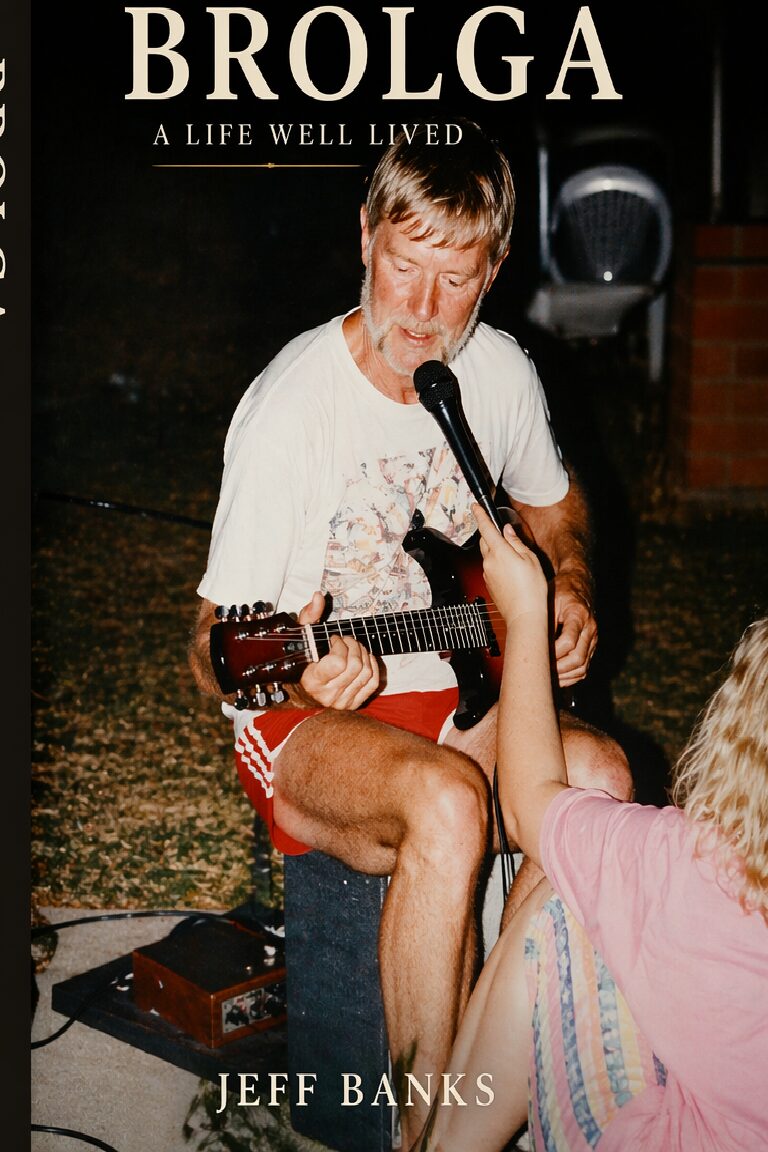
Brolga - A Life Well Lived - Chapter 7 - Whats Wrong in the Now

Brolga - A Life Well Lived - Chapter 7 - Whats Wrong in the Now | Travelling Around Australia with Jeff Banks

The old world, as he knew it, asked more of the body. The new one asks more of the patience. He had survived both. He had paid into the shelf, fed himself from the bush, worked where he could, learned what mattered, and watched as the space around an ordinary life narrowed under the weight of people calling it progress. If there is any wisdom in that, it is not complicated. A place must be known before it is governed. A life must be understood before it is judged. And a man ought to be heard in the language of the ground he has actually walked.

BROLGA


A Life Well Lived


Chapter 7 – Whats Wrong in the Now


Still here, on the riverbank again, where the light folds over the water like a tired blanket and the gum leaves murmur with every breath of the breeze. The bank is still damp in patches, the jig of yesterday’s rain leaving a thin sheen on the timber of the fallen trees. Brolga stands a step back from the water, hands in his pockets, the river doing its slow, patient work beside us. I tell you what I’m trying to do here: put a moment down where the world feels both too loud and just loud enough for its own sake. The kind of moment that doesn’t pretend to fix the weather, only to listen to it a little longer.


“All good fun,” I say, testing the air between us, “what other madness do you see? Around the place.” My voice is casual, as if we’re discussing a fishing spot and not the way the world seems to tilt on its axis every time someone with a piece of paper forgets what bush means.


Brolga doesn’t look at me while he talks. He looks out toward the river, where the light pools in the current and the water leaves its own fingerprints on the rocks. “Oh good Lord save me, …” He lets the sentence trail, a pause stitched into his response like a seam in an old shirt. 


Then: “We’ve got the booze bus. We’ve got the mad green trying to keep them, yeah.” The words come out dry, practical, a little bemused, as if they’ve survived so long by being funny about how ridiculous the rest of it is.


“Ah, Jesus,” he adds, with that same quiet twist to his mouth that says he’s not surprised by the farce, only disappointed by the scale. “Look, it’s just ridiculous what these people don’t… If people up here working in the Shire office here and there from Sydney, you know and the likes, they know nothing about the bush. We’ve got to take everything by the book, which in a lot of times does not work. You’ve got to have the practical experience, lots of things, their own show because they’ve got this piece of paper, they’ve got the right bow.” The river breathes; a lizard flicks across the bank; somewhere a child’s laughter drifts from the town, a reminder that life carries on outside the argument.


“They got business?” I ask, as if I’m trying to pin a point to the wobbling map of it all.


“Yeah,” Brolga says, and I hear the small shake in his voice, the acknowledgment that the world, in its own bureaucratic fashion, keeps moving with or without us.


“The right bow, that sounds like a bit of a card player, you a bit of a card player?” I push, trying to tease out the rule of thumb they’ve learned by heart out here.


“Yeah, I used to cheat, like, shit,” he says, a quick, almost embarrassed laugh escaping him. “Yeah, I just loved that, there you go. Wellbeing in this year in game, that’s what I used to do. I have to, I have to.” He stops himself, the rhythm of a life lived at the edge of the line between bluff and truth. “Night clean the table up. Sitting around playing, you go like, my room will play your room, the winner’ll got to play their room.” The words stumble into the moment, but the memory doesn’t feel wrong here, not when the river keeps its own ledger of small deceptions and larger debts.


“So, did you ever see the movie Sunday Too Far Away?” I ask, as if to anchor us to a shared cultural memory that may or may not exist in equal measure for both of us.


“Yeah.” His reply is short, but his eyes shift just enough to tell me he’s thinking of a night under a starless sky, a fire’s glow, and the stubborn, stubborn land that wouldn’t yield.


“The comment there is Friday too tired, Saturday too drunk, Sunday too far away. Is that how it was?” I press, trying to pull a pattern from the fog.


“Na, no, shit,” he says, and the corner of his mouth tightens with his enduring practicality. “As city people see, they haven’t actually been there to do it. You know I haven’t been out there.” He gestures vaguely toward the far scrub, toward the idea of a life beyond the river that still lives in his chest. “I was reading a book on Syria yesterday, and I was like, Jesus, shit like that, people believe that.” The ache in his voice is not directed at the reader or the listener; it’s directed at the gulf between what’s seen on screen and what’s lived on the land.


“That’s a problem, isn’t it?” I say, trying to keep the conversation from straying into a sermon.


“Yeah, yeah, like on TV,” he says. “I was watching the TV the other day and one of the kids having the exam, fourteen or fifteen year old kids, and one of the questions was about where it will come from and actually from the bush, and most of them put such a big emphasis on a bush. Off a bush. Where it all come from.” The frustration slides across his face as if rain on a window, leaving a smear he can’t wipe clean.


“There’s a cotton farmer up the road here but that’s not where it will comes from,” I say, trying to triangulate the idea with what we know from the ground.


“No, it should be made come out this way for a while. You straighten him out of it, this political correctness,” He punctuates with a shake of his head, and I hear him compress the word, the price of living with a language that keeps moving.


“So you’re not into national service you’re talking about out here and” I’m almost urging the moment toward a tidy moral, but the bush doesn’t want tidy.


“Get out of here, you never look at the real world,” he says, his voice soft but final, as if the land itself has spoken its verdict and left it for him to carry. “Yeah the real world. Well she’s a lot different to that other side of the Blue Mountains. Yeah, the real world.”


There’s a short silence, the kind that makes space for the unspoken to drift in. Then the conversation loosens into something closer to everyday life, the way cricket once drew a map of possibilities across the family’s table, the way a kid from the bush could dream of Campbelltown or Campbelltown’s distant cousin, the city, with its bright lights and bright salaries. We drift to the memory of sport and feet that never quite had the chance to run on a national stage, a life measured not by the scoreboard but by the weight of the day’s labour and the hush of the river when the sun begins its slow descent.


“Is it going to go or not?” I ask, not for a forecast so much as a question about whether there is space to wrestle with the world and still stay here.


“Maybe,” he says, a quiet shrug threading through the syllables, as if the land itself is offering a verdict that cannot be spoken aloud. “Maybe it’s not about fixing the world, but about fixing the moment you’ve got to live in. You plant your feet, you watch the water, you tell the truth the best you can, and you keep going. That’s how you keep the river from swallowing you whole.” The line sits between us, a little oath whispered to the river, to the land, to the stubbornness that keeps us both from turning our backs on something we’ve learned to call home.


The sun slides lower, and colour bleeds into the water like spilled paint, blue, gold, green, until the river glows with that old, patient mercy. An occasional bird darts past, a dog barks somewhere in the distance, and the interruption remains part of the scene, not a fault to be excised. The world’s noise inches closer to the edge of the bank, a reminder that this moment isn’t a sermon or a lecture but a living conversation between two men who have learned to listen as much as they talk.


I don’t pretend to tidy away the mess of the day. If anything, I try to record how Brolga’s words sit inside me: a stubborn political weather, a sense that the bush’s wisdom often travels in a language of practicalities, a distrust of grand theories in favour of lived truth. He isn’t offering a manifesto so much as a stance, to keep listening, to keep working with what the land gives you, to hold on to the ordinary with both hands.


And so we rise, hands tucked back into our pockets, boots pressing into the soft clay along the water’s edge, and we walk toward the car where the day’s last light gathers on the hood like a small, stubborn sun. The river keeps its quiet testimony, and I keep mine, the author’s version of a witness, trying to hold the texture of a world that refuses to simplify, a place where understanding is earned in the small, stubborn acts of staying and listening and telling the truth, as best I can, in this corner of the wide, sprawling bush.


We actually caught three fish that day. All carp, all disposed of as the law required, and in that act alone, much of what my Uncle Max was intimating made sense. 


By the time the light had gone from white to honey and the river had settled into that evening look it gets, as if it has stopped arguing with the day and is prepared now just to carry what comes, Brolga had reached that point where the talk was no longer about one thing. It was about fish and school and work and cards and cod and blokes in offices and money, which is to say it was about life as he had known it, and life as it had slowly been fenced, signed, licensed, corrected, improved and interfered with by people who, in his view, had never once had to stand where he stood and make a week out of not much.


A worm worked its way through the damp edge near our boots. I nodded at it. “What do you reckon that is?”


He looked down, half-snorted, and said, “Just too active, yeah, yeah.” Then, because that was his way, the worm became the opening into a life. “But I was always active. Always done something. Right from about eleven or twelve. Had to.”


Had to. There was a world in that. Not self-pity, not romance either. Just fact. The river lapped at the bank below us with that faint, sucking sound, reeds ticking together in the breeze, and I could picture them all as kids and young parents and old workers all at once, moving because there was no choice but to move.


“We used to decorate the shelf,” he said.


I thought for a second he meant actually decorate it, polish it up, put out some little ornament, and he caught the mistake before I could properly make it. “No, no,” he said. “Put money on the mantelpiece every Saturday morning. That was decorating the shelf. If you was earning, you put it there.”


There was his whole childhood economy in one line. No lecture needed. No sociology. Just a mantelpiece, a Saturday morning, and whatever a pair of hands had managed to bring in. They all spoke like that, in the family: a joke laid over a harder truth, not to hide it exactly, but to make it carryable.


When I asked what he first did for work, he shrugged the way men do when work has been around them so long it hardly counts as biography.


“Picking up. I was in the shed. Then I went off behind the counter stacking shelves. Didn’t like that. You’re inside too much.”


That mattered to him, the inside. It came up again and again, as if being shut in was not just inconvenience but offence. He’d worked as a prison officer for nearly three years and talked about it the same way.


“You’re penned up,” he said. “You had to do this, had to do that. Not my style. My style’s, when you’re ready, do it tomorrow.”


He laughed after saying it, because he knew how it sounded, and because his own laziness, where it existed, was always of a practical kind, never a moral failure. What he meant was that there are times to move and times not to be pushed, and he had spent enough of his life being told by somebody else when and how to do things to distrust any system that arrived with too much certainty.


Then, with that sideways turn he could make without warning, he said if he had his life over he reckoned he’d have been a male nurse.


“I took to that pretty good.”


I reminded him he didn’t like being inside.


“No,” he said, “but I had a driving job, patient transport. Took people Forbes, Parkes, Orange. So I picked up a bit of first aid and a few little skills. And you had people with you all the time.”


“You don’t mind a job,” I said. “No,” he said, smiling. “They’d ask to have me go with them.”


That was Brolga too. Not sentimental, but useful. He liked company if it came with purpose. A road, a patient, a bit of talk, a thermos somewhere, and a reason to keep moving. Even his regrets were practical. He said there were things he’d have done different, same as anyone, but he never spoke as if life had cheated him personally. It was more that life had narrowed and tightened around people like him, year by year, until ordinary survival had become a thing watched over by experts.


He learned more after school than at it, he said. He’d got to about a class above Year 6 and no further.


“I’ve learned a lot more since I left school than I did at school.”


“The bush can teach,” I said. “Oh yeah,” he said. “Give ninety per cent of people a rabbit trap and a rifle and send ’em to the bush, they’d die younger. Just give me a rabbit. I’ll feed you for a week.”


He said it matter-of-factly, without swagger. There was no performance in him when he talked about feeding yourself. It was simply a body of knowledge he carried, same as where the roads went, where the fish held, what weather was coming up the river, what could be made into a meal if it had to be. He talked about pies and fish and prawns and muddy-tasting yabbies with the same seriousness other people reserve for policy. He could laugh at a rough feed while still knowing its worth. Last year, he said, he’d picked a couple of hundredweight of oranges. He could put a meal together out of “just out of the damn bush”, he said, and there was a kind of pleasure in that, a satisfaction in not needing much from the world except room to get on with it.


That, more and more, was what he felt had been taken away.


Not all at once. That was the thing. Not one big theft, but a thousand small interventions. Rules. Forms. Office people. Rangers. Signs. Advice. Improvement. The sort of tidy, well-meaning control that always arrives saying it is for your own good and somehow leaves you with less.


We were talking about Gum Bend by then, and the old little expeditions out there, six or seven kids walking or riding bikes, fishing and picnicking and spending the day away from grown-ups. He could see it plain as if the bank in front of us had folded back and shown him the old place underneath.


“We used to go fishing all the time,” he said. “Walk out there or ride bikes out there. Whole little crew. Then they build a lake there.”


I asked about the day they emptied it, because I knew, and because even after all these years the anger still had heat in it. “I was really, really angry about that,” he said. “Really angry. And they wouldn’t let anybody go and transfer from the fish floundering about, to the river, which is only four or five hundred yards away.”


We were talking about cod then. Big fish. Five and ten pounders, yes, but also bigger. “Twenty-five, thirty pound,” he said. “Big fish. Lots of fish.” Not the introduced carp, the scourge of the inland waterways these days.


And then the verdict, delivered as he delivered most of them, not loudly, but with weary certainty. “City people. They don’t know what they’re doing. City people that like the country area. They just don’t know.”


He meant the sort who arrive with a fondness for the idea of country and an authority over its actual workings. Wardens, rangers, office staff, departmental men and women, all the new custodians of places they had never grown inside. You weren’t allowed to move the fish. You weren’t allowed to take them. You weren’t allowed to solve the problem in front of you with the knowledge in your own hands.


“They wouldn’t let you eat them and they wouldn’t let you deal with it,” I said. “Just ridiculous,” he said.


It was a word he came back to often: ridiculous. Not tragic, not evil, though sometimes you sensed he could have mounted a case for either. Ridiculous was better because it captured the insult of it. A person trying to live, feed people, work, mend, transport, catch, carry, keep a place in order, and some distant mechanism stepping in with a printed instruction that had never once had mud on its boots.


When I asked him what other madness he saw around the place, he gave that little exasperated laugh that was half amusement, half despair.


“Oh, good Lord save me.”


We stood there watching the river slide past. Somewhere up behind us a vehicle changed gears on the road. A bird carried on in the lignum. He started with the obvious things, booze buses and this campaign and that campaign, but quickly got to the part that mattered to him.


“Look, it’s just ridiculous what these people don’t know. People up here working in the Shire office here and there from Sydney, and the likes, they know nothing about the bush. We’ve got to take everything by the book, which a lot of times does not work. You’ve got to have the practical experience.”


He spoke of “this piece of paper” the way some men speak of a weapon. Qualification, permit, certificate, licence, policy, directive, report: all those official versions of knowing. He did not begrudge learning. He begrudged authority being handed to people who had learned only one way.


“They think because they’ve got this piece of paper they got the right,” he said.


A fish rose somewhere out in the slower water with a soft plop and was gone. It seemed to underline the point.


He wasn’t against all order. That would have been too easy, and too false. He knew the world needed laws. He had worked in a prison. He had carried the sick from town to town. He had seen enough of human beings to know chaos was no philosophy. But he had also seen what happened when rules were written with no smell of river mud in them, no memory of drought, no understanding of what it means to be poor a long way from help.


The talk wandered, as it always did, to cards, because even indignation could not keep him solemn for long.


“Used to cheat,” he said cheerfully. “Shit, yeah. Loved that.”


He laughed, and I laughed, and for a minute the whole thing was rooms and tables and men staying up too late, playing whoever won the previous hand, cleaning the table up if your luck ran. Then he was back to the world beyond the card game, talking about a film version of the bush and rejecting it outright.


“Na, no, shit,” he said, when I asked if it was really Friday too tired, Saturday too drunk, Sunday too far away. “That’s city people. They haven’t actually been there to do it.”


That was his grievance in its simplest form. They haven’t actually been there. He’d say the same of television, newspapers, school exams, all those airy public conversations in which the bush appears as topic, backdrop, product source or voting bloc, but rarely as a lived world with its own intelligence. He mentioned seeing kids asked where something came from and most of them, in his telling, had no idea. Out of a bush, off a bush, from nowhere they understood.


“Should be made come out this way for a while,” he said. “Straighten ’em out of it.”


He did not mean that in some grand civic program sense. He meant literally: come here. Stand here. See what this takes. See what a week looks like, a dry year, a poor season, a morning when the shelf needs decorating and there is not much to put on it. See what happens when there is no money to send a talented kid away to chase sport or study or something shinier over the Blue Mountains.


“Did you ever think of doing that sort of thing?” I’d asked him earlier, talking about country kids who make it big.


“No, we never had the money,” he said. “Maybe if there’s money around maybe I’d have done a lot for myself. I don’t know. But you just couldn’t afford to send your kids away. There’s just nothing there. We had to go to work.”


That sentence stayed with me. We had to go to work. It explained half the family history and most of the bitterness without turning any of it sour. The old world, as Brolga saw it, had been hard, certainly, but it was legible. You worked. You contributed. You learned from the bush because the bush was there to be learned from. You knew who your people were. You knew the river and the roads and the seasons and who’d lend a hand and who wouldn’t. It was not easier, necessarily. Only clearer.


The world as it is, in his reckoning, is fuller of interference and emptier of understanding. There is more advice, less wisdom. More management, less knowledge. More people telling you how things ought to run than people who have ever had to run them. “The man,” though he never always called it that, was everywhere now: in offices, in regulations, in inspections, in cameras and buses and gatekeepers and environmental fixes done badly and social fixes done from a distance. Not some single villain, not a neat conspiracy, just a steady pressure of officialdom on a life already busy surviving.


And that pressure, over a lifetime, had become personal. You could hear it in him. Not only anger for what had happened to places like Gum Bend, or irritation at this or that shire rule, but a deeper exhaustion at being perpetually instructed by strangers. He was a man who had fed himself, worked from childhood, contributed at home, served in jobs that were not easy, carried patients, learned first aid, known the roads, known the rivers, buried people, remembered people, and still had to stand there while somebody fresh over the range told him what the real world was.


He looked out across the water for a while before saying the thing that, in one form or another, had been sitting underneath the whole afternoon.


“They should walk a mile in my shoes,” he said. “Before they even open their mouths.”


He said it looking out over the river, not at me, as if the water was the proper witness for a thing like that. There was no big performance in it, no table-thumping outrage, just the flat weariness of a man who had spent a lifetime being explained to. What he meant was plain enough. Come out here before you start in on us. Come out here before you write the rule, make the speech, cut the ribbon, announce the package, shake hands for the camera and tell everybody how the country ought to be run. Come out here when the pump’s playing up and the bills are sitting there and the price of fuel has climbed again or inflation is just a way of life. Come out here when a kid can’t go because there’s no money to send him, when a family has to choose between keeping something going and letting it go under, when the help on offer turns up in the form of forms, conditions, delays and somebody in polished boots talking about outcomes. Walk that mile first. Then, maybe, open your mouth.


There was no rhetoric in it. If anything, he sounded tired. Just tired of being spoken over by people who had never gone hungry, never left money on a mantelpiece because that was how home was held together, never watched good fish die under a decision made elsewhere, never had to choose work over possibility because possibility cost too much petrol. Tired, too, of politicians forever mistaking charity for respect. That had come up before in other ways, this business of a hand up, not a handout. Brolga had no time for being patronised by people whose whole trade seemed to be keeping themselves in office by looking helpful at a distance. He did not want saving. He wanted room to stand up in his own life. A fair go. A practical chance. The sort of help that lets a person keep going under their own steam instead of lining them up to receive some small favour as if gratitude were part of the transaction.


That was the difference, as he saw it, between doing your job and saving your job. Doing your job meant making it possible for people to work, travel, repair, catch up, keep stock alive, keep kids in school if they could, keep old people near services, keep a town breathing. It meant roads that held together, rules that had some common sense in them, departments that listened before they dictated, and legislation written by people who knew that a map and a policy brief were not the same as a life. Saving your job was something else entirely. That was all promise and posture. A bit of money flung at the symptom, a slogan about support, a visit in election season, then back over the mountains before the dust had settled on the car. Out here, people could smell the difference.


Brolga’s view of it was hard-earned and simple. If a man is trying to survive, you don’t weaken him with dependency and call it kindness. You back him to do the thing he already knows how to do. You clear some space. You stop making every ordinary act of living answerable to somebody who has never had to rely on it. You give him a hand up if he needs it, sure, but you do it in a way that leaves his dignity intact and his hands still his own. The river slid on beside us as he spoke, quiet and old and unimpressed by governments of any stripe, and that seemed part of the point as well. Country does not ask for much in the way of speeches. It asks whether you understand what it takes to stay.


And that was the pressure he had lived under for so long: not just hardship itself, which he knew how to meet, but the added weight of being managed by people who confused intervention with understanding. Over the course of his life the man had arrived in more and more forms, office, ranger, department, inspector, regulation, incentive, restriction, scheme, each one claiming to know what was best. But Brolga had learned early that surviving was not a theory. It was a practice. It was Saturday money on the shelf. It was making a meal out of what was there. It was doing without and carrying on. So when he said they should walk a mile in his shoes, he was not asking for sympathy. He was asking for competence. For humility. For legislators to do the decent thing and learn the ground before they presumed to govern it.


The river moved on, as it always had, carrying sticks and light and old reflections of gum trunks. A mosquito found my wrist. Downstream, a cow bawled. The ordinary world kept interrupting the larger one, which felt right. That was Brolga’s philosophy too, if it could be called one. No grand theory survives long out here unless it can stand up to weather, bills, grief, hunger and the plain business of living.


As the light dropped further, he softened a little, or maybe just widened out. He was not saying the old world was perfect. He knew too much for that. There had been poverty in it, and limits, and chances missed for no better reason than no money. There had been hard men and narrow lives and too much work too young. But there had also been a kind of freedom in being left alone to know your country and answer to it. The new world, for all its improvements, too often treated that freedom as ignorance and that knowledge as something quaint until it wanted to use it.


We turned back toward the car at last, our boots scuffing the sandy rise above the water. He said he had some pictures he could show me, something about crayfish and traps and foil and pizza boxes, and the whole thing nearly collapsed into laughter again, which was also right. You could not stay solemn with him too long. Humour was one of the ways he stopped grievance turning poisonous.


At the top of the bank I looked back. The river was darker now, the far trees almost blue, and the current held the last of the sky in a long broken stripe. It occurred to me then that this was not simply Brolga’s complaint against the modern world. It was his defence of a lived one. A plea, maybe, though he’d never use a word as soft as that. A demand, more like, issued in the plain speech of a man who had earned it.


Come out here. Before you legislate, before you theorise, before you improve, before you tell us what country life means, walk a mile in my shoes. Walk it in the heat. Walk it in the mud. Walk it with not enough money and too many mouths and a shelf to decorate on Saturday morning. Walk it with a rabbit trap, a busted net, a patient in the back, a deadset understanding of weather, a memory of fish in a waterhole now ruled over by signs. Walk it with all the little pressures a life gathers when it is forever being managed by people who do not know it. Then open your mouth, if you still feel the need.


Brolga opened the car door and stood there a second, one hand on the roof, the last light catching him side-on. Behind us the river went on doing what rivers do, indifferent to every office and argument, faithful only to its own old course unless somebody intervened there too. That, in the end, felt like the right place to leave him: not defeated, not triumphant, just standing in the pressure of his own time, still dryly amused, still unconvinced by most official explanations, still certain that the world had become too full of the man and too thin on understanding.


The old world, as he knew it, asked more of the body. The new one asks more of the patience. He had survived both. He had paid into the shelf, fed himself from the bush, worked where he could, learned what mattered, and watched as the space around an ordinary life narrowed under the weight of people calling it progress. If there is any wisdom in that, it is not complicated. A place must be known before it is governed. A life must be understood before it is judged. And a man ought to be heard in the language of the ground he has actually walked.


The river kept moving in the dark, and that seemed answer enough.


Like I said, we actually caught three fish that day, all the dreaded European carp, just another reminder of the madness of decision-making away from the reality of the coal face.


Author

Menu