

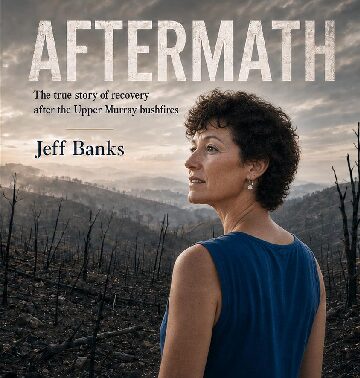
AFTERMATH Chapter 14 - Staying on via Gateway Health

AFTERMATH Chapter 14 - Staying on via Gateway Health | Travelling Around Australia with Jeff Banks

Recovery, I have learned, is full of repeated questions. Are we there yet? No. Are we better than we were? Sometimes. Has the community recovered? Which community? Which family? Which farm? Which person? Which day are you asking about? The answers can sound the same for a very long time, not because nothing has changed, but because change after disaster does not move in a straight line. People rebuild one thing and then find another has cracked. They get through an anniversary and then fall apart over a smell, a wind direction, a road closure, a bank letter, a child’s question, or the sight of new grass growing where everything was black.
AFTERMATH

Chapter 14

Staying On via Gateway Health

Leaving bushfire recovery was not as simple as handing back a phone, closing a laptop and saying thank you very much, I am off to do something else now. I think, at the time, part of me wanted it to be that clean, because there is something tempting about a neat ending when you have been living inside a thing that has had no neatness in it at all. A formal role ends. A contract changes. A position disappears or becomes something different. The calendar says one chapter has closed, so surely the mind and body should fall obediently into line.

Of course they do not. People do not stop recovering because your job title has changed. Communities do not stop needing answers because the structure around them has shifted. The questions keep coming, and often the answers sound much the same as they did months earlier. How are people going? They are going. What do they need? It depends who you ask. Are things getting better? In some ways, yes. In others, not yet. Not really. Not in the way people outside the place imagine when they hear the word recovery.

When I moved into Gateway Health, I was not walking away from the Upper Murray, but I was trying to step out of the centre of the bushfire recovery space. Gateway Health, or GH as we often called it, was a broad community health organisation working across seven local government areas. It did a bit of everything, really. Mental health, dietitians, allied health, events, behaviour change, family violence programs, services for people who needed support in all sorts of different ways, and even a GP clinic. It was one of those organisations where the title community health did not quite capture the size of the umbrella.

My role there was a new one, around diversity and inclusion. The organisation had recognised that the communities around Wodonga and across its wider footprint were changing. There was more multicultural diversity, a need to be more thoughtful around First Nations people, LGBTI people, people with disability, and people who might not always find mainstream services easy to approach. My work was meant to help set up the internal environment so Gateway could work more successfully with that diversity. On paper, it was a shift away from bushfire recovery. In practice, it was people and systems again, and trying to make the two of them behave sensibly in the same room.

That was the part that felt familiar. I had come from bushfire recovery with a head full of lessons, many of them learned the hard way, and a heart that had not quite worked out where to put them all. My boss at Gateway knew that. She sat at a senior level in the organisation, just below the CEO, and she understood that my experience was not something I could simply file away under previous employment. Gateway had a bushfire recovery team of caseworkers working into affected communities, one-on-one with families dealing with complex things. It was an innovative model, and it mattered, because recovery does not always fit comfortably into a form, a program guideline or a tidy service map.

Very quickly, I found myself being drawn into conversations with the manager of that team and with senior people around how to make the most of the work. There were questions about grants, challenges about how to keep programs going, and discussions about how to respond to what families were still bringing through the door. I was not back in the same role, and I was not carrying the same direct responsibility, but I was still close enough to know the language and the landscape. It was actually good, in a complicated sort of way, to be able to think differently while still remaining connected to the recovery space.

That connection mattered to me, although I had to be careful with it. I knew so many people by then, not just as names on stakeholder lists or contacts in a spreadsheet, but as people. Some I emailed. Some I spoke to. Some I crossed paths with when work took me back up towards Corryong or into other parts of the Upper Murray. There were also a couple of women I had become very close to through the recovery work, and in those early days after leaving BRV and joining Gateway, we caught up quite a bit. One lived between Tallangatta and Wodonga and another in Albury, so the geography made it possible. The friendship made it necessary.

Those catch-ups kept the fire recovery alive in my head. That was comforting, and it was also hard. Both things can be true without cancelling each other out. I was glad to know what was happening, glad not to feel as though I had vanished from a place that had taken up so much of me, but I also needed distance. I needed to grow again in another direction. I needed to use my skills for something that was not only bushfire, loss, grants, trauma, fencing, insurance, exhausted families and agency meetings. There is a point where staying useful can become another way of not leaving, and I had to watch that in myself.

I do not think people still saw me as part of the formal recovery effort, and that was probably healthy. Occasionally a community group would ring and say, look, we just do not know how to solve this, can you give us some advice, we want to write this grant and it is really important to us. Occasionally someone from the recovery team would ring and say, there is this issue, you know more about the background than we do, can you fill us in so we can move forward. That was fine. It was not constant, and just as well, because if it had been, I think it would have kept me anchored too tightly to a space I was meant to be leaving.

The stories still came, because people were used to telling them. Once someone has trusted you with a part of their experience, they do not always go back to treating you as a stranger just because your email signature has changed. The difficulty was knowing where all those stories belonged. There were professional communications people doing good work, and efforts were made to capture community stories through web pages and local reporting. The Corryong Courier kept telling local stories, which was important. Organisations working in the area also included community stories in their public reporting, often connected to the services they were providing.

The wider media moved on, though, and I found that a shame. I understand how media works. The next emergency comes. The next dramatic image arrives. The attention of the general public shifts, not always because people stop caring, but because they are not being shown what comes next. I think there were follow-up stories people would have wanted to hear, if only they had been told. Stories about the slow return of ordinary things. Stories about people still waiting. Stories about fatigue that does not photograph well. Stories about what recovery looks like when the flames are long gone and everyone is tired of being asked whether they are okay.

Through Gateway, I also had the chance to reach out to diverse groups across the organisation’s footprint. That took me back up to Corryong and into contact with people who could be very isolated, including LGBTI people and people with disability. That mattered because disasters do not land evenly. They find the cracks that were already there. If you were isolated before the fire, the fire could make that isolation sharper. If services were hard to access before, they did not magically become easier because a recovery program had been announced. If you did not feel seen by mainstream systems before, a disaster could make you feel even more invisible.

That was one of the things I came to understand more strongly after leaving the formal bushfire role. Recovery was not only about people who had lost houses, fences, stock or sheds, though of course it was very much about those things. It was also about how people entered the disaster with different levels of safety, power, health, money, connection and confidence. Some had family nearby. Some did not. Some had the kind of personality that could ring an agency and push until they got an answer. Others could barely make the call. Some could sit in a room full of officials and say what they needed. Others would nod politely and leave with nothing solved.

Later, when my role at Gateway ended and I moved into Women’s Health, that understanding deepened again. That move began almost as a stopgap. My role had been made redundant, and a friend working in Women’s Health said there was a short-term role where I could help with something they were struggling with. I thought it would give me a couple of months of headspace while I worked out what came next. Like many sensible plans, it did not survive contact with real life. The role became permanent, and I became a Community Development Coordinator across eleven local government areas.

It did not take me long to find my way back up to the Upper Murray. There was momentum around establishing an inter-agency network there, where the different organisations doing bits and pieces of work could come together once a quarter and compare what they were hearing. What are the gaps? What is coming up again and again? Who is seeing what? What can we do about it? That sort of work can sound dull if you put it in a report, but on the ground it can be the difference between everyone working hard in separate corners and people actually joining the dots.

I still felt I had an influence there, although it was a different sort of influence. I was not the person standing in the immediate aftermath trying to work out what needed to happen by the end of the day. I was one of the people asking what was still happening months and years later, when the questions had become quieter but not necessarily easier. In Women’s Health, I also dived into the research around disaster recovery and women’s health. There was already important work done by Women’s Health Melbourne North East on the gendered impacts of disasters, and that helped give language to things I had seen but not always had the framework to explain.

The gender impacts after disaster are fascinating, and I do not mean fascinating in a distant academic way. I mean the sort of fascinating that makes you sit back and think, yes, that is exactly what I saw, and also, why did we not see it clearly enough at the time? There are social norms around fire and disaster that say men go out and fight the fire while women look after the kids and evacuate. The Upper Murray did not fit that neatly. Plenty of women were right in the middle of practical farm and fire realities, and plenty of men were carrying fear and helplessness in ways that did not announce themselves openly.

Still, the gendered pressures were there. I saw women from farming families trying to deal with insurance companies or banks, only to be told that nothing would be signed or progressed until they brought their husband in. It might not matter that she was a legal owner of the property, or at least a fifty per cent owner. The assumption still sat there, stubborn as an old fence post. The man was the one they wanted in the conversation. The woman could do the work, gather the papers, chase the answers, hold the family together and understand the details, but still be treated as though she was only partly authorised to speak about her own life.

That sort of bias adds pressure in a way that is hard to measure. After a disaster, women were often expected to help get the household functioning again, manage children, watch the finances, keep an eye on neighbours, rebuild routines and also monitor traumatised partners. I had women talk about the stress of not knowing how to support their husbands, and that stress sat on top of everything else. The house, the farm, the bills, the children, the community expectations, the forms, the appointments, the phone calls, the emotional weather inside the home. It was all connected.

Young people were part of that too. There is a risk after disaster that young people reach a point where they do not know what to do with what they are carrying. They might not have the words, or they might be tired of the words. A parent, often the mother, can find herself watching constantly, not just for whether homework is done or whether school is being attended, but for signs of despair. That is a terrible kind of vigilance. It is not dramatic from the outside. It looks like ordinary parenting, until you understand the level of fear under it.

Men and women often carried recovery differently, although I am wary of making that sound like a hard rule. In general, men were often seen to hold recovery through doing. Fixing fences. Buying stock. Burying stock. Clearing, rebuilding, repairing, assessing, getting on with it. Women did some of that too, because rural women are hardly standing around waiting for someone to hand them a decorative role. But many women also carried the planning of how the family would recover as a family. How are we going to keep the finances even? How are we going to get the kids to school when they do not want to go? How do we reconnect with the footy club, the neighbours, the school, the services, the small ordinary structures that made life feel like life before all this?

None of that is more important than the other, but it is different. The problem is that it is not always acknowledged as different. I came to see that some mental health services focused on women as a pathway to reach men, rather than seeing women as people who needed support in their own right. The logic is understandable, because women were often the ones who would answer the phone, come to the meeting, say yes to the appointment, or quietly explain what was really going on at home. But if you only see women as the access point to someone else’s wellbeing, you miss the weight they are carrying themselves.

I was asked once whether women became the emotional organisers of families and communities, and I still find that difficult to answer cleanly. Women were often the first to start reconnecting in an obvious way. They would check who needed food, who needed water, who had been seen, who had gone quiet, who might need someone to drop in. That sort of checking can be dismissed as nattering if you are not paying attention, but it is not nattering. It is social infrastructure. It is emotional mapping. It is people keeping track of one another because no official system, however well designed, can know everything a neighbour knows.

But men were doing emotional work too. It just looked different. Two men standing at a fence line talking about whether the posts are straight may be having a deeper conversation than anyone gives them credit for. They might be checking how each other is going without asking the question directly. They might be testing whether the other bloke is coping, whether he is still himself, whether he needs help, whether he is ready to accept it. It is chalk and cheese compared with the way many women connect, but both forms matter. If recovery systems only recognise one language of distress, they will miss half the conversation.

All of this made me better at my later work, although I wish I had learned some of it earlier. Bushfire recovery taught me to listen better. It taught me to bite my tongue when my first instinct was to jump in with a solution. That was hard for me, because practical people like fixing things, and recovery work is full of things that appear to need fixing immediately. But you can do damage by offering the first solution too quickly. You can set up hope that later fails. You can answer the wrong question because you have not listened long enough to hear the real one.

That lesson stayed with me. Listen and respond without trying to fix something. It sounds simple, and it is not. Sometimes people do not need you to solve the whole problem in the first conversation. Sometimes they need you to understand why the problem is not as simple as everyone keeps making it sound. Sometimes they need you to sit with the fact that there is no good answer yet. That is uncomfortable, especially inside systems that like outputs, outcomes and action plans. But discomfort is not a reason to rush.

The later work did reopen wounds. Not as sharply each time, but enough. When I first started at Gateway, and then again when I first moved into Women’s Health, anything connected to the Upper Murray could still hit hard. If a conversation came up about women’s health in that space, or a gap in services, or a chance to get something useful up there, I could feel myself become intense. I would bring a lot of my own need into those conversations. I wanted the area remembered. I wanted resources to go there. I wanted the people I cared about not to be forgotten simply because they lived up a winding road beyond the easier reach of decision-makers.

Over time, I think I matured in that space. That is the word that feels right. I still have a bias towards the Upper Murray, and I do not apologise too much for that, although I try to be aware of it. If there is something useful happening, I will still try my hardest to get a version of it to that area. But I can stand back better now. I can see the broader picture without feeling I am betraying the people up there. I can care without having to carry everything.

Some of the people I first met through the fires have remained part of my life, and that is one of the unexpected gifts of a hard time. I have friends now I would not have had without the fire, which is a strange sentence to write because you would never choose the cause. Still, the friendships are real. People from the Upper Murray, people from the bushfire recovery teams, people from Gateway. Some of us still meet every six weeks or so for lunch, just to catch up. Not because there is an agenda. Not because a project requires it. Because we care about how each other is going.

There is something very grounding in that. After all the formal meetings, the grant applications, the service coordination, the difficult phone calls and the heavy stories, sometimes what remains is a group of people around a table asking about each other’s lives. That is not a small thing. In recovery work, you see people under pressure, and they see you under pressure too. You learn who keeps showing up. You learn who can sit with hard things. You learn who remembers that behind every role is a person trying to do a decent job without losing themselves completely.

Staying connected now means staying interested. It does not mean being on the phone every week or catching up constantly. It means being aware of what is happening in that space and with those people. I still get the local paper electronically every week. I am on Facebook pages connected to the area, and through those I get a sense of what is moving, what is stalled, who is celebrating something, who is grieving something, who is asking for help, who is quietly getting on with it. I do not feel the need to contribute all the time. I just feel a need to know.

Sometimes, if old Corryong friends come down to Wodonga, we will arrange to meet and have a cuppa, or at least try to. My two close friends from that period and I still make time when we can. We may go too long between proper catch-ups because jobs change and life gets busy, but then one of us will say it is time. Time for a weekend. Time for a chin wag. Time to retell some stories and probably repeat ourselves a bit, because that is what people do when they have shared something that still needs a place to live.

Could I have walked away completely? Yes, I think I could have. I could have moved five hundred miles away and got on with my life. I would have taken the learning with me. I would have kept some connections, probably, but it would not have been the same. I do not think I needed to remain useful in the way I once was. That is an important distinction. I did not need to keep doing things for people, or solving problems, or being called into every conversation. But part of me did need to keep an eye on them.

That phrase, keeping an eye on them, sounds almost parental, and I do not mean it that way. The Upper Murray does not need me hovering over it like some self-appointed guardian, and the people there would rightly tell me to pull my head in if I behaved like that. What I mean is quieter than that. I mean I remain interested enough to notice. I remain connected enough to care when something happens. I remain close enough that the place has not become a past-tense chapter in my own working life.

Recovery, I have learned, is full of repeated questions. Are we there yet? No. Are we better than we were? Sometimes. Has the community recovered? Which community? Which family? Which farm? Which person? Which day are you asking about? The answers can sound the same for a very long time, not because nothing has changed, but because change after disaster does not move in a straight line. People rebuild one thing and then find another has cracked. They get through an anniversary and then fall apart over a smell, a wind direction, a road closure, a bank letter, a child’s question, or the sight of new grass growing where everything was black.

My work through Gateway Health, and later through Women’s Health, taught me that staying connected does not have to mean staying trapped. It can mean carrying the learning forward into different rooms. It can mean recognising the same patterns in new work. It can mean hearing the same question and not rushing to pretend the answer has improved just because time has passed. It can mean understanding that long-term recovery is not a slogan. It is a lived reality, and for some people it is still unfolding long after the rest of the world has turned the page.

I am grateful I did not have to leave completely. I am also grateful I found work that gave me some distance, because without that distance I do not think I would have grown. The fires changed the people who lived through them, and they changed many of us who worked around the edges of their loss. Not in the same way, and not with the same weight, but enough that the old version of ourselves did not quite come back either.

So I stayed connected, but differently. Through Gateway. Through Women’s Health. Through friendships. Through local stories. Through the habit of noticing. Through the understanding that sometimes the work after the work is not to fix, lead, organise or rescue, but simply to remain awake to what is still happening. That may not sound like much in a formal recovery plan, but in real life, in the long tail of disaster, it matters.

Because the aftermath does not end when your role ends. It keeps moving through people, families, services, friendships and small towns that are still learning what the new normal asks of them. The questions continue. The answers often sound familiar. And sometimes the best thing you can do is stay interested enough to hear them properly when they are asked again.

Author

Menu