

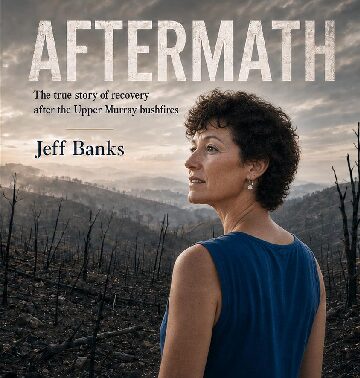
AFTERMATH Chapter 15 - It Never Ends

AFTERMATH Chapter 15 - It Never Ends | Travelling Around Australia with Jeff Banks

Recovery is hard because it is not restoration. That may be the simplest and most important thing I have learned. Restoration suggests putting things back the way they were, but that is not possible. Recovery means finding a way to live with what has changed. It means building something that may work, even if it does not match the memory. It means accepting that some losses cannot be compensated, some mistakes cannot be undone, some relationships will not return to what they were and some people will carry the fire quietly for the rest of their lives.
AFTERMATH

Chapter 15

It Never Ends

There is a particular feeling now when smoke appears on the horizon. It is not panic exactly, although panic may be sitting in the room somewhere, waiting to be invited in. It is more like every sense in the district lifts its head at once. People look out the window, step onto verandahs, ring neighbours, check the wind, open Facebook, listen for sirens, scan the ridgelines and start building a map before any official map has had time to catch up.

I have watched it happen. A puff of smoke appears and within minutes the valleys are talking to each other. Someone asks where it is. Someone else says it looks to be near a certain road or gully. Another person knows whose place is in that direction. Then comes the small comfort of a reply: it is all right, Fred is burning off, or Joe has got a machine going, or Mary has checked it and it is not moving. On other days the replies are not comforting. On other days the questions come faster, and the old knowledge sits underneath them all: where is it going now, where is it going now, where is it going now.

That is part of what I mean when I say it never ends. I do not mean everyone remains in the same raw place forever, unable to laugh or work or plant a garden or barrack at the footy again. People do come back into themselves in different ways. Fences go up, mailboxes appear, stock return to paddocks, community groups meet again and the local paper slowly begins to carry stories that are not all about fire. That matters, because those things are not cosmetic. They are signs of life pushing up through ground that has been asked to carry too much.

But recovery is not a door you walk through and close behind you. It is not a ribbon-cutting, a grant acquittal, a rebuilt shed, a new set of yards, a school assembly, a memorial event or an anniversary morning where someone can finally say, there, that is done. The fire changed the shape of things. Whatever path the Upper Murray was going to take before those fires, that path is gone. Not necessarily ruined, and not necessarily worse in every respect, but gone. The story from that point on bends around the fire whether people want it to or not.

Years from now, some young bloke might be standing at the local footy ground talking about the surface and the irrigation and how good the facilities are, and someone older will say, yes, that came through bushfire recovery money. A community might meet in a hall with new improvements and somebody will remember that the funding came after the fires. A fence around a cemetery, an artwork in a town, a playground, a mural, a rebuilt shed, a changed road, a line of trees planted differently from the ones before: all of it becomes part of the place. It does not mean the fire won. It means the fire is now woven into the fabric, whether anyone asked for that or not.

That is hard for governments to understand, I think. Government likes a beginning, a middle and an end, preferably with reporting dates. It likes programs with names, teams with structures, funding rounds with guidelines and outcomes that can be described in a paragraph by someone who has not had to sit in the kitchen with the person living the outcome. I am not saying that to be cruel, because there are many good people inside those systems. I have worked with them, argued with them, relied on them, been frustrated by them and at times probably frustrated them in return. Recovery needs government, but government does not always know how to sit with recovery.

The trouble is that disaster does not wait its turn. In the North East, it has felt as though one disaster has barely taken its boots off before the next one is at the door. Fires, then landslides, then floods, then COVID sitting over everything like a wet blanket nobody could shake off. Now there are fresh fires layered over old ones, and drought sitting on the horizon with its arms folded, giving everyone the look of something that knows it will eventually be let in. You do not get a clean finish. You do not even always get a breathing space month.

That layering matters. It matters because when another fire goes through, you cannot always separate what belongs to which event. Physically, some of the lines blur in the landscape. Emotionally, they blur even more. A person may be reacting to the latest smoke, but the body is remembering the last fire, the one before that, the night the phones went out, the day the road closed, the morning the stock were gone, the afternoon someone came with a form and good intentions but no real answer. You cannot put those things in separate folders and expect people to behave as though they stay there.

I still believe one of the greatest pieces of unfinished work in recovery is learning how to stop relearning the same lessons. We gather extraordinary people into teams, and those people work hard enough to wear themselves thin. They learn the country, the families, the politics, the small histories, the mistakes that will hurt if repeated and the words that should not be used in a particular hall on a particular night. Then the funding ends, the team is stood down, the people move on, and the knowledge leaves with them. The next disaster comes and we start again, acting surprised to find the same holes in the same road.

If you read recovery reports from different disasters, the same lessons keep appearing like weeds after rain. Community knowledge matters. Local leadership matters. Timing matters. Trust matters. Communication matters. Flexibility matters. People need to be listened to before services decide what they need. None of this is mysterious, yet somehow it keeps being rediscovered as though the last lot of people had not already learned it the hard way. That is one of the things that still sits with me, because it is not only inefficient. It is disrespectful to communities that have already paid for those lessons in loss.

The Upper Murray still has unfinished work of its own. The relationship between community and government, particularly local government, has been bruised and is still being repaired. It is better than it was at different points, but better is not the same as healed. There is still mistrust, still cynicism, still that wary look people get when an outsider arrives with a logo on their shirt and a plan in their folder. Some of that is unfair and some of it has been well earned, which is usually the uncomfortable truth of these things.

Planning and rebuilding have carried their own pain. Regulations are there for a reason, and nobody sensible wants people rebuilding in ways that put them straight back in danger. But there is also the reality of what people can afford, what insurance will cover, what a family is prepared to risk and what a farm actually needs in order to function. A shed is not just a shed when it holds the working life of a property. A fence is not just a fence when it controls stock, protects income and marks out a routine that has existed for decades. A house is not just a house when it is the place a family has measured itself against for generations.

That conversation between safety, responsibility, government expectation and personal risk is nowhere near finished. Years ago, people built and carried more of the risk themselves, partly because there was not much choice. Now there is an expectation, sometimes reasonable and sometimes complicated, that government will help, protect, regulate, rescue and rebuild. Somewhere in that is a line that communities and governments need to understand together, not through a policy document thrown over the fence after the event. Until that line is clearer, people will keep feeling trapped between being told what they cannot do and being left to carry what nobody else can fix.

The mental health work is still enormous. I know that is a plain sentence for a complicated thing, but sometimes plain is all that will do. There are people who still live with the fire every day, not in a dramatic way they announce to strangers, but in the way their shoulders change when smoke is mentioned. You can sit down with someone, have a cuppa, talk about ordinary things, and then one word will pass through the conversation and the room tightens. It may be smoke, wind, generator, insurance, cattle, road closure, school, summer. The word itself does not matter so much as the door it opens.

Some farms have problems that cannot be solved simply by replacing what was there before. You cannot build back breeding lines of stock that took years to develop. You cannot restore income overnight when the stock are gone, the pastures are damaged, the fencing is incomplete and every dollar you have is going into rebuilding the thing that used to produce the dollars. You cannot always live on the farm while the farm is being rebuilt, and you cannot always make good decisions when every option is expensive, temporary or wrong in a different direction. People outside that world sometimes think recovery is about assets. Farmers know it is about rhythm, identity and the quiet confidence that tomorrow’s work still belongs to you.

The land itself keeps speaking. You can still see ridges where the fire burned so hot that the old cover is gone and the bones of the country show through. Granite that was hidden by scrub for a lifetime is suddenly exposed. Hillsides that once carried green now throw light back in ways that can feel almost indecent. I remember speaking with a woman after rain and frost, on a clear morning when she had walked outside as she always did. She told me she had her eyesight back now, and for a moment I thought she meant illness or injury. What she meant was that the granite face above them, once covered by scrub, had iced over and turned into a mirror. The hill she had known all her life had become something so bright it was blinding.

Those are not the kinds of details that make the news for long. They do not sit easily beside footage of flames or helicopters or a politician in clean boots. But that is where the fire keeps living. It lives in the changed light off a hill. It lives in the creek that still needs restoration, the paddock not yet properly resown, the half-burnt posts stacked where someone has not had the heart or the time to move them. It lives in old trees with strange limbs because the fire took one part of them and left another. It lives in a derelict old inn by the road, burnt to a husk, that I pass and remember as something people once had plans for.

It also lives in the small, deliberate things people keep. I have seen burnt fence posts set into gardens, twisted metal kept as a marker, little private memorials made from objects that might look like rubbish to anyone else. There is a difference between a hurtful reminder and an acceptable memento, although nobody else can decide that line for you. Four posts left where a hay shed used to be can feel like an accusation. A charred piece of timber placed carefully near a garden bed can feel like acknowledgement. People find their own ways to say this happened, and I am still here.

Anniversaries are strange things. The first one taught me that very quickly. We had this idea that we might bring people together and mark survival, and a part of the community thought that was right. Another part was deeply upset by it, and fair enough too. One person’s celebration of endurance can be another person’s reminder of the worst day of their life. In the end, the villages and communities needed to decide for themselves what the date meant, because no single event could carry it for everyone.

What I noticed more strongly as the next fire seasons approached was not ceremony but preparation. People wanted to know how to maintain a generator, how to start a pump, how to manage solar when the power was out and the system still needed electricity to function. There were hard lessons in that. Some people had believed they could run pumps from solar when the mains failed, only to discover there was no water coming at the moment water mattered most. The fire had turned theory into experience, and experience is a very blunt teacher.

I remember workshops going around the smaller villages, including sessions that made sure women knew how to start pumps and generators and manage equipment that, in many households, had traditionally been maintained by the men. Not always, of course, because country life is never as neat as people like to make it. But often enough, the men had been out fighting fires while the women were at home with children, older relatives or houses to protect, and then the generator stopped or the pump would not start. A machine that might as well be a lump of iron when you cannot get it going is no comfort at all.

The first pre-summer briefings after the fires were different too. The Bureau, CFA, SES and fire management people had always done seasonal information sessions, but this time the rooms were packed. Standing room only, from memory, and the community wanted them earlier than before. People were not sitting back waiting to be told the season had begun. They were pushing for information, asking about roadside fuel, grass control, private land, council responsibilities and what everyone else was doing to reduce risk. That vigilance has remained. I do not know whether it will fade over time, but for now the expectation that everybody does their bit is much sharper than it was.

That is one sign of damage, but it is also one sign of strength. People are more alert, and alertness takes energy. They are more prepared, and preparation takes time. They are more willing to leave early in some places, which is a profound change in communities where staying and defending has often been part of the culture, the pride and the practical reality of protecting farms. In one village damaged badly in the earlier fires, people evacuated much faster during a later threat than anyone might have expected. They packed what mattered, got children and older people out, and went to the places they had already thought about. Then they came back when it was safe, because of course they did. Leaving does not mean you have stopped belonging.

In another valley, people had organised themselves with radios because mobile coverage could not be relied upon. They had thought through who would be where, how people would stay connected, and even had frozen meals prepared in case the hall had to hold people for a while. That level of local organisation was impressive, and still the fire damaged them badly. Preparedness reduces risk, but it does not make anyone invincible. Sometimes the wind does what the wind does, and all the good planning in the world has to stand there and take the hit.

I have seen healing, though I am cautious with that word. Healing is not the same as forgetting, and it is not always peaceful. Sometimes healing looks like a new fence line because the old one no longer made sense. Sometimes it looks like a proper mailbox where a temporary one stood for too long. Sometimes it looks like stock back in a paddock, a shop trading reasonably well, a football club talking about its season instead of its losses, or a local newspaper carrying ordinary news again. Ordinary can be a beautiful thing after disaster. People who have never lost it may not understand that.

There is also more openness now, I think, to support. After the first fires it could be very hard to get people to accept that trauma had affected their mental health, and even harder to suggest they might ask for help. That is not because people were ignorant or stubborn in some cartoon way. It is because self-reliance runs deep in those communities, and because accepting help can feel like admitting something you have spent your whole life avoiding. More recently, I have heard of people self-referring to services or finding their own ways into support, whether that is a formal mental health appointment, a community event, an activity, or turning up at the pub on a Friday night to be among people who do not need the whole thing explained.

Small businesses are still fragile. Schools and health services have carried too much change and too much strain. Isolation makes everything harder, including attracting staff with fresh energy and different ways of thinking. The people already there get tired, and then tired people are asked to keep holding up systems that were stretched before the fire came. It is easy from outside to say a community is resilient, but resilience can become a word we use when we do not want to admit people are exhausted. There is only so much praise a place can live on when what it needs is people, services, money, time and trust.

The community has changed, but that is almost impossible to measure fairly because no one can say what it would have become without the fires. Every town changes. Every district has old leaders step back and new ones step forward. In the Upper Murray, I have seen that shift in leadership, and I think it matters. Some of the people who had always carried things began to tire or withdraw, and others found themselves stepping into spaces they may not have expected to occupy. Disaster can expose leadership, but it can also wear it down. Sometimes it does both to the same person.

There remains a strong mistrust of outsiders, and I understand it more now than I did at the beginning. People go to that sort of country for reasons. Some are born into it and cannot imagine being formed anywhere else. Some choose it because they love the environment, the distance, the mountains, the rivers, the hard beauty of it. Some choose it because they are escaping something, and that is not a criticism. There are people tucked away in obscure valleys where even Council records did not always reflect what was actually there. After the fires, checking on houses and properties, we would find dwellings we did not know about, sometimes more than one where the paperwork suggested less. That country gives people room to disappear a little, and not everyone wants to be found by a system carrying a clipboard.

Still, the character of the place remains. If I had to describe the Upper Murray, and Corryong in particular, I would probably get myself into trouble by saying it reminds me of an elderly, obstinate farmer: wise, funny, loyal, suspicious when necessary and stubborn as all hell. I mean that with affection. There is pride there, and ownership, and a deep loyalty to place even from people who have not lived there very long. The fire did not create that. It revealed it, tested it, sometimes distorted it and sometimes strengthened it, but it did not invent it.

I have changed too. I am gentler than I used to be, especially with people I do not understand straight away. That is no small thing for me to admit, because I have always been capable of seeing what needs doing and wanting to get on with it. Recovery taught me that getting on with it is not always the same as helping. It taught me that patience can be practical, not just polite. It taught me that a community may move more slowly than a program wants it to move because people are carrying things the program cannot see.

It also taught me my limitations. I am more tired than I think I would have been if I had not done that work. There is nothing dramatically wrong with me, and I do not want to make myself the injured party in someone else’s disaster. But I can feel that it wore my body and my mind in ways I did not fully understand at the time. You absorb things in recovery work. You absorb anger that is not really about you, grief that has nowhere else to go, confusion that turns into blame, gratitude that makes you uncomfortable, and stories people tell because they need to put them somewhere. Some of those stories stay.

There are things I will never repeat. Not because they are scandalous, or because I am protecting some grand secret, but because no one else needs to hear them. People did things during and after the fire that belong to them, their families and their own conscience. Some surprised me by being stronger than I expected. Some disappointed me. Some people I might have thought fragile stood up and made a difference. Others who might have been expected to lead did not, or could not, and I am more careful now about judging that than I might once have been. Disaster reveals people, but it also distorts them. A single moment under impossible pressure is not always a fair biography.

If I could speak to the version of myself who first put the kettle on, I would tell her to be patient. I would tell her that when she sees things that are not right, she does not have to spend all of her own energy worrying at them as though worry itself will become a tool. I would tell her that recovery is a team effort, and the community is not a client sitting passively at the end of a service. The community is part of the team. In many ways, it is the most important part, even when it is angry, divided, suspicious or too tired to attend one more meeting.

I would also tell her to be careful not to do for people what they can do for themselves. That sounds simple until you are standing in front of someone who has lost too much and you have the capacity to make one small thing easier. The urge to help can run ahead of wisdom. There is a fine line between being useful and disempowering people, and I still do not pretend I have that line perfectly worked out. I know more than I did, which is not the same as knowing enough.

And I would tell her to be gentle with herself. I was not. I thought if something needed doing and I could see it, then some part of it belonged to me. That is a dangerous way to work in recovery because the need is endless and the boundaries are not always clear. There is always another person, another form, another meeting, another misunderstanding, another roadblock, another family falling between programs, another farmer too proud to ask, another official process moving at the speed of a wet week. If you are not careful, you begin to measure your worth by what remains unfixed, and in recovery there will always be something unfixed.

One of my fears, even now, is that someone will one day say I caused more harm than good. I do not say that for reassurance, and I am not fishing for someone to pat me on the hand and tell me I did my best. I know I did my bit as well as I could with what I knew at the time. But recovery work is complicated, and good intentions do not protect anyone from getting things wrong. That fear sits at the back of my mind because the work mattered. If it had not mattered, I would not worry about it.

What I want readers to understand is that fire damage is so much more than the things that turn black and become ash. The damage goes into the connection between people and land. Farmers do not simply own land; they live in conversation with it, even when that conversation involves drought, weeds, debt, machinery, fences, weather and language that would not be suitable for a council meeting. Town people are part of it too. The shop worker, the teacher, the retired couple, the child on the school bus, the person who has never owned a cow in their life but knows which paddocks belong to which family: they are all connected to that country in ways outsiders may not see.

When the land is damaged beyond recognition, something in people is damaged with it. Not destroyed necessarily, because people are more complicated than that, but damaged. The place that helped them know who they were has changed its face. A hill reflects light differently. A road opens onto a view that used to be hidden. A paddock sits empty when it should be carrying stock. A creek runs differently after rain. A family drives past where something stood and does not speak. These are not sentimental details. They are the daily mechanics of grief.

Recovery is hard because it is not restoration. That may be the simplest and most important thing I have learned. Restoration suggests putting things back the way they were, but that is not possible. Recovery means finding a way to live with what has changed. It means building something that may work, even if it does not match the memory. It means accepting that some losses cannot be compensated, some mistakes cannot be undone, some relationships will not return to what they were and some people will carry the fire quietly for the rest of their lives.

None of that means there is no hope. In fact, I think hope becomes more honest once we stop pretending recovery has an ending. Hope is not the claim that everything will be fixed. Hope is the neighbour checking the smoke. It is the community radio system tested before summer. It is the woman who knows how to start the pump now. It is the young leader who puts up a hand when the old one finally needs to rest. It is the person who rings a service without being pushed. It is the footy ground being used, the cemetery fence standing neat, the mailbox replaced, the pub noisy on a Friday night, the stock back in the paddock, the joke painted on a sign by some farmer with a sense of humour sharp enough to survive almost anything.

So yes, it never ends. It never goes back to the shape it was, and the ripple effects will see this generation out and probably the next one too. Every long-term story in the Upper Murray will, in some way, reflect back on the fires and the disasters layered around them. That is not despair. It is memory. It is responsibility. It is the price of loving a place that can be harsh, beautiful, isolated, stubborn and generous, sometimes all before lunchtime.

If this book is worth anything, I hope it leaves people with more curiosity and more empathy for the next community that finds itself standing in ash, mud, floodwater, drought or smoke. I hope they understand why people get cranky, why they mistrust help, why they cling to odd things, why they refuse what seems sensible, why they can work together one day and fall apart the next. I hope they understand that the people who go into recovery usually have big hearts and good intentions, and that none of it will ever be perfect. We are not restoring what was. We are taking the first steps into what comes after, and after is a very long road.

Author

Menu