

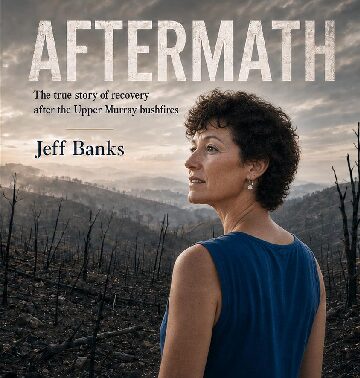
AFTERMATH Chapter 16 - Epilogue

AFTERMATH Chapter 16 - Epilogue | Travelling Around Australia with Jeff Banks

In the end, I hope people finish this story with empathy for the humanness of recovery. Not admiration from a safe distance, and not pity, but empathy. We are not talking about processes, grants, agencies, services or structures, although all of those have their place. We are talking about human beings, the ones whose lives were burned and the ones who walked beside them afterwards, all of them trying in their own way to work out what was still standing.
AFTERMATH

Chapter 16

Epilogue 

I drove up to Corryong again after the latest fires, and I knew before I got there that it would not just be a drive. Roads have a way of holding memory, especially roads you have travelled when the country around them has been burnt, frightened and stripped back to bone. I was going up as a friend this time, not as the person responsible for anything, and that sounds like a simple difference until you have lived on the other side of it.

There is a world of difference between being in something and seeing it. When you are in it, you are watching the next task, the next person, the next phone call, the next form, the next risk, the next thing that might fall over if you do not notice it in time. When you are seeing it later, from the quiet of a car, with no lanyard on and no one waiting for you to solve something, memory has room to come and sit beside you.

The Upper Murray is beautiful country, and that is not just something people say because it looks good in tourist brochures. Around Corryong, the green can be so rich it almost looks unreal, with the river running through it and the mountains sitting in the background with snow on them at the right time of year. Before the fires, there were views where the whole place seemed to have been made in layers: river, paddocks, trees, hills, sky, then the mountains beyond, all of it carrying that old-world charm of a village somehow dropped into an isolated valley and left to get on with things.

After the fires, it was not that place. It was still Corryong, but it felt like a staging ground between devastation and hope, and it stood in that space for a very long time. The green had gone from places where I had always expected it to be, sheds were burnt or gutted, stock were missing from paddocks, birds were not flying, and even the wind sounded wrong when it moved through dead branches instead of leaves.

There was a lookout I used to go back to when I was working up there. It gave a beautiful view down the Murray River, and I knew what it had looked like before, so I could stand there and remember the place as it had been. That mattered to me because, when you spend your day inside an office, a meeting room, a recovery centre or a hall, you can start to lose sight of the reason you are there. The room becomes its own little world of phones, paperwork, people coming and going, and you forget for a moment that outside that room the valley itself has been changed.

I would go to that lookout because it grounded me. It reminded me that the damage was not only what had burnt. The fire had changed the valley, changed the rhythm of farms, changed what people heard when they woke up, changed what they trusted, and changed what they thought tomorrow might look like. I could stand there and think, this is why I am here, and that was often enough to get me back into the next thing.

In the beginning, of course, there was no time for such neat reflection. I was more like one of those ducks people talk about, smooth on top and paddling like mad underneath, except this particular duck had no real idea where she was paddling to. I had a sense of urgency and chaos, and a very strong internal responsibility to appear unflustered, organised and useful, even when inside I was scrambling to keep up with what was changing around me.

That is one of the strange things about disaster recovery. People imagine someone tells you when it has begun, and that the system shifts cleanly from emergency to recovery with a nice line drawn through the middle. It does not feel like that on the ground. It arrives in people walking through a door, phones starting again before you have finished the last call, someone asking where such-and-such is, someone else needing a form, someone needing somewhere safe to sit, and someone trying to tell you their name while their mind is still back on a road, a farm, a shed, a paddock or a house that may no longer exist.

The faces that came through those doors are still with me. It was almost like looking at masks, but not in the sense that people were pretending. It was as if each person had found the face they needed to wear in order to move through chaos, fear, anxiety and the unknown. Their eyes were often the part that told the truth, because they were blank or bleary or not quite connected to the person I suspected was normally there.

There was tiredness, but it was not ordinary tiredness. It was the kind that comes when a body has been holding itself upright for too long. There was fear as well, although it was not always spoken out loud, and sometimes there was a tiny bit of relief because they had made it to a place of importance, a place where someone might know something, or at least where someone might write their name down and remember they had come in.

In those first couple of days, people wanted escape and safety. After that, as people came in off farms and had a chance to stop and think, the questions shifted. They were not polished questions, and they did not come in any tidy order. They were things like, “Where is such-and-such?” or “Have you heard how such-and-such is going?” or “Is such-and-such all right?” before they moved to “What do I do about this?” or “Can I get that?” or “Do I need to fill this in?”

Even taking someone’s details could become a fifteen or twenty-minute conversation, not because anyone was being difficult, but because trauma does not move in straight lines. You could ask for a name and get part of a name, then a story, then an address, then a question about a neighbour, then a memory of the flames, then silence, then a practical need. On paper it should have taken three minutes, but the paper never knew what it was asking of people.

What they did not say was often just as important. Most people did not walk in and say, “I thought I was going to die,” although I did hear that sometimes, and when I did it stayed with me. More often they talked about where the fire came to, what it burnt, who they had not heard from, what they needed to find, and what had to be done next. The fear was there, but it was tucked under practicalities because I think taking the lid off those big emotions felt too dangerous for them at that stage.

I understood that more than I probably realised at the time because I was doing a version of it myself. I found ways to suppress my own emotions and not acknowledge them, and when something got too much I would go outside for fresh air or I would do the opposite and dive into something busy. I was frightened that if I opened the gate to emotions, I would not be able to shut it again, and then I would not be able to do what needed doing.

I think many of us in those spaces were frightened of the same thing. If one person opened up completely, it might set off a chain reaction of grief and shock that no one knew how to manage. We were surviving one day at a time, and my habit became to put my emotions on with the rest of the work uniform, buttoned up and out of sight. Later on, I became so good at not acknowledging them that the not-acknowledging became part of the job.

Humour was the way I let pressure out. I did not always cry when a cry might have given me some relief, and I used to get annoyed with myself about that. Instead, I found myself making something that was not really funny seem hilarious, just so there could be a laugh and the pressure in the room could drop for a moment. It sounds odd unless you have been there, but humour became one of the few cheap, available and immediate coping mechanisms we had.

I did cry later, just not often in the middle of things. I would go home for a break and some half-sad thing would come on the television and I would have a good bawl about that, knowing full well it was not really about whatever was on the screen. In front of others, apart from two very close friends, I mostly did not let myself go, because there was always that feeling that if the door opened, the floodgates might not respect my timetable.

Professionalism in that work was not about being cold. It was not about sitting there like a brick wall while someone handed you the worst pieces of their life. It was about showing enough emotion for the person to know you were human and that you understood the gravity of what they were telling you, while also keeping enough of a barrier that you did not jump into the well with them.

That line is hard to explain and even harder to hold. People needed empathy, but they also needed you to remain steady enough to do the job. I saw people from different organisations who could not manage that line, and while their emotion may have shown that they understood the grief, it did not always help the person in front of them get what they needed. Recovery work does not suit everyone, no matter how kind their intentions are.

A lot of people want to help after a disaster, and that is a lovely thing. But if you cannot manage the internal work that comes with being close to other people’s trauma, you can do harm to yourself and sometimes to others. You have to know yourself well enough to understand where your line is, and that is its own labour on top of the actual recovery work.

The sound I remember from the evacuation centres is movement. Not a single dramatic sound, just movement all the time: people walking, shuffling, carrying things, chairs scraping, boxes being shifted, doors opening, voices rising and falling, someone looking for someone else. The word that comes to mind is shuffle, because even when people were moving with purpose, there was a heaviness to it.

Later, out in the community, it was the lack of sound that struck me. You did not hear motorbikes the way you normally would, or tractors, or cows, or the background hum of wind through leaves. When the wind did blow, it had a sharper sound as it moved through dead branches. That absence was a kind of evidence, because the ordinary soundtrack of the district had been taken away as surely as the fences and sheds had.

The smells were smoke first, of course, but not only smoke. There were diesel fumes around the office space, with trucks, machinery, council vehicles and deliveries coming and going. There was the particular smell of donated clothes, that op shop sort of scent that no amount of washing ever quite removes, and there was a mountain of those clothes, more than a department store would hold. Strangely, I do not remember perfume, deodorant, chalk or any normal school or office smells, even though some of those spaces must have held them once.

There were children too, and I realise now that I have not always given them enough space in the story. It was school holidays, and mothers would come in trying to sort things out with little ones beside them. We worked hard to make the recovery centre child-friendly, with toys and things for different ages, and the children brought a strange sort of normality into an abnormal place.

They chattered, misbehaved, went quiet, asked for things, played, and did all the things children do. Some of them knew something terrible had happened, but they could not possibly understand the depth of it. I often wonder where the teenagers went, because I do not remember them being in the same spaces in the same way. Some were helping on farms, some were still evacuated, some were being looked after elsewhere until school reopened, and perhaps some were simply finding their own way through it out of sight.

I remember animals coming back too. I was staying in a motel room I liked, where the windows at the back opened onto a dairy farm, and one morning I woke up and saw the dairy cows back. It was such a simple thing, just normal milking cows ready to be brought in, but I remember thinking, “Oh, the dairy cows are back,” and feeling something shift. Sometimes hope looks grand, and sometimes it looks like cows in a paddock behind a motel.

So much of recovery was like that, made up of things that would sound too small if you tried to explain them to someone who wanted big turning points. The practical work mattered, of course, and there was an enormous amount of it. We had to learn whole systems quickly, including the state systems for recording needs, responses, risks and actions. We had to keep the bureaucratic side going while also learning how to work with communities who were still trying to understand what had happened to them.

Every step seemed to uncover the next thing we did not know. When Jen and I were out inspecting properties, we started with clipboards and phones because that was what we had. Then one day I was standing in the rubble of a house, kicking at something while talking, and the person with me said, “Stop kicking that, that’s asbestos.” After that came hazard suits, masks, equipment, storage, forms, risk procedures and a whole other layer of seriousness.

That is the kind of thing an outsider would not necessarily see. They might see a delay and think someone was being slow. They might see a form and think it was only a form. They might not see that the people trying to help were learning new systems, new technology, new risks, new agencies, new language and new processes while the work kept moving and while mistakes genuinely mattered.

In ordinary work, if a system changes, people get training, they have a practice run, someone writes a procedure and eventually it rolls out. In recovery, it often felt like the next thing simply arrived and had to be done today. We had people learning Microsoft Teams, learning to use phones on the road, learning new reporting expectations, learning who had authority over what, and learning how to make the whole thing work with local people who knew the district but did not always have the computer skills the system assumed they would have.

One of the best council liaison people we had was brilliant with people and almost useless with computers. That was not a failing in him; it was a mismatch between the work that mattered most on the ground and the system built to record it. So we worked around it. He took handwritten notes, and someone else typed them in, because the point was to keep him doing what he did well without slowing everything else down.

There were failings in the recovery, and I do not think there is any honesty in pretending otherwise. Some were system failings, some were process failings, some were communication failings, and some were simply the result of people trying to build the plane while flying it through smoke. The real problem was that every failing landed on human beings who were already tired, frightened or grieving, and that is why the small things mattered so much.

I became far less patient with complicated processes after the fires. I have more respect now for systems than I used to, because you cannot manage chaos with chaos, and systems are one of the best tools we have. But a system that cannot be understood by the person it is supposed to help becomes another burden, and in disaster recovery that burden can feel cruel. A form, a deadline, a missing document or a rule that makes sense in an office can become something else entirely when it is handed to a person whose life has just been burnt apart.

Insurance forms taught me that in a very practical way. One of the outdoor council team leaders lost everything, and it took us a while even to understand that what we had looked at on his property was the remains of a house because there was so little left. He had kept working, kept helping others, made no fuss, and later came in quietly asking if I could help him with a form for the contents of a shed.

He was about sixty and had to list sixty years’ worth of things that had been stored in that shed, along with a value for each item. We started with the obvious things, then little by little remembered more. Golf clubs, mountain bikes, tools, equipment, things that mattered and things that only came back to him because someone asked the right question at the right time. It took days of “Oh yeah, that was in there too,” and I remember thinking how unfair it was to expect a traumatised person to inventory their whole life from memory.

Most of us could not list every item in our garage on a good day. Yet after a fire, people are expected to remember not only what they owned but what each thing was worth, often while sleeping somewhere strange, worrying about animals, fences, banks, children, insurance and whether the next rain will bring another problem. That is one of the ways recovery can be quietly brutal, not through cruelty of intention but through the assumptions built into ordinary processes.

There were other absurd and painful lessons. I learned that if power goes out and food ferments in a fridge during a hot summer, it can blow the fridge door open and leak down into the floorboards, which then have to be replaced. I learned things about septic tanks, ash, asbestos, contaminated debris and unstable trees that I never imagined needing to know. Some of that knowledge is now tucked away in my mind with nowhere useful to go, but at the time it mattered very much.

Mistakes stayed with me too, even the ones that were really learning exercises. There was a tree on a property, a big gum near a driveway, and we were worried about a limb. The owner loved that tree and had lived under it for fifty years, and we let ourselves be talked out of marking it as urgent. Before the tree experts got there, the limb came down and barely missed a person driving under it.

That is the kind of memory that can be triggered years later by a branch cracking in a park. In the scheme of the whole disaster, it may look small, but small things are not always small when they carry the weight of what might have happened. I have many little stories like that tucked away: dead fish in a creek, a grandchild coming across a dead dog, tiny awful moments that do not need to be laid out for public viewing but still exist inside the people who were there.

Not everything was failure, of course. Some of what happened was extraordinary, not because it was shiny or formal, but because people simply stepped forward. Every person who volunteered on a community recovery committee is a quiet hero in my mind, even though most of them would probably hate being called that. They took on the work of asking traumatised communities what they needed, what mattered most, and what should happen next, all while dealing with their own exhaustion and grief.

Those were not volunteer jobs where people turned up to a meeting, sat politely, and went home. They consulted, listened, argued, worried, followed up, carried messages, and took personal responsibility for outcomes in a way that was both admirable and sometimes too heavy for them. They did it more or less on the government’s timetable, which is no small thing when your community is still trying to work out what normal even means.

The CFA volunteers deserve their own kind of respect. Quite a few lost their own properties while they were out trying to save somebody else’s, and I do not know how to describe that without using words that sound too large and still not large enough. The local ambulance people were everywhere as well, often calm in a way that made you forget their own lives had been affected. The outdoor council staff filled water tanks, helped people get up driveways, fixed access, and kept going even when their own properties had burned.

Then there were the organisations and people who filled gaps before a neat system had even named the gap. BlazeAid was a massive exercise, with volunteers, materials, farmers, roads, boundary fencing, camps at Corryong and Walwa, and all the organising that went into keeping stock off roads and farms functioning. The person coordinating that effort could have run an army, and I mean that as a compliment.

Rotary was the same sort of practical miracle. There were people who turned up with a simple attitude that if a problem could not be fixed through one avenue, they would find another. I remember one household where the fire had burned around the house but not through it, then rain came, and mud slid down from the stripped hill and went through the house. Fire recovery funding could not neatly cover it because it was mud, even though the fire had clearly created the conditions for it. Rotary stepped in where the system could not find a door.

That happened again and again. Australian Business Volunteers rang and offered help for local businesses. GIVIT did extraordinary work matching needs with people around the country who could provide exactly the thing someone needed. Local bakers, butchers, supermarkets, cafes and pubs kept people fed, caffeinated, connected and held together in ways that no formal recovery plan could ever fully capture.

The bakery in Tallangatta ran around the clock when the evacuation centre opened. Volunteers, fireys and workers could get coffee and food without being questioned or made to prove they were worthy of it. Food kept arriving, and they did not keep tidy accounts in those first moments because the need was more urgent than the paperwork. Later, people might say businesses made money from all that activity, and perhaps some did eventually get reimbursed for parts of it, but I can tell you many put in far more than they ever got back.

I think often of the people behind the scenes who were more remarkable than they appeared at first glance. There was a woman involved with a hall committee who seemed at first like one of those country women who had always been in the background of this committee and that committee, but when I sat down with her, I realised she was astonishingly sharp. She had plans, contingencies, ideas for acoustics, electrical systems, solar, podcasts and uses of the hall that were miles ahead of where I thought the conversation would go.

That is one of the gifts of working deeply in a place. You begin to peel back the layers and discover the brilliance that has been sitting there quietly all along. There are seed developers, alternative power thinkers, historians, novelists, environmental experts, practical inventors and community builders in those valleys, often doing extraordinary things without needing to be recognised for it.

There was a young woman on the recovery team, barely out of her teens or in her early twenties, who seemed to be related to everyone in town. She was bright, cheery, mature, and had an instinct for connecting people with other people. She worked incredibly hard, then one day wisely said she thought she was done and needed to step away. Later she came back after a break, ready to help again, which told me she understood something about boundaries that took me much longer to learn.

There was a man who came in quietly because he was worried something he had been using as a garden ornament might actually be an Aboriginal artefact. He wanted to be respectful, and sure enough, when the right people looked at it, it turned out to have significance. That story stayed with me not because it was dramatic, but because of the humility in it, and because it said something about the histories that sit under a place whether or not everyone has been willing to see them.

There were people who were difficult too, and I have learned not to make that word do too much work. Upper Murray Inc, for example, had been doing important economic development work before the fires and saw themselves, understandably, as community leaders. When recovery committees started forming, there was tension because they felt it should naturally be them. It took time, conversation and a fair bit of effort to build trust and separate the importance of economic recovery from the broader work of community recovery.

I can understand them better now than I did in the first moments of frustration. People who have carried responsibility in a town do not suddenly stop feeling responsible because a new structure arrives. They were trying to keep Corryong on the map, trying to defend the future of the place, and perhaps trying not to be pushed aside by systems that had only just arrived. It was difficult, yes, but difficulty often makes more sense once you understand the fear underneath it.

The fire created leaders too, though many country people are uncomfortable with that word. They will chair something, organise something, run something, fix something or quietly hold a whole district together, but call them a leader and they look like you have accused them of getting ahead of themselves. There is humility in that, and probably a bit of tall poppy syndrome as well, but there are leaders in every rural community whether they like the label or not.

I think of a young fellow from one of the smaller communities who stepped into the community recovery role with real grace. He was a natural leader who did not see himself that way, which is often the best sort. I think of a young woman from Corryong who had gone away, become well educated, built a life elsewhere, and came home to help her family after they were affected. She had a lovely way of walking behind people and supporting them, which is a quieter form of leadership but no less real.

The old farming resilience was there too, in the men and women whose families had been on the land for generations. Many farms had more than one generation still living there, and you could see the tussle between older people not ready to let go and younger ones ready to take on more. That is a whole story in itself, because the fire did not arrive into simple families or simple histories. It arrived into decades of love, labour, disagreement, habit, pride and land knowledge.

The younger generation trying to stay carried a different kind of weight. Corryong has that missing age group you see in many rural places, where young people leave for university, work or a wider world and may only return when they start families or when parents age on the farm. If you are around thirty in a small town and do not fit neatly into footy, netball or established circles, it can be lonely. Yet some did come back, and some stayed, and that matters because recovery is also about whether people can imagine a future there.

I became more patient with people through all of this, and less patient with process. That is probably one of the clearer changes in me. I became more interested in the stories behind difficult behaviour, and more able to step back when someone was angry, vague, sharp or suspicious. Pressure does strange things to people, and I do not think I really understood pressure until I saw it playing out in so many different bodies and voices.

I also became more curious about systems. I do not think I became simply suspicious of them, although some days it may have looked that way. I started asking why a system had evolved as it had, what it was trying to achieve, what helped it work and what stopped it working. I learned that jargon, complicated communication and pointless process are not just annoying. They can do real damage when people are already stretched beyond themselves.

Before the fires, I was an ordinary person who loved working with community and had found ways to do that. I had worked in community development and health promotion, the sorts of fields where the results may not be visible for twenty years. In bushfire recovery, I could see the impact of the work quickly, not full recovery, but the immediate difference it made when someone felt heard, helped or just a little less alone. I became a bit addicted to that, which is not entirely comfortable to admit.

The work revealed strengths in me. I had more patience than I thought, more courage than I thought, and more conviction in what I had to say. I became more willing to admit when I did not understand something, especially to people in offices back in Melbourne who were asking for things that did not make sense on the ground. Before the fires, I might have been anxious about saying, “You need to walk me through this.” During the fires, there was no time for pretending.

It also exposed my superwoman streak. I thought, perhaps unconsciously, that I could keep going and ignore all the signs that I needed to rest. I had always struggled with boundaries, and it took me too long to understand that, as a more mature person in a team, people watch what you do. If you do not show boundaries yourself, others will assume there are none to be had.

I did not feel consumed at the time, but I was. That is an important distinction. It was like the frog in the water, or like a flood slowly filling cracks and crevices without you noticing. Social outings dropped away, cups of tea with friends dropped away, wider family contact dropped away, tennis dropped away, and visits to the beach or to family became things I would do later. There was always later, until later had swallowed years.

My family saw some of it, though I do not know how much I let them see. My son once said he was glad he had his mother back, and that sentence tells me more than I probably knew at the time. I used to have my grandchildren stay on Friday nights, partly for my time with them and partly to give their parents a break, and that stopped because I was not around in the same way. I lost time with them, especially the little ones, and I cannot really get that back.

I hid the hard stories from my family, or at least the worst of them. My youngest son is a police officer, and I remember once pulling the car over and ringing him because I had to unload something and did not know who else to talk to. For most people, though, I would not put those icky, awful stories on them, because they were not theirs to carry. The trouble was that they were still in me, worming their way into memory and body in ways I did not understand then.

I also hid things from myself. I hid the amount of alcohol I was using to relax and sleep, not drinking to get drunk, but still using it as a tool. I hid tiredness under the phrase “I’m just getting old,” which is a terrible thing to say to yourself when it becomes an excuse instead of a reason. I hid how deeply the stories were lodging in me because I honestly thought I would be able to brush them off later.

I never resented the purpose of the work. I always knew why I was there, and I never lost that. But I did resent the ask of it at times, the unrelenting paperwork, the brick walls, the impossible translation between what community needed and what government could do. I resented the moments when the work of preparing for a dignitary visit seemed to stop the work of recovery itself, even though I also understood that ministers and senior people needed to see the reality for themselves.

Some of those visits were genuinely good. There were people who came up, rolled up their sleeves, put on gumboots and said, in effect, show me the mud. Others came with more ceremony attached, and the itinerary work alone could eat days of energy. You would line up community members, workers and stories so decision-makers could hear directly from people, only for the timing to shift and everyone to sit around waiting because someone was running late.

There was one minister who walked into the evacuation centre without announcing herself to me as a minister at all. She was well dressed but practical, pulled up her sleeves, asked who was in charge and said she had a couple of hours to volunteer. I put her to work sorting groceries, only finding out later who she was, and I could have died. But I still like that story because it shows that some people really did understand that being useful mattered more than being seen.

I loved the work, even while I hated parts of it. I did not love the disaster or what had happened to people, but I loved doing something that mattered at a time when it was needed. I can get to the end of my life and feel there are two things I was blessed to gift to the world: my three children, and that work. All my other work has been important, but this was important in a different way.

I felt useful, and I feel I did a good job. I was not a hero, not a standout, not above anybody else, but I feel good about what I did. There is still a fearful little part of me that dreads someone one day saying, “Actually, when you did that, it hurt me,” because I can only judge the work through my own eyes. I have no guarantee I got everything right, and anyone who says they do after work like that is probably not being honest.

Would I do it again? Absolutely, but with hindsight in tow. I would not line up now for exactly the same depth of job because I know more about what it takes and what it costs. But I would work in bushfire recovery again quickly, in a role I could do well, because the work matters. I would just try to remember earlier that the people helping with recovery are people too.

The word recovery bothers me more now than it did then. It is a convenient word for government because it carries the suggestion of an ending, but recovery does not end neatly. It is not a matter of finding what was lost and bringing it back. You cannot go backwards to the old world. You have to rebuild, adapt and step forward into a new one.

That does not mean nothing heals. Green comes back, cows return, roads reopen, fences stand again, halls fill, children go back to school, and people learn where the new edges of their lives are. But it is not a return to what was. It is a different life built from what remains, what can be repaired, what has to be grieved and what people are willing to carry.

The fire took time, and that is one of the losses no one can properly measure. It took the time between normal life and some new sense of routine. It took months and years of decisions, forms, rebuilding, waiting, arguing, explaining, cleaning, remembering and starting again. It also dented people’s resilience, though I dislike that word because it is used too easily. It did not break people, but it damaged their emotional elasticity, their ability to keep bouncing day after day.

What surprised me was how few people gave up. I expected more farms for sale, more people saying, “No, that is enough, I am out.” Some did, of course, and no one should judge them for it, but fewer than I thought. That stubborn refusal to leave was not the glossy resilience people put on posters. It was something rougher, quieter and more complicated, bound up with land, history, identity, family and the simple fact that for many people, this was home.

This book began, in one sense, for me. It was a way of sorting out what had happened in my own brain, what it had done to me, and what I was going to do with it. As it grew, I started to see that it might be for other people too, especially those who think they may want to work in recovery. I hope it gives them some sense of what the work is really like, not to scare them away, but to tell the truth.

It is also for the people who make decisions about recovery from a distance. I hope they understand that plans and processes land on human beings, both the ones affected by disaster and the ones sent to help. Every decision about timing, funding, reporting, communication, eligibility, staffing and support has a human consequence. On the ground, nothing is just a process.

If the book has a smell, it is smoke. It should probably have smoky, buff-looking pages, if we are being literal about it, because that smell never quite leaves the story. If it has a sound, it is movement in an evacuation centre and then the missing sounds outside: no tractors, no cows, no soft wind in leaves. If it has an image, it is Corryong standing between devastation and hope, not healed, not helpless, not finished, but still there.

The scene I think should open the book is still that first simple act of opening the doors. There is expectation in that, and uncertainty too, because you can have a plan and still have no real idea what will come through once the doors are open. That is how the story began for me, with ordinary work becoming something else before we had time to name it.

The scene I think should close it is that later drive back through the country, when I was no longer responsible. I was not going to fix anything, coordinate anything, report anything, record anything or carry anything official away with me. I was going as a friend, and as a person who had once been inside the machinery of recovery and now had to learn how to stand outside it.

Driving through that country, I could feel the memories rise up, but I could also feel the difference. The valley was not the same, and neither was I. The work had taken things from me and given me things I will never lose. It had shown me the worst sort of loss and the most ordinary kinds of courage, the failings of systems and the brilliance of people, the absurdity of paperwork and the holiness of a cup of tea at the right moment.

In the end, I hope people finish this story with empathy for the humanness of recovery. Not admiration from a safe distance, and not pity, but empathy. We are not talking about processes, grants, agencies, services or structures, although all of those have their place. We are talking about human beings, the ones whose lives were burned and the ones who walked beside them afterwards, all of them trying in their own way to work out what was still standing.

Aftermath is not empty space after disaster. It is where people live once the flames are gone and the cameras have left. It is where they grieve, laugh, argue, rebuild, remember, fail, try again, and slowly adapt to a life they did not choose. It is not the end of the story, not really. It is the long part, and if recovery has taught me anything, it is that the long part deserves to be seen.

Author

Menu