

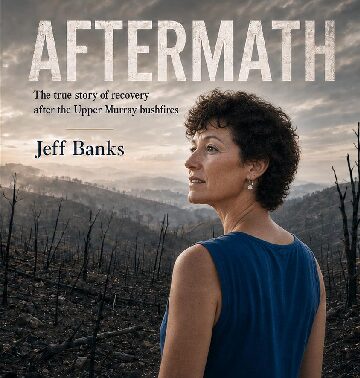
AFTERMATH Chapter 11 - Transition Plan

AFTERMATH Chapter 11 - Transition Plan | Travelling Around Australia with Jeff Banks

So transition planning was never really about ending recovery. It was about admitting that our part in it had to change. It was about stepping back without turning away. It was about trusting that the people of the Upper Murray, with the right anchors still in place, could carry the next part without us standing quite so close. That trust was not simple, and it was not sentimental. It was a difficult, uneasy, practical kind of trust, the sort you build because eventually you have to hand the weight back to the people whose lives it is.
AFTERMATH

Chapter 11

Transition Plan — when the recovery team would eventually finish

There comes a point in recovery when people start asking when the recovery will finish, as though there is a door somewhere with a sign above it saying, “This way out.” I understand why they ask it. Governments need timelines, budgets need endings, workers need to know where they will be next month, and communities need some sense that they are not going to spend the rest of their lives inside the word recovery. But by the time we began planning our transition out of the Upper Murray, I had already learned that recovery was not a room you simply walked out of when the job was done. It was more like a landscape you kept crossing, only the fence lines had moved, the trees were gone, and nobody was quite sure whether the old map was any use anymore.

We had been there a long time by then. I think it was about two years after Bushfire Recovery Victoria had come on board that we started seriously talking about what leaving might look like, although “leaving” was not the word I liked. Leaving sounded too clean. It sounded as though we would pack up the files, take the lanyards off, put a final note in the system and drive back down the road feeling satisfied with ourselves. That was not what it felt like. It felt much more uncertain than that, and much heavier, because by then the people of the Upper Murray were not case numbers or committee members or stakeholders. They were faces I knew, voices I recognised, paddocks I had stood in, halls I had sat in, and people whose grief had become part of the weather of my working life.

On paper, the timing made sense. We had community recovery plans in place. The state recovery plan had been done. There were programs running, services operating, committees meeting, agencies connected and a general sense that the full intensity of a recovery team was no longer needed in the same way it had been at the beginning. Nobody can stay forever, and I knew that as well as anyone. There is only so long a recovery structure can remain in place before it starts to blur the line between supporting people and accidentally making itself necessary. That is a difficult line to hold, because people who have lost so much do need support, and sometimes a lot of it, but communities also need the chance to regain their own weight under their feet.

The department had decided it was time for us to begin transitioning out as a full recovery team, and once that decision came, we put a lot of thought into what it should mean. We had to look at what needed to stay local, what could become regional, what could be handed to other services, and what simply had to stop because no bucket of money is endless, no matter how urgent the need feels on the ground. That is a very cold sentence to write, and it felt cold at times to live with. There were other disasters by then, other storms, floods and fires, other communities hurting, and the state had to balance the Upper Murray against everything else demanding attention. Knowing that did not make it easier when you were sitting across from someone whose project had stalled, whose rebuild had not begun, or whose nervous system was still reacting as though the fire was just over the next ridge.

The community reaction was never one thing, because the community was never one thing. That is one of the mistakes people make from a distance. They talk about “the community” as though it has one mind, one mood and one level of readiness, but the Upper Murray was made up of towns, valleys, farms, families, old leaders, new leaders, people with insurance, people without enough insurance, people who wanted help, people who wanted government gone, people who were grieving quietly, and people whose grief came out sideways at whoever happened to be in front of them. Some people were not especially surprised when we said formal support would eventually wind down. They had always known we could not stay at that level forever. Others felt the news as a dent in their optimism, and whether we thought that was fair or not was beside the point. If they felt abandoned, then that feeling had to be respected as real.

That is why I kept thinking of it as a transition plan rather than a leaving plan. A leaving plan would have been about us. It would have been about dates, staffing, office arrangements and who was taking which boxes back to where. A transition plan had to be about them. It had to ask what people still needed, what they were afraid of losing, what supports had to be anchored before we stepped back, and where the loose threads might go once our hands were no longer holding them. There is a big difference between saying, “We are going,” and saying, “This is how we are going to make sure you are not left with nothing but a phone number and a memory of meetings.”

Even then, I did not feel ready. I understood the logic, and I could see the bigger picture, but there were still too many balls in the air for me to feel peaceful about it. When I say that, I am not only talking about projects or programs, although there were plenty of those still unfinished or stuck in some form of bureaucratic treacle. I am talking about the emotional weight of the place. I am talking about whether people had enough optimism left to keep going, whether committees had the confidence to push through conflict, whether local government had enough capacity to carry what was being handed back to it, and whether the smaller, more isolated parts of the district had enough strength around them to handle the next bump in the road.

From an economic point of view, some parts of the community probably looked ready enough. Businesses were reopening, money was moving through projects, and there were signs of ordinary life reappearing in ways that looked reassuring if you drove through quickly. But from an individual farmer’s point of view, or from the point of view of communities with complex internal tensions, many people were not ready at all. They knew it too. There were people who were still not firm in how they would approach the future, still unsure whether they would rebuild, still caught between the land they loved and the trauma attached to that land. Recovery does not suit a neat program cycle when a person can take eight or ten years to decide whether they can bear to build again on the same piece of country.

That was one of the lessons we had heard from Black Saturday, and it sat heavily with me. Years after those fires, people were still recovering, still revisiting decisions, still being triggered by new fires, new smoke, new news footage, new loss somewhere else. By the time of our transition planning, I had already stopped believing there was such a thing as finishing recovery. There is only a point where enough resilience has returned for the formal structure to step back without everything falling apart. That is not the same as saying people are healed. It is certainly not the same as saying they are done.

Mental health was still up and down like a yo-yo. That is a blunt way to put it, but it is probably the most honest one. In a small rural community, a suicide is never a distant event, even if you did not personally know the person who died. The old idea of six degrees of separation shrinks to one. Everybody knows somebody who knew them, or worked beside them, or sat near them at something, or drove past their gate for years. A death like that rocks a place already carrying more than enough, and it reminds you that recovery is not only about houses, fences, roads and bridges. Sometimes the most fragile infrastructure is inside people.

I thought another six months would have helped. I said that at the time, and I still think it now, although I also know it would not have solved everything. Another six months would have given us more time to work through some of the community conflicts that were still sitting there, particularly in places where old tensions had been exposed by the fire rather than created by it. It would have given some committees a bit more confidence and allowed some of the newer leaders to find their feet alongside the older ones. But I also know we had already stayed longer than some arrangements might have allowed, and leaving six months later was better than leaving six months earlier. Disaster recovery is full of those unsatisfying measurements. You rarely get perfect. You get the least-wrong thing you can manage.

Before we could step away, we had to know there was more than a plan on paper. We needed to see some confidence in the committees that sat underneath those community recovery plans. Every project hits barriers and challenges, and that is not failure. That is just life, especially in places where distance, weather, funding rules, volunteer fatigue and government process all have their say. What mattered was whether the committees had enough resilience to work through those barriers without us in the room every time. In some places they did. In others, I was not quite convinced, and there were a couple of communities that still felt too raw and too complex to be left without significant help.

The Upper Murray was fortunate that Towong Council stepped further into that space than they probably wanted to, and for longer than was easy. It is a small council, and small councils do not have drawers full of spare staff sitting around waiting for disasters. They are already stretched in ordinary times, and then a major fire comes through and suddenly everybody expects them to absorb the work of roads, bridges, planning, environmental issues, community meetings, grant programs, advocacy, complaints, grief, frustration and everything else that falls between the cracks of state and local responsibility. People often say government should be more local, and in principle I agree, but local government cannot carry state-sized expectations on small-town resources forever.

Gateway Health was one of the really important pieces that made me feel we could leave without the whole recovery process falling over. Their program worked with complex family recovery journeys, which is a very neat phrase for work that was often anything but neat. They would work with families, advocate for them, follow up with services, push when things were not moving, and help people navigate systems that were already hard enough without trauma sitting on top. They had several workers in the Upper Murray, and one of their strengths was that they had a range of personalities in the team. That mattered more than some people might realise, because not every worker fits every person. Sometimes the difference between a door opening and a door staying closed is whether the person knocking feels like someone you can bear to talk to.

I do not think recovery would have been as successful without that program continuing beyond us. At the end, when they were finally closing it down years later, they had resolved most of their cases, and that says something about the length and complexity of the work. Those cases did not fit neatly inside the early recovery window. They took time, trust and persistence. Some of them had begun as bushfire recovery and then became something much broader, because the fire had not created every problem. It had exposed some, worsened others, and made old fragile arrangements impossible to ignore.

There were people I worried about leaving behind, and that worry was not always attached to the obvious cases. One of them was my pastor friend from the evacuation centre, who had been a character from the beginning and was still going at a thousand miles an hour more than two years later. She was giving 120 per cent of herself, which sounds admirable until you look closely at what that does to a body and a life. I worried that if she burnt out, the community would feel more than the loss of her practical work. She had become a sign that things were still moving, that someone still had energy, that there was still a bit of brightness available in a place that had been asked to absorb too much darkness.

She was not holding up the whole community on her own, and I would never want to put that burden on her. But people like that become part of the emotional scaffolding of a town. Whether people loved what she did, disagreed with it, or simply heard her somewhere in the background getting on with things, she gave off a sense that life was still happening. I saw her again not long ago, and she was still energetic, still bubbly, still herself in that unmistakable way. Thank goodness she had also learned to go away sometimes, see her grandchildren and take a break, because you could see the toll the years had taken on her. She looked older than she should have, and I say that with affection, not criticism. Some people give so much that their bodies keep the records when the minutes of meetings do not.

I also worried about a quiet man in one of the more divided valleys. That valley had carried a lot of tension, and people had a habit of taking it out on each other, as people sometimes do when the real enemy has already passed through as fire and left them with nowhere sensible to put their anger. This man sat in the middle in a way that was easy to underestimate. He could move between sides, associate freely with different people, and quietly keep some kind of thread between them. He was not loud, not political, not someone who would stand at the front of a meeting and command the room. He just went along doing what he did, a tiny bit naive perhaps, and maybe too easily taken advantage of, but sometimes the glue in a place is not the strongest person. Sometimes it is the one person everybody can still tolerate.

Preparing groups to continue without us meant being transparent once we had a plan. We told people we would be withdrawing, but we also told them we had thought it through and wanted to work with them on what needed to be left in place. We asked what else they might need, what they were most worried about, and what could be done about those worries. We did not pretend we could fix everything, because false reassurance is worse than no reassurance at all. People who have survived a disaster can smell nonsense very quickly. They have already heard too much of it.

We had regular meetings with other service providers so we could feed back what communities were telling us. That mattered, because a service can think it is doing a wonderful job from an office somewhere and still be missing the thing that is making people unwilling to use it. Sometimes communities would say they did not like a particular service, or did not like the way a person from that service operated, or did not trust how something was being handled. Our role then was not to gossip or smooth it over. It was to go back to those services and say, as honestly as we could, “This is what the community is worried about. It is now in your hands to do something with that.”

We also used warm introductions wherever we could. That sounds like a bit of service-system language, but on the ground it was very simple. It meant taking another service to a meeting, a gathering or a person and introducing them face to face. It meant letting people hear a voice, see a face and feel some connection before we stepped away. Trust does not transfer automatically, but it can sometimes be lent for a little while. If people trusted us enough to give someone else a chance, then we had a responsibility to make that handover as human as possible.

A lot of our work was also about leadership, although not in the glossy way people sometimes talk about leadership. The Upper Murray had strong established leaders who had carried plenty before the fires and kept carrying things afterwards. It also had newer leaders emerging because disaster creates spaces people did not necessarily ask to occupy. I was concerned about how those two groups could hold their space without one crushing the other or the other feeling it had to fight for legitimacy. So I did a lot of research around community involvement and what had happened in other places, both with and without disaster sitting over the top. We tried to build that thinking into the community plans, because recovery needed continuity, but it also needed renewal. A community cannot keep asking the same few people to do all the lifting until they drop.

There were also people who wanted government gone, or at least wanted the feeling of being managed to end. By the time we were transitioning out, there was a lot of frustration with bureaucracy in general. That was not surprising. Even when the intention is to be community-centred, it is very hard to make government processes feel that way. Forms still have to be filled in, eligibility still has to be assessed, decisions still have to pass through systems, and people who are already exhausted are asked to explain themselves again and again. I could understand why some community leaders felt ready to take the community back, so to speak. They were tired of wrangling with departments, timelines, reporting requirements and the constant sense that help came wrapped in conditions.

At the same time, many of those same people knew they still needed support. They needed environmental work, mental health services, roads and bridges repaired, planning issues resolved, and all the big slow things that no community can simply volunteer its way through. That tension is one of the hardest parts of recovery. People want the support but not the bureaucracy that comes with it, and I do not say that as criticism. I would have wanted the same. The trouble is that once state departments begin stepping back, a lot of expectation gets pushed onto local government, sometimes with funding and sometimes without enough funding. That puts more pressure on the relationship between community and council, and in a small place that relationship is already close enough to bruise.

Our way through that was honesty. We were clear about what was within our control and what was not. We could talk to other agencies, negotiate, advocate and try to keep a holistic view, but we could not make every decision bend just because we could see the human need sitting underneath it. Some people did not like that, but most could at least accept it when it was explained plainly. I kept reminding people, and probably myself, that there was a big “we” in recovery. We were one part of a very large and complicated puzzle, and that puzzle included other disasters, money, health systems, private services, environmental realities, politics, time and plain old capacity.

That did not stop some people from becoming dependent on the recovery structure. There were a couple of families who seemed to make a lifelong commitment to being in the recovery phase, or at least to staying inside what our systems called recovery. That is a harsh thing to say, and I do not say it lightly, because many cases were genuinely complex and people’s circumstances were often awful. But there were also times when the fire became part of a much longer pattern of need, decision-making, crisis and expectation. Some people had been living in difficult circumstances before the fires, and the disaster gave them access to supports that they then expected to transform their whole lives beyond what had existed before, without much movement back from their side.

One case that stayed complex involved a person who had been living in a caravan before the fires. The property was highly impacted, and through the recovery process they qualified for short-term modular housing. Those homes were meant to be temporary, although “temporary” became a very stretched word after the Black Summer fires. Rebuilding took longer than anyone expected, new disasters came along, and the modular homes that were meant to move on to the next crisis could not always move because the first crisis had not finished. In this case, the person began to argue that having had a temporary house meant they now needed a permanent one supplied, even though they had not had that before the fire.

On one level, that was deeply frustrating. On another, it was more complicated than frustration could cover. This person was older, had medical issues, and wanted to remain in a small community like Corryong for their last years. The question then became bigger than bushfire recovery. How do you support an ageing person with complex needs in a small rural community with limited services, when the original disaster is still part of the story but no longer the whole story? That is where recovery systems struggle, because human lives do not stay inside program boundaries. A fire can be the trigger, but the problems that follow can belong to housing, health, ageing, isolation, poverty, family breakdown and every other hard thing people carry.

That is why finishing is such a difficult word. Governments and agencies need to define an end point because funding cannot stay open forever, and I understand that. But the people living it do not experience an end point in the same way. There are still people who have not decided whether to rebuild. There are still people who drive past a piece of land and feel their chest tighten. There are still people whose recovery was going along well enough until another fire season arrived and the old fear came back through the cracks. Recovery has threads that keep running long after the official fabric has been folded up and put away.

There was grief in the ending for our team. We had worked closely for a long time, and that kind of work forms bonds that are hard to explain to people who were not inside it. We have pretty much kept in touch. The core of us, the longer-standing ones, still catch up for lunch every six weeks or so, even though we have gone in different directions and taken different jobs. That is not only nostalgia. It is because we shared something intense, and because we came to value what each person brought to the table. Even the people we do not see as often are still known to us in that way. We know where they are, what they are doing, and there is still a connection from the work we carried together.

From the community’s point of view, it was not as though one day the whole team was there and the next day we had vanished. That would have been cruel and foolish. We left at different times, and some roles continued. The infrastructure specialist needed to stay because building and rebuilding were still happening. There was still a regional presence, still someone to go to around recovery from a BRV perspective, and still a community engagement role covering a broader area. That staggered departure helped soften the loss. It did not remove the grief, but it stopped the ending from feeling like a cliff.

For me personally, there was grief and relief sitting side by side, which is not always comfortable to admit. I grieved because I did not think I had finished. There were still things I could have done, still conversations I could have had, still places where I thought my presence might make a difference. But now, looking back, I can see there probably never would have been a time when I felt completely done. I could have stayed another ten years and still left thinking there was more to do. At some point I had to accept that I was not indispensable, and neither was our organisation. That was not an easy thing for me to work through, but it was a necessary one.

The relief was real too. I did not realise how run down I had become until I left and could look back. The constant pressure of keeping a neutral face while hearing sad stories, angry stories, complicated stories and stories that had no clean answer had worn me down more than I understood at the time. Not having to do that every day was an absolute relief. So was not having to make that drive up and back so often, that hour and a half of horrible road where you could not let your attention wander for a second. Potholes, branches, wandering stock, weather, darkness, the shape of the road itself, it all demanded something from you before the work even began.

I used to listen to talking books on that drive, one after another, just to keep my mind occupied and my body pointed in the right direction. Sometimes I would drive from Wodonga to Tallangatta and then jump in a car with someone else for the rest of the trip, partly for company and partly because it made better use of resources. Often I would stay overnight rather than travel up and back in one day. I stayed with friends when I could, although I suspect I started to wear out my welcome a bit in some places, and there were times when a motel room, impersonal as it was, became its own kind of mercy. I loved the Upper Murray, but the logistics of caring for it were wearing.

Even after I moved into other roles, I kept finding ways to keep a connection to the Upper Murray. I would wangle an excuse to go up there for something, or keep in touch with services I had worked with, or maintain professional links that meant the place was not entirely cut off from my life. One of the people from my BRV team had been seconded from the Department of Families, Fairness and Housing and went back to her substantive role. Because my own work continued in community development and health promotion, there was always a reason for us to keep talking. Some connections survived because the work still needed them. Others survived because we did.

Looking back now, I think the timing was probably good for me, even if I did not think so then. If I had stayed too much longer, I might have become so entrenched in that space that I could not get my head or my heart out of it. That is one of the dangers for recovery workers that does not get talked about enough. You can become attached not only to the people and the place, but to your usefulness. You can start to believe that leaving means failing them, when sometimes leaving is part of doing the job properly. That does not make it painless. It just makes it true.

I had to reassure people while privately wondering whether enough had been done. At the start of transition planning especially, I worried that we had not made enough difference, although I could not have told you what enough would look like. Enough is a slippery thing in disaster recovery. Enough for one family is nowhere near enough for another. Enough for a funding body might be a completed plan, a closed case, a report submitted or a program acquitted. Enough for a person who has lost their home might be the first night they sleep without waking in alarm. Enough for a town might be when people can argue about ordinary things again without every argument carrying smoke underneath it.

Eventually I had to come around to a more practical understanding. There is always more, but there is also what is sensible, what is fit for purpose, and what can realistically be carried by the people and systems left behind. I felt good about the work I had done. I felt I had worked hard, acted honestly, made a difference and done the best I could as one person inside a much bigger structure. That did not remove the sadness, but it gave me somewhere to stand. Looking back now, I feel more at peace with it than I did then.

A good exit in disaster recovery would be one where nobody misses you because you have done such a good job that you have done yourself out of a job. That would be the perfect version, and like most perfect versions it probably does not exist. A realistic good exit is one where people feel you have done your best to leave them in good hands, and where that is actually true, not just something written in a transition document. It means the threads that are still loose have anchors somewhere. It means there is nothing left dangling with nobody responsible for knowing what happens next.

That is what I think we managed, imperfectly but honestly. We did not solve everything. We did not heal everyone. We did not remove every fear, settle every conflict or complete every project. But I do not think we left anything with no answer at all. There was someone, somewhere, connected to each of the things that still needed carrying. That matters, because abandonment is not always about whether you physically leave. Sometimes abandonment is leaving people with nowhere to take the next question.

There is no point where you can stand in a fire-affected landscape and say, “All right, we have recovered now.” The landscape itself refuses the sentence. The trees are different, the shadows are different, the paddocks are different, and even when the grass comes back, people remember what it looked like when it was gone. You cannot measure recovery against what used to be, because what used to be is not coming back in the same form. You cannot measure it against the future either, because nobody knows what that will look like. All you can do is look for signs that people and places have enough strength to keep moving through ordinary life, knowing ordinary life will never be quite as ordinary as it once was.

Recovery starts earlier than people think. It starts the minute someone can walk into a space where flame has been and begin to ask, “What now?” But it does not finish in any neat way. It changes shape. It becomes less visible. It moves from emergency centres and public meetings into kitchens, paddocks, doctor’s rooms, council offices, school gates, church halls and the private conversations people have with themselves when they are deciding whether to stay. The formal support may wind down, the teams may move on, and the reporting lines may close, but the aftermath remains. People keep living with it, because that is what people do.

So transition planning was never really about ending recovery. It was about admitting that our part in it had to change. It was about stepping back without turning away. It was about trusting that the people of the Upper Murray, with the right anchors still in place, could carry the next part without us standing quite so close. That trust was not simple, and it was not sentimental. It was a difficult, uneasy, practical kind of trust, the sort you build because eventually you have to hand the weight back to the people whose lives it is.

I still think about them. I think about the pastor friend still buzzing around with more energy than seems medically advisable, and the quiet man in the valley holding a fragile thread between people who might otherwise pull further apart. I think about the families still unresolved, the people still deciding, the workers still checking in, and the council still carrying more than most people realise. I think about how we called it transition because leaving was too small a word for what was happening.

And perhaps that is the best way I can describe the finishing stages of long recovery after a fire that large. It is not a finish. It is a change in who stands closest to the wound. For a while, we stood there with them, close enough to hear the anger, grief, humour, confusion and stubbornness that made up the days after the flames. Then, slowly, carefully, and not without doubt, we stepped back. The community was still there. The aftermath was still there. The work was still there too, only now it belonged more fully to the people who had never had the luxury of leaving.

Author

Menu