

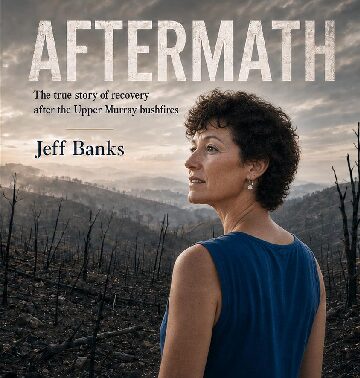
AFTERMATH Chapter 13 - PTSD Management After the Work

AFTERMATH Chapter 13 - PTSD Management After the Work | Travelling Around Australia with Jeff Banks

It also changed what I am willing to accept now. I do not want to compromise anymore on the things I know are my strengths. I am not happy in roles where I am not working with community, not part of complex decisions, or not able to give what I know I can give. A simple job that bores me to tears may sound peaceful to some people, but after that work I know it would not be enough. It gave me perspective too. Someone once said, “We save PDFs, we don’t save lives,” and that has become a bit of a mantra for me. It is not meant to dismiss ordinary work or ordinary frustrations. It is just a useful reminder that not every problem deserves
AFTERMATH

Chapter 13

PTSD Management After the Work

The first thing I noticed was not the word PTSD. Words like that tend to arrive later, after the body has already been keeping records for a fair while. At the time, I would have called it tiredness, or pressure, or one of those ordinary names we give to things so we do not have to look too closely at them. I was a slow learner in that respect, or perhaps I was just a fairly typical farming woman who had been taught early that if you were still upright, you were probably all right.

I had always been someone people talked to. That was not new to me, and I do not say that in any grand way. Some people are good at fixing fences, some are good with figures, some can make a cake appear out of nowhere when a room needs settling, and some of us seem to find ourselves sitting beside people while they unpack the parts of life they can no longer carry neatly. I had done that before the fires, but I had never done it at that scale, and I did not understand at first that listening can become a form of lifting.

There is a difference between hearing one person’s pain and standing in a place where pain has become the weather. In Corryong and the surrounding districts, it was not one story, one family, one bad week, or one sad event. It was everywhere, in every road, every paddock, every burnt fence line, every person who came through the door carrying paperwork in one hand and a whole other life in the other. I thought I was helping people by listening, and I was, but I was also taking in small amounts of their shock, grief, anger and exhaustion without noticing where it was all going.

For a long time, I blamed the obvious things. I was not sleeping because I was not in my own bed. I was tired because I was spending too many nights in motel rooms, cabins at the holiday park, or at a friend’s place, and too few in the familiar quiet of home. I was worn out because of the constant driving, the meetings, the long days, the roads, the phone calls, the effort of trying to be useful when none of us really knew the full size of what we had been asked to do.

That explanation worked for a while because it sounded sensible. Anyone would be tired doing that work, and anyone would be unsettled sleeping in different places, eating at odd hours, and carrying a job that did not leave politely at five o’clock. The trouble was that the tiredness started to take on a different shape. I could be awake, properly awake in the ordinary sense, and still realise while driving that I was not really present.

That frightened me more than I admitted at first. There is a particular kind of road concentration that country people understand, especially on roads you know well. You do not think about every bend, every rise, every shoulder, because the road has been part of you for years, and yet some deeper part of you is still watching. After the fires, I would sometimes find myself driving those same roads and realising that my eyes were open, my hands were on the wheel, and some essential part of me had drifted somewhere else.

The roads themselves became part of it. There were drives I had known before the fires as beautiful, peaceful runs through country that could settle you just by being there. They were the sorts of roads you might take on a weekend when you needed calm, when the trees, the bends and the views gave you back a bit of yourself. After the fires, those same roads carried destruction, pain and grief, and my body seemed to know that before my mind had finished naming it.

It is hard to explain what it feels like when a familiar road stops being familiar. The line of the road may still be the same, and the hills may still sit where they always sat, but the country has been stripped of the things your memory expected to find there. You are not only seeing burnt trees, ruined sheds, damaged fences and bare ground. You are seeing the absence of what should have been there, and that absence has a weight of its own.

The older men affected me in a different way. I grew up in a farming community, and older rural men came with a certain code. They might get angry, they might go quiet, they might lean on one hip with their hands in their pockets and say bugger all, but they did not often let the soft part show. You could know grief was there and still not see it on their faces, because that generation had made a lifetime’s work of keeping it packed down.

After a while, that was not happening anymore. Men who had survived previous fires, floods, deaths, family disputes, droughts and all the ordinary cruelties of farm life could not hold this one in the same way. I would see tears rolling down a face that probably had not allowed tears much public space before, or I would hear a shakiness in a voice that was trying very hard not to shake. Sometimes they stood differently, with that punched-over look, as though the fire had not only burnt around them but had taken some invisible prop out from under their ribs.

That really floored me. It was not because I thought men should not cry, or because I was surprised they felt deeply. It was because I knew what it took for men like that to reach the point where the feeling came through despite every habit they had been raised with. When the stoic ones could no longer be stoic, you understood that something larger than property loss had happened. The fire had got into identity, and that is a harder thing to rebuild than a shed.

I did not have nightmares in the way people might expect. I cannot remember waking up from scenes of flames or running or screaming. In truth, I do not think I slept enough to have that sort of nightmare. What I remember is lying there unable to get rid of the smell of smoke, and the strangest part is that I could even smell it in my dreams.

I do not know if that is common, but it was real to me. Smoke had become so constant that it seemed to move into the back of my nose and set up camp there. Even if I went away for a weekend, even if I was physically somewhere else, I still carried that smell with me. It was as though the fire had found a way to follow without needing flames.

The thought that kept me awake was often very practical. What am I going to face tomorrow? What story is going to come through the door, what scene am I going to have to stand in, what person am I going to visit who has been holding themselves together with fencing wire and habit? Even months later, going to a place that had already been burnt and standing beside a destroyed home, a ruined shed or a fence that had been repaired was enough to pull us back into those first days.

Those first days had their own inventory. You did not know what you would find when you checked damage on a property. It might be a dead animal, sheep piled against a fence, or something as small and dreadful as a dog chain with a burnt collar on the end of it. Those things did not leave politely just because the calendar moved on. They waited, and then a smell, a road, a paddock or a story would bring them back.

My body understood it before I did. In the early evacuation centre work, I think I held the tension in my back. I ended up with aggravated discs in my lower back and had to take a few days off, even though I had not been lifting anything in the way that would usually explain it. The stress had simply gone somewhere, and my back had kindly decided to make the announcement.

I remember getting into trouble from my boss for letting myself get to that state. I also remember going to a physio in Wodonga and being told, quite reasonably, that the discs were aggravated, it would take time, and I needed to do certain things to let the injury settle. My response was not my finest work. I told him I was a bushfire recovery worker and I had to get back up to Corryong the next day, so he needed to get me back in the car.

He was not impressed, and fair enough too. He did understand, though, which mattered. He made it clear that I could not pretend the underlying damage was not there just because the work felt urgent. I probably nodded as though I had absorbed that wisdom fully, while still calculating how soon I could be back on the road.

That is part of the problem with recovery work. The need is real, so you can justify almost anything to yourself. There is always someone who has lost more, someone who needs the form filled in, the appointment made, the service chased, the question answered, the story heard, or the silence sat beside. The fact that the need is real does not mean you are endless, but it can make you act as though you are.

We became hyper-alert, all of us in different ways. Around the anniversary of the fires, any tiny bit of smoke anywhere could make the whole community stop. It was not dramatic in the way people might imagine. It was more like a stillness passing through everyone at once, a shared question in the air: where is that, what is that, do we need to worry?

There was another sort of hyper-vigilance too, and that one belonged more to the work. We learned to look for the people who were hiding the fact that they were not managing well. Farmers can be very good at hiding that sort of thing, but they have tells if you learn to notice them. You watched the eyes, the face, the way a person answered too quickly, joked too hard, or seemed just a fraction too flat.

That watching became part of the job. We were always looking for where the next tension might jump up, where a community group was starting to fray, where a person with influence was becoming brittle, where someone needed support but would never ask for it in words. We kept in touch with community leaders and groups, sometimes with people we would not have naturally chosen to spend time with outside that space. Every couple of days, you would find an excuse to check in, and after a while even the excuses started to cost something.

We had people around us who helped us learn that skill. Tony was one of those people who could see the signs before they became obvious, and he was worth his weight in gold. He could step into some of those difficult spaces and take over for a while when we needed a break. In work like that, the people who give you a break are not luxuries; they are part of how you keep functioning without snapping something important.

I do not think I switched off for the whole time. During the council work, it was extremely stressful, but there was still a sense that we were responding to what was directly in front of us. Later, when I moved into the broader recovery role, I knew I was in for the long haul. That was when it became quite real to me that this was not a short burst of emergency effort, but a long, slow, grinding process of helping people live with what had happened.

About eighteen months in, I began to recognise the toll more honestly. The two women I had started the work with through council helped with that, although I do not know that any of us would have called it a mental health strategy at the time. We organised our own little weekends away. The first time, we went up into the bush in the middle of nowhere, camped for the night, talked a lot, laughed a lot, ate a lot, drank a lot, and let some of the stories out.

There was something very healing in being with people who did not need the background explained. We did not have to tidy the stories up for each other, or make them sound more reasonable, or pretend the absurd parts had not been absurd. We could laugh at things that were not really funny anymore, and we could say the things that would have sounded too sharp or too tired in a more official room. It was not a cure, but it was a release valve, and by then we needed one.

I had been drinking more than I should have been. I had also developed the habit of getting home after working up there during the week and simply accommodating at home on weekends rather than going out and socialising. I told myself I was resting, and sometimes I probably was. But there is a difference between resting and retreating, and I had quietly crossed that line without noticing the exact spot.

I did not feel guilty for struggling in the sense of comparing myself to people who had lost homes, animals, livelihoods or loved ones. You cannot compare apples and oranges, and in this sort of work that comparison does not make sense. What we carried as workers was not the same thing as what fire-affected people carried. It was still something, but it was not the same thing, and trying to rank pain is one of the least useful exercises humans have invented.

There were moments, though, when I felt less resilient than I thought I should be. I had grown up tough, and the women I worked closely with were tough as well. Two of them had grown up in that community and had come out of retirement to do the work because they knew how important it was. We held strength for a long time, and we propped up people who were, in some ways, too strong for their own good.

The closeness of the people in the recovery hub helped us survive that period. I do not use the word survive lightly, and I do not mean it in the same way as the people who had faced the fire directly. I mean that the work pushed people to limits they did not always have the language for, and the little group around you often became the thing that kept you upright. We quietly used chances to unwind where we could, and we watched each other in the same way we watched the community.

It was still difficult to admit needing help. Born and bred farming women are not always gifted at saying, “I cannot do this.” We are raised in a culture of seasons, weather, livestock, economics and endurance, and you tend to go with the flow because what else are you going to do? The message, spoken or not, is that capable people keep going.

A person from the Gateway Health casework team helped me more than she probably realised. She had a psychology background, and she was able to say, in effect, that it was normal to feel like that. We were all feeling it in different ways, even if some people could express it more clearly than others. There was enormous comfort in hearing that struggling did not mean I was the wrong person for the job.

The first time PTSD was reflected back to me by a counsellor, I did not quite know what to do with it. I had not recognised it as that, and part of me thought, hang on, why would I be feeling like this? I was only on the fringe of things compared with the firefighters and the people who had been at the hardest edges of the disaster. They were the ones going into houses, dealing with the direct aftermath, and seeing things no one should have to see.

That was probably the only point where shame tried to get a proper foothold. It was the old voice again, the one that says someone else had it worse, so what right do you have to be affected? Thankfully, it did not last in the same way it might have if we had not had good people around us. We were given enough knowledge to understand that there is no normal way to react in those situations, and there is no bar you are supposed to reach to prove you are strong enough.

Dr Rob Gordon spent time with us, and he was very good at putting language around things that otherwise just sat there like a fog. He made it clear that what we felt was not about strength or weakness, success or failure. It just was what it was, and it would become whatever it was going to become while we were working in that space. That sounds simple, but sometimes simple truths are the ones you need most.

The moment my body made the argument impossible came on a drive from Wodonga to Corryong. I got about halfway there and suddenly felt a wave of fatigue so strong I knew I had to pull off the road. I found a sunny spot, put the seat back, and thought I would just close my eyes for a little while. Then the heart palpitations started, and for a moment I thought I might be having a heart attack.

There was no phone service, which made the whole thing feel more exposed. I sat there wondering what on earth I was going to do, and after a while the feeling passed enough for me to think properly. I was halfway between places, which is not a very comforting thing to be when your body has just announced it may not be cooperating. I had to decide whether to keep going up to Corryong and check in at the hospital there, or turn back down the hill towards Wodonga where there were more services.

I turned around. I went to the accident and emergency department at Wodonga Hospital, and my blood pressure was up around the sort of number that makes medical people look at you with a very particular expression. It was stress, anxiety and blood pressure that had been quietly rising while I was too intent on doing the job to notice. My body had finally said, no, that is enough, I am not supporting this nonsense any further.

That episode forced me to stop. I needed medication, time off, rest, and more importantly, I needed to talk through what was actually happening. Once I could name it, I felt less frightened, because naming something gives you at least a handhold. I knew some strategies already, such as meditation, deep breathing, walking, and giving myself permission to stop when I needed to stop, but knowing them and using them are two very different things.

I told my key people what had happened. I asked them to tell me if they thought I was looking stressed or fatigued, because I had clearly proved I could not be trusted to notice everything myself. After that, we did that for each other at different times. We ordered each other home when needed, because stress creeps up like the frog in hot water, and by the time you notice the temperature, you may already be in trouble.

That incident helped because it reminded me I was not Superwoman. I had been raised on a farm where it was a rare occasion for any of us children to admit we had been hurt, even with broken bones, holes in us and whatever else. That sort of training sticks, and it can serve you well in some ways. It can also make you an idiot when your body is waving a flag and you keep pretending it is only a suggestion.

I have had a few quiet laughs at myself over that. I could see the problem clearly enough in older male farmers, the pride, the stoicism, the refusal to admit pain until the pain came out sideways. Then there I was, doing my own version of the same thing with a different hairstyle and perhaps slightly better paperwork. It is a humbling thing when your own body gives you a lesson in the very behaviour you have been observing in others.

What did not help was the frustration of recovery itself. It did not matter how hard you worked or how hard you did not work; recovery was going to be long and slow. That sounds obvious now, but at the time it was maddening. The desire to move things forward could become another form of tension, because every step seemed to reveal three more steps sitting behind it.

I also do not think organisations always understood the extent of what was being done to their people. I say that carefully, because there were well-meaning people who did good things and tried to support staff in the ways they knew. But good intentions are not the same as adequate support. It has taken years for some people to undo parts of the mental health and stress damage that came from doing the work well.

That is the lesson I still think is not properly understood. Supporting your people does not mean they are weak, unsuitable or not up to the job. It may mean the opposite. It may mean they are doing the job properly, and the cost of doing it properly has to be acknowledged instead of treated as an unfortunate private matter.

Reflective supervision should not be optional in work like that. If you make it optional, the people most likely to need it will often say, “I’m right, don’t worry about me,” because pride is a very persistent little creature. You almost have to build it into the everyday practice so people are required to stop, talk, name what is happening, and put down some of what they have been carrying. Talking does not fix everything, but it is often the start of preventing things from hardening inside you.

There were plenty of well-meaning phrases that did not help much. Government language can do that without meaning to, and I say that as someone who has spent enough time around it to recognise the smell. There was a lot of talk about getting things back on track, getting things back to normal, and moving forward. The difficulty was that normal was not the same normal anymore, and sometimes the push to restore a familiar activity did not take enough notice of the people being asked to participate in it.

The football season was one example that stayed with me. There was pressure in some places to get football back up and running, because football is more than sport in those towns and it can be a gathering point, a comfort, a sign of life continuing. I understood that, and looking back I am less dismissive of it than I might have been at the time. But when players were also trying to recover properties, livelihoods and families, the push for normal could sometimes feel like another demand placed on people who were already at capacity.

It is hard to say what was right and wrong with certainty. We did the best we could at the time with what we knew, and we do not know what the outcome would have been if we had done things differently. Some things that felt wrong in the moment may have helped people in ways we could not measure then. Other things that sounded sensible may have caused harm because they asked people to act recovered before they had even found the edges of what they had lost.

I did get angry at times, mostly around the expectation that recovery workers would simply cope. Some people on committees or in community roles could be very difficult, although the fire often made them more difficult rather than creating that difficulty from nothing. There were people I would not normally choose to spend time with, and they could irritate me, sometimes very efficiently. At the same time, I could usually see the heart behind what they were doing.

One person had that retired schoolteacher way of telling people what to do rather than asking them what might be possible. That sort of approach can wear you down very quickly when everyone is already tired and raw. Yet even there, I could see dedication, community spirit and a genuine desire to contribute. It was rarely as simple as someone being difficult for the sake of it; more often, they had something good in them that was coming out through a very scratchy delivery system.

I learned to manage those spaces partly through my parenting experience. I had a child who did not respond well to average parenting techniques, and I had to learn to be flexible, creative and willing to try things that might not work. That helped me in recovery work more than any neat theory could have done. People under stress do not always respond predictably, and you need enough humility to try a different way when the first one fails.

Our core group learned to give each other breaks. Someone would say, “Let me go to that meeting this time,” or “You have had enough of that person for now,” and the person being discussed would never know. That was not dishonesty in any cruel sense. It was simply part of keeping workers positive, healthy and resilient enough to continue doing the job.

There was one young woman who taught me a painful lesson about functioning not being the same as coping. She was intelligent, bright, capable and full of all the qualities you would normally want in a recovery worker. She also overcommitted at a deeply personal level, and she managed to get herself assigned to liaison work for her own home community. That was a dangerous thing, although I do not think she could see it at the time.

She took the whole community onto her shoulders. She would be up at midnight sending emails, advocating for things, trying to attend every gathering, and burning herself down week after week. No matter how hard we tried, she could not seem to stop. At one point, I had to draw a hard line and tell her, as her boss, that she was not to attend anything that finished after seven o’clock unless another team member could take it.

She defied me, because in her mind she was still functioning and therefore still fine. From the outside, it had become clear that she could not be trusted to take care of herself, and that made her a danger to the team as well as to herself. Eventually, we had to let her go, and she was bitter about it. I understood her bitterness, but I also understood by then that letting someone keep harming themselves in the name of dedication is not kindness.

That is what I would say to another recovery worker who thinks they are fine because they are still functioning. Functioning is not the same as being well. A ute can keep going with half the warning lights on if you are stubborn enough, but that does not mean you should keep driving it into the hills. At some point, someone has to be brave enough, or unpopular enough, to say stop.

I do not think PTSD is something I recovered from in the sense of finishing it. To me, it is more like layers. You work through one layer and think you have done well, and then something else triggers the next one. You work through that, and later another layer appears, and the process begins again.

I do not even think post-traumatic stress is as rare as we sometimes make it sound. People can experience it after a sudden death in the family, a terrible accident, a frightening illness, or any event that changes the way the world feels under their feet. We put a label on it when it reaches a certain size, but smaller versions of it probably move through many lives without being named. The naming matters, though, because it helps you stop treating the reaction as a personal failure.

The work took some elasticity from me. That is the best way I can describe it. If you stretch a piece of elastic too far for too long, it may not break, but it does not spring back into quite the same shape. I do not feel broken, but I do not feel the same shape I was before.

Even knowing that, I would do it again. I do not say that because it was noble or because I see myself as a hero. I was not a hero, and I was not an expert. I do think the role drew out the best of my strengths, and I felt I was able to use the full extent of my skills and knowledge in a way that mattered.

It also changed what I am willing to accept now. I do not want to compromise anymore on the things I know are my strengths. I am not happy in roles where I am not working with community, not part of complex decisions, or not able to give what I know I can give. A simple job that bores me to tears may sound peaceful to some people, but after that work I know it would not be enough.

It gave me perspective too. Someone once said, “We save PDFs, we don’t save lives,” and that has become a bit of a mantra for me. It is not meant to dismiss ordinary work or ordinary frustrations. It is just a useful reminder that not every problem deserves the full emergency setting inside your body.

The work gave me incredible friendships. It gave me people who became anchor points in my life, because you cannot go through that sort of experience together and remain only colleagues. It gave me a clearer sense that working in community is my gift, if I can use that word without sounding too lofty. That is the space where I feel I can make a genuine difference.

It also gave me a different way of thinking about cycles. That probably sounds a bit airy-fairy, and I am not generally one for floating around in clouds of inspirational language. But there is something about seeing destruction at that scale, and then watching small signs of life come back, that changes how you understand endings. Sometimes something is destroyed, and no amount of positive thinking should pretend that is not terrible, but sometimes the destruction also begins a different future.

That does not make the fire good. It does not make the losses fair, or the grief useful, or the suffering somehow tidy because people learned lessons from it. I do not believe in forcing meaning onto other people’s pain. I only know that for me, the aftermath became a place where I saw what humans can carry, what they cannot carry alone, and what happens when a whole region has to learn a new shape for itself.

That is why the trauma of disaster recovery is not held only by those who stood in front of the flames. It spreads through the people who come afterwards, through the listeners, the form-fillers, the drivers, the organisers, the quiet ones making phone calls, the ones who sit in rooms while someone cries, the ones who notice the farmer who says he is fine but cannot meet your eye. It is not the same trauma as losing a home or a livelihood, and it should never be mistaken for that. But it is still real, and if we ask people to do that work, we need to be honest about what the work can do to them.

I think that is the gentlest truth I can offer from it. Recovery asks everyone to live differently, including the people sent in to help. Some of us learned that lesson through exhaustion, some through back pain, some through smoke that would not leave our dreams, and some through a blood pressure reading that finally got our attention. In the end, managing PTSD after work was not about putting the experience behind me, because it was never going to sit that neatly. It was about learning to recognise the layers, respect the body, trust the people who could see when I could not, and accept that the shape I came out with was still a useful shape, even if it was not the one I had before.

Author

Menu