

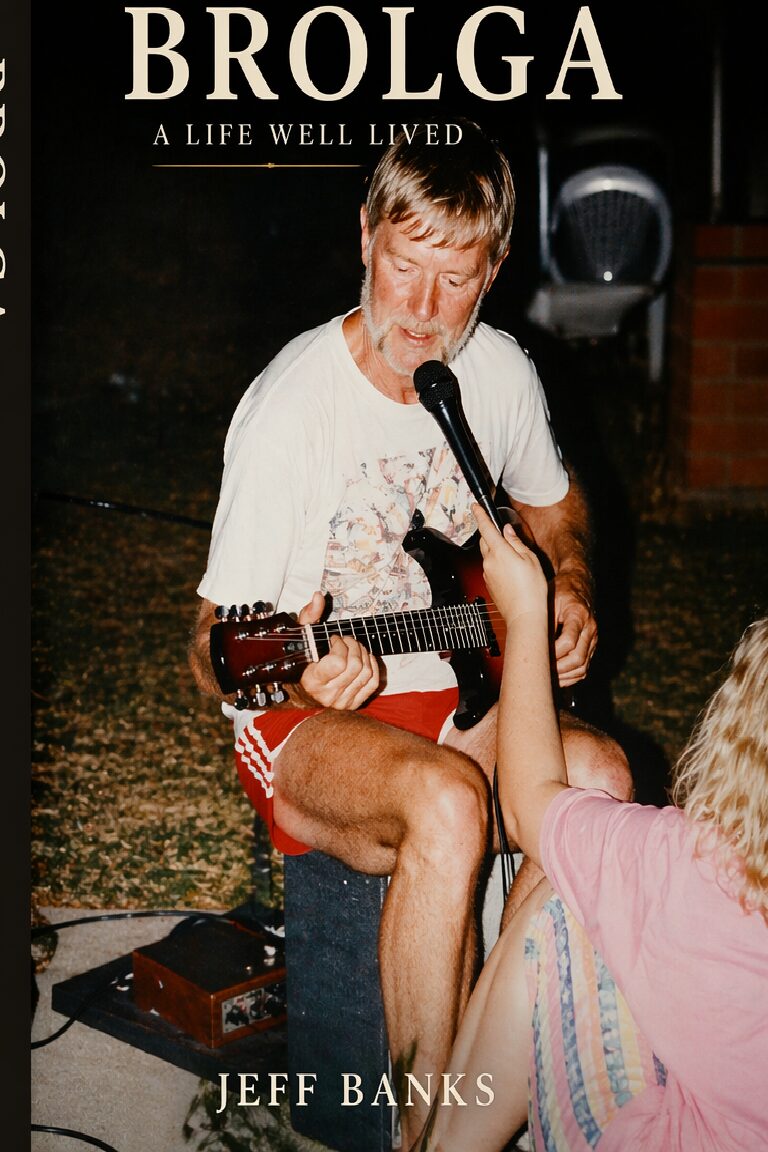
Brolga - A Life Well Lived - Chapter 6 - The Entertainer

Brolga - A Life Well Lived - Chapter 6 - The Entertainer | Travelling Around Australia with Jeff Banks

The town’s grand, stubborn plan, the broader plan they cling to like a lifebuoy on the riverbank, drifts into the talk. “That little town, the plan and the walk-in, cricket matches and storms,” I say, letting the memory hover. He laughs again, and the memory threads itself into the present like a seam that won’t come undone.

BROLGA


A Life Well Lived


Chapter 6 – The Entertainer


The riverbank is quiet today, but not empty. It holds the day like a patient elder, sun-warm and listening. I’m here with my virtual notebook, a phone on camera video record, though I know the pages will stay mostly blank while Brolga speaks. He’s one of the many professional entertainers of this family, ones who makes a room feel larger with a dry shrug and a well-timed joke, the voice that carries the laughter downstream like a current. I’m merely directing the talk, prompting the bends, letting him steer the memory ferry while the river nods along.


“Reading music,” I start, not barging in but inviting the rhythm to show itself. “You are evidence of my mother’s side of the family being really musically inclined, yet very few of them read music and I know you have a pretty good talent for entertaining”


Brolga gives me that practical, steady grin, the one that says he’s seen enough stages to know when to lean into the line and when to let it roll. “Reading the room,” he says, and there’s a breath in the pause, like a tide turning. “Not even kindergarten yet. I can’t read music; I just like, I just picked it up”


“And track your brother,” I lightly finish for him, a thread you follow when you’re threading a story through a crowd you’ve walked with since you were kids. “Yeah,” he agrees, soft and sure. “It’s easy to entertain.”


“Brilliant,” I say, letting the word hang a beat longer than necessary, because I know the ledger of laughs and losses this family keeps. Justin sits in that ledger, the brother who won’t be boxed by a page of notes. “Justin is the same. He can’t read music.”


“Yeah”, he murmurs, almost as a concession to the river’s own quiet listening. “And I don’t, I don’t think Two Dogs can read music either,” I add with a patient grin, the joke gliding in like a familiar boat through a familiar channel. The river agrees, a soft murmur that seems to approve every line we stroll past.


“Oh yeah,” he says, a nod that feels almost like a weather event. “Kirsten picks up that saxophone and needs the music in front of her. Otherwise she’s got no hope.”


Kirsten, the PhD doctor in Astrophysics, the youngest, the astronomer-child with a joke tucked under her arm, gets named into the afternoon as if the sun itself is circling to hear her name. “Kirsten, Kirsten,” I echo, and we both share a quiet smile that says: here’s a family that names a future into the present.


“You’re right,” I tell him, and the air between us softens. “Oh yeah, yeah.”


The riverbank loosens into a warm hush as a family reunion breathes into view. Sunlight rides along the water, tally marks on the skin of the day, while a dozen voices crowd the shade of the trees. Here, in this easy, ordinary moment, Brolga sits at the heart of it all, the man who can turn a crowd with a shrug and a wry aside, the steady pulse of entertainment without a stage, without even a guitar to hold him up. I’m there, notebook in hand, coaxing the memory across the current like a boat coaxed toward the bend.


The invitation went out with a practical edge: every division had to provide an entertainment interlude. My family is easy, I tell myself, let Justin handle it, our oldest, a professional entertainer on the pub circuit, with a knack for turning a room inside out with a single wink. Kirsten, polished and precise, the saxophone’s whisper of metal and air, would carry the more formal note. Max’s kids, I hear, had rallied in the backyard to stitch together something that would make the lake lean in, a stirring rendition of I Got High, they’d called it, a cheeky nod to the highs and lows that run through our kin. And then there are the odd ones out, as there always are; in this crowd, it’s the Parnaby side who carry the label with a shrug and a sigh.


Brolga’s laughter is the first thing that slips into the air, a dry, honest sound that doesn’t pretend to be bigger than the moment. He’s not strutting a stage; he’s drawing the circle a little wider with a few words, and the river keeps time with him, a patient witness with a spray of light on the water.


He had started proceedings, even annoyingly disappeared and returned with amplifiers and microphones to give the performers the requisite sound levels. Foslon City Blues and a number of other Cash-like songs, all known and all sung along to, some accompanied by Two Dogs others not.


“Remember Bruce,” I hear myself say, the line slipping free as if I’d laughed it out before and it’s returning from a better place. Bruce, egged on by the rest of his tone-deaf family, creating pandemonium with a taking bum, an image that lands with a soft clatter of remembered chaos. The bank erupts in a mixture of fondness and righteous grumpiness, exactly the way a big kin group loves to celebrate its own chaos while pretending not to notice the mess.


Brolga’s eyes narrow in amusement, the corners crinkling. He doesn’t need a plan to make a crowd comfortable; the crowd already is.


The drift into memory comes easy, unhurried as a boat finding the bend. “We drift into the memory with a careful, unhurried drift,” I narrate, the river listening in on the sides. Then the line, my line, the old chorus of recall, pops out as if it were spoken yesterday: “Remember Justin, my oldest, out there, the other day, the other day, there might be.” He nods, not just with memory but with the weight of what that moment contained. “2013 it was,” I supply, and his acknowledgment is a small, stubborn anchor in the current, the way a good memory holds fast when the river wants to drift.


Brolga clears his throat with that practical cadence that’s part joke, part memory. He doesn’t pretend the reunion wasn’t a riot of nerves and talent. He tilts his head toward the line of trees, as if coaxing the sound of distant applause from the leaves. “Justin,” he says, with that quiet certainty that makes you want to lean closer, “knows how to light a room. He’s the one they trust with a microphone and a crowd counting on him to keep it honest.”


Kirsten’s name flits into the talk like a bright comet, Kirsten, the sax, the instrument’s breath in her hands, the way she can shape air into a shape you can hear. Brolga nods, the memory lingering. The other divisions, the others who showed up with lighter ambitions and bigger egos, would twine their stories into the moment, but in this circle it’s Kirsten who carries the gentle precision of a crafted jewel.


In this family, the entertainment interlude isn’t a single act; it’s a chorus line that includes every division, every misfit, every aunt or cousin who found a way to turn an ordinary afternoon into something that feels like belonging. Max’s kids set the tempo with their joy; Justin brings the weather, sunny, precise, and generous; Kirsten adds the breath of something true and clean; the Parnaby branch offers the quiet, stubborn proof that not every note needs to sing to be heard.


Brolga, the entertainer, holds it all with the simple grace of someone who knows you don’t need a stage to give the crowd what they want. He welcomes the interruptions, the laughter, the imperfect harmonies, and the memory remains: a river, a family, and a long, shared moment where entertainment isn’t something done to you but something you do together.


“The memory comes back,” I say, inviting the river to lean in as if it wants to hear the rest too. “The lawn bowls days, the pub that wouldn’t throw you out, the fights and the laughter that followed like a chorus line.” He doesn’t push back; he lets the memory coast, settles into the shade of the trees and waits for the next line.


“It’s unreal,” he finally says, the truth settled into his voice like a well-worn boot. “Hungaria lot and all that, and the pub doesn’t throw you out anymore.” A dry laugh; the kindness in it is the sort that makes a room feel homey, not small.


The town’s grand, stubborn plan, the broader plan they cling to like a lifebuoy on the riverbank, drifts into the talk. “That little town, the plan and the walk-in, cricket matches and storms,” I say, letting the memory hover. He laughs again, and the memory threads itself into the present like a seam that won’t come undone.


And then the part that keeps time with the heartbeat of the family, Max, Brolga, the Entertainer in the context notes, invited to the USA to jam, to test another country’s air with their old-country rhythm. He didn’t read the notes either; a fever hit before he left, energy drained like rain through a tin roof. He sang when he could, listened when he couldn’t, and they called him Brody over there, and he played along.


“Five weeks of gigs with little energy left and a crowd that believed in the performer more than the man believed in his own lungs.” Not a boast, but a weathered confession, the kind of truth that sits in a room and makes the walls feel a little taller.


“Two Dogs,” I remember aloud, the nickname Tony Ferguson earned, sticking to the skin of the day. “Two Dogs is Tony.” The big screen behind us shows Dusty, Dusty Smith, dying, Dusty’s name popping up on the memory like a cruel wink from fate. Dusty, Dusty, the timing always sharper than we expect.


“Do you ever do And the Band Played Waltzing Matilda?” I ask, because some memories travel without permission. “No, no I tried once,” Brolga admits, the blunt honesty landing like a line drive that misses the heart but not the truth. “It’s a tough song to sing.” And the river agrees with that understated truth, letting the moment stay.


The talk threads toward a final weave as he talks about his kids, drifting away for a moment, Col in the air force for sixteen years, a comedian who can turn a room into a small circus of stories, a life that circles back to the stage even when the world says otherwise. The memory stays sun-bleached and real, a family ledger written in light and dust.


In the end, there’s no instrument in hand, just the river and a voice that has learned to coax laughter and memory from the same throat. The entertainer inside Brolga isn’t a showman who arrives when the mood strikes; he’s the steady current beneath the talk, the quiet spark that keeps the room warm when the weather turns cold. Max’s fever, Dusty’s old photo, the dream of a life earned by the ear rather than the page, these sit with us as a way of listening, not as a melody to be played.


The sun sinks, and the river keeps time with our breaths. We aren’t chasing perfect notes or flawless finishes; we’re listening for the stubborn honesty that binds a family: a rhythm learned not from a page but from each other, a story told in the interruptions as much as in the lines. The talk continues to weave, the way water finds a new bend long after you’ve learned the old one by heart.


Author

Menu