

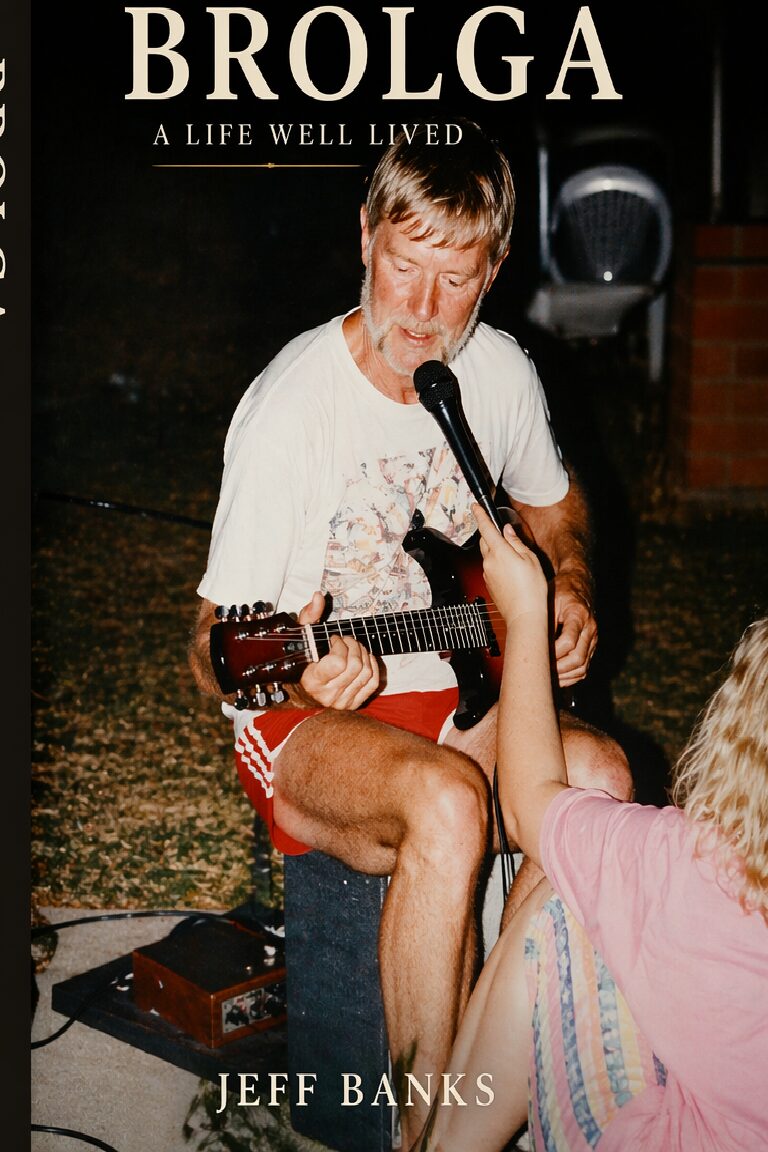
Brolga - A Life Well Lived - Chapter 5 - Brolga the Boong

Brolga - A Life Well Lived - Chapter 5 - Brolga the Boong | Travelling Around Australia with Jeff Banks

He went on, grinning now, about Sundays. Bowls at the lake, waiting on the raffle, then heading down to Barry’s place ten or fifteen minutes out towards Condobolin. A singalong in the yard. Laughter that got louder as the day ran on. Some fella they called the Snake. Another bloke who couldn’t keep up but tried bravely anyway. The whole rough-edged fellowship of country men making a day of it.

BROLGA


A Life Well Lived


Chapter 5 – Brolga the Boong


The Lachlan continues to hold its breath, a pale thread of morning between water and sky, the phone remains on a weathered bit of driftwood, the lid of the bait tin clinking softly as if to remind us we’re alive to small details. The bridge’s iron nerves hiss into the hush, and the bypass trucks grunt past, their sound bending into birdsong and the faint splash of water against the riverbank. I’m listening, and I’m listening for something that might make sense of the life I’m living, here, with Brolga.


I say it aloud, the question catching in my throat and then dropping, as if the river itself is listening more closely when I speak in a lower voice. “Tell me about our Indigenous heritage.”


Brolga turns his gaze toward the far bank, where the town’s memory sits in the dust like a switchblade of light. He doesn’t rush, not ever, but settles into the moment with that patient, almost ceremonial straightness of a man who knows time is a friend only if you treat it gently.


I didn’t know till I was fairly late. No, I must have been thirty before I was told. The words came with a slow, almost polite insistence, as if the land itself were asking me to lean in and hear the longer story behind the surface. The confession sharpened the morning’s ordinary light into something closer to a measured edge, the kind you feel in your chest before your brain catches up.


The morning hum folds into something steadier, the coffee across the river hissing into a handful of honest cups, the line’s soft rattle, the birds taking a longer breath as if they too are listening for a doorway in the day. I listen, not just with my ears but with the memory that’s been sitting behind my eyes for years, waiting for the right morning to loosen its hinges.


“Hidden generations, not stolen generations,” I drift out, the phrase settling between us like a seed that might grow if watered with quiet hours and patient talk. The river leans a fraction closer, a ribbon of light threading through the spray and the ripple, as if it wants to witness what we’re about to name aloud for the first time in a place that has seen so many names whispered to the water and the land.


“So we were to be stolen apparently,” Brolga says, his voice a careful notch above the river’s own whisper, catching on a remembered sting. “But every time there’s a big black car, the bloke’s name was Mr Linton, or something like that, they’d see the car coming and we’d all race down, hide in the gutters. When Ferguson kids hid, you couldn’t find us.” He lets the line sail into the air with a small, dry humour that sounds like a foot tapping on a wooden floor, a sound with no malice, only memory’s stubborn persistence.


I picture the guttered edges of the town, the narrow channels that show up in the dawn like secrets you weren’t meant to tell and then discover you already have told in the way your heartbeat tells the truth when you’re not looking. The map of a town feels small in the bright morning light, yet heavy with history, the way a single street can carry the weight of a thousand quiet refusals, the way absence can feel like a visible thing when you look back from the river’s slow, patient gaze.


There’s more beneath the surface than the old fear of being found, though. There’s a line of people who didn’t walk away from the country so much as coaxed it to stay, to listen, to hear itself spoken back. I think of his grandfather, a man he never met, William Ferguson, though the memory feels slippery, as if it’s trying to slip into the next breath you take. A man who walked on with the land in his boots and the politics of place in his pocket, who believed that country’s dignity required more than quiet endurance, it required a stubborn, public voice. Activist footsteps, not in grand marches alone but in the slow, steady pressure of standing up in a room where your neighbours didn’t want to hear you talk about rights, and yet you spoke anyway.


“William Ferguson,” I say, almost to myself, as if naming him aloud might coax the memory into a more solid form. “He wasn’t just a name in the family tree; he was the kind of man who stood in the doorway of a hall and asked you to look at the world through a different window.” The river hisses at the far bank, a subtle acknowledgement, a shared history leaning in to listen.


Brolga’s eyes drift toward the water, then back to me. “Wasn’t he the bloke who did the long walk for land rights, or spoke at the meetings, or kept the stories alive when the town wanted to forget them?” His voice holds a reverent shade, not a boast but a quiet recognition of a life lived in the public, and sometimes painful, space between memory and recognition.


“Could be,” I say, letting the thought settle like sediment. “Maybe it was my father who carried that another way, never giving me the names, never unfolding the family tree the elders whispered about. But Bill, if he’s the one who did the activist path, he made a form of kinship with the land that didn’t require a piece of paper to prove it. He fought for education in enrolments and speech, for the right to speak your own language on your own ground, for the dignity of being counted when the census came around and people forgot to count you properly. It wasn’t only about land; it was about who got to stand in a room and be heard without having to prove their bloodline first.”


The line moves, and I notice how the river’s surface catches a thread of light and holds it like a tiny, patient promise. My own expectation, my own need for a neat genealogy, meets the stubborn ache of a history that stubbornly refuses to be tidied into a tidy narrative. The realisation, the sense that heritage is not a badge you pin but a practice you enact, lands with a quiet gravity. It is not a verdict; it is a way of moving through the day with a country inside you so fully that you no longer need to spell out every connection to feel the land answering your breath.


“Dad’s line wasn’t about who we were mixed with or what we said at school,” Brolga repeats, the cadence of memory returning like a familiar friend who never leaves your front lawn without your permission. “It was about how you stood when the jokes came on a Saturday arvo and the world felt too loud for a boy whose heart kept time with the river. It was about how you pretended you didn’t hear, and how you learned to hear anyway.”


The confession lands with a small, stubborn gravity, not a blame, not a boast, but a quiet admission of the cost of growing up with a truth held just beyond reach. The gutters, the remembered hideaways, become not just the site of fear but a symbol of a life lived in the shadow of a larger story that was never spoken aloud enough to keep you safe, or perhaps never spoken aloud at all except in glances and the long, careful listening of a family that learned to wait for the telling until the river itself seemed ready to mirror it back.


“There’s a great story about Kerre,” I say, the name soft on my lips, “lost Show Week.”


The story goes that Kerre’s disappearance during Show Week was the fuse for one of the great arguments between my grandparents, Cyril and Kerre’s mother. It was the kind of row that leaves a mark on the kitchen table, on the floorboards, on the air you breathe when you walk into the house after a long day at the river. Kerre had wandered off to the show on her own, a girl with the world at her feet and a mind full of small adventures that felt as natural as breathing. The day’s energy had that bright, ridiculous tilt to it, the cattle, the horses, the clatter of show bells, the way the town swallows its own noise and turns it into a kind of music. It was all innocent enough, almost euphoric, a child’s certainty that the day would keep giving.


But the moment Cyril sank into those evenings that follow a day of poker and pub talk, the moment his mates’ laughter and the clatter of coins mingled with the sound of traffic on the highway outside Condobolin, everything changed. He was playing cards, gambling with his mates at the pub, and refused to be drawn into the search. The search, if you were listening to the whispers, became a town’s chorus: the showground, the back streets, the gutters, the schoolyard, the whole place turning itself inside out, hunting for a child who wasn’t really lost at all, but simply had wandered into a quiet corner of the day and fallen asleep.


The rest of the family moved into panic mode, as families do when the clock starts to tick in that way: loud, relentless, and a touch melodramatic in the telling, the sort of fear that refuses to be named until it has its own weather system. Word had it that Mr Linton, the big black car, the kind of thing that makes a town feel suddenly small and watched, was in the area. We were supposed to be looking around the show ground, around the town, everywhere a lost child might drift, while the adults kept their own kind of vigil in the rooms that don’t open to the sun.


Kerre wasn’t lost. She’d simply gotten tired, and had fallen asleep against a horse in a stall at the show. The image comes to me in fragments, the stall’s wooden boards, the horse’s warm, calm flank, Kerre’s breathing steady as a child’s after a long day of laughter. It’s almost comically innocent, this picture: a girl curled against a creature that knows nothing of the world’s anxieties, a moment of quiet that could almost be mistaken for peace if not for the louder truth that follows.


Cyril arrived home with the significant winnings of the poker game, the money looked on the table as if the afternoon’s luck still had a hand in his fingers. He threw the bills back at the night, and the anger that followed was much more than anger about a missing child. It was about the life that had taught him to play hard in a town that didn’t give away easy answers, about the price of a man’s pride, about the way a family’s safety belt can snap in seconds when a dream of success collides with a child’s night of wandering. The chastising came not just for the absence but for the tremor behind the absence, the fear that the show’s bright surface hid something darker waiting to surface.


I think of Kerre, not as a single incident, but as a girl and then a young woman who threads through our family like a bright thread in a stubborn weave. She’s the sort of child who gives you a story you can’t quite forget, the donkey-work of care in the small acts of defiance, the stubborn cunning that makes a sister vanish into a moment and reappear with a story that refuses to be told in any neat or tidy way. The memory of her, the show days that have become our own family myth, holds a particular light now, the light that comes when you see how a life can be both an adventure and a responsibility, all at once.


Kerre’s disappearance didn’t just test Cyril’s pride; it tested the very shape of the family’s trust in itself. The search wasn’t merely a search for a missing girl; it was a search for who we were when the world around us demanded more courage than we thought we possessed. The mother, left to carry the fear in the kitchen light and in the quiet at night, and Cyril, who would no doubt tell you that he did what he did because he believed he could weather the storm by counting cards and measuring luck. The truth is more stubborn than luck, and it sits in the memory with a quiet ache: the cost of a moment’s pride, the price of a family’s safety net, the weight of knowing that sometimes the world doesn’t let you keep your stories simple.


And then the mother’s anger, so loud in those days, so quiet now in the telling, became the other edge of the memory. The fight that followed wasn’t merely about Kerre’s night away; it was a reckoning with a life lived under pressure, with a land that demanded more of its children than the family could always give, with a town that wanted to pretend nothing bad ever happened to good people while the stories of loss kept moving from mouth to mouth like a game of Chinese whispers. It’s a memory that doesn’t cosy into sentiment; it sits with the gravity of a heavy hammer tapping a nail into the world’s rough wood, reminding us that safety isn’t a guarantee but a daily practice of listening, forgiving, and choosing to stay.


I think of Kerre as a girl, then a young woman, a thread through the family’s fabric that won’t snap even when the loom buckles. The donkey-work, the small acts of defiance, the stubborn cunning that comes with growing up in a world that isn’t always kind to those who play by their own rules. Kerre knew the world could be generous and cruel in the same breath, and she learned to move through it with a storyteller’s instinct, to vanish into a moment only to return with a tale that could not be dismissed.


“And then there’s the time she rode a horse into a shop because she didn’t want to get into trouble with mum,” I finish for him, the half-lam of memory turning into a full flame of recollection. “Or so the stories go.”


“I can’t remember,” Brolga says with a soft grin. The instruction was go to the shop – dont get off your horse. “That wouldn’t surprise me; she’s mad, so, probably.”


“She’s the effective matriarch now,” I say, a line that lands like a pebble skimming the river’s surface and leaving a bright ripple. “Isn’t she the MCA, the CEO of the family’s show?” “She’s the CEO,” Brolga agrees, a chuckle in his voice that sounds like a lid being coaxed back on a pot. “She runs the show.”


“Not the youngest,” I add, thinking of the long line of women who pulled us through the storms with quiet hands. “Julie’s younger than her,” he notes, the memory sorting itself into place with the patience of a man who has watched a family become itself over generations.


“Julie is the same age as my wife,” I murmur, the phrase a hinge between two families, two generations, two mornings on the Lachlan. “Yeah.” He draws a breath, a pause that carries the weight of a life lived with horses and dogs and the stubborn work of food and care. “They weren’t bad on horses and food.”


I smile, the river catching the light in its own careful way, as if to say: yes, here is the weather of life, weathered and true, and we are listening.


“I was mad,” I admit, letting the words slip out, not as a boast but as a memory kept honest. “He was mad, I was mad.” “Anything other than cricket you play?” I ask, trying to map the young man I once was against the life that Kerred me here.


“Footy,” he says, and the memory takes on a clearer form. “I was lucky enough to win a premiership in every sport I played.” I laugh softly, a dry sound that doesn’t pretend the truth isn’t stubborn. “You’re starting to sound like me now.”


“Lucky, yeah,” he agrees, with a shrug that acknowledges luck and labour alike. “Cricket, basketball, whatever, you name it, I played it.”


The talk slides into the old fields, the oval, the pitch, the scrubbed lines, the way a town’s heart beats in a sporting season. He explains his position in the short time it takes for a memory to tilt a lid: a ruckman in Aussie rules, a rover in cricket, a mind that knew the space between plays as well as the action itself.


“You’re not particularly tall,” I say, half chuckling at the old joke of bodies and limits.


“Not really,” he replies, a practical shrug. “Six foot or so. A rock, but not everyone out there was tall. You, on your right”, the sentence trails off; the memory of bodies and games is a chorus that never quite ends.


“We didn’t just play,” I tell him, keeping the river between us and the past as a living thing. “There was a scramble for numbers. I remember I played for you once because you were so short.”


He nods, the old ritual of teams and Sunday mornings and the half-forgotten names we used to call one another when the world felt too loud to carry in our mouths.


“Just like that, you’d drive around Sunday morning looking for players. Even Shield cricket, what do you call it, Cup, forms, and all that. You were always looking for a player. Usually you’d find them at the pub in the afternoon and snag a fastball and”


“And then the plan was to keep this one’s drunk so we could hold them together,” I finish for him, the memory’s grin as stubborn as the river’s current.


“But then,” he testifies with a dry, almost affectionate tone, “the good old days, we played fair. Then somebody hit somebody, and we checked if they were all right.”


The talk shifts, as it always does, toward the old battles of sporting etiquette and rough play, toward the way a life can tilt from competition to something like kinship if you’re lucky enough to survive the days that shape you.


“Do you know this storming-back-to-the-top-of-your-marks stuff the Prima Donnas do now?” I ask, trying to glimpse the young man I was in the middle of a game, not in the middle of a reckoning.


Brolga’s answer lands with a likeable bluntness: “No, no, I just, good shot, mate.”


“What are you doing, you silly bastard?”


“I’m listening,” he says, the simplicity of a man who has learned that the best moves in a game are the ones that keep the larger game intact.


We drift on, the river’s surface brightening, and I test the waters of a thought I’ve harboured for a long time: the idea that heritage isn’t a badge, but a weather system you learn to live with. We speak of the old cricket and football fields, the way the community gathered, the way the land kept score in the margins, the way a fastball could become a shared joke and a reason to stay a little longer on a riverbank.


“If you had to put your trust in any life,” I say, letting the river breathe between us, “to go into a life-and-death moment, which man would you choose? Ian Chappell or Greg Chappell?”


“Oh, Greg,” Brolga replies, almost before the question finishes forming. “He’s elegant, brilliant, beautiful. I’d take Greg.” Then softer, a hint of mischief: “Not sure if he’s still such a legend, but I’d still take him. Sir Ian, they call him now.”


We laugh softly, as you do when the edge of memory is a friend you haven’t seen in years but who knows your jokes by heart. The talk turns again to families, the mother who bet on horses, a mentor who taught you to read the field before you could read a rulebook, the lightness and stubbornness of the old men who kept their tongues steady as the world changed.


We drift to Two Dogs and Justin, boys with significant musical talents and the memory of a weekend with cousins who became kin. There’s a sense of closure without a bow, of memory as a continuous thread rather than a neat chapter break. The river remains the steady witness, the day remains open, and the quiet humour of the moment, the way a line of banter can sit beside a memory of hardship without dulling the ache, stays with us.


“I’ll stop this for a moment,” I say softly, a line break in the middle of a living story, and I feel the weight of what’s been said settling into the river’s slow, patient curve.


But the river isn’t finished with us. It never is. It invites us to listen a little longer, to hold the image of Kerre’s madness and the way the family kept going, to hold the memory of a grandmother’s weathered voice and a country inside us that isn’t a map but a way of hearing the land speak back. It asks us to remember that the naming, the belonging, isn’t a verdict but a practice, one that happens on mornings like this, on a riverbank where memory rises and the day begins again.


So we stay, two voices bound by river and time, the author and the elder, the boy who ran and the man who stayed, letting the next memory approach on the current, the next question to ask, the next truth to hear, and the next quiet moment to share with a river that keeps showing us how to stay, how to listen, how to tell a belonging that isn’t loud but lasts.


A bit later, when the lines had gone slack again and the river had settled back into its own business, I asked him about the statue of William Ferguson in Dubbo. The question had been sitting there for a while, like a snag just under the surface.


Brolga squinted across the water before he answered, as if Dubbo might be somewhere over the far bank if you looked at it the right way. He said he’d gone over for the unveiling. Carolyn had gone, and Chris, and Ken. Family had made the trip, as families do when history has finally been cast in bronze and put on a plinth by people who ignored it for long enough. He said it without much ceremony. No swelling pride. No grand declaration. Just that he went.


Then he shrugged. “It doesn’t mean a real lot to me,” he said. “Could be anybody.”


That was Brolga all over. No false reverence. No performance. A statue, to him, was still only a lump of metal unless it touched something lived. William Ferguson might have been our grandfather and a known man in the wider story of Aboriginal political life, but Brolga had not grown up in the warm glow of that knowledge. He had not been raised with a framed family tree on the wall, lines carefully drawn and stories neatly attached. He had grown up in a house where some things were known without being spoken, and other things were never spoken until late, if at all. By the time the truth arrived, it arrived like weather after a long dry spell: explaining the cracks in the ground, but not filling them.


He nodded towards me, then back to the river.


“But if I tell people I’m a blackfella and they don’t quite know what to make of it, I say, go and have a look at my Grandfather’s statue over there. Then they sort of believe it.”


He gave a little laugh at that, the dry Ferguson laugh that says the joke is funny because it’s true and sad because it’s true. It struck me then that the statue did mean something to him, just not in the way people imagine. Not as inheritance, exactly. More as evidence. Proof for other people. A public monument standing in for a private absence. There is something cruel in that, when you think about it. Your own history made official only once it has been set in bronze by strangers. Your own belonging needing a landmark so the world will stop looking doubtful.


The line twitched and he glanced at it, though nothing came of it. Across the river, a truck hammered over the bypass. Someone at the servo had started up early with the coffee machine. The day was broadening, but the cold still had a bit of sting in it.


“We were never brought up that way,” I said. “We were mainstream.”


“Yeah,” he said. “Mainstream wise, who would’ve thought?”


He said it lightly enough, but there was something under it. We had been brought up to fit in, or near enough to it. To get on with things. To play the game. To work, fish, drink, laugh, turn up, not make too much fuss. Aboriginality, when it finally came into view, did not arrive as a full and generous inheritance. It was not as though someone opened a door and there were all the answers waiting in a tidy room. It explained something, yes. The pull of the bush. The instinctive comfort on the riverbank. A way of being in the world that had always felt older than the life laid out in front of us. But it did not hand Brolga a map. It did not tell him how to live differently. It did not suddenly restore what had been left unsaid by his father, or hidden, or withheld, whether out of fear or habit or the long training of survival.


He was clear on that. “I don’t exploit it,” he said. “I just say I’m part Aboriginal. But I don’t get into all these claims and that.”


It was not dismissal. It was his own way of carrying it. Brolga had no interest in turning identity into a speech. He was too practical for that, and too wary of anything that sounded like showing off. But you could hear, if you listened properly, that the knowledge had found its place in him all the same. Not loudly. More like underground water.


I asked him whether it explained anything, whether maybe that was why we liked the bush so much, why the river and open country never felt like scenery to us but like a place you dropped back into, the way a person settles into their own skin.


“Well, that’s probably why I do like the bush,” he said. “Probably because it’s coming out in me.”


He said it without drama, and because he said it that way it carried more weight. The riverbank seemed to approve. We sat there with the rods angled out over the Lachlan, the mud cold underfoot, the morning moving slowly around us, and the thought settled in. Not as revelation exactly, but as recognition. Something that had been there all along, waiting for a name.


He told me then about Barry, a mate of his, downriver, a man he spoke of with the sort of affection men usually reserve for brothers, dogs, or old utes that have never once let them down. Barry was a blackfella, he said, though the point of the story was that it hardly mattered. They’d never seen each other that way.


“We just hit it off first time,” he said. “Just mates.”


That was the phrase he came back to. Just mates. Not in the thin modern sense, but in the older, heavier one. A word that covered trust, habit, loyalty, shared piss, shared fish, shared silence. Barry and his brothers and the other fellas would play every second Sunday, and there’d be Brolga among them, the lone white pair of jeans sitting in the middle of the mob, as he put it, laughing. They’d fish together, camp together, talk rubbish together.


“Live like blackfellas,” he said.


I asked him what he meant by that, and he looked at me as if the answer was obvious. “Just camp on the bank of the river. Don’t take much. No swags and all that fancy gear. Just camp on the bank. But it’s got to be a bit warm first.”


I could picture it at once because I knew the sort of camp he meant. Not the curated kind people write about in magazines, all enamel mugs and tasteful blankets. This was riverbank living stripped back to the proper essentials: a fire, a bit of shelter if needed, a few folding chairs if someone had remembered them, meat wrapped in newspaper, esky not far away, everyone sitting close enough to pass a plate or tell a yarn without raising their voice. The kind of camp where the dark feels companionable and the smoke gets in your clothes and stays there.


His face brightened talking about the cooking. Barry, he said, was a magnificent cook. Take half a lamb down there and Barry would spend all day with it over the coals, turning it slow, basting it, minding it like a duty. There’d be trays of baked potatoes, pumpkin, carrots, parsnips. A feed fit for kings, Brolga said, and because he said kings with that little mock flourish of his, it carried both joke and truth.


“Eat like kings,” he said.


The thing that stayed with him most, though, was not the food. It was the order of the place. The camp had rules, clear and firm, and they were not written down because they didn’t have to be. No bad behaviour around women. No swearing for the sake of it. No carrying on till it turned ugly. If a bloke started trouble, Barry would put him out straight away. No dithering. No committees. No sentimental nonsense about giving him another chance while everyone else suffered through it.


“He’s well respected all through the river country,” Brolga said. “Barry is.”


I told him that on our latest trip around Australia we’d been in places where the old authority still made more sense than the official kind, where country and community were managed by people who belonged to it rather than people who administered it from a distance. Places where problems were dealt with before they became systems. Brolga nodded. He didn’t need the theory. He knew the practice.


“That’s what it’s like,” he said. “We sit around talking shit.”


There was a good deal packed into that line. Not polished conversation. Not healing circles or identity statements. Just people sitting around on the bank talking unadulterated shit, as he put it, and in that nonsense there was belonging, and in belonging there was a kind of law. The family version of civilisation. Tea if it was early. Beer if it wasn’t. A song later on if someone felt musical. Stories becoming funnier as the night wore on and no less true for it.


He said he’d welcome Barry into his house before nearly anybody else. “Beautiful person,” he said simply.


The river moved past us with that flat, steady confidence it has out there at Condo, as if nothing in human life could surprise it much anymore. A cormorant lifted off upstream. My line had cabbage on it again. Brolga watched me reel it in with the sort of sympathy usually reserved for the terminally hopeless.


He went on, grinning now, about Sundays. Bowls at the lake, waiting on the raffle, then heading down to Barry’s place ten or fifteen minutes out towards Condobolin. A singalong in the yard. Laughter that got louder as the day ran on. Some fella they called the Snake. Another bloke who couldn’t keep up but tried bravely anyway. The whole rough-edged fellowship of country men making a day of it.


Then, as if it had to come eventually, the talk turned to drink.


“Do you have a drinking problem,” I asked him, “or does drinking have a problem with you?”


He barely paused. “Drinking has a problem with me,” he said. “Only trouble is I can’t get enough of the bastard.”


He was laughing by then, and so was I. That old Brolga line of self-mockery, delivered with perfect timing and no self-pity. I pressed him a bit further, and he said he was training to be an alcoholic but wasn’t fully fit yet. It had kept him broke, he admitted. Kept him half-pissed over the years. But he was a happy drunk, he said. Didn’t go looking for fights. Didn’t carry on. Just liked a drink.


There was a whole life in that too, though neither of us bothered laying it out like a case file. In families like ours, drink is never only a joke, but the joke is often how you manage to say its name.


I reminded him he’d been barred from one pub once. “Never been asked to leave in my life,” he said, all innocence. “Just not allowed back.” “Just allowed to go to a different one,” he said.


Even the river seemed amused. The trucks kept rolling over the bypass. The servo across the water brightened with the proper business of morning. I baited up again while he looked downriver, still half-smiling to himself, and I had the sense that this was how the larger story would keep arriving. Not as a straight line. Not as a lesson. A statue in Dubbo. A mate called Barry. Half a lamb over coals. Hidden heritage. Mainstream childhood. A joke about booze. The bush, always there underneath it all, waiting patiently for us to notice that what felt like preference might in fact be memory.


“Things need to be done right, don’t they?” I said.


Brolga looked at the line, then at the water, as if the river might answer first.

Author

Menu