

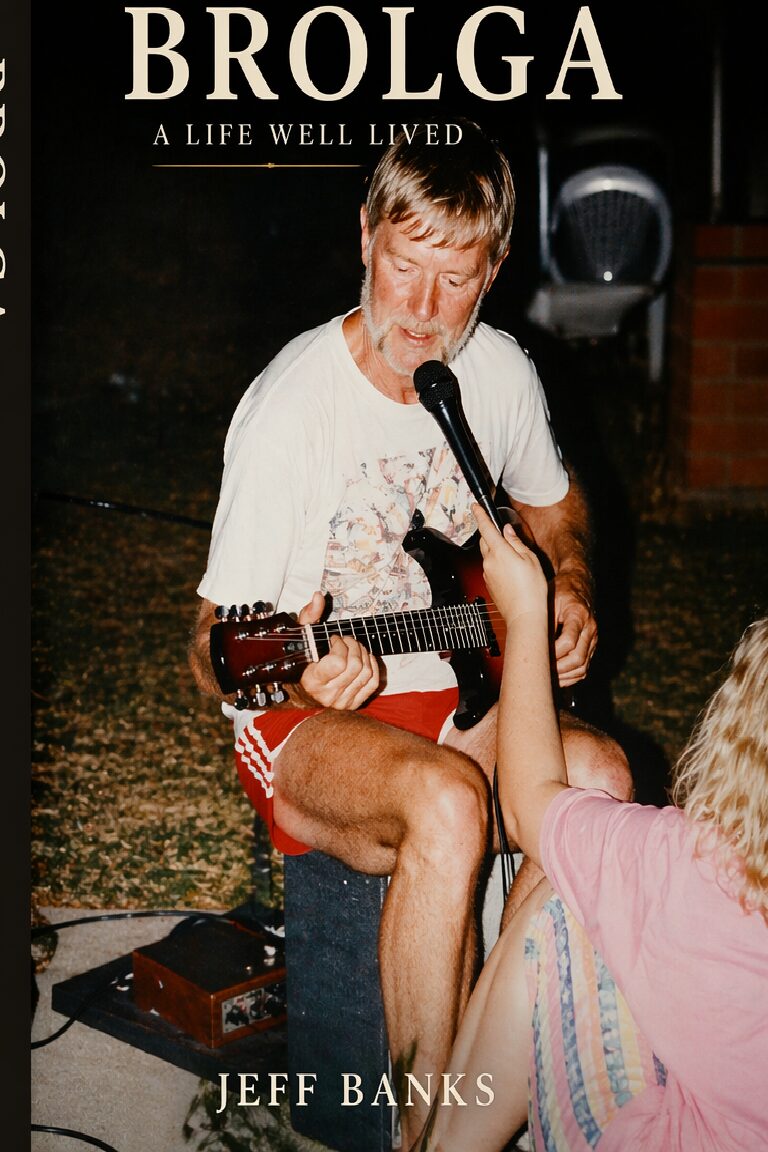
Brolga - A Life Well Lived - Chapter 3 - Brolga the Cricketer

Brolga - A Life Well Lived - Chapter 3 - Brolga the Cricketer | Travelling Around Australia with Jeff Banks

Then, almost immediately, Borlga digresses. One of his most favoured memories of being sunburnt on a Saturday afternoon in the scorching heat of the west comes to light. It's a story I had heard hinted about, but about to get from the horse's mouth.

BROLGA


A Life Well Lived


Chapter 3 – Brolga the Cricketer


The Lachlan glints along the far bank, a ribbon of stubborn green in a land that’s seen more weather than care. We’re parked on the edge of Condobolin’s riverfront, the red dust of the day still clinging to boot soles and the back seat like a memory you can’t quite shake off. The riverbank sits there, patient and listening, as if it’s waiting for a story to slip out from the gum trees and weigh the air down with something real. I’m in the passenger seat with Brolga, the engine ticking softly, the late-afternoon light stitching gold across the dash.


We still are yet to catch anything from the river, but have already caught so much.


“You were telling me a story in the car on the way here,” I say, “and the question that begs to be asked is: how quick were you?”


Brolga taps the ground in a rhythm that’s half a drumbeat, half a memory, and writes the answer in the space between us. I had heard stories in lore, “Back in the day, the Brolga was pretty well known as the quickest thing west of the divide.” “Yeah but,” I push, “it wasn’t that you were exactly fast, but it was what you did with the ball, apparently. So I don’t know, I never faced myself. I wasn’t game, probably bash me up.”


He laughs, a dry sound that isn’t trying to be clever, just honest. “And you were telling me a story about a guy you asked about how quick you were and the reply was ‘you scared the shit out of me.’”


“’You scared the shit out of me you big bastard,’” he repeats, with a grin that makes the river look a little kinder. “But it was a game to me. I used to play it as a game, not as a… I never ever sledged anybody, ever. Batsman would walk past.”


I’d argue the point, but the moment doesn’t need pushing. The river seems to hum with chalk dust and the memory of fields where a good ball could pull a grown man from his crease with nothing but a whisper of seam. “If you’re making the ball talk, that’s sledging enough,” I offer.


He shrugs, the memory settling in him like it always does, between the small talk and the long drive. “Back then,” he says, “you’d see the big guns come out. They’d have the helmet. They’d have the hat. They’d have the wrist guard. They’d have everything on. Thigh guard. You’d knock their stumps out first ball. They would walk off playing the shot they should have.”


“Even back in your day helmets were around,” I remind him, because the old memory of Gooch has a stubborn place in the mind.


“Yeah, they’d just come in. Only a few blokes wore helmets. You were a sissy if you wore a helmet.”


“Like Graham Gooch.”


“Yes, if they were a bit of a girly kid. If you’re a girly kid nowadays you’re targeted. We’d bet a bottle of Coke, a bottle of drink on who could knock his head off first.”


“So how many did you actually put in hospital you reckon?”


“Only one.” “Only one,” I echo, astonished.


“Yep. That was his own silly fault. He tried to hook and the ball was too far up and he tried to hook it and it came up off the edge of his bat and hit him fair in the head between the eyes.”


I’ve been that bloke with the box, I’ve bowled him a few over, and I know there’s a line in the memory where you can pretend it’s entirely their fault, but you can still hear the thud of what’s gone by. “I used to ask every kid that came past me, have you got a box on? Oh mate, go and get one if you haven’t.”


I remember a moment when the homm, that wry term for the delivery that slips in the notch, came and went, and there wasn’t the customary thud when it found its mark. “There was certainly the ‘ERRRRR’,” Brolga adds, and we both laugh, because the sound of a ball finding skin is a literacy you carry with you long after the game stops.


Gordon, the church man, a nice bloke with a quiet smile, had his own cautionary tale, a memory that still sits in the room like a lamp left on. “And you remember his name.”


“Oh yeah, Gordon. He was a nice bloke. It was his own silly fault he got hit. I went and saw him in hospital that night and he said, ‘Yeah, it was my fault, mate.’ So yeah. About the only one I did any real damage to.”


Gordon, with his compulsion to hook and his habit of stepping outside his off stump, became a kind of living chalk line for the young bowlers who learned how to tilt a ball just so, to bait a man into his own risk. “Wherever the ball was, whatever side of the wicket, Gordon would try and hook it. He would step outside his off stump and try and hook. So you would definitely target him. Then you would bowl him a really slow one on his stumps and bowl him. Wide open stumps, yeah. Old Glary.”


“Not averse to bowling the slow ball?”


“Oh no,” he says, with a shrug you can hear in the air rather than see. “I never slowed my action down. I bowled exactly the same. I took a foot or two back from the bowling crease, the popping crease, and they couldn’t tell whether it was slow or not because you didn’t change anything.”


“That extra yard of distance,” I murmur, and he nods, the memory settling again, the old trick of the trade still bright in the mind.


“There are a few bowlers that do that,” I add, trying to coax a smile out of him. “Yeah I got a lot of satisfaction watching them silly bastards,” he says, and the words sit there like a familiar knot in the throat, crisp, stubborn, true.


So the conversation slips to the geography of Condo, the country tours, the grounds that were never built for show but always ready for a game. Derriwong, Bermet Hills, the way the main grounds would fit two turf pitches and you’d pick which corner to set the stumps in, just to give a bit of space to the town’s pride. “Fair Dinkum,” he says, a simple exhale of memory that makes the day feel more real.


We drift into the old tours, the car radio muting into the sound of cattle and the soft scrub of the wind. I remember Sydney University and the country trips, the miles between Gunnedah, Young, Cootamundra, and all the stops that turned into stories you tell around a table long after the keg’s gone dry. “You’d drive out to Derriwong. Bermet Hills was the worst. Sixty-odd miles of dirt road. You’d get out there in your beautiful white creams and come home red, red dirt. Doesn’t wash out readily, red dirt. You sort of got that colour in your clothes forever.”


Something like the Redex Bashes, the rituals that cling to your ribs like a stubborn stain. “Exactly, and we were playing out at Melrose, about 33 miles out north of here one day, and all of a sudden there was about a thousand kangaroos come burning across the pitch. Just getting out of the road. They were having a roo drive on the next-door property and yeah, thousands of kangaroos. We had to stop playing. Then we had to sweep the pitch.”


The ground was a character in its own right, the malthoid or the quoia mats, the surface that could make or break a day. “The glaze, glazed concrete,” he groans with a mix of affection and disdain. “That’s wicked.” We remember Rye Park, the chrome-bright surface that made the ball skid in a way that felt almost illegal. “The glazed concrete, it used to really skid through on it.”


The memory returns in a rush: a day on the back oval where the surface shone like a blade, and seven for six is a score you still whisper with fond humility. “Over here at the back there was glazed concrete. Yes, seven for six.” A grin appears, all mischief and memory. “That skinny bloke, Deevesy, he’s an undertaker now, came out in pads up to his naval, and I thought, I won’t lift one into him, like the other blokes. I bowled him one, and he belted me back over my head for four, the little bastard. And whoever was bowling on the other end, might have been Doyley, got him. Yeah, got him out.” We lay claim to the moment with a shared laugh at the ridiculousness and the fate that threads a game together.


There are junior teams, too, but the days when sixteen town teams filled the schedule feel like a field of stories now fading in the heat. “Just around Condo,” I sigh, only half knowing what I’m asking for. He nods, softening into the old chair of memory. “Sixteen teams. Now there is a few young blokes keen enough to go Lake Cargelligo or Forbes to play. Yeah, she, the place is just falling apart because of that.”


The ride in his mind ends on the note of a long afternoon spent chasing shade, the keg’s memory still circling the car like a stubborn bee. The day’s rhythm doesn’t hurry. It moves like a river, slow and certain. I think of those miles between Derriwong and Bermet Hills, the dirt roads that coloured a uniform and a dream. I think of the Wilga tree by the rabbit killers’ place, the keg, the singing that would rise and then fall like a wave you ride home on. “You would get home about eight or nine o’clock at night.”


Cricket, for Condo and for Brolga, isn’t only about speed or score. It’s a way to move through a landscape that never quite loosens its grip on you. It’s about mateship that can bite as cleanly as it can guard, about a town that holds on to its characters long after the scoreboard has forgotten them. It’s about the riverbank’s quiet witness and a day that ends with a glassy sky and the memory of a ball that found its mark with the same quiet certainty as the river finding its edge.


Then, almost immediately, Borlga digresses. One of his most favoured memories of being sunburnt on a Saturday afternoon in the scorching heat of the west comes to light. It’s a story I had heard hinted about, but about to get from the horse’s mouth.

 

The Bankstown Cricket Club Country Tour rolled in like a weather front across the plain, sweeping down on Condobolin with that loud, confident hurry of a city club come to a country ground. Thommo, Jeff Thomson, wasn’t just fast, he was a myth that walked off the plane with a case of cold beer and a grin that said he could scare the stumps and the town in equal measure. The locals had heard the name before the car doors opened; the country crowd had waited long enough for a sighting, and the sighting didn’t disappoint.


Brolga, the lower-order batsman in the fixture with a stubborn streak and a backhand of memory, stood at the crease in his own mind even before the ball left Thommo’s hand. It was a country tour moment that felt bigger than the ground, bigger than the scorebook, bigger even than the sun’s slow slide down the River Lachlan. Thommo strolled in with that pace that looked casual until you realised he belonged to a different clock: a clock that ran in meters-per-second and demanded your attention before you could blink.


“I was out to face the rampaging Thommo,” I hear Brolga recalling, the way he tells a story that’s already become a family anecdote. “First up, he served me something innocuous enough outside off-stump. Just a gentle nibble, a test balloon to see if you were still breathing cricket at all.” He smiles, and the smile folds into the memory like a crease that won’t flatten.


In cricketing terms, he explains what happened next with a Northern Territory stubbornness: “I threw the kitchen sink at scoring six over backward point.” He’s not bragging, not really; it’s the blunt honesty that marks these stories, how a bloke with a stick can decide a moment belongs to him if he’s gutsy enough to swing at gravity.


The crowd, Condobolin’s own, a mix of dusty boots and better-than-average hats, leaned in as Brolga raised his bat to acknowledge them. It wasn’t a roar so much as a chorus of long pauses and clinks, the kind of sound that sticks to memory like red dirt on a white shirt. He tells it with a dry, almost offhand relish: “And then Thommo was beside me, asking if I liked my leg stump.” The line is delivered with that casual bluntness, as if you’re discussing weather, not a confrontation between a quick and a stubborn local who still counts the days since his last outside-off-ball.


“Did you see the next one?” I ask him, and the memory slips into detail, not drama. “Next delivery had my leg stump cartwheeling towards the fence as opposed to the ball of the previous delivery.” The stumps, white paint, a stubborn silhouette, took their own victory lap, leaving the moment to land in the crowd’s memory with a thud that sounded like leather on timber and not much else. The crowd didn’t need a scoreboard for that instant; they needed the arc, the grunt, the small gasp that comes when a bowler and a batsman tango on the edge of history and the same ground remembers both of them.


Thommo, the legend, didn’t linger on the ledger. After the cry and the laughter and the applause, he offered a quiet, practical truth that belonged to a man who’d spent his life between the breath and the ball. “You like your leg stump?” he might have asked, an old joke, a test, a dare. And then the day moved on, as days do when you’ve chased something ridiculous and real in a small-town oval.


After the game, as is the way of country cricket, the pub called them like a harbour bell after the storm. The road home wasn’t long, but it carried the hum of a night all of them deserved to share. Thommo bought drinks for the now repentant Brolga, a gesture that felt less like a courtesy and more like a tribute, the way a good bowler’s generosity can be as memorable as a ball that clips the edge of a bat and lands in a spectator’s hat. The room filled with the soft chatter of men who’d seen things you can’t print in a scorebook, and each voice carried the weight of a memory that won’t fade.


The conversation wandered toward the old theatre of fast bowling, the line between power and poetry, the need to hear the thud of leather meeting bat, the cadence of a bowler’s run, the rhythm of a fielding side’s heartbeat. Thommo’s pace was the raw, living memory of speed itself, but Lennie Pascoe, “Lennie Pasco,” as the room would always say it, stood as a counterpoint. Thommo’s thunder and Pascoe’s insistence, the two tones of a country cricketing orchestra. They talked, not to settle anything, but to hear the difference, the way leather sounded when it met the bat at full tilt, and the way a field spinner’s hand could weave the same old ball into a dozen different stories. The “need to hear the thud” wasn’t a competitive longing so much as a shared language, an unspoken bond that kept the room honest.


I watched Brolga listening, the half-smile of a man who’s learned to read the room as a fielder reads the pitch. The pub’s air was thick with old jokes and fresh ones, with the kind of banter that starts as a challenge and ends as a chorus. Thommo’s stories, told with a country man’s straightforwardness, could make the room feel suddenly small and forgiving at the same time. Pascoe’s memory, how many times had the crowd begged for the next ball to land with a louder crack?, stood as a counterweight to the lightning of Thommo’s thunder. And in the middle, Brolga, who’d faced the rampage and not flinched, became the hinge between myth and memory, the ordinary bloke who dared to stand and swing when the sun was at its harshest and the scoreboard was a distant map.


That night wore on, as nights tend to do in a country pub where the clock hands move with a different rhythm. Thommo bought another round, and another, and we all laughed in that way people do when they’ve spent a day chasing the line between caution and risk and found that the line was, somehow, a friendly thing after all. We talked about the sound, the deep, satisfying thud of leather meeting bat, the sting of a ball’s pace on the fingers, the way a good innings can be measured not in runs but in the memory of a moment when a bowler’s speed makes you realise you’ve only ever played against yourself.


The tale isn’t just about a moment in Condobolin. It’s about a collision, Thommo’s raw pace meeting a country boy’s stubborn heart, how a lower-order batsman’s audacity can create a story that outlives the innings, and how the crowd’s hush and then a cheer can become the language of a night that belongs to both the ground and the pub. It’s about the way a town’s memory keeps the thud of the ball and the warmth of a night in the same chest, a chest that holds the river’s patience and the road’s dust in equal measure.


Author

Menu