

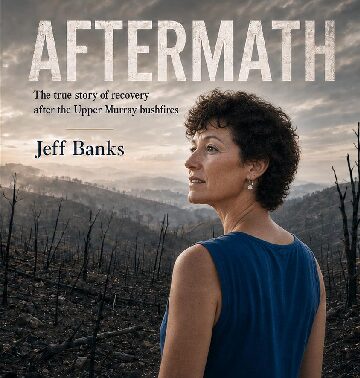
AFTERMATH Prologue - The Fire Came First

AFTERMATH Prologue - The Fire Came First | Travelling Around Australia with Jeff Banks

Some heroes are named on plaques. Some are thanked in speeches. Some are remembered only by the people whose lives they helped steady for a moment when everything else had fallen away. This book is for them too. By the way Tracey was awarded a medal for her work, along with many others in this most trying of times
AFTERMATH

Prologue

The Fire Came First

Fire is a tyrant, never satisfied with taking everything in its path. It does not pause at a boundary fence because a man built it with his own hands forty years earlier, nor does it hesitate at a verandah because a woman stood there each morning watching the light come down the valley. It does not respect a family name, a paid-off mortgage, a hay shed full before Christmas, a mob of cattle boxed in the bottom paddock, or the fact that somebody has already had enough trouble for one lifetime.

It comes as if it owns the place. In the Upper Murray, when fire comes properly, it does not creep in like a visitor uncertain of its welcome. It arrives with a roar in its chest, smoke ahead of it, embers travelling like scouts, wind pushing from behind, and the whole country suddenly bent to its will. Those who have lived there long enough know fire is not merely flame. It is weather, fuel, terrain, fear, memory, instinct, luck, and a long list of things no one controls once the day turns against you.

The country above the Hume Weir has a beauty that can fool people from elsewhere. On a calm morning it can look almost gentle, the Murray lying down in the folds of the hills as if it has all the time in the world, the paddocks stepping away from the water, the timbered ridges rising behind them, and the roads curling around corners as if they are not entirely convinced they should be there. Lake Hume sits back towards Albury and Wodonga like a great inland sea, but further up the system the land tightens, narrows and lifts. The river becomes less a postcard and more a working thing, carrying water, history, boundaries, habits, arguments and hope.

There are places along that country where the Murray feels as though it is running at the bottom of a great crack in the earth. You can stand high above it and see a thin line of water glinting through the trees, with steep country falling away so sharply you wonder how anyone first decided to put stock there, let alone stay. Yet families did stay. They cleared what could be cleared, fenced what could be fenced, cursed what could not be fixed, and learned to read the country by its moods rather than by anything printed on a map.

It is farming land, but not the soft sort that lends itself to easy descriptions. It is hill country, river country, alpine edge country, where beauty and difficulty are so tangled together that one cannot be separated from the other. Some of it has the feel of a place that never promised to be convenient. Tracks disappear into timber, gullies hide more than they reveal, and the distance between two points on a map can mean very little when there is a mountain, a creek crossing, a locked gate, and a road that has decided to become a suggestion rather than a fact.

People sometimes make jokes about places being Deliverance country, and there is an unfairness in that because it can make tough country sound backward rather than simply remote. Still, I understood what they meant. There were stretches where the bush pressed close, where the bends came one after another, where phone service appeared and vanished like a bad promise, and where a stranger could feel the land watching them before the people ever did. It was not a place that gave itself away quickly. You had to earn your way into it, and even then it kept something back.

Corryong sits in that upper country with a kind of stubborn grace. It is known by many as Man from Snowy River country, and there is a romance in that, but romance does not mend fences, feed cattle, rebuild sheds or pay accounts after a dry year. Tallangatta, lower down near Lake Hume, carries its own story of water and removal and reinvention, a town that learned long ago what it meant to be shifted by forces bigger than itself. Omeo sits further into the high country, another name that speaks of cold, distance, horses, cattle, old roads and hard winters.

Then there is the Mitta Mitta, the Dartmouth country, the valleys and river systems that make the map look simple until you try to drive it. Dartmouth Dam is not just a wall holding water. It is a reminder that in this part of the world even water has to be managed, stored, argued over, measured and released. The rivers feed the farms and shape the roads, but they also carve the country into places that can be hard to reach when everything is going well and almost impossible when smoke drops low, trees fall, bridges are threatened, and the sky turns the wrong colour.

The farmers of that country are not made quickly. They are built over years by drought, debt, flood, frost, market prices, poor seasons, good dogs, bad luck, busted machinery, calving problems, fallen timber, snakebite, bank managers, and the quiet knowledge that nobody is coming to save the day just because the day has turned ugly. They learn not to complain too much because complaining does not pull a bogged ute out of a creek flat. They learn to fix things because waiting for a tradesman can take longer than the emergency itself.

There is a particular sort of strength in those people, but it should not be mistaken for invincibility. Outsiders often confuse stoicism with absence of pain. They see a farmer standing beside a burnt-out hay shed and hear him say, “Could’ve been worse,” and they think he is coping. Sometimes he is. Sometimes he is simply using the only words he has that will allow him to remain upright.

By the summer of the fires, the land had already been tested. The country was dry in that brittle, exhausted way that makes grass whisper underfoot and leaves sound sharp in the wind. People who lived there did not need a briefing paper to tell them the season was dangerous. They could feel it in the paddocks, see it in the dams, smell it in the bush, and hear it in the way conversations changed when the forecast came on.

Warnings are strange things in rural communities. Everybody wants them, everybody needs them, but a warning does not arrive into empty space. It lands on top of local knowledge, pride, responsibility, fear for stock, fear for family, and the deep reluctance of people to abandon a place they have spent their lives defending against one thing or another. To leave early may be wise, but wisdom can feel like betrayal when every fence, shed, dog kennel, orchard tree and childhood memory is still sitting there waiting to be defended.

So when the alarms sounded and the messages came through, some people left, some waited, and some did what they had always done. They put on boots, filled tanks, checked pumps, moved stock if there was still time, loaded vehicles, opened gates, cleared around houses, and watched the sky. They rang neighbours, or tried to. They listened to the radio. They looked to the ridges because the ridges usually told the truth before anyone official could.

In country like that, fire is not fought from a distance. It is fought at fence lines, in paddocks, beside sheds, at gateways, along narrow roads and around houses where the garden hose suddenly looks like an insult. Men and women who had spent their lives taking on hard country took on the fire as well, not because they thought themselves heroic, but because the alternative was to stand aside and watch everything go. That is not an easy thing to ask of anyone, and it is not an easy thing to judge afterwards from a safe office with clean air and full reception.

There would have been moments when the fire seemed almost beatable. A wind shift, a tanker arriving, a strip of burnt ground holding for a while, a shed saved, a house spared, a mob moved through a gate just in time. Fire gives people those moments, and perhaps that is part of its cruelty. It lets them believe the contest is still human, still within reach, still something that courage and labour might influence.

Then it changes. It spots ahead. It crowns in the timber. It runs where no vehicle can follow. It comes over country too steep and too broken for machinery. It throws embers across lines that men had cut and crews had defended, and suddenly the fire is no longer at the gate but behind you as well, no longer one front but many, no longer a fight but an occupation.

There are sounds people remember afterwards. The freight-train roar is one, though even that does not seem quite enough. There is the cracking of timber, the thump of things exploding, the sudden panic of stock, the engine noise of vehicles moving too fast on roads never built for panic, and the awful quiet that can come after the front has passed. That quiet must be one of the cruellest sounds in the world, because it asks people to step outside and discover what is still there.

The aftermath of fire is not only black. That is what photographs often fail to show. It is grey, white, rust, ash, twisted tin, dead grass, burnt posts, melted plastic, heat-shocked glass, empty tanks, and animals standing where no animal should have survived. It is a smell that gets into clothing, hair, car seats, paperwork, bedding and skin. It is the taste of smoke at the back of the throat days after the flames have moved on.

For farmers, the losses are not abstract. Fencing is not a line on a grant application. It is the difference between stock contained and stock wandering, between order and chaos, between a farm functioning and a farm becoming one enormous problem. Hay is not just feed. It is summer saved for winter, money already spent, labour already done, insurance never quite enough, and the thing that keeps animals alive when the paddocks cannot.

Machinery is not just machinery either. A tractor carries the dents of years. A ute has known every rough crossing on the place. A shed may look like a shed to someone passing through, but to the owner it can contain generations of tools, spares kept because they might come in handy one day, fencing gear, chemical drums, calf feeders, old saddles, dog chains, and a thousand small pieces of a working life. When it burns, it takes utility, memory and confidence at the same time.

Then there are the animals. No one who has not stood near burnt stock should speak too quickly about recovery. Livestock losses are not simply economic, though they are certainly that. They are distress, guilt, responsibility and decision-making at the worst possible moment. Farmers are expected to be practical, and mostly they are, but practicality does not protect a person from the sight of animals they bred, fed, watched over and failed to save because the fire was bigger than all of them.

People look for something to take away that sort of loss. They look for explanations, for blame, for a sentence that might make the scale of it manageable. They ask whether warnings came early enough, whether roads were closed too soon or too late, whether aircraft could have flown, whether crews were sent where they were most needed, whether someone should have known, done, said or seen more. These questions matter. They must be asked. But even when answers come, they do not give back a house, a herd, a photograph album, a line of old trees, or the feeling that the world is still dependable.

Fire does not care about fairness. That is perhaps the hardest truth to absorb. One house is gone and the one beside it stands with washing still on the line. One paddock is stripped bare and another looks untouched except for ash lying across the grass like dirty flour. A dog survives under a tank stand. A mob of cattle is lost in a gully. A family returns to find the shed gone but the rose at the front step somehow alive, and nobody knows whether to call it mercy or mockery.

By the time recovery workers come in, the first story has already been written by flame. We arrive after the tyranny, after the front, after the noise, after the decisions that will replay in people’s minds for years. We come with forms, lists, names, maps, phone numbers, referrals, vouchers, emergency payments, temporary arrangements, and the careful language of government and support agencies. We come wanting to help, and mostly we do, but we also arrive carrying processes into places where people are standing in the ruins of lives that did not used to need processes.

That is one of the first things I learned, and perhaps one of the hardest. Disaster recovery sounds organised when it is written down. It has stages, structures, roles, acronyms, meetings, reporting lines, needs assessments, outreach, case management, mental health supports, rebuilding advice, waste removal, fencing assistance, animal welfare, road access, grants, donations, community meetings and more meetings about the meetings. On paper, it looks like a road.

On the ground, it feels nothing like a road. It feels like walking through paddocks after a fire, stepping over wire, avoiding hot spots, trying not to stand on something that mattered to someone. Every person is at a different point. One wants action. One wants silence. One wants to talk for three hours. One cannot speak at all. One is angry at Council, one at the fire services, one at the government, one at God, one at themselves, and one at the neighbour whose house somehow survived.

You learn quickly that help is not always received in the spirit in which it is offered. That is not because people are ungrateful. It is because they are injured in ways that cannot be seen, and because the arrival of help can confirm the very thing they are trying not to admit. They are no longer simply farmers, parents, business owners, volunteers, neighbours, capable people who manage their own affairs. They are now disaster-affected, fire-impacted, eligible, ineligible, assessed, referred, recorded and followed up.

There is dignity to be protected in that space, and it is fragile. A person who has lost nearly everything may still want to offer you a chair, apologise for the mess, or explain that they are usually better organised than this. They may laugh at something that is not funny because laughter gives them somewhere to stand for a moment. They may tell you about the neighbour worse off than them, because even in the middle of devastation people will try to rank their suffering below someone else’s.

I watched the Upper Murray burn first from a distance, as most people did, through warnings, reports, calls, images, smoke, rumour and the grim rhythm of updates. Names I knew as places on signs and maps became places in trouble. Corryong, Cudgewa, Walwa, Tintaldra, Burrowye, the valleys and roads between them. The fire did not move across a blank space. It moved through communities, through farms, through places where people had been married, buried, raised, ruined, restored and kept going.

As a Council Appointed Disaster Relief Liaison, I knew enough to understand that the fire was only the beginning. That sounds almost cruel to say when flames are still threatening homes, but it is true. The emergency has sirens, smoke, uniforms, maps and urgency. Recovery has exhaustion, paperwork, grief, waiting, confusion, resentment, generosity, fatigue, and mornings when people wake up and remember all over again what is gone.

I knew there would be impact assessments and outreach visits. I knew there would be people needing accommodation, people needing food, people needing fuel, people needing fencing, people needing stock feed, people needing someone to listen, and people insisting they needed nothing while standing in the middle of evidence to the contrary. I knew there would be community meetings in halls where the air carried equal parts dust, anger and casserole. I knew there would be agencies trying their best, sometimes tripping over one another, sometimes missing the obvious, sometimes doing quiet good that no report would ever properly capture.

I also knew there would be a toll on the helpers. That part is less often spoken of because it seems almost improper to mention it beside the losses of those who lived through the fire. Yet recovery work asks people to keep walking towards pain, house after house, farm after farm, story after story, and to remain useful without becoming numb. You learn to hold yourself together in someone’s driveway and fall apart later in a council car, a motel room, or not at all because tomorrow’s list is already waiting.

I could see, even then, the long road forming. It would run from the first relief centre to the last unresolved claim, from donated hay to rebuilt fences, from temporary accommodation to permanent decisions, from the shock of survival to the slower ache of living with what survival had cost. It would be measured not only in months and funding rounds, but in birthdays held in borrowed rooms, anniversaries of the day the fire came, children who flinched at smoke, farmers who could not drive past a particular paddock, and helpers who carried other people’s losses home with them.

The fire came first, because fire always does. It took what it wanted and left the rest for human beings to sort through. Watching it unfold, I knew the flames would eventually be contained, the roads would reopen, and the language would shift from emergency to recovery as if changing the word changed the weight of it.

But I also knew this. Long after the last ember went cold, the aftermath would still be burning.

This book is dedicated to not just my sister Tracey, who, after reading this book you will agree is a hero in her own right, but to all those volunteers and disaster recovery people who made the road back just a little easier


AFTERMATH

Foreword

Some heros are never truly recognised, not because their work does not matter, but because the work they do happens quietly, away from cameras, away from speeches, and often long after the rest of the world has turned its attention elsewhere. In disaster, we tend to remember the flames, the smoke, the uniforms, the sirens, the helicopters, and the dramatic moments that make the news. We remember the day the fire came through. We remember the images of loss because they are impossible to forget.

What is harder to see is what happens after.

After the emergency crews have moved on, after the roads reopen, after the reporters leave, after the politicians have had their photographs taken, there remains a different kind of disaster. It is slower, quieter, and in many ways more complicated. It sits in burnt paddocks, empty driveways, temporary accommodation, unanswered forms, insurance delays, government language, exhausted families, and communities trying to work out how to keep going when the place they knew has been changed forever.

This book is about that aftermath.

It is also about the people who step into it. Not as saviours, and not as heroes in the polished sense of the word, but as ordinary people doing extraordinary work because someone has to. People like Tracey Farrant, who became part of the long, difficult, human business of recovery in the Upper Murray after the bushfires. Her role carried a title, as all council and government roles tend to do, but the work itself could never be contained by a position description. It was practical, emotional, exhausting, frustrating, and deeply personal.

Recovery is often spoken about as if it is a process. A plan. A framework. A series of meetings, grants, assessments, referrals and outcomes. All of those things matter, of course, and without them people fall through cracks that should never have been there in the first place. But recovery is also a hand on a shoulder, a cup of tea in a cold room, a phone call made twice because the first one was too hard, and the ability to sit with someone’s grief without trying to tidy it up.

What Tracey shows in these pages is that disaster relief is not just about rebuilding fences, homes, sheds, roads or services. It is about rebuilding trust. It is about learning the difference between what people say they need and what they are still too shocked, proud or tired to ask for. It is about understanding that grief can look like anger, silence, stubbornness, humour, paperwork avoidance, or a bloke standing beside a burnt-out shed pretending he is fine because he has no idea what else to be.

There is no false grandness in this story. That is its strength. It does not try to turn suffering into something neat, nor does it pretend that good intentions always make the work easier. Tracey tells it as it was: messy, human, sometimes absurd, often heartbreaking, and occasionally held together by the sort of dry humour Australians use when the alternative is to fall apart completely. That honesty matters because the truth of recovery is not always inspirational. Sometimes it is simply endurance.

This book also asks us to look more closely at the toll carried by those who help. The people who walk into damaged lives do not leave untouched. They absorb stories, faces, silences, smells, sounds and moments that stay with them long after the formal work is done. They learn to stay professional when they want to cry, to keep moving when they are tired, and to hold other people’s pain while quietly misplacing pieces of themselves along the way.

There are many kinds of courage. Some are loud and immediate. Others arrive later, when the world is no longer watching. The courage to knock on a door. The courage to listen. The courage to return the next day. The courage to keep caring when the system is slow, the need is endless, and the answers are never enough.

Aftermath is a tribute to that quieter courage. It is a record of what was lost, what was carried, what was learned, and what remains. It reminds us that communities are not rebuilt by policy alone. They are rebuilt by people who show up, again and again, in all the ordinary, unrecognised ways that turn out to matter most.

Some heroes are named on plaques. Some are thanked in speeches. Some are remembered only by the people whose lives they helped steady for a moment when everything else had fallen away. This book is for them too. By the way Tracey was awarded a medal for her work, along with many others in this most trying of times

Author

Menu