
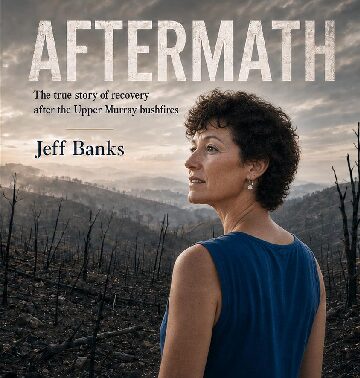
AFTERMATH Chapter 9 - Commissioning the Works

AFTERMATH Chapter 9 - Commissioning the Works | Travelling Around Australia with Jeff Banks

When I look back at commissioning works, I do not think first about contracts or project plans. I think about how much people needed to see something real. A truck arriving. A court being repaired. A hall being worked on. A burnt house site cleaned up. A pile of firewood stacked for winter. A piece of timber from a damaged landscape being used to repair something else. These things mattered because they told people the aftermath was not only about what had been lost.
AFTERMATH

Chapter 9

Commissioning the Works

You would think, once the money was found, the hard part was over. That is how it looks from the outside anyway. You have a project plan, a funding stream, a few signatures in the right places, and a clear idea in your head of what needs to happen next, so surely the rest is just a matter of getting on with it.

That is not how it works after a fire. Nothing moves in a straight line, because people do not move in a straight line after something like that. Communities do not either. They loop backwards and forwards between urgency and exhaustion, gratitude and anger, wanting help and not wanting anyone telling them what to do. One day people are ready to rebuild the whole district before lunch, and the next day they cannot face making a phone call about a water tank.

Commissioning works sounded like a practical job. In some ways it was. It meant finding people, lining up contractors, getting quotes, dealing with council requirements, working out materials, permits, insurance, timelines, approvals, reporting, and all those lovely little words that look harmless on paper until you are the one trying to make them behave in real life. On paper, it was delivery. On the ground, it was where recovery started to show whether it had any legs.

By that stage we had already been through relief, donations, volunteers, inspections, the recovery hub, community meetings, project ideas and grant applications. We had talked and talked and talked, because talking is part of the work, even when people are sick to death of talking. We had helped communities shape ideas into something that could be funded, and we had pushed and pulled those ideas through the machinery until some of them finally came out the other side with money attached.

Then came the next sentence nobody really wants to hear.

Now we have to actually do it.

That was when another part of the aftermath revealed itself. Funding did not rebuild a fence. Funding did not pour concrete. Funding did not put a tank on a truck, repair a hall, clean up a burnt house site, remove a dangerous tree, or make a local contractor suddenly available. Funding was only permission to begin another argument with reality.

The Upper Murray is beautiful country, but it is not easy country. It is not just up the road from everywhere else. Corryong is not somewhere an architect decides to casually pop into between appointments. Walwa, Cudgewa, Tintaldra and the farming districts around them are not sitting beside a city full of spare electricians, builders, plumbers, planners and engineers with nothing else to do. Distance is not a small thing up there. Distance is part of everything.

We discovered very quickly that having a good idea was one thing, but finding the people to turn that idea into a finished project was something else altogether. You might have needed an architect to look at a community building, but the nearest one could be three hours away, and they were not going to drive all that way for a single conversation about a small job. Fair enough too, from their point of view, but fair enough did not help the local hall committee sitting there with a grant approval and no idea how to make the next bit happen.

The sensible thing was to try and line up three or four projects in one trip, so that one professional could come up and make the journey worthwhile. That sounds simple as I say it now. It was not simple for community members who were already dealing with burnt farms, insurance companies, stock losses, temporary accommodation, exhausted children, broken routines, and the general fog that sits over people after trauma. They did not have the headspace to coordinate a neat little itinerary for an architect.

That sort of thing landed on council’s shoulders more often than not. It was a real pain in the neck, and I say that with affection as well as honesty. Somebody had to make the phone calls, connect the right people, work out who was coming from where, what they needed to see, who needed to be present, and how many different projects could be crammed into the one visit. It was fiddly, time-consuming work, and nobody standing outside the process could see the hours disappearing into it.

That was one of the hardest things about commissioning works. The community could see when a playground was rebuilt, or when a court surface was repaired, or when a truck finally came through to pick up fencing wire. They could not see the thirty conversations, the missed calls, the unavailable contractors, the unsigned forms, the supply shortages, the road issues, the planning questions, and the people sitting at desks trying not to look as tired as they felt.

And everything was short. That is what people forget. It was not just the Upper Murray trying to recover. Fires had ripped through so many places that the same materials and the same trades were needed everywhere at once. You could not just buy timber because local timber had burnt and the broader rebuild had swallowed what was available. Irrigation pipe was hard to get. Water tanks were like gold. Cement, fencing materials, building supplies, skilled labour, machinery, all of it had a queue attached to it.

The lack of ordinary things wore people down more than anyone expected. It is one thing to be told a project has been approved. It is another thing to stand there week after week and still see nothing happening because the materials are not available and the contractor is booked solid until some mythical point in the future. Hope can survive a lot, but it gets tired when it keeps running into closed doors.

That was where the emotional shift happened for many people. At first there was energy around projects. There was a sense of, right, we have lost so much, but here is something we can do. Then came patience, because everyone knew it was a difficult time. Then came frustration, because patience has a use-by date. Then came anger, and underneath the anger was often fear that nothing was really going to change.

I do not think people entirely lost hope, but I saw how easily recovery could grind down whatever energy they had left. A person might begin with a project idea that felt positive, even exciting in a cautious sort of way, but by the time they had been knocked around by quotes, approvals, unavailable trades and delayed materials, the same project could feel like one more burden. That is a terrible thing to watch, because the project was supposed to help.

Council was already under enormous pressure before we added community projects to the pile. Their own amenities and services had been hit. Their own roads, facilities, staff and systems were stretched. They were dealing with residents trying to rebuild homes, sheds and farm infrastructure, and on top of that they had to manage planning, building, clean-up, access, dangerous trees, waste, roads, community expectations and the normal everyday business of local government.

It is almost an Australian sport to be angry at your local council. We do it very well. If the weather is wrong, blame council. If the grass grows too long, blame council. If something takes three weeks instead of three days, blame council. There were times during recovery when that would have been funny if my very close friends had not been the ones inside council wearing the blame.

From the community side, I understood it. All they could see was delay. They saw forms, rules, approvals, hold-ups and people telling them something could not be done yet. From inside the process, I could also see council staff working themselves into the ground, trying to deal with a backlog that would have overwhelmed any organisation. Both things were true, and recovery is full of those awful spaces where two things are true at the same time.

Towong had strong working relationships with other councils, and that helped. Staff could be borrowed here and there, and extra people were brought in where they could be found. But every fire-affected council needed the same kind of help. There was not a magic cupboard somewhere full of spare planners, building surveyors and project managers waiting for a disaster to make them useful.

The planning and building area was absolutely swamped. People needed to rebuild houses, sheds and other farm infrastructure, and none of that happened in a vacuum. There were rules for good reasons, even when those rules felt cruelly slow to people who just wanted a roof, a shed, a fence or a working piece of land again. Council became the face of obstruction, even when they were simply the place where impossible expectations came to die.

One small example that was not small at all was burnt fencing wire. To anyone outside the process, it sounded easy. Roll it up, take it away, and get on with life. But burnt wire lying across paddocks, roadsides and creek lines is not just rubbish. It is dangerous, it is environmental waste, it catches stock and wildlife, and it has to be handled properly.

It was no use everyone doing it individually in a panic. It needed coordination. Routes had to be organised. Trucks had to go through the right places at the right times. People had to be told where to put the wire and when it would be collected. Then, of course, someone would miss the message, or not get their wire picked up, or put it in the wrong place, and suddenly the whole thing was another example of council not caring.

I could see why people got angry, but I could also see the unfairness of it. That was one of the few benefits of working with Bushfire Recovery Victoria rather than council. Council was always the first target. If something went wrong, whether it had anything to do with council or not, the anger went there first. It is funny now in the way some things become funny with distance, but it was not funny then.

Local contractors and services were absolutely essential to the recovery, and using them was a deliberate part of the work. Recovery done to a community does not really work. Recovery done with a community at least has a chance. If money was going to be spent, it made sense to keep as much of it as possible in the Upper Murray, because local businesses were part of the community’s survival.

But again, nothing was simple. Local businesses meant local people, and local people meant people who had also been impacted. Their own farms might have burnt. Their machinery might have been damaged. Their staff might have been exhausted. Their families might have been living in temporary arrangements. They might have been trying to run an off-farm business while also rebuilding their own fencing, water systems, stock yards and sense of normal life.

Some of them worked themselves into the ground. That is not a throwaway line. They really did. There were people trying to keep their business alive because the recovery work was there and they needed the income, while at the same time their own property and family life needed them just as badly. From the outside, it could look like recovery was a good business opportunity. From the inside, it often looked like survival with an ABN attached.

There were businesses that did well out of the recovery period, and there is no point pretending otherwise. Motels, hospitality venues, supermarkets, butchers and other services had an influx of people needing accommodation, food and supplies. Recovery workers, contractors, agency staff and volunteers all had to stay somewhere and eat somewhere. That brought money into town, and in some ways that was helpful.

At the same time, outside people coming in to do work caused resentment. Sometimes the resentment was fair, sometimes it was not, and sometimes it was just grief wearing work boots. If an external service came in, people would ask why a local person had not been given the job. If a local person got the job, someone else would ask why that person and not somebody else. If a new person was employed, the question became whether they were really local.

That word, local, is not as simple as it sounds in a place like the Upper Murray. You can live there and still not be considered local. You can move there with the best intentions and still be seen as someone from away. You can turn up wanting to help and discover that wanting to help does not automatically give you a place in the circle.

I remember one woman who came into a council recovery role after deliberately choosing to move to Corryong. She and her partner wanted a tree change and wanted to contribute to bushfire recovery. She was lovely, capable, and genuinely there for the right reasons. But no one knew her face. Her language was a bit different, her networks were not local, and she dressed in a way that made her stand out whether she meant to or not.

She bumbled around for a while in that space, and it caused a lot of angst. It was unfair, because she had not come to take advantage of anyone. Her partner got involved helping on dairy farms, and she tried in her own ways to become part of the community, including starting a small business. But tight-knit communities do not open automatically just because someone arrives with good intentions.

There was a lesson in that for all of us. Recovery work is not only about whether a person can do a job. It is about trust, belonging, perception, history and all the invisible lines that exist in a community long before a disaster arrives. After a fire, those lines become even more sensitive, because people are trying to work out who is with them, who is using them, who understands them, and who will leave when the funding runs out.

The first visible works mattered because people had spent so long looking at damage. There is a stage after a fire when everything seems to sit there too long. Burnt houses. Burnt fences. Blackened trees. Twisted metal. Empty spaces where sheds used to be. Roadsides that look like they belong to another country. People drive past the same damage every day, and every day it tells them the same thing.

Nothing has changed yet.

That is not always true, of course. A lot may be happening behind the scenes. Plans may be forming, contracts may be moving, environmental assessments may be underway, funding may be allocated, and people may be working flat out. But if the burnt house is still there, or the roadside is still dangerous, or the fence line still looks like a wreck, the person driving past it does not feel progress.

That was why the relief centre staying open for as long as it did mattered so much. At least people could see something. They could come in, get donations, talk to someone, find a service, hear an update, have a place to stand where recovery felt present rather than theoretical. It did not solve everything, but it gave people a visible point of contact while the bigger machinery was still grinding away.

Then little by little, projects began to hit the ground. A playground being rebuilt. A mural appearing. Events starting again. A hall getting work done. Tennis courts beginning to look like something more than an idea in a grant application. Those first visible signs carried more emotional weight than the projects themselves might suggest.

Not everyone saw it that way. Some people became angry that events were happening while rebuilding projects were still delayed. I understood that too. If your house site had not been cleaned up, it could feel insulting to see energy going into a community event. If your fences were still down, a mural might look like a waste of time.

But people need more than timber and concrete to recover. They need a reason to come out again. They need to feel safe enough to stand beside each other without the whole conversation being about what burnt. They need music, food, sport, art, kids running around, people laughing even if they feel guilty afterwards. You have to rebuild hope and social confidence as well as infrastructure.

In some ways, the easier projects started first because they needed less material. Events could happen with a space, some organising, and the right people. Creative projects could move faster than construction projects. That did not make them less important. It just made them more visible at a time when the larger rebuilding work was still tangled in all the things nobody could see.

Did delivery restore confidence? Yes, I think it did, but not neatly. It restored confidence in the community more than it restored confidence in government. People could see that they still had a future, that they were still capable of making things happen, and that the towns and districts they loved were not finished. That mattered enormously.

At the same time, the delivery process often reinforced people’s lack of faith in government. They saw how complicated everything was. They saw how often an idea went into the system looking like an apple and came out looking like an orange. They saw delays and explanations and reporting requirements and funding conditions. They did not always see why those things existed, and to be honest, why should they have had to?

That is another thing I learned. It is unfair to expect community members to understand how services work. They had already lost enough. They should not have needed a working knowledge of government accountability, procurement, environmental compliance, project governance and grant acquittal just to understand why something had not happened yet. If services could not explain clearly why they were there, what they were doing, and what difference it would make, then community frustration was inevitable.

Complaints came with the territory. Pressure came with it too. Trauma often needs somewhere to go, and government services are easy targets. Visiting agencies, council staff, recovery workers, contractors, volunteers, we all became places where people could put their anger. Sometimes the complaint was about the thing being complained about, and sometimes it was about something much bigger.

I learned not to dismiss complaints too quickly. That did not mean every complaint was fair or accurate. Some were not. But behind many of them was a person trying to regain control in a life where control had been burnt away. It is easier to complain about a process than to say, I am frightened my family will never feel settled again. It is easier to be furious about a contractor than to say, I cannot bear looking at that black stump one more day.

Every finished project carried emotional weight. I do not mean every project was universally loved, because that never happens. Someone will always think the money should have gone somewhere else. But for the people who had identified the idea, helped shape the plan, written or supported the grant, argued for it, waited for it, worried about it and finally saw it delivered, completion meant something.

It meant the community had moved one step further away from the fire.

I cannot remember the first completed project that made people feel something had shifted. I wish I could give a neat answer to that, but I cannot. The projects blur in my head now, not because they were unimportant, but because there was so much happening at once. Starts and finishes, meetings and openings, delays and small wins, all mixed together in the fog of that period.

I do remember the start of the tennis court work in Corryong being very visible. I remember work around the hall having that same quality. I remember a tennis court project in one of the smaller communities feeling significant because it was concrete progress in a place that had been extremely damaged. That community had always been good at bringing people together socially, getting events going, opening the pub again, doing the things that make a town feel alive. But rebuilding something physical carried a different sort of message.

The clean-up of burnt house sites was another major shift, and I cannot take credit for that. It was technical work in a way I had not understood before. In my naive mind, cleaning up a burnt house was probably something like digging a hole, pushing everything in and patting down the top. Of course it was not that simple. Nothing ever was.

There were environmental issues, safety issues, remains of materials that had to be handled properly, metal, ash, contamination, and all the rules that exist because doing it badly can create another problem on top of the one already there. When people saw the first house sites being cleaned up, that mattered. It was painful, but it was also movement. A burnt home sitting there is a wound that keeps showing itself.

Even the arrival of scrap metal collection made a difference. When someone came through and people could start loading fencing wire and twisted junk onto a truck, it was more than rubbish removal. It was a sign that the burnt mess did not have to sit there forever. It was a sign that someone had finally found a way to take part of it away.

Some works sounded ordinary on paper but were deeply important on the ground. Trees were a good example. On paper, removing dangerous trees looks straightforward. Get a chainsaw, cut the tree down, load it up, take it away. In reality, like everything else, it needed thought.

There were huge numbers of burnt trees, and the last thing anyone wanted was to simply burn more wood. That would have been wasteful and environmentally unsound, and frankly, people had seen enough fire. What happened instead was much more thoughtful. Good firewood was stacked in different communities so locals could access it for winter, because so much forestry and timber had been burnt and people still needed to heat their homes.

Some of the better-quality timber was earmarked for rebuilding huts in the High Country. That mattered because those huts are not just buildings. They are part of the identity of the High Country, part of how people understand that landscape and its history. Knowing burnt timber could contribute to bringing some of that back gave people a sense that not everything damaged was wasted.

Other timber and root balls were used in creek and river restoration. Intense fire changes waterways. Banks become unstable, debris moves differently, fish habitat is damaged, and creeks can begin to collapse in ways most people do not think about until they see it happening. Using burnt timber to help rebuild habitat and stabilise those areas was clever. It meant people could look at something blackened and damaged and think, all right, it still has a use.

I liked that. It felt respectful in a way. Not sentimental, not dressed up, just practical and decent. Burnt did not have to mean useless. Broken did not have to mean finished. In recovery, sometimes that is as close to poetry as you get.

My everyday job sat between two forms of accountability. Government accountability was one side of it. Ministers, public servants, Treasury, voters, media, reporting systems, funding rules, all of them mattered. As a worker, I had to be able to explain what I was doing, where the money was going, what had been achieved, what was still outstanding, and why.

Community accountability was the other side. People wanted to know where I had been, who I had spoken to, what I had done, whether I had shown my face, whether I understood what mattered to them, and whether I was being straight with them. They did not care that I had a report due somewhere. They cared whether I had been present enough to be trusted.

Trying to make those two things fit together was exhausting. My kids used to joke that someone should give me a BA in BS because I was always playing with words, trying to make a sentence satisfy the government requirements without betraying the reality on the ground. I was not always successful, but I am still proud of how often I managed to hold the line between the two.

That line mattered to me. I did not want to become a government mouthpiece. I also could not ignore the fact that I was working inside a government-funded system with responsibilities attached. I wanted community to feel respected, and I wanted the reporting above me to reflect the truth without exposing people’s pain or flattening their lives into dot points.

There were times when I felt personally responsible for delays, especially early on. It took me a while to learn the discipline of not promising anything I could not absolutely guarantee. That sounds obvious, but when you are sitting in front of someone who has lost so much, and they are looking at you with exhausted hope in their face, every part of you wants to say, yes, I can fix that.

You cannot say it unless you know you can deliver it.

I learned that the hard way, and I saw others learn it too. There is a horrible hollow feeling when you have to go back to someone and say, I know I said this, but now I cannot deliver it. You can dress that up however you like, but it still feels like failure. If a government promise falls over somewhere above you, that is one thing. If you personally told a person you would help them get something and then could not, it goes into you differently.

That feeling dragged me down at times. It could overwhelm you if you let it. Thankfully I had good colleagues around me, people I could talk to when something went wrong or when I had fallen into the trap of wanting too badly to help. We all did it from time to time. We learned to be careful, then more careful, and then careful again.

Even then, things fell over. Something could look guaranteed and still disappear under a process change, a supply shortage, a contractor issue or a funding condition nobody had understood properly at the beginning. That was one of the hardest parts of the job, because people do not come into community recovery work wanting to represent a system. Most come because they want to help.

When the work gets shaky, it shakes more than your diary. It hits your professionalism and your own sense of who you are. You go into those roles with a sense that you are giving yourself to the work. When the work fails to give the respect to community that you wanted it to give, it can feel as though you are losing a piece of yourself.

I saw that happen to a young woman who came into bushfire recovery full of energy, talent and commitment. She loved her community and wanted desperately to fix things for them. But she made a promise to herself that was bigger than the resources, capability and support available to her. She burned out, and it was really sad to watch.

That taught me something about boundaries. You have to be mature enough to know where you end and the work begins, or perhaps where the work ends and you begin. That is not easy in recovery, because the job rewards the part of you that gives too much. It praises commitment while quietly consuming the person doing the committing.

People would sometimes ask what completion felt like. Relief, pride, exhaustion, or just the next problem. My honest answer is, completion of what? Recovery is not completed. You choose a point in time where it is right for you to move to the next thing, but the work itself is not finished.

Recovery is an interesting word because it sounds like a destination, but I think it is more of a verb. It is something people keep doing. You do not recover a community by putting it back where it was twelve months before the fire. You could not do that even if you wanted to, and I am not sure it would be in the community’s best interests anyway. The fire becomes part of the story, whether anyone likes that or not.

That is a difficult thing to accept as a recovery worker. If you go into the job thinking you will fix it, you will either become arrogant or broken. Probably both, if you stay long enough. You have to decide what your own goals are, what you can honestly contribute, and when you have given what you came to give.

Then you have to ask yourself a harder question. Am I prepared to give more of myself and set new goals, or have I done what I came to do? Can I leave in a healthy position, with respect for the community and for myself, and find the next thing? That is not quitting. Sometimes it is the only way to leave without becoming another casualty of the recovery.

The human cost of that period is still with me. It is years later now, and I still see my psychologist every quarter, unpacking the trauma that comes back to bite. I used to think trauma was something you got under control, and in some ways you do. But every now and then something unpeels another layer, and there it is again.

The stories do not go away. They sit quietly until something wakes them up. I can still picture a stoic farmer, tough as nails and probably more comfortable with a broken tractor than a conversation about feelings, sitting there with tears running down his face and no words coming out. I can still hear the stories of farms settled by grandfathers, great-grandfathers and the one before that, places held through generations, suddenly altered beyond recognition.

Those stories do not belong to me, and yet they live in me now. That is one of the strange parts of recovery work. You are trusted with people’s grief, but grief is not a file you close at the end of the day. It leaves a residue. You learn to carry it better, but you still carry it.

There has been a physical cost too. I joke about the smell of smoke, because sometimes joking is the only way to keep something from becoming too large. But my asthma has been shocking since that time. There is no structural damage to my airways, because I have had that checked, but any whiff of smoke can set me off. I think it is a combination of asthma and nerves, my body remembering before my mind has had time to be sensible.

I sold my wood heater because I could not cope with the smoke. That sounds like a small domestic decision, but it was not small to me. The smell could bring on an asthma attack quickly, and behind that was everything else the smell carried. Smoke is not just smoke after you have worked through something like that.

The exhaustion changed me too. You learn to live in an unhealthy way with tiredness because the job is never done. Recovery does not work nine to five because communities do not work nine to five. You meet people when they can meet, and sometimes that means a meeting late at night, then a long drive home through fog and dark, with wombats, deer and kangaroos waiting to make the trip more interesting than anyone needs.

We were smart enough, at least sometimes, to start later the next day after those nights. But the body still keeps score. So does the mind. You cannot keep stretching yourself around other people’s pain without eventually realising you have stretched something inside yourself as well.

Some relationships changed because of the work. I did not set out for that to happen, and I would not say they were damaged exactly, but some became weaker. So much of my focus went into bushfire recovery that my social life outside that world shrank without me noticing at first. The people who understood what I was carrying were the people who had been carrying it too.

Even now, if there is work trauma or something that shakes me, the first people I want to call are the friends I made during the fires. We can go months without speaking, then one of us can pick up the phone and say, do you want to have a cuppa, and the other one understands. There is a level of trust there that is hard to explain to people who were not inside it. You can say almost anything, and nobody looks at you as though you are being dramatic.

That is a gift, but like many gifts from that time, it came with a cost. Other friendships sat on the back burner. Other parts of life waited. Recovery work can build very deep bonds, but it can also narrow your world around the people who understand the particular kind of exhaustion you are talking about.

When I look back at commissioning works, I do not think first about contracts or project plans. I think about how much people needed to see something real. A truck arriving. A court being repaired. A hall being worked on. A burnt house site cleaned up. A pile of firewood stacked for winter. A piece of timber from a damaged landscape being used to repair something else. These things mattered because they told people the aftermath was not only about what had been lost.

But I also think about what it took to make those things happen. The phone calls, the arguments, the waiting, the shortages, the blame, the careful language, the promises we learned not to make, and the quiet damage that builds inside people who are trying to help without becoming the story themselves. Delivery brought relief and pride, yes, but it also brought pressure, complaints, resentment and another set of impossible expectations.

That was the truth of that stage of recovery. Once works started, people could see that the community was moving. They could also see every delay more clearly. Progress gave hope, but it also gave people something new to measure disappointment against.

I still believe those projects mattered. I believe the visible work helped communities feel that they had not been forgotten, even when the process was slower and clumsier than anyone wanted. But by then I was beginning to understand something I had not fully understood at the start. Recovery was not only changing the towns, farms and people we were trying to support.

It was changing us as well.

Author

Menu