
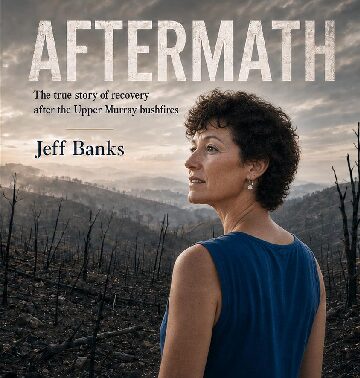
AFTERMATH Chapter 8 - Grant Writing

AFTERMATH Chapter 8 - Grant Writing | Travelling Around Australia with Jeff Banks

That was the uncomfortable truth of being in the middle. I could criticise the system and still work within it. I could feel angry at the hoops and still help people jump through them. I could believe communities deserved more trust and still know that a badly written application might cost them a project they desperately needed. Recovery was full of those contradictions. Very little was pure. Very little was simple. Most of it lived in the grey area between what should have happened and what we could actually make happen.

AFTERMATH

Chapter 8

Grant Writing

The first thing a grant application wants is a name. Then it wants an amount, a project description, a budget, evidence of need, quotes, milestones, outcomes and some neat explanation of how the whole thing will be delivered on time, within budget, and preferably with photographs of smiling people at the end of it. It does not ask what it feels like to stand in a hall that has held dances, funerals, junior sport presentations, Anzac Day morning teas, emergency meetings and every other little thread that keeps a rural community stitched together, and know that the roof leaks, the court fence is falling down, the grass is dead and the people who care about it are tired before they have even begun.

That was the strange cruelty of grant writing after the fires. It sounded dry, almost administrative, like something that belonged in an office with clean carpet and a spreadsheet open on a second screen. In reality, it was one of the most emotional parts of recovery because it asked people to take what hurt and turn it into something fundable. It asked them to package loss, hope, exhaustion and need into the language of eligibility criteria. It asked them to prove, politely and with evidence, that their community mattered enough to deserve help.

I had done grants before. I had been on both sides of them in other parts of my working life, both coordinating programs that handed out money and helping people apply for it. I understood the theory. I knew there had to be rules. I knew public money, philanthropic money and recovery money all needed some kind of process around them because otherwise it would become a free-for-all, and that would not be fair either. I knew all that in my head.

What I understood differently after the fires was what those rules felt like when they landed on people who had already been through too much. A community that had lost homes, sheds, fencing, stock, feed, privacy, certainty, landscape and a bit of faith in the world was then asked to collect quotes, write objectives, nominate milestones and demonstrate measurable outcomes. They had to talk about resilience when some of them were barely sleeping. They had to talk about community capacity when the same three volunteers were holding together the local hall committee, the tennis club, the recovery committee and probably someone’s calving problem up the road as well. They had to talk about shovel-ready projects when half the district was still trying to work out which fences were theirs and which ones had simply disappeared in the smoke.

Grant writing is a game. That sounds harsh, and I do not mean it in a clever or cynical way. I mean it because it is true. It is a skill, a talent and a game, and it is not always about who has the greatest need or the best idea. It is about who understands the language, who can read the funder’s values, who can match a community’s vision to an organisation’s strategy, and who can make all of that sound neat enough to sit comfortably in an assessment panel’s folder. There is a certain coldness in that, not always intended, but still there.

That was where I often felt like the meat in the sandwich. On one side were the funding bodies, government agencies, processes, deadlines, guidelines, buckets of money, embargoes, acquittals and application rounds. On the other side were communities with genuine need, real hope and very little spare energy left for disappointment. I could see the logic of the system and I could feel the pain of the people being fed into it. Some days I wanted to argue with both of them, and on a good day I probably did, at least quietly.

The first lesson was to encourage people without promising them anything. That sounds simple until you are sitting with a community group that has finally found a project to rally around. In recovery, a project is not just a project. A netball court is not just a netball court. A tennis fence is not just a fence. A hall is not just a building with a kitchen and a noticeboard. These things are often the places where people become a community rather than a cluster of separate farms and houses spread across difficult country.

So when someone said they wanted to refurbish a hall, build a better gathering space, fix sporting facilities or set up a water supply to keep community grounds alive, I could see why it mattered. It was not vanity. It was not people trying to get something for nothing. Most of the time, it was a community saying, in the only way it could at that stage, “We are still here.” That sort of statement should not have to be reduced to a funding application, but that was the path available.

At the same time, I had to be careful not to build hope too high. There was money around, but there were also more projects than funds. It was not just the Upper Murray that had burnt. Large parts of eastern Victoria had been affected, and across the east coast there were communities all looking at the same pools of funding with their own losses, their own stories and their own urgent needs. Every place thought its project mattered because it did, but not every place could be funded.

That created pressure between neighbouring communities that did not need any more pressure. One valley would apply for funding for something genuinely important, and another valley would apply for something just as important. One might get up and one might miss out, not because one community deserved help and the other did not, but because that is how competitive grant rounds work. There is a quiet cruelty in making injured communities compete against each other for recovery money. I do not think the system means to be cruel, but the effect can still be cruel.

At the start, I did more direct writing than I did later. In time, we became smarter, or perhaps the state government became smarter, and we gained access to professional grant writers who could work on behalf of community groups. That helped enormously, but it did not remove the work. It shifted it. We still had to sit with people, draw out their ideas, work out what they were really trying to achieve, and then massage that into something that fitted the funding guidelines without losing the heart of it entirely.

That word “massage” sounds gentle. Sometimes it was not. Sometimes it meant telling people that the thing they most wanted to say would not help the application. Sometimes it meant saying, “That is important, but the funder is asking something slightly different.” Sometimes it meant taking a beautiful, messy, human idea and reshaping it until it looked like a project plan. I did not always like that, but I knew it was necessary. A good grant application has to speak two languages at once. It has to speak the language of the community and the language of the funder, and those languages do not always naturally understand each other.

The part many people did not see was the amount of work behind even a simple application. If most community members did not understand how much work was being done, that probably meant we were doing our job well. A lot of council workers carried an enormous load in that space. They ran around gathering information, chasing quotes, finding evidence, pulling together data, checking eligibility, matching projects to funding rounds and trying to make sure applications were lodged properly and on time.

Evidence of need is a phrase that sounds harmless until you are the person trying to gather it. In ordinary language, need is obvious. You stand beside a damaged facility, or in a town that has been knocked sideways, and you can see it. In grant language, need has to be supported by data, documents, photos, figures, strategies, letters of support and anything else that will stand up in an assessment process. Story matters, but story alone is rarely enough.

Then there were the quotes. Every grant wanted quotes, and fair enough too, because an idea without a budget is just a wish. But getting quotes in a bushfire recovery area was not simple. Local businesses were already stretched. Tradespeople were busy. Materials were uncertain. Everyone wanted to support local businesses because that was part of recovery too. If a local business took the time to quote on a project, the hope was that, if the grant was successful, that same business would get the work.

But a quote takes time and effort, and there was no guarantee the project would be funded. Businesses were being asked to do work up front for possibilities. Community groups were being asked to get accurate costs in an environment where nothing stayed still. A grant could be lodged with quotes that were current at the time, then three months could pass before anyone knew the outcome, and by then the price had changed, the materials were unavailable or the contractor was booked solid. Post-COVID, resources were thin anyway. Add bushfire recovery to that, and the neatly typed budget in the grant application could become outdated before anyone had even opened the acceptance letter.

That was one of the absurdities of the process. The grant application expected certainty because the form needed certainty. Recovery did not provide it. Recovery was not neat, and neither was construction, supply, volunteer capacity or community energy. People could write in good faith that a project would be delivered within a particular timeframe, but that depended on trades, weather, materials, fatigue, paperwork, mental health and about twenty other things nobody could fully control.

The better bushfire recovery funders understood that. They knew things would not go exactly to plan because nothing in recovery does. Some philanthropic organisations were particularly good to work with because they seemed to understand that community recovery needed flexibility, patience and trust. Not all funders were like that. Some were painful, and I am being polite there. Some seemed to want the emotional benefit of funding recovery while still expecting the process to behave as though it was a normal capital works project in a normal year.

There were moments when a grant application felt like a lifeline. Communities had been watching facilities deteriorate for years. Across regional Victoria, money had been tight for a long time, and community infrastructure is expensive to maintain. Little halls, sporting facilities, courts, fences, kitchens, water systems and public spaces do not fix themselves. They depend on volunteers, sausage sizzles, raffles, working bees, small grants and people who are stubborn enough to keep turning up.

After the fires, some of those places took on even greater meaning. A hall might have been old and tired, but it was still where people gathered. A sporting facility might have needed work for years, but it was still where children played, parents talked, teenagers hung around, and older people saw one another without having to make a special appointment to do so. These were not glamorous projects. They were the bones of community life.

So when funding appeared, it looked like a means to an end. It was a carrot dangled in front of communities that had been waiting a long time for the chance to do something practical and hopeful. But the carrot was always just a little out of reach because before they could get to it they had to jump through the hoops. There was money, yes, but first there were forms. There was hope, yes, but first there were eligibility criteria. There was a chance to rebuild something, yes, but first there was the small matter of proving you deserved the chance.

The rejections were hard. They were hard for the community leaders, hard for the council workers who had put their hearts into the applications, and hard for me. When you put that much effort into something you know is needed and it misses out, it does feel personal, even when you know it is not. You can tell yourself the funding bucket was oversubscribed. You can tell yourself the project was strong. You can tell yourself another equally worthy place got the money. All of that may be true, but it does not take away the sting.

Telling a community group they had missed out was one of the jobs I hated most. The only way to do it was to be honest from the beginning. When we were writing applications, I tried to build the warning in early. We would say, “We have done the best we can, but there is no guarantee.” We would remind them that missing out did not mean the project was not needed or the application was poor. It meant the funding was competitive and somebody had to lose.

That was not a comforting thing to say, but it was better than allowing people to believe a good application automatically led to a successful one. It does not. Sometimes very good applications miss out. Sometimes a project that seems perfect for one grant is just slightly wrong for that funder’s priorities. Sometimes the timing is wrong. Sometimes the money runs out. Sometimes you never really know why one thing got up and another did not. The system may have reasons, but reasons are not always the same as comfort.

For communities already injured, rejection was one more blow. That is the part that sat with me. A failed grant did not just mean a project had to wait. It could mean a group of people who had finally found the energy to organise, imagine and apply were told no. It could mean volunteers who had stretched themselves again were left with nothing but another meeting to explain what had happened. Recovery is full of small setbacks, and sometimes a rejection letter is heavier than it looks.

The successful grants were beautiful in their own complicated way. When funding came through, there was excitement, relief and sometimes a burst of energy that you could almost feel move through a room. It was a win, and every community needed a win. Not always a big win, and not always a perfect one, but something that said progress was still possible.

Then, after the first excitement, the anxiety would often arrive. People would look at what they had promised to do and suddenly realise they had to do it. They had money now, but money came with obligations. There were agreements to sign, project plans to follow, milestones to meet, quotes to revisit, contractors to confirm and acquittals waiting somewhere down the track. I saw that change in people, from “We got it” to “Oh, now what?” and I understood it completely.

It reminded me of a family story about my mother winning the soccer pools and being beside herself with excitement, only to start worrying almost immediately about everything that might go wrong before realising the amount was not quite the life-changing fortune her imagination had already spent. Grants could be a bit like that. The announcement felt enormous, and then the practical reality crept in. What if the cost had gone up? What if the contractor could not do it? What if the committee could not manage it? What if the community was too tired to carry the project on the timeframe they had promised?

Usually we could sit down and work through that. The grant application itself generally had a project plan, so we would go back to that and make it simple again. Step one. Then step two. Then reassess. Recovery often had to be broken down that way because if people looked at the whole thing at once it was too much. A funded project was the same. You did not build the whole thing in your head in one sitting. You took the next step, then the next one, and tried not to let the whole mountain fall on top of you before you had even picked up the shovel.

There were also times when we knew things before the community did, and that was a particular kind of awful. Some funding outcomes were embargoed. Internally, we might know what had been successful and what had not before the community could be told. That put us in a painful position because we could start thinking about alternatives for the unsuccessful projects, but we could not talk openly with the people most affected. It added another layer of stress that none of us needed, though I understood why embargoes existed.

One round became almost funny, in that ridiculous recovery sort of way where you laugh because the alternative is putting your head on the desk. A Gippsland MP, very keen to support the Gippsland fire-affected communities, ignored the embargo and started announcing outcomes in his area first. Because there was a finite amount of money in the bucket, we could work out a fair bit about what had happened elsewhere by watching what was being announced there. He apparently got into trouble for it, although I do not think he ever apologised. I suspect he thought he was simply being transparent with his own community, and perhaps he was, in a slightly naive and inconvenient fashion.

Grant rounds also forced timing that did not always fit community recovery. Funding came in rounds, and often the biggest amount of money was in the first round. The second round might have less, the third less again, so there was immediate pressure to get large projects ready early. That made sense from an administrative point of view. It did not always make sense from a human one.

Some communities were still trying to work out what they needed. Some had ideas but not the energy to shape them. Some had the energy but not the information. Some had strong leaders who were already overloaded, and others had people who cared deeply but had never had to navigate a major grant process in their lives. A closing date does not care whether a community is ready. It just sits there on the guidelines like a little bureaucratic cliff edge.

One project that stayed with me was up a tiny, isolated valley overlooking the Murray River. Biggerer Valley, as I remember it, is a beautiful place, but beautiful does not mean easy. Internet service was patchy. Electricity could be patchy. Distance mattered. The valley had a hall and tennis courts beside it, both a bit tired, and a tree had fallen on part of the tennis court fence and crushed it. The people there had a lovely vision to do up the hall, improve the courts and create a community setting with a small amphitheatre.

It was not an overblown idea. It fitted the place. It understood the scale of the valley and the way people there might use it. But because the amount of work was significant, the project needed to go into an early funding round, and that placed a lot of pressure on a small number of people in a small, isolated community. The grant program was meant to help, and in the end it did help to some extent, but the process also created tension that did not need to be there. That was one of the times I thought a recovery program could do good and harm at the same time.

They did not get everything they first imagined, but they got some funding and could do the work in stages. That is often how recovery really happens. Not in one grand announcement. Not in one perfect project. In stages. A bit now, a bit later, adjust the plan, find another grant, chase another quote, hold another meeting, keep going. There is something very rural about that too. People in those valleys know how to make do and keep going, but that does not mean the system should make it harder than necessary.

I often thought the early stages of funding could have been handled differently. For some programs, especially the ones connected to our own organisation, I believed we could have made them more community-driven. We could have trusted communities with small amounts of money up front. Give each community recovery committee a small pool, even $5,000, and say, “Here it is. Spend it on something useful. No strings attached beyond basic honesty.” In any burnt community, $5,000 could have done something worthwhile.

That kind of quick win matters. It builds confidence. It gives people a reason to meet that is not just about loss. It takes pressure off the idea that every first application has to be perfect. It says to communities, “We trust you.” Instead, too often, the process began with the full grant machinery. Forms, quotes, criteria, competition, deadlines. For people who had already lost control over so much, being handed a little bit of control back would have meant something.

There was also an argument at one point that if there was just one community recovery group for the entire Upper Murray, the grant applications could filter through that group and perhaps reduce competition between different valleys and towns. I could see the common sense in the theory. It sounds tidy, and governments do like tidy. But the Upper Murray is not one single, neat thing. Walwa is not Corryong. Cudgewa is not Tintaldra. A small isolated valley is not the same as a larger town. The needs, the personalities, the histories and the sense of identity are different.

The group being suggested for that role was not necessarily representative of the whole Upper Murray in a bushfire recovery sense. It had been formed for a different reason, and that mattered. You cannot just place a structure over the top of communities and assume it will fit because it looks efficient from the outside. Recovery has to respect the grain of the place. Otherwise, even a good idea can cause distrust.

That was another lesson grant writing taught me. Fairness is not always built into systems that claim to be fair. Grants are not really about fairness. They are about alignment, strategy, language, timing and capacity. They are about matching what the funder wants to achieve with what the applicant wants to do. That may produce good outcomes, and often it does, but it is not the same as saying the greatest need will always be met first.

Your average community group might have experience with a local sports grant or a small council application, but bushfire recovery funding could be a different beast altogether. They were competing not only with neighbouring communities but sometimes with professionally written applications from other areas. A small hall committee with a worn-out secretary and a volunteer treasurer could be up against an application prepared by someone who knew exactly how to write to the guidelines. There is no real fairness in that unless support is provided to even up the field.

That is why the professional grant writers helped. It is also why people like Pete made such a difference. Pete seemed to arrive out of nowhere, and for a while he just appeared in grant conversations all over the place. He was clearly not local, but he seemed to know what he was doing, and he supported a lot of community groups to put applications together. Later we found out Deloitte had allowed him to come down into bushfire-affected areas to help in whatever way he could. For a company that size, that was an impressive thing to do.

Pete did not always work in close collaboration with us or council, which could make things a bit untidy, but the important part was that he helped communities get significant grants. In recovery, you learn not to be too precious about who gets the credit. If someone turns up with useful skills and uses them for the benefit of communities, then good. We needed all the useful help we could get, even if it occasionally arrived from an unexpected direction and caused a few coordination headaches along the way.

The more I worked with grants, the more I understood persistence differently. I am not sure grant writing taught me persistence so much as resilience and patience. If a project missed out, that did not mean it was finished. It meant going back to it and asking better questions. Was the project poorly written, or was it just not right for that funder? Did it fail to align with the funder’s values? Was it too ambitious for that round? Did it need staging? Did the budget need more work? Was there another pathway?

People often write grants because they want something. That is understandable. A community needs a court fixed, a hall repaired, a water system installed or a space improved. But the funder is also trying to achieve something. That was the part that became clearer and clearer to me. It is not enough to say, “We need this.” You have to understand why the funder might want to fund it. What story do they need to be part of? What outcome are they trying to create? What does recovery mean to them on paper, and how does that connect, however imperfectly, to recovery on the ground?

There is a danger in that, of course. The danger is that communities start shaping themselves to fit funding rather than funding shaping itself to meet communities. That is where the balance becomes delicate. A good application should not lie. It should not twist a community beyond recognition just to chase money. But it does have to translate. It has to take the truth of a place and make it legible to people who may never stand there, never drive those roads, never lose phone service in that valley, never see how far one farmhouse is from the next, never understand why a small hall can matter more than its replacement value.

That translation was the work. It was also the burden. I could sit in meetings with people whose faces showed the fatigue of the previous months, then turn around and help shape their need into something an assessment panel could score. Some days that felt useful. Other days it felt indecent. Not because the projects were wrong, but because the language was too small for what had happened.

A form cannot hold the smell of smoke that lingered in people’s memory. It cannot hold the sound of someone’s voice when they are trying to explain why a place matters without sounding foolish. It cannot hold the embarrassment some people feel when they have to ask for help. It cannot hold the tension between two neighbouring communities both needing a win. It cannot hold the quiet anger of people who feel they are being made to prove something that should already be obvious.

But we still filled in the forms. We still chased the quotes. We still wrote the objectives and the outcomes. We still tried to give communities the best chance we could because the alternative was worse. The alternative was leaving money on the table, or allowing only the most polished communities to access it, or watching good ideas fade because no one had the energy or skill to push them through the process.

That was the uncomfortable truth of being in the middle. I could criticise the system and still work within it. I could feel angry at the hoops and still help people jump through them. I could believe communities deserved more trust and still know that a badly written application might cost them a project they desperately needed. Recovery was full of those contradictions. Very little was pure. Very little was simple. Most of it lived in the grey area between what should have happened and what we could actually make happen.

Looking back, grant writing was not a side issue in the recovery story. It was one of the places where the whole thing was exposed. It showed who had capacity and who did not. It showed how much unpaid labour sits inside rural communities. It showed how government processes can be well-intentioned and still feel cold. It showed how hope can be both necessary and dangerous. It showed how a win can lift people and frighten them at the same time.

Most of all, it showed me that recovery is not just about replacing burnt things with new things. It is about giving people reasons to keep gathering, keep planning, keep arguing, keep laughing, keep turning up and keep believing their place has a future. Sometimes that future began with a grant application, which is a ridiculous thing to say and also, in that time, entirely true.

By the time the money came through, the work was only beginning. A successful grant was not an ending. It was a promise made under pressure, written in careful language, accepted with relief, and then carried back into a community that still had to find the strength to deliver it. That was the next part of recovery too: turning the approved words back into something real, something built, something used, something that might one day feel ordinary again.

Author

Menu