
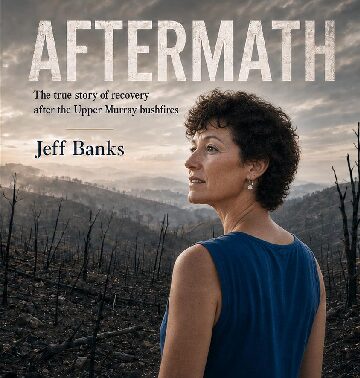
AFTERMATH Chapter 7 - Community Project Development

AFTERMATH Chapter 7 - Community Project Development | Travelling Around Australia with Jeff Banks

Recovery was never about returning to what existed before. That was impossible. Too much had changed. People had changed. The land had changed. The towns had changed. Even the trees, where they were replanted, were not the same trees. Community projects helped people move from staring at what had been burnt to asking what could still be made, not as a replacement for the past but as a way of living with the new normal.
AFTERMATH

Chapter 7

Community Project Development

The whiteboard was almost as big as the wall, or at least that is how it sits in my memory now. It was in one of the old classrooms at the recovery hub, and like a lot of things in those days, it had been pressed into service for something much bigger than its original purpose. Once upon a time it had probably held spelling words, maths sums or the day’s school notices. Now it held the beginnings of halls, tennis courts, playgrounds, safe places, memorials, trees, events, water tanks, toilets, fences, kitchens, grants, permits, costs, delays and all the things that had to be thought about before a community idea could become something solid.

I would stand in front of that board with a marker in my hand and try to turn a conversation into a pathway. Sometimes the idea sounded simple enough when someone first said it. We want to resurface the tennis courts. We want to fix the hall. We want to replace the playground. We want somewhere safe for the kids next time. We want to plant trees. We want to hold an event. We want to gather stories. We want to make something beautiful out of something that has been lost. Then the marker would start moving across the board and before long the simple thing had become a web of questions, arrows, permissions, costs and risks.

That was community project development. It was practical work, but it was never only practical. A project might look like a building, a court surface, a row of trees, a concert bus or a Friday night food run, but underneath it was usually something else. It was a community trying to take back a little control. It was people who had spent months being acted upon by fire, weather, government, insurers, road closures, contractors and other people’s decisions, finding one thing they could act upon themselves. It was action becoming part of recovery.

By the time we reached this stage, the fire had moved from emergency into aftermath, and that was its own strange country. The flames had passed, mostly, but their presence was still everywhere. There were burnt paddocks, damaged sheds, missing fences, blackened trees, melted bits of plastic, twisted metal, empty spaces where familiar things had been, and people looking at all of it with the expression of those trying to be practical because the alternative was too much. Survival had already asked a lot of them. Recovery was asking for more, but in a slower, less obvious way.

The team around me had grown by then. I had someone working directly under me in community engagement, which made a difference, and there were people in the broader Bushfire Recovery Victoria team with all sorts of skills I came to appreciate very quickly. There were people who understood strategic planning, people who could deal with council processes, people with building knowledge, people who knew how to think through projects properly and people who could see risks I would not have known to look for at the beginning. Council had more people on board too, including community liaison staff who could go out and work directly with residents, and the planning and building people who knew the difference between things I had only just learned were different.

One of those early lessons was that a planning permit and a building permit are not the same thing. I had lived quite happily without that knowledge before, and I probably would have continued living happily without it if the fires had not introduced me to the entire world of permits, land ownership, public assets, compliance and building codes. Recovery has a way of educating you whether you asked to be educated or not. It also has a way of showing you that the thing everyone thinks should be simple almost never is.

You would think that replacing something burnt would be straightforward. It was there. The fire came through. Now it is not there. Surely the normal human response would be to put it back. But public spaces do not work like that, not once you begin poking around underneath them. Who owns the land? Who manages it? Is there a committee? Is the committee formal enough? Is the building insured? Is there asbestos? Does the water tank belong to the same body as the playground? Does the power supply meet current standards? Is the toilet block accessible? Does the kitchen comply? Does the fencing need upgrading? Does anyone know where the old paperwork is?

That was before we even got to the money.

The Community Recovery Plans were the place where a lot of this work began to take shape. They were government-driven, so there was plenty of paperwork attached to them. Government does love paperwork. It sometimes seems to believe that if a thing is not written down in the right box, it has not happened, even if the thing in question is standing in front of you with smoke damage and a headache. But behind all the paperwork, the idea of the plans was right. A community needed a way to say what mattered to it now, in its own voice, from its own experience, rather than having someone else arrive with a list of assumed priorities.

That mattered because recovery never belonged to “the community” as though there was only one of them. Every town, every valley, every farm and every small cluster of people had its own experience of the fire. Some had lost houses. Some had lost stock. Some had lost fencing, sheds, income, shade, old trees, confidence or sleep. Some had not been physically damaged in the same way but had carried the fear, the smoke, the isolation, the guilt of being spared, or the sheer exhaustion of helping others. What mattered in one place did not automatically matter in another.

We tried very hard to minimise the paperwork for people on the ground. They had enough to do without us turning them into unpaid government administrators. If there was a form to be filled in, a grant application to shape, a risk to document or a process to translate into normal language, we tried to carry as much of that as we could. The community’s job was not to become expert in bureaucratic language. Their job was to tell us what mattered, why it mattered, what they wanted to see happen and what they were prepared to do themselves.

Once a community had identified its priorities, we would start working through them. There was always a sort of matrix involved, whether formally or in my head, around need, impact and achievability. What would help the most people? What would lift morale? What could be done quickly? What was essential but likely to take longer? What was so complicated that it might crush the very people it was supposed to help? It was not only about the best idea. It was about the best idea that could survive contact with the real world.

I always wanted every plan to have quick wins built into it. That became very important. People needed to see something happen, even something small, because talking without visible movement becomes its own form of fatigue. In a place already worn down by loss, consultation can start to feel like another demand. Meetings, notes, priorities, draft plans, revised plans, funding guidelines, more meetings. At some point people need to look up and say, “Right, something has actually changed.”

That is where the whiteboard came in. A community would bring an idea, and I would go and have a look at what might be involved. I would come back and stand at that board, breaking it down into steps. Whose permission do we need? What testing has to happen? What sort of quotes are required? What can the community do? What can we do? Who needs to be brought in? Is this a grant-writing job, a council job, a project management job, or all of them at once, which was usually the answer?

One of the projects that sits clearly in my mind was the resurfacing of tennis courts in a small community that had very little in the way of public infrastructure. They had a hall and a pub that I think opened only on Friday and Saturday nights. There was no shop, no garage, none of the things a larger town might take for granted. In earlier days they had had more, as many small places did, but by then the public life of the community had narrowed to a few places that had to carry a lot of meaning.

The tennis courts were tired. They had been used for years, probably longer than they should have been, because country people are very good at making things last past the point where a city person would have declared them finished. The surface was old, the fencing needed work, the lights were ordinary and the little clubhouse needed attention. But they still played there, and there were people in that community with memories of very good tennis players and nights around those courts when the place felt alive.

One person in particular had the energy to drive that project. Every community has those people, the ones who somehow still have enough fuel in the tank to get something moving. The project was not enormous in a funding sense. It was resurfacing, fencing, tidying and making the courts usable and decent again. But the impact was far bigger than the cost. The courts became a gathering place, not only for tennis but for social events, conversation and the simple act of people being together somewhere that belonged to them.

That sort of project gave people control again. It said, “This is ours. We can improve it. We can use it. We can gather here.” It was not grand, and that was part of its strength. Not everything in recovery needs to be grand. Sometimes grandness is the last thing people need. Sometimes they need somewhere to stand on a Friday evening, a reason to put shoes on and go out, a surface that is not cracked cement and a fence that does not look like it gave up three years before the fire.

Other projects started with an even sharper sense of purpose. In one isolated valley, the community had already begun planning before I arrived. They were close-knit, proactive and very clear in their thinking. They did not have much in the way of public assets, mainly a hall that was well used. There was no reliable mobile phone coverage down the valley, so they had their own communication system, a sort of hopscotch arrangement with radios where one person let the next person know, and that person let the next one know, and so on until the message moved through the valley.

They had already thought about the next fire, because in that country people do not have the luxury of believing there will never be another one. They had a plan for certain people to gather the children and take them to a safe place unless evacuation advice changed the plan. I remember being struck by that. They were not sitting around waiting for someone to rescue them. They had already done what rural communities often do best: looked at the problem, looked at what they had, and worked out a practical way to protect their own.

Their project was to make the hall a safer, more fortified place for the next time. They wanted a big water tank up on the rise behind the hall so they could keep it full and use it to protect the building if fire came through again. From outside, someone might have seen a hall upgrade. That was not what it was, not really. It was a plan to keep children safe. Community gatherings would be a benefit, but they were not the heart of it.

Then I came along and complicated their lives. I remember saying, in effect, “This is really, really good, but if you are going to have children there, we probably need to look at the toilets. We need to think about fencing. We need to think about the kitchen. We need to think about safety and compliance.” None of that made their idea less important. It just meant that a simple, powerful community plan had to be translated into the language of buildings, codes and funding.

That was the hard part. The community knew exactly what they wanted and why, and I respected that deeply. My job was to help them get there without letting the practical world ambush them too badly. Sometimes I succeeded. Sometimes the practical world ambushed all of us anyway.

The biggest bugbears were money and regulations. Money was obvious enough. Even with volunteer labour, donated time and people doing far more than they should have had to do, projects still needed materials, contractors, specialists, reports and approvals. Regulations were more complicated emotionally because they could feel like barriers placed by people who did not understand the situation, even when the regulations existed for good reasons.

Halls were particularly difficult. At the beginning, a lot of the hall-related work ran reasonably well, and then council became more strategic about it, which was sensible. They could see that recovery funding and community project work might be leveraged into broader upgrades: solar, improved water capacity, internet connectivity, renovations, and in some cases work that might help halls function in fire situations or as places of last resort. That was good thinking. It recognised that halls were not just old buildings sitting in small towns. They were community infrastructure in the deepest sense.

But some projects grew bigger than Ben Hur, and that was unfair on the community. A group might begin by wanting to fix something fairly modest, and before long the project had acquired planning issues, building issues, water issues, electricity issues, land tenure questions, access requirements and costs that seemed to multiply in the dark. People who had already been through fire then found themselves having to attend meetings about compliance matters they had never heard of and never wanted to hear of.

I remember the playground that had burnt. The fire had melted the plastic equipment, including those slippery-slide pieces that children normally climb over without a second thought. I have seen photos of what that plastic looked like afterwards, sagged and twisted by the heat. In another life it might have looked almost funny, but not there, not then. It was a children’s place that had been reduced to something warped and useless.

All we wanted to do was replace the playground equipment. There had not been much there to start with, and it did not seem as though it should be a major undertaking. A company even offered to pay for the equipment, which was a wonderful offer and made us think, briefly, that perhaps this one would be straightforward. That shows how optimistic we still were in small bursts, despite all evidence to the contrary.

Then came the question of who owned the land. We assumed it was under a community committee or some sort of department arrangement, but it turned out to be more complicated. There was also CFA-related land involved because of a water tank in one corner. Then we had to work out whose permissions were required. Then we discovered there should have been a more formal regulated committee than had ever existed. By the time we had worked our way through the mess, the company offering to fund the equipment had moved on to something else, which was understandable but deeply frustrating.

You would think the difficult question in replacing playground equipment would be whether to choose a green swing or a blue swing. That would have been a lovely problem to have. Instead, we were tangled in land ownership, governance structures, permissions and funding. Nobody had set out to make it hard. There was no villain in it. But it still became hard, and the hardness landed on people who had already had enough.

That pattern repeated itself in different forms. A building project would uncover asbestos. A hall upgrade would reveal old wiring. A simple improvement would trigger current standards that had never applied before. A piece of land would turn out to be managed by three different bodies, none of whom had spoken to each other in any meaningful way since the invention of the fax machine. Each issue could be explained. Each delay had a reason. But reasons do not always make things feel fair.

Asbestos was the word that could stop the room. A community might have been using a hall since the 1960s, entirely accustomed to its quirks, smells, power points and odd corners. Then someone found asbestos in a power box or a wall lining, and suddenly everything stopped. Specialist people had to be brought in, costs rose, timelines stretched and the project became something entirely different from what the community had imagined.

The sensible part of me understood why. Safety matters. Regulations usually exist because somewhere, at some point, something went wrong. But the human part of me could also stand there and think, “These people have just been through a bushfire. They are trying to fix a hall. How is this now about asbestos removal, specialist contractors and a budget that no longer makes sense?” Recovery often required holding those two truths at once. The rule might be reasonable, and the impact might still be cruel.

There were projects where the emotional meaning was obvious to locals and almost invisible to outsiders. One town had a beautiful avenue of old pine trees down its main street. The trees were burnt in the fires, and with the best of intentions someone came along and cut them down. I assume they believed the trees were dead and dangerous, and I do not think anyone was trying to hurt the community. But after rain, the trees sprouted where they had been piled up in a paddock down the road. They had not been dead after all.

That discovery hurt. It hurt in a way that was not only about trees. Those pines had been planted by schoolchildren decades earlier, and the story in the community was that each tree represented a local soldier who had gone to war. They were part of the town’s main street, part of its visual identity, part of the way people understood where they lived and what had gone before them. To an outsider, trees can look replaceable. To that town, those trees were history standing upright.

If you were government being very simple, you might say, “Here are some saplings. Plant them and the avenue will grow back.” But that would have missed the point completely. The pain was not only that the trees were gone. It was that a decision had been made without the community feeling consulted, and that something deeply meaningful had been removed from the heart of the town and piled in a paddock. After everything else people had lost, that felt like another taking.

I remember talking with them and saying, in effect, “We cannot put the trees back together. I am really sorry this has happened, but we cannot undo that part. What can we do now that acknowledges what those trees meant and what you have been through?” That question became the beginning of the project. Not “How do we replace the object?” but “How do we honour the meaning and still move forward?”

The plan was lovely. New trees would be planted, and timber from the old pines would be used to make street furniture down by the river. People would be able to sit on benches made from the trees that had once stood in the main street, and the story would continue in another form. It sounded exactly right, which naturally meant it did not happen quite that way.

Over time, the pine warped and could not be used as planned. There were questions about whether it was the right sort of timber anyway. Then the historical side became more complicated. The story was that each tree represented a soldier, but finding the records to identify exactly who was represented, and how, proved harder than expected. The project took far longer than anyone imagined, and the end result was not the original plan.

What emerged, after all the twists and frustrations, was still beautiful. There was a riverside park, furniture with plaques acknowledging the pines, and tree planting in other areas that helped beautify the town. It did not go to plan at all, but that almost became part of the recovery journey. The community moved from the first urgent impulse to replace what had been burnt into something deeper, something that asked what the town was now, how it could honour its past, and how it could make space for change.

That is one of the lessons recovery kept teaching me. People often began by wanting to put back exactly what was there before, and that was completely understandable. When you have lost too much, the first instinct is to restore the known shape of the world. But recovery is not the same as restoration. Sometimes the thing cannot be put back. Sometimes the old timber will not hold. Sometimes the records cannot be found. Sometimes the past has to be honoured without pretending the fire did not change the present.

There was another town with a similar grief around trees. It had an avenue of large English-style trees that had been badly damaged. People tried so hard to save them, but in the end they could not. For a while, some in the community felt that losing those trees meant losing the town’s identity altogether. From outside, that might sound like too much weight to place on trees, but after a fire, symbols become heavier. When so much has been stripped away, the things that remain, or fail to remain, carry more than they did before.

Over time, that community moved through it. They came to see that the town had more to offer than the trees, while still respecting why the loss of them had hurt so much. That is not a neat lesson. It is not the sort of thing you can put into a grant acquittal. But it is recovery. It is the slow movement from “everything is gone” to “something is different, and we are still here.”

Art and story projects sat in that same space. They were symbolic, but not in a decorative sense. Communities collected stories, gathered photographs, made books and turned memories into public art. I could understand why outsiders might question that. People would say, “Why are you spending recovery money on art when things need rebuilding?” But that question assumes rebuilding is only physical. It is not.

I have probably been guilty of that sort of thinking myself in the past, looking at money spent on art and wondering whether there were more practical priorities. The fires changed how I saw it. Pride, identity and beauty are practical in a damaged community. If people lose their sense of who they are, the rest of recovery becomes harder. A fence might keep animals in, and that is vital, but a story can help keep a community together.

The Katy Perry concert was a big example of outsiders not understanding impact. It was a free concert for fire-affected people, and it became a huge logistical exercise to get local people there and home safely. The venue was not in Corryong. I think it was in Bright, or somewhere more suitable from the performer’s side, but either way it meant buses, timing, safety and coordination. Nothing was simple when people were scattered across damaged, isolated country.

Some people outside the recovery effort complained about it being a waste of money. They did not understand. First, it did not cost anything like what people imagined because Katy Perry donated her time. More importantly, the night gave people a chance to be somewhere else for a while. Not in the middle of burnt paddocks, damaged sheds, temporary arrangements and the endless list of jobs. Somewhere else, with music, lights, noise, young people and a memory that was not just smoke.

People still talk about that concert. That tells you something. It was especially important for young people, and young people were hard to reach in recovery. Adults could be brought into meetings, committees, grants, halls and practical jobs, but young people needed something different. They needed relief that did not feel like a program. That concert gave them a night that belonged to them, and sometimes that is worth more than outsiders will ever understand.

There were also small things that barely looked like projects at all. Someone organised pizzas or pies on a Friday night at a road corner. They would pick up a supply of hot food, take it out, and people would come to collect it. They would stand around or sit for twenty minutes or half an hour, have a chat, and then head home.

That kind of thing can be easily missed because it is not flashy. It does not need a sod-turning ceremony, a funding announcement or a photographer. But it brought people out of their houses and off their farms. It gave them a reason to gather without the pressure of a formal meeting or the heaviness of a recovery session. They did not have to talk about the fire if they did not want to. They could talk about the food, the weather, the road, the neighbour’s dog, the price of something or nothing in particular.

I learned a lot from that example. Recovery does not have to be expensive or impressive to be effective. Sometimes it is simply the fact that someone has taken the time to coordinate something that allows people to come together as themselves. In an isolated rural community, half an hour at a road corner can matter. It can be the thread that keeps people connected until they are ready for more.

The people who drove these projects were often the same people who had always kept their communities moving. Every town has them. They are on the football club committee, the golf committee, the hall committee, the Landcare committee and probably three other groups no one remembers until something goes wrong. They are the doers, and everyone trusts them because they have always done the work.

There is an old saying that if you want something done, ask a busy person. Bushfire recovery proved that beyond all reasonable doubt. The busy people became busier. They picked up project work, checked on neighbours, attended meetings, talked to agencies, followed up grants, opened halls, organised events and somehow still managed their own lives, farms, families and losses. From the outside they looked capable, which was both true and dangerous.

We had to watch them carefully because the most capable people were not necessarily the safest. They could be close to falling over while still looking like the ones holding everything up. Some had been badly damaged themselves and project work gave them a way to keep moving rather than sitting and staring at what had been lost. Others had not been directly impacted in the same way and seemed to carry a strange guilt about that, so they worked even harder to help. Both responses were generous, and both could become too much.

There were organisations that quietly offered things like paying for a family to go away for a week and have a proper break. Those offers were not always publicised, and not everyone knew about them, but they mattered. Even then, in farming country, rest was not simple. You cannot just tell a farmer to leave for a week and expect that to happen because someone has offered accommodation somewhere nice.

Someone has to look after the farm. If it is a dairy farm, someone has to milk. If there are animals, water, machinery, routines and risks, the person stepping in has to be trusted. A stranger with qualifications may not be enough. Often it had to be someone the farmer knew, someone who understood the place and would not need every little thing explained. A break only becomes a break if the person leaving can believe the place will still be standing, functioning and cared for when they come back.

That was another layer of recovery outsiders could miss. Rural life is not easily paused. Distance, terrain, stock, weather and habit all matter. Even kindness has to fit the shape of the place, otherwise it becomes one more thing people cannot accept.

Project development also revealed leaders who had been there all along but had not been seen. Some people stepped up without seeing themselves as leaders. They were not necessarily chairing meetings or becoming official project leads. They were the ones who followed through, rang the right people, brought others into the room, took responsibility for one piece of work and made sure it happened. A lot of them were younger people, and in that part of the world I say “younger” with the understanding that anyone under forty can seem young.

The twenty- and thirty-year-olds in particular stood up in ways that mattered. They brought energy, ideas and a willingness to do things differently. They did not always have the labels, but they had the substance. That was important because many of these communities had long-standing leaders who had carried the load for years. The fires did not erase that history, and nor should they have. Those existing leaders had done a bloody good job. But recovery created space for others to be seen.

It also revealed fractures. I do not know that they were hidden to the people who lived there, but they were certainly more visible during recovery. Isolated communities have histories. They have loyalties, old disagreements, quiet resentments, strong personalities and ways of doing things that have built up over decades. The fires did not create those fault lines, but they brought some of them to the surface.

In and around Corryong and the immediate surrounding communities, there had long been an unnamed group of leaders, movers, shakers and influencers. They were the people everyone knew would be involved when something needed doing. They had influence because they had earned it over a long time. But one of the things the fires highlighted was that other people also had capacity, vision and leadership, and they had not always had a chance to get a look in because the established leaders did their jobs so well.

That was not anyone’s fault. It is how communities evolve. But the balance had to shift a little. Some older leaders will eventually step back and say, “I have done my job.” Some newer ones will gain traction, respect and confidence. That process was already beginning, and I think the fires made it happen faster than it otherwise might have. Recovery can do that. It can expose what is strong, what is tired, what is changing and what needs to be allowed to change.

Disappointment was harder. I do not think I always managed it well personally. There were many times I knew a project was good, I knew it mattered, I knew it would help, and still we could not get it up. There might have been no funding. There might have been too many permissions. There might have been a land issue, asbestos, ownership confusion, a regulation that could not be worked around or simply too many complications for the people involved to keep carrying it.

The recovery hub helped because there was a non-public area where you could go and have a small tantrum out of sight. Someone would put the kettle on, you would mutter about how ridiculous or unfair something was, and then eventually you would pull yourself together and go back out. That was not a formal resilience strategy, but it was probably as useful as anything with a title.

It was much harder for the community. When an idea failed because it was a bad idea, people could usually accept that, eventually. But when it failed because the world around it was too complicated, that was harder. It felt unfair, because it was unfair. These were communities that had already been through enough. To raise expectations, help them make a plan, identify projects and then watch something collapse under the weight of process was awful.

That is one of the risks in recovery work. You need hope, but hope creates expectation. You need action, but action reveals obstacles. You need plans, but plans imply that something will follow. When the thing does not follow, or does not follow quickly, people can feel let down again. Not always by one person or one agency, but by the whole machinery of recovery.

I came to understand that managing expectations was not about dampening people’s hopes. It was about being honest enough to say, “This matters, and we will try, but I need you to know what might be involved.” That is a hard conversation to have when someone is standing in front of you with a good idea and tired eyes. You want to say yes. You want to be the person who can make the simple thing simple again. But pretending does not help anyone for long.

When I look back, I do not have one project I am most proud of. There are projects I feel especially close to, and others I admired from a bit of a distance. Some of the environmental work was stunning. Some of the temporary housing solutions were innovative. Some of the art and story projects carried more weight than outsiders could ever see. But my pride, if that is the right word, is less about one project and more about the fact that we tried to let communities be definite about what mattered to them.

That was not always easy. There were people who questioned why money should be spent on halls that were not used often. They would say the halls were expensive to maintain, or that they did not have enough activity to justify the investment. I understood the argument on paper, but communities do not live on paper. A hall might only be used once a year, but if it stands strong and firm year after year, that means something. It says the place still has a centre. It says there is still somewhere to gather when gathering matters.

A hall is not just a hall. In a small community it can be a memory bank, a meeting place, a polling booth, a dance floor, an emergency shelter, a fundraiser venue, a Christmas party room, a funeral afternoon tea space and a sign that the town has not disappeared. It may not be busy every week, but it holds possibility. That is a kind of sustainability too, just not the sort that fits neatly into a usage report.

Standing up for those hall projects mattered to me. They became far more expensive and complicated than any of us imagined, but I still believe they were worth fighting for. Not because every hall was perfect or every project was smooth, because they were not. They mattered because communities need places where they can see themselves continuing.

That is what I eventually understood about community project development. At the beginning I thought it was about helping communities build, repair or fund things. That was part of it, of course. The practical work mattered. Tennis courts needed surfaces. Halls needed toilets. Playgrounds needed equipment. Parks needed furniture. Events needed buses. Friday night food needed someone to pick it up and bring it out.

But the thing being built was often the least of it. What mattered was what happened around the building. The meetings, the arguments, the shared decisions, the frustrations, the people stepping up, the younger ones finding a voice, the older ones beginning to share the load, the memories being honoured, the future being imagined and the community realising that it could still act.

If there was one moment when I thought, “This is what recovery looks like,” it was not the completion of a single project. It was when a Community Recovery Plan was finished. That might sound terribly dull, as though I am saying recovery looks like a piece of paper, but that is not what I mean. The paper mattered because of what it held. It held conversations, grief, disagreement, hope, priorities, identity and a vision that had come from the community itself.

Projects could stall for reasons outside the community’s control. Funding could fail. Permits could delay. Timber could warp. Asbestos could appear. Land ownership could become a dog’s breakfast. But the act of making the plan was something the community did. It was people sitting together and saying, “This is what matters to us. This is what we want to protect. This is what we want to become.” That was recovery before anything had been built.

Recovery was never about returning to what existed before. That was impossible. Too much had changed. People had changed. The land had changed. The towns had changed. Even the trees, where they were replanted, were not the same trees. Community projects helped people move from staring at what had been burnt to asking what could still be made, not as a replacement for the past but as a way of living with the new normal.

Sometimes that looked like a hall with better toilets and a water tank. Sometimes it looked like tennis courts with a decent surface and people gathering again around the fence. Sometimes it looked like a riverside park acknowledging trees that could not be put back. Sometimes it looked like a busload of young people going to a concert and coming home with one bright memory in the middle of a hard year.

And sometimes it looked like people meeting at a road corner on a Friday evening for pies or pizzas, standing around for half an hour before heading home again through the valleys and paddocks that had tested them so badly. Someone driving past might not have seen anything special. They might have seen a few cars, a bit of takeaway food and some people chatting near the road.

But if you had been there long enough, and listened properly, you could see it for what it was. It was not just dinner. It was connection. It was action. It was community putting itself back into motion, not in one grand leap, but in small, stubborn, ordinary ways. And in recovery, small, stubborn and ordinary can be stronger than it looks.

Author

Menu