

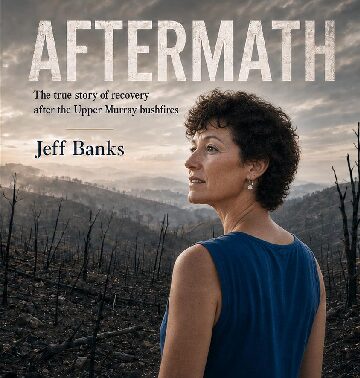
AFTERMATH Chapter 6 - Community Recovery Planning

AFTERMATH Chapter 6 - Community Recovery Planning | Travelling Around Australia with Jeff Banks

Recovery did not arrive in a meeting with an agenda. It came in small ways, through loud rooms and quiet rooms, through notebooks and cups on tables, through difficult conversations, through people turning up when they were too tired to turn up, through a bloke standing up for Towong with too much already on his plate, through mental health workers watching gently from the side, through Tony bringing people in carefully because he knew what fire had taken from them. It came through plans, yes, but the plans were only the surface of it.
AFTERMATH

Chapter 6

Community Recovery Planning

The hardest thing about community recovery planning was not the planning. It was the word community. It sounds simple enough when you say it in an office or put it in a document. Community recovery plan. Three neat words, as if a whole town, a valley, a farming district, a racecourse, a hall committee, a water committee, a family that has just lost everything and a bloke standing beside a burnt fence post can all be gathered up and placed under the one heading. It does not work like that, and if there was one thing the fires taught me early, it was that recovery could not be drawn with a ruler.

When we were first expected to go out and start talking to people about community recovery plans, some of them were not grieving yet. That sounds strange, but grief sometimes takes a while to find its way in. Some people were still in shock. Some were still counting stock, looking at fences, dealing with insurance, wondering where the next feed was coming from, or walking around a place they had known all their lives and trying to understand why it no longer looked like itself. Then along came people like us, with clipboards and notebooks and words like planning, consultation and committee, asking what they wanted for the future.

I look back now and think it was a fair question to ask, but it was an awful time to ask it. People were being asked to imagine a future when they were still trying to survive the present. They were being asked what their community needed when many of them did not yet know what they personally needed. They were being asked to think collectively when their own lives had been blown apart in very private ways. That was the tension we had to sit with from the beginning. We had to help communities look forward without pretending they had finished looking at what had just happened.

The first step was not to hold a meeting. It was to work out who people trusted. In each town and valley there were always a few people others naturally moved towards. They were not always the loudest people, and they were certainly not always the people with official titles. Sometimes they were on the hall committee or the water committee or had been involved in the show society or the sports club. Sometimes they were just the person everybody knew would give you a straight answer, whether you wanted one or not. In country communities, that is often more useful than a job description.

Most of those people came to the top fairly quickly. Even if they were traumatised, even if they were flat out with their own damage, they would usually stop and have the conversation because they cared so deeply about where they lived. They might not have had much energy left, but if you asked them about their district, they found a bit more from somewhere. I learnt very quickly that if you wanted to understand a community, you did not start by asking government who the leaders were. You went and found the people others already trusted.

Towong was harder. It was a beautiful little place, but it had been so badly damaged that you really had to walk through it to understand what had happened there. From the outside it could look like a small village with a racecourse and a hall and that extraordinary old grandstand, the sort of place people might drive past without ever understanding what it meant to those who lived there. There was a local story, or at least one I heard more than once, about Phar Lap having run there at some point. Whether every detail of that was exactly right or not, the story mattered because it said something about the pride of the place. Towong might have been small, but it had history. It had identity. It had something people held onto.

Finding the right person there took longer. We had tried, as much as we possibly could, to employ local people in our team, and that turned out to be one of the best decisions we made. One young woman seemed to be related to everybody, or at least knew someone who was. She understood the threads between people in a way no organisational chart ever could. Through her, we found the person who eventually stepped forward in Towong, and he turned out to be exactly the sort of person that community needed.

He had his own devastation to deal with. He was working in environmental recovery as well, which meant he was already flat out, and his wife was heavily pregnant. On top of that he seemed to be on every committee known to mankind, or at least every committee in that part of the world. Hall committee, water committee, this group, that group, and probably three others I never heard about. Yet he still stood up. That is the sort of thing that happened again and again in recovery. The people you most needed were often the people who had the least time to give, and somehow they gave it anyway.

Finding leaders was one thing. Getting people to come to meetings was another matter altogether. Nobody wants to hear the word committee at the best of times, let alone when they are tired, traumatised and have more pressing things to do than sit in a hall talking about plans. For some people, a meeting would have felt like another burden. For others, it would have sounded like bureaucracy arriving with a plate of sandwiches and a long agenda. I could hardly blame them for that.

The people who did come were not always the full picture of the community. They were often the people who had enough time, enough energy or enough habit of civic involvement to turn up. That mattered. In Corryong, for example, we had an excellent committee made up of committed, generous people who had lived there a long time and cared deeply about the town. They did a tremendous amount of work, and I do not want to take anything away from them. But looking back, I think we missed some voices, particularly newer people in town and people with a different vision of what Corryong might become.

That is one of the uncomfortable truths of community recovery planning. You can do it with the best intent in the world and still miss people. You can advertise, invite, ask, encourage and stand at the door smiling, and still the people most affected might not be there because they are fencing, feeding, grieving, dealing with children, dealing with banks, dealing with insurance, or simply unable to sit in a room and listen to one more conversation about the fires. Younger people were largely missing too. I do not remember having anyone under twenty in those committees, and very few under twenty-five. That meant we missed a youth perspective, and that was a loss.

The people most impacted were often the least available to help write a plan. That seems obvious now, but it is worth saying plainly because recovery systems do not always allow for it. The person whose place has been burnt out does not necessarily have the time or emotional capacity to sit in a meeting and talk about broader community needs. They might have the most important insight in the room, but they may not be able to get to the room. So the committees did their best. They went out into their communities, up valleys, down roads, across paddocks, into halls, wherever they could, and they consulted as widely as they were able. The plans were sound. They were not perfect, but they were honest attempts by tired people to look after the places they loved.

We were lucky to have people around us who understood recovery from the inside. Two men who had been through the Black Saturday fires came up to help, and one of them, Tony, was priceless. He had lost everything in those fires, and that gave him a connection we could never pretend to have. He had a country way about him, a way of talking to people without making them feel handled. He did not barge in with answers. He came alongside people, slowly and carefully, and helped them find the courage to come into the conversation.

Tony also helped us understand how careful we had to be with meetings. We did not want to run them. That was never the point. A community recovery committee had to belong to the community, not to council or government or whichever agency happened to be funding the biscuits that day. At the same time, we had to be very aware of the mental health and wellbeing of the people who were chairing those meetings and carrying those roles. It is easy to say communities should lead their own recovery. It is much harder when the people leading are also sleeping badly, grieving quietly, dealing with their own loss and trying to hold everyone else together.

We nearly always took mental health workers with us. They were not presented as anything dramatic, and they did not look or sound like what some people might imagine mental health workers to be. They were just the people who came with Tracey or Jen or whoever else was there at the time. But they had a very specific role. They watched gently. They noticed who was not there this week, who had gone quiet, who was sitting with folded arms, who seemed agitated, who might need a follow-up conversation over a fence post rather than a referral form.

That quiet, over-the-fence-post sort of mental health support mattered. Country people will often talk, but not always in the way systems expect them to. They might not say, “I need help.” They might tell you their neighbour is not doing too well, or that someone up the road has not been seen much, or that a bloke is getting a bit short with people. If you listened properly, there was often a second conversation underneath the first. Our team was trained in psychological first aid, and we put real effort into understanding what to look for, what to be careful of, how to protect people in our space and how to protect each other. We did not always get it right, but we knew the work could not just be about plans and projects.

Sometimes the people who needed the most help were the hardest to reach. Pride played a part. Fatigue played a bigger one. Some people were so tired they could not have explained what they needed even if they had wanted to. Over time, you learn not to come straight at people like that. You ask about their neighbour. You ask who else might be struggling. You let them tell you what someone down the road needs, and slowly the conversation winds its way back to them.

There is a humility in country areas that still does my heart good. People would sometimes check first on the neighbour they did not even particularly get on with. They might grumble about them afterwards, because that is also part of the natural order of things, but they would still check. That sort of care is not always tidy or sentimental. It can be awkward, blunt and wrapped in complaints, but it is care all the same. In recovery, that mattered more than any neat phrase we could put in a plan.

When we asked communities what they wanted, much of what came back was surprisingly simple. Yes, there were practical needs. There were roads, halls, fences, services, facilities and all the visible things people could point to. But underneath that, what communities kept asking for was time to be together. They wanted activities and gatherings where they could be in the same space without pressure, without an agenda and without bureaucracy sitting at the front of the room explaining itself. They wanted to yarn.

Sometimes community was a hall full of people. Sometimes it was three or four blokes around a fence post. Sometimes it was people sitting in the same room, not even saying all that much, but feeling a little safer because they were not alone. They did not always have the capacity to organise these things themselves. That sounds like such a small thing, organising people to gather, but when your mind is full of damage, forms, stock, family, money, weather and memories, even a simple get-together can feel too hard. If we organised it, they would come. They just needed someone to take that bit of load off them.

I think what they were really saying, underneath it all, was that they were scared. They may not have used that word. In fact, most of them probably would not have. But there was safety in being together. There was comfort in seeing familiar faces. There was dignity in sitting with people who understood the country, the roads, the ridges, the names of the places that had burnt. Outsiders could bring services, money, advice and structure, and all of that had its place. But neighbours brought a different kind of safety.

This is something I still do not think recovery planning gives enough credit to. We can be too quick to organise events with guest speakers, programs, music, brochures and branded banners. Sometimes people just want the hall open. They want a table, chairs, something warm to drink, maybe a sausage in bread if someone is feeling energetic, and the freedom to talk or not talk. The silence in those rooms could be as important as the conversations. Being together without having to perform recovery was recovery in itself.

There were frustrations, particularly because the plans had to be community focused. Many people lived on farms, and their most urgent needs were private, individual and practical. A community recovery plan was not going to rebuild their fencing or fix their business or replace the personal losses that sat behind their front gates. A lot of money went into implementing community plans, and that inevitably meant there was money going to community projects rather than directly to individuals. I understood the angst around that. How could you not, when someone was standing in front of you with real damage and real need?

At the same time, most people understood the difference. Their private enterprise, their farm or business, was their responsibility in a way, even though that sounds harsh when disaster has just ripped through it. Community was everybody’s responsibility. That was the value sitting underneath most of the conversations. People wanted their halls, gathering places and local facilities to survive because those places held the idea that the community itself would survive. A hall might only be used once a year in ordinary times, but after a fire it could become a symbol of whether the place still had a heartbeat.

Nearly every community recovery committee ended up wanting to do something with its hall or community centre. At first glance you could look at that and say, “Really? Is that the priority?” But the more I listened, the more I understood. It was not just about paint, toilets, kitchens, heating, cooling or access. It was about saying, we are still here, and we intend to keep being here. Even if everything around us has changed, we will still need a place to come together. That was hope, although most people would never have called it that.

Hope did not show itself as grand optimism. There were no neat moments where the clouds parted and everyone suddenly believed recovery was possible. In fact, people were more likely to have the opposite sort of realisation, the moment where it dawned on them that this was going to be much harder and much longer than they first thought. Hope, in those communities, looked more like trudging. It looked like people getting on with things. It looked like someone turning up at a meeting after a day when they would have had every excuse not to. It looked like a farmer talking about a ridge that was burnt black and then telling a story about his father on that same ridge years before.

That was where grief often came out too, in the storytelling. Farmers have a connection to land that is hard to explain properly if you have not sat and listened to it. Whether you agree with every farming practice or not is beside the point. They love the land. The fire was not only the loss of assets. It was hurt done to country they knew deeply. A fence line was not just a fence line. A ridge was not just a ridge. A paddock was not just a paddock. These places carried memory, family, work, arguments, seasons, failures and pride.

Sometimes a conversation about a new fence would become a story about a father, or a grandfather, or the way a paddock used to look. People would start with the practical and then, almost without meaning to, reveal the grief underneath. They might tell you about where stock used to shelter or where they had ridden as kids or how a certain stand of trees had always been there. Then you would realise they were not just describing what had burnt. They were describing a relationship.

Men and women often talked about recovery differently. This is a generalisation, and like all generalisations it has exceptions, but it was true often enough to notice. Men tended to talk about physical things: fences, sheds, stock, land, machinery, roads. Women tended to talk more about connections: getting a group going again, getting access to services, bringing routines back, making sure people were checking on each other. Both were talking about recovery. They were just reaching for different parts of it.

Older farmers often carried a certain certainty that life would go on. It was not necessarily cheerfulness. It was more a deep, worn-in understanding that hardship had happened before and would happen again, and somehow the community would keep moving. Younger families did not always have that same confidence. They may have heard stories of fires, floods, droughts and hard seasons, but hearing about endurance is not the same as having it demanded of you. For some of them, this was the first time they had been forced to ask whether rebuilding was actually possible.

Anger was part of it too, though perhaps not in the way people might imagine. Mostly, anger showed itself through withdrawal. People stopped coming. People went quiet. People grumbled to themselves or to their neighbours. We did have a few people who were aggressive enough that we made sure only experienced people in the team dealt with them. That was not about blacklisting them. It was about recognising that trauma can come out sideways, and that not everyone should be placed in front of someone who might unload it all at once.

There were moments that were almost funny afterwards, although they were not especially funny at the time. Once, a senior recovery official from Melbourne came to visit and went out to one of the more complicated areas. He found himself physically getting between two people in an argument. For a Melbourne bureaucrat of not particularly large build, he did a surprisingly good job of getting between them and bringing the conversation back to what it was supposed to be about. I do not think that was what he expected when he got in the car that morning.

Some areas carried tensions that had started long before the fires. The fires did not create every conflict. Sometimes they simply took the lid off things that had been simmering for years, even generations. There was one valley where the geography itself seemed to reinforce old divisions. There were people who had been there a long time and people who had arrived more recently, and each group carried its own sense of what respect looked like. We brought in experienced people and even specialist help to work through it, and we made progress with many individuals, but we were never fully able to bring every part of that valley into a shared vision. That was one of those hard lessons. Recovery cannot fix everything that was broken before the disaster.

What surprised me was that there was not more competition between communities. I expected more of that, more of one town saying another had received too much or one valley saying its damage was worse. There was some feeling from outlying communities that Corryong itself received a different sort of focus, and I could understand why people might see it that way. Corryong was the economic base, so its recovery had a different shape. That did not make it more important, but it did make it different. Still, compared with what could have happened, there was remarkably little resentment between communities.

Corryong had another layer because Upper Murray Inc., the economic development and chamber-of-commerce type organisation, already existed alongside the community recovery committee. That created some tension around boundaries and roles. Who was responsible for what? Who spoke for business? Who spoke for residents? Who spoke for the broader community? Those questions are not always easy in ordinary times, so they were certainly not easy in the aftermath of fire. It would have been interesting to see how things might have shifted with a stronger balance of business voices on the recovery committee, but you work with who is able and willing to be there.

A good community meeting had a particular feel. It was loud, but not raised-voices loud. It was the noise of people contributing because they felt safe enough and energised enough to do so. It could be chaotic, and I learnt to prefer that. If people were interrupting politely, adding thoughts, disagreeing, laughing a little, going off track and coming back again, that usually meant something real was happening. It meant the room had some life in it.

The meetings that worried me were the tidy ones where only the chairperson spoke and everyone else sat with folded arms. Those meetings could look successful on paper. The agenda was followed, the minutes were neat, the boxes were ticked, and everyone could go home on time. But you could feel the absence of engagement. People were either not feeling safe, not feeling valued, or not believing that anything they said would matter. A quiet meeting could be more troubling than a messy one.

The other sort of bad meeting was the one where the volume came from people having nowhere else to put their stress. They were tired, overwrought, grieving and angry, and suddenly here was an audience. Often the issue that sparked it was not the real issue at all. Someone said something, someone else took it the wrong way, and off it went. Most of the time I did not feel people were trying to drive a personal agenda. They were letting off steam because there was nowhere else for it to go.

We had to understand the cycles of recovery. There is a point in bushfire recovery where neighbour can start turning on neighbour, and while that sounds terrible, it can actually be part of the progression through trauma. First there is adrenaline and survival. Then there is the relief of having made it through. Then comes the heavy realisation of what has been lost. Then, sometimes, anger looks for somewhere to land. It cannot blame the whole world, so it blames the nearest available person.

That stage is dangerous if you are not watching for it. It is often around then that hidden family violence becomes more visible, suicide risk rises, and people who had been holding themselves together begin to unravel. You need the right mental health services in place before that happens, not afterwards. They need to be trusted, present and connected to the community. That is part of the skill of good recovery strategy: knowing that different stages need different support, and that the thing that looks like bad behaviour might be grief wearing work boots.

There were suicides, and there is no way to write about hope in recovery without also acknowledging that. Not everyone found a way through. Not everyone could keep trudging. That truth sits heavily because recovery work is full of small wins and practical achievements, but there are losses that no plan can soften. You carry those too, even if quietly.

Still, every day someone did something generous. That was the thing that kept you going. It might be a hand on a shoulder, a story shared, a plate of food, or someone saying, “Come and have a look at my place,” because once you had their trust, people wanted to share their lives with you. Some days I would shake my head and think, “Why would you do that?” because people are still people, even in disaster. But underneath it all, every day there was some story of someone taking something to someone else, checking on someone, helping someone, or offering what little energy they had left.

That is what you hang onto in bushfire recovery. Not because it makes everything all right, because it does not. You hang onto it because it reminds you that damage is not the only thing moving through a community. Care is moving too. So is stubbornness. So is humour, even dry and tired humour. So is the quiet determination to keep going because no one can think of a better alternative.

The plans themselves had a double edge. They were not just documents. At their best, they helped communities strengthen their identity, identify what services were needed, and show government where each community was at. They gave structure to grief without pretending to solve it. They helped turn scattered conversations into something that could be acted on.

But they also created expectations. That was one of the burdens. Once something went into a plan, people could understandably think it would happen. Government templates did not always fit what a community actually needed, yet we still had to work within them. We had to translate between the way communities spoke about recovery and the way government needed recovery written down. That translation was necessary, but it was never perfect.

I learnt a lot about listening in that period. I learnt that it is not enough to listen. People have to know you are listening. I used to take a notebook to meetings and write copious notes, even when someone else was taking minutes. I did not always need those notes in a practical sense, but the act of writing mattered. People could see their words landing somewhere. They could see that what they said was not just drifting into the air.

Listening in a meeting is different from listening one-on-one. In a meeting, people need visible signs: eye contact, a nod, a note taken, something reflected back. One-on-one, it can be quieter. You angle your body a little towards them. You give them room. You do not turn listening into a performance. The skill is knowing the difference, and I saw good people get caught by that. They might have heard every word and remembered it perfectly, but the person speaking still walked away feeling unheard because there had been no sign that the words had mattered.

That, in the end, was what community recovery planning really asked of us. It was not just asking traumatised people what projects they wanted funded. It was asking them to trust that their words mattered at a time when so much else felt out of their control. It was asking them to imagine that their hall, their valley, their town, their racecourse, their road, their gathering place and their ordinary routines still had a future. It was asking them to believe that the community had not ended, even though the version of it they knew had been changed forever.

Recovery did not arrive in a meeting with an agenda. It came in small ways, through loud rooms and quiet rooms, through notebooks and cups on tables, through difficult conversations, through people turning up when they were too tired to turn up, through a bloke standing up for Towong with too much already on his plate, through mental health workers watching gently from the side, through Tony bringing people in carefully because he knew what fire had taken from them. It came through plans, yes, but the plans were only the surface of it.

What sat underneath was something more fragile and more important. People were trying to find a way to be a community again when the old shape of community had been burnt, shaken or exposed. They were not trying to go back to what existed before, because that place was gone in ways no funding program could reverse. They were trying to work out what could still be carried forward, what had to be rebuilt, what had to be let go, and what could be made stronger because they had survived together.

By the time the community recovery plans began to take shape, I understood that planning was not the opposite of grief. Sometimes it was one of the ways grief moved. A hall improvement could be grief. A fence line story could be grief. A loud meeting could be grief. A quiet one certainly could be. Hope could look exactly the same from the outside, which made the work difficult and human and never as tidy as anyone in a city office might have liked.

Those plans became the bridge to the next stage of recovery. Once communities had found some words for what they needed, the work shifted again. Ideas had to become projects. Projects had to become applications, budgets, approvals and delivery. The human mess of recovery had to be carried into systems that liked straight lines. That was where another kind of work began, and where we learnt again that even the best plan is only useful if it can survive contact with real life.

Author

Menu