

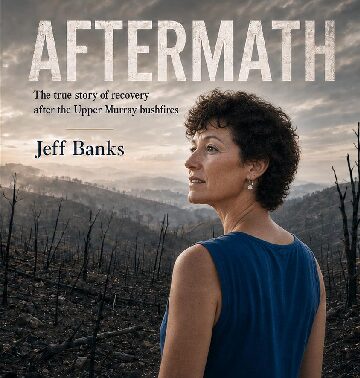
AFTERMATH Chapter 5 - The Shift to BRV

AFTERMATH Chapter 5 - The Shift to BRV | Travelling Around Australia with Jeff Banks

That is the part that still sits with me. There were no simple goodies and baddies. It would be easier to tell the story that way, but it would not be true. The community was not always easy. Government was not always wrong. Council was not always the problem. BRV was not always the answer. Everyone was looking through different lenses, using different tools, and working toward goalposts that did not always line up. Most people were genuinely trying to do the right thing, and still people got hurt.

AFTERMATH

Chapter 5

The Shift to BRV – Bushfire Recovery Victoria

When I moved from Council to Bushfire Recovery Victoria, I did not even shift desks. There is probably something telling in that. On paper, I had moved from local government to state government, from Council recovery work into a broader state recovery agency with a bigger name, a bigger reach and, supposedly, a bigger capacity to make things happen. In practice, I was still sitting in much the same place, looking at the same roads, the same valleys, the same tired faces, and the same communities trying to work out how you start again when starting again is not really the right phrase.

There was a very strategic reason for the move. I could see that BRV had a bigger scope than Council did, and with that came more opportunity to influence the recovery in a way that might actually make a difference. Council had done what it could in those first months, and there were people inside it who had worked themselves into the ground. But there were also internal changes happening, and I was not happy with the direction recovery seemed to be taking. I do not say that as a neat little career explanation, because recovery never felt neat. It was partly a career move, yes, from local government into state government, but it was also a decision about where I thought I could do the most good.

At the time, I believed the shift would give me more room to move. Looking back, it did, but not always in the way I expected. State government brought resources, money, programs, specialist staff and a level of authority that Council could never have carried on its own. It also brought hierarchy, language, reporting lines, approvals, ministers, templates, systems and a particular confidence that comes from people in offices believing the process must be sound because it has been written down somewhere. Both things were true at once. BRV was support, takeover, structure and bureaucracy, all wrapped together, and most days I was trying to work out which bit of it I was dealing with before I opened my mouth.

The work changed almost immediately in tone. With Council, so much of it had been practical and immediate. It was doors open, kettle on, phone ringing, people coming in with ash still on them in one way or another. It was field trips and secondary inspections, sitting beside people who were trying to describe what used to be where there was now nothing but twisted tin and chimney bricks. With BRV, the work became more strategic. There were programs to line up, reports to write, community plans to support, grants to match against ideas, and a whole state-level structure sitting above the local work. The funny thing was that the recovery itself had not become strategic. The people still needed the same things: someone to listen, someone to explain, someone to help them get through the next piece of paper, the next inspection, the next decision they did not want to make.

One of my key roles in BRV was to keep the connection with Council close. Because I had worked there, because I knew the people, and because I had not physically gone anywhere, I could help carry the momentum forward. That mattered. The last thing the Upper Murray needed was a clean line drawn between one organisation and the next, as though recovery could be handed over like a folder on a desk. But that overlap also caused confusion and tension. People did not always know whose role was whose, and to be fair, sometimes neither did we.

That is one of the quiet truths of disaster recovery. From the outside, people imagine there is a plan and everyone knows where they fit. From the inside, there is often a plan, several plans in fact, but they do not always agree with each other, and the people trying to apply them are doing so in a landscape that has changed faster than the paperwork can follow. You can have the best intention in the world and still trip over the system you are standing in. You can be there to help and still become one more person asking a traumatised farmer to explain the same thing again.

BRV talked about being locally driven. Later the language shifted more toward community-centred, which was probably closer to the truth. The intention was genuine. I never doubted that. There were people in BRV who were working extremely hard to put the community at the centre of decisions, and there were leaders who understood the importance of listening before announcing. But intention and practice are not the same thing, and government, by its very nature, struggles to be truly community-led. It is too big, too accountable, too political and too bound by rules that were made somewhere else for a broader purpose.

That does not mean the rules are always wrong. It means they often arrive with square corners in places where life is anything but square. A community is not a machine. It is not a committee, a dot point, or a single voice that can be captured in a consultation report. It is a shifting group of human beings, and after a disaster those human beings may be grieving, angry, exhausted, ashamed, proud, suspicious, generous and completely overwhelmed, sometimes all before morning tea. What they need at nine o’clock might not be what they need by lunchtime. What one valley wants might be the last thing the next valley would accept. What seems reasonable in Melbourne can look ridiculous five minutes out of Corryong where the internet drops out and the power is not something you take for granted.

That was one of the hardest things to get through to people. So many of the tools and processes were online, because of course they were. That is how government works now. Forms, updates, grant portals, emails, attachments, logins, passwords, digital signatures, scanned invoices, online consultation. In the city, that can seem efficient. In the Upper Murray, you only had to drive a short way out of town and you could lose the whole lot. There were people who had never had regular, reliable internet access, so of course they had not built their lives around email. Why would they? It is not stubbornness if the tool has never worked for you.

I had a proper barney one day over a handwritten invoice. A local club had put on catering for a community event, and we were paying them back because no one was supposed to be out of pocket for helping. The invoice came to me handwritten, not especially beautiful, but perfectly clear in the ways that mattered. It had what it needed to have. I scanned it and sent it through, and someone in Melbourne refused to process it because it was handwritten. To him, I suspect, it was just one more non-standard document in a pile of work he was trying to get through. To me, it was the whole problem in miniature.

I argued that it was a legal document and that the burden should not be pushed back onto a community member who had already done the work. The person at the other end was not trying to be cruel or pompous. He was trying to be efficient inside a system that valued clean inputs and repeatable processes. But community-centred recovery cannot mean the community adjusts itself to the system every time the system feels inconvenienced. Sometimes the system has to bend. I took that one as far as I needed to, and I was proud of it, not because it was a grand victory but because it forced a small recognition that local reality had to count.

A lot of my work became translation. I used to joke, though not always very cheerfully, that my role should have been called community meat in the sandwich. On one side was the local community, with lived experience, dignity, fury, grief and very practical knowledge of what would and would not work. On the other side was government, with responsibility, money, legal obligations, political oversight and a set of rules that could not simply be wished away. My job was to take one language and turn it into another without losing the truth of either.

That was where a lot of my exhaustion came from. It was also where some of my pride came from, because when it worked, it mattered. I could sit with a community group and help them explain what they needed in a way that would make sense to a grant program. I could sit with government people and explain why a tidy consultation model would fail in a valley where people were still rebuilding fences and feeding stock and sleeping badly. I could help the community understand that a minister’s office was asking a question for a particular reason, and I could help the minister’s office understand that the answer might not come back in the form they expected.

For a while I wrote a monthly report that went straight to the Minister’s desk. At first, I did what many public servants do and wrote it in a polished, bureaucratic style, all tidy language and careful tone. Then the message came back that this was not what was wanted. The Minister wanted to know what was actually happening. That became part of my job: gathering local intelligence, listening properly, and then translating it into something accessible enough to be useful but formal enough to survive the system. I did not have to pretend everything was going well, but I did have to write it in a way that could be received.

I carried a bias toward the community, and I knew that. I do not think it made me dishonest. If anything, it made me more careful. I wanted the Minister and the people around her to understand how hard the community was working at recovery, not as a sentimental idea but as a practical truth. People were not sitting around waiting to be saved. They were trying to get stock contained, insurance sorted, access restored, sheds replaced, kids settled, businesses moving, and some sort of rhythm back into days that no longer had a recognisable shape. If they sounded angry, there was usually a reason. If they did not turn up to a meeting, there was usually a reason for that too.

That was another lesson government struggled with. Keeping the community voice in the room sounds simple until you remember that the most impacted people often do not have the time, energy or mental capacity to sit in a meeting and represent themselves. They are too busy recovering. Farmers do not stop being farmers because the government has scheduled a consultation session. Dairy runs still happen. Stock still need feeding. Fences still need attention. Men and women were both working all day, and by evening many of the men in particular were physically done. If we put something on too late, everyone would be half asleep before we started, and fair enough too.

We learned to work around farm life as best we could. Do not schedule a meeting during milking. Do not interfere with feeding routines. Do not assume that because a time suits the diary of a government officer it suits the people who are supposed to be in the room. Even then, the people who came to meetings were often the ones with slightly more capacity, which sometimes meant they were the least impacted. That was not their fault. They were doing the work of representation as best they could. But it left a real dilemma, because the voices we most needed to hear were often the voices least able to attend.

The Upper Murray had another layer sitting underneath all of this. Trust in government was not high before the fires. There had been long-standing tensions with Council, and there were strong feelings about state land management, forestry, the High Country and the decision to ban hardwood logging. These were not abstract policy positions to people. They were tied to livelihoods, identity, history and a sense that decisions were made far away by people who did not understand the country. Then the fires came through, and government arrived in high-vis, boots, suits, vehicles and acronyms, promising to help. It was always going to be complicated.

Some government people understood that better than others. We were lucky early on to have a senior BRV leader who would come up in boots and jeans, sit with people, talk about ordinary things, and listen without looking like he was waiting for his turn to speak. That built trust. It did not solve everything, but it mattered. Communities can smell performance a mile off, and they can usually tell when someone has come to learn rather than inspect. When someone from head office arrived in a suit and tie with their bureaucratic hat firmly on, the difference in how they were received was obvious.

Politicians were their own category. Most were decent enough. They let us know they were coming, and yes, we would have to drop things and show them around, but many understood that they were dealing with traumatised people, not scenery. Others were less flexible. There were times when the community felt like fish in a bowl, with visitors coming to look at the damage as though seeing it was the same as understanding it. I remember one visitor being more concerned about the ingredients in the morning tea cupcakes because of a diet than about the people who had baked them and the place he was standing in. You had to laugh, because the alternative was saying something unhelpful.

Language mattered more than people realised. In government, the difference between departments, agencies, levels and reporting lines can be very important. On the ground, most people did not care. Government was government. If someone in a shirt with a logo told them one thing and someone in another logo told them something different, it all blended together into the same frustration. Part of my job was to help people work out who they actually needed to talk to without making them feel foolish for not already knowing. That was a delicate thing. You never wanted to sound patronising, because the community was not ignorant. They simply had not spent their lives learning the internal map of bureaucracy, and why should they have?

Sometimes the language problem became almost comic. Our tree people would go around marking dangerous trees so they could be assessed or removed according to risk. At one point, a cross was used to mark a tree that needed urgent attention. The community quickly learned what the marks meant, and before long some people started putting crosses on trees they wanted removed, whether those trees met the criteria or not. I could hardly blame them. If you are surrounded by burnt timber and worried about what might come down in the next wind, you use the tools available. Of course, we had to change the marking system, because once the language was understood, it became part of the negotiation.

That little story says more about recovery than it might seem to. People were not being sneaky for sport. They were trying to regain some control in a landscape where control had been stripped away. Government was trying to manage risk, liability, cost and fairness. Both sides had reasons. Both sides could be right and still clash. That was the pattern over and over again.

There were times when bureaucracy protected people. I saw that too, and it is important to say it. We had issues with some insurance companies after the fires. Many people had insurance of some sort, but farming is not a bottomless bucket of money. Some had made hard choices over the years about whether to insure fences, stock, sheds or the house, because there simply was not enough to cover everything properly. Then, when the fire came, those choices turned into consequences no one should have to face all at once.

One day we noticed an insurance representative driving in and out of properties in a way that did not sit right. He seemed to stop at one farm, skip a couple, stop at another, and move on quickly. When we spoke to people, it became clear he appeared to be prioritising the biggest claims and giving very little attention to smaller ones. That was not good enough. As a department, we were able to make an official complaint and push back against that kind of behaviour. That is where government weight can be useful. An individual farmer might be brushed aside, but a department asking questions is harder to ignore.

There were also insurance people who were wonderful. I remember one in particular who was so genuine that word spread quickly. Even if only one person down a road was his client, he would stop at other places and ask whether anyone needed advice or help understanding the process. He did not have to do that. He just did. The community noticed, because communities always notice who turns up properly. I would not be surprised if a few people changed insurance companies later because of him.

There were also many times when bureaucracy hurt people, often unintentionally and often while trying to keep them safe. Rebuilding was one of the hardest areas. A house might have sat on the same ridge for sixty years without anyone questioning it. Then the fire went through, the fire rating changed, and suddenly the person who had lost their home was being told they could not rebuild where their home had always been. The rule had a reason. No one wants people rebuilding in a way that puts them in danger. But knowing the reason does not soften the blow when someone is standing there looking at the place where their life used to be and being told, in effect, that even the ground has been taken from them.

The costs were another wound. People who believed they were adequately insured discovered they were not, especially once new building requirements, assessments, environmental considerations and fire standards came into play. To rebuild could cost three, four or five times what they expected. Some people could not rebuild at all, not in the way they had imagined, and sometimes not in any meaningful way. That is a cruel kind of loss, because it comes after the first loss. The fire takes the house, and then the process takes the hope that you can simply put it back.

I think of a man in a beautiful valley with a creek running beside the road. He had a block of land and plans for what he wanted to grow there, something clean and careful, the sort of dream people carry in their heads for years before they manage to make it real. Access to his property depended on a small wooden bridge on someone else’s private driveway. The bridge burnt. Because it was private, government would not rebuild it. The person who owned the driveway did not use the bridge and was not going to pay for it. In the end, the man had to sell the block because it had no proper public access.

That sort of situation makes you want to go back in time and ask how it was ever allowed to happen. Bureaucracy failed him long before the fire. Somewhere along the way, a system allowed a block to exist without secure independent access, and then after the disaster another part of the system stood back and said it could not help. Everyone might have been technically correct. That did not make the outcome fair.

The community did not trust the process, not fully, and I understood why. They were not in charge of it. That alone changes how people experience help. If a process is imposed on you, even with good intent, you are likely to resist it more than if it has been built with you. Emergency recovery still carries a kind of military structure underneath it. There is a hierarchy. Decisions are made, passed down and implemented. That can be necessary in a crisis, but recovery is not the same as response. Recovery needs more patience than command.

We started well in some ways, but we also stumbled badly. After one of the early trusted people moved back to her substantive role, a new Council recovery leader came in with a very different approach. She came from another fire-affected area and no doubt brought experience with her, but she seemed to operate from a “we will do” mindset rather than “we will do with.” That distinction might sound small unless you are the person being done to. In the Upper Murray, it lit a spark.

By then we had recognised that the Upper Murray could not be treated as one neat community. Every valley had its own identity, its own history, its own impact and its own priorities. We had made a conscious decision to let each smaller community have its own recovery committee and recovery plan. It meant more work for us, a lot more driving, more meetings, more listening and more complexity, but it respected the reality of the place. It gave people dignity. It acknowledged that Tintaldra was not Corryong, Walwa was not Cudgewa, and none of the valleys wanted to be swallowed into a single voice for administrative convenience.

Then came the push to simplify it. One committee to represent everyone. One structure. One table. In a report, that probably looked efficient. On the ground, it was the sort of idea that could only come from not understanding the place. There was talk of using an existing town business group as the recovery committee, because it was already there and already organised. But a business group is not automatically a recovery committee. The movers and shakers in town are not necessarily representative of the people on isolated farms, the people who have lost more than they can say, or the people who would rather chew their own arm off than sit in a formal meeting.

The backlash was immediate and deserved. It was one of those moments where I thought, this is what happens when bureaucracy is put before people. Again, I do not think the person involved set out to cause harm. She probably thought she was bringing order to something messy. But recovery is messy because people are messy, and because place matters. Trying to clean it up too quickly can be its own form of damage.

At the same time, I do not want to pretend BRV was a failure or that government did nothing useful. That would be unfair and untrue. State government brought things that genuinely helped. One of the best was access to grant programs that were broad enough and flexible enough to support community priorities. If I could sit with a community group, or enough representatives from that community, and help them work out their top priorities, I could often match those priorities to a funding stream. That was powerful when it worked.

The panel of grant writers was another very good idea. Grant writing is a game, and it is a skill. It has its own language and its own strange assumptions. Expecting a traumatised community group to master that game while recovering from a fire is unreasonable. Being able to connect them with a professional grant writer changed the burden. The community could say, “This is what we want. This is what matters. This is what would help.” The writer could then turn it into the kind of application the system understood. The project still belonged to the community, but they did not have to spend their scarce energy pretending to be bureaucrats.

A lot of the Upper Murray communities chose to put money into their halls. That made perfect sense to them, and it made perfect sense to me. Some of those halls were not fire damaged, but they were the centre of community life. They were where people gathered, held fundraisers, fed each other, argued, voted, mourned, celebrated and checked who had turned up and who had not. In small communities, a hall is not just a building. It is social infrastructure, though I doubt many locals would have used that phrase unless they were forced to sit through one of our meetings.

The communities were clever about it. They understood that strengthening the hall strengthened the community. At first, the process was reasonably simple and worked well. Over time, of course, it became more complicated, because nothing involving old buildings stays simple for long. Many halls were around a hundred years old. There were electrical issues, asbestos problems, compliance requirements and all the other surprises that sit quietly in old walls until someone applies for a grant. To my knowledge, the communities that applied for help did improve their halls, even if not always as extensively as they first hoped. That mattered. It was visible, practical recovery, and it belonged to them.

The BRV team itself worked hard. We covered not only the Upper Murray but also Alpine areas, and we had people focused on community engagement, infrastructure and land, communications, economic development and other pieces of the recovery puzzle. Not everyone lived locally, but they made the effort to be on the ground every week. They made themselves available. They let people rant and rave at them because they understood that people needed somewhere to put all that anger and grief. That takes a toll, even when you understand it.

We became very close as a team. Shared trauma does that, though it is not something I would recommend as a team-building exercise. We were on a first-name basis with the motels and pubs in town. I had a favourite room at one motel, and the owner would try to keep it for me because I was there so often. If I needed more space and quiet, I would stay at the caravan park a couple of kilometres out of town, where they knew my favourite unit too. Everyone had their little routines, their preferred places, their ways of making the work survivable.

When someone left the team and someone new came in, even if they were lovely and capable, it felt like a shock. We had become tightly bound by the work and by what we were carrying. That is another side of recovery people do not always see. The workers are not the story in the same way the affected people are the story, and they should never take up more space than the people who lost homes, stock, fences, routines and certainty. But the workers do absorb things. They carry stories home in their bodies. They sit in motel rooms at night replaying conversations. They learn which roads make their stomach tighten because of what they saw there last time.

I often felt caught between community expectations and government requirements. Every single day, really. I felt like a local, and I was treated like one in many ways. I had loyalty to the Upper Murray because I knew the people and the place, and because I had looked too many of them in the eye to hide behind a position description. But I also worked for a government organisation. I accepted that role and that pay, and I owed loyalty there too. The tension never fully went away.

In the back of my mind, I often thought that government should be the one to flex more. Government is paid to be there. Community is not. Community is trying to recover its own life. That does not mean every community expectation is reasonable, because sometimes it is not. Trauma does not make every demand possible or fair. But if one side has the wages, the vehicles, the laptops, the hierarchy and the ministerial briefings, then perhaps that side should carry more of the adjustment. It did not always work that way.

The bigger the government involvement became, the more individualism seemed to disappear. Not because people stopped being individuals, but because systems struggle to hold that much difference. A grant program needs criteria. A minister needs a recommendation. A department needs a risk rating. A report needs categories. But a person is not a category. A farm is not just an asset. A hall is not just a building. A handwritten invoice is not just an administrative inconvenience. A dangerous tree is not just a mark on a map. A bridge on a private driveway is not just a line in a policy.

That is the part that still sits with me. There were no simple goodies and baddies. It would be easier to tell the story that way, but it would not be true. The community was not always easy. Government was not always wrong. Council was not always the problem. BRV was not always the answer. Everyone was looking through different lenses, using different tools, and working toward goalposts that did not always line up. Most people were genuinely trying to do the right thing, and still people got hurt.

I learned that recovery at scale always risks sanding the edges off people. The state needs systems because it is responsible for more than one valley, one town, one disaster. Local communities need to be seen in their full particularity, because recovery only happens in real places, not in frameworks. Somewhere between those two truths was where I spent most of my time, translating, arguing, smoothing, pushing, apologising, explaining and occasionally winning a small battle over something as ordinary as a handwritten invoice.

When I think back on shifting to BRV, I do not think of it as leaving local recovery behind. I think of it as stepping into the space between local knowledge and state power, and discovering how narrow and uncomfortable that space could be. It gave me more influence, yes. It gave the communities access to resources they would not otherwise have had. It also showed me how easily recovery can become something people talk about in meeting rooms while the people who most need it are out fixing fences, chasing insurance, feeding stock, or sitting quietly in a house that no longer feels like theirs.

The next stage was trying to help those communities name what mattered to them, valley by valley, hall by hall, road by road, without pretending they were all the same. That was the work that followed: community recovery planning, though even that phrase sounds too tidy for what it really was. What we were really asking was much harder. After everything that had happened, after all the loss and all the noise, what do you want to rebuild, what do you want to protect, and what sort of community do you want to be now that the old one has been changed forever?

Author

Menu