

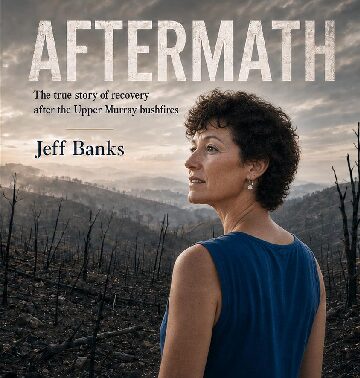
AFTERMATH Chapter 4 - Transition to Recovery

AFTERMATH Chapter 4 - Transition to Recovery | Travelling Around Australia with Jeff Banks

I can still walk down the street in Corryong and have people know who I am. Amanda and Jen can too. That means something to me, not because I need to be remembered, but because it tells me the relationships were real. The trust did not vanish when a funding stream ended or a role changed. Jen is still working in that space for council, and some of the liaison people we later put on became so trusted that when fires went through again, they were brought back straight away. That is not a small legacy.
AFTERMATH

Chapter 4

Transition to Recovery

By the time we started talking about a recovery hub, the fire was no longer only a fire. That sounds obvious now, but it did not feel obvious at the time, because in those first days everything had been about response: where the fire was, who was safe, who needed to get out, who needed a bed, a cup of tea, a phone charger, a blanket, a quiet corner, or someone to tell them what was happening even when none of us really knew.

Response was immediate. It had smoke in its hair and ash on its boots, and it was made up of radios, road closures, exhausted faces, and people walking into evacuation centres carrying far less than they had left behind. Recovery was something else entirely, and although it did not have the same siren urgency, it carried a weight that settled deeper and stayed longer.

Recovery was the silence after the siren stopped. It was people beginning to understand that the thing they had survived was not finished with them yet, because homes were gone, sheds were gone, fencing was gone, stock was gone, routines were gone, certainty was gone, and people were having to ask questions they did not want to ask and accept help they did not want to need.

It was also where the cracks started to show, not only in people, but in systems. Government needed to be seen to be doing its job, and the locals needed what they felt they actually needed, and those two things were not always the same thing, no matter how good the intentions were on either side.

The evacuation centre had done what it was meant to do. It had held people in the first shock, and it had been a place where you could come in from the smoke and be known by somebody, or at least be seen by somebody. But it was never going to be the place where recovery could happen, because for a start it was the school gym, and the fire had broken out during school holidays. Schools have a habit of needing to become schools again, and children had to go back, teachers had to teach, and a gym full of bedding, donated clothes, forms, services, exhausted people and council staff trying to look as if we knew what we were doing was not a long-term plan.

More than that, the gym felt like response. It was open and exposed and temporary, and you could not have a private conversation in that sort of space, not really. You could not sit quietly and let someone take the time they needed to tell you what had happened, and you could not bring in all the different services people were going to need and expect it to feel anything other than overwhelming. Recovery needed a different sort of room. It needed walls, but not walls that boxed people in. It needed services, but not a parade of badges and brochures. It needed to feel official enough that people trusted it, but not so official that they turned around and walked out.

That was the line we were trying to walk before we even had a building. We knew people needed a central place where they could go for information about how they were going to recover from whatever damage had occurred, and that meant access to government grants, psychological support, agricultural services, practical advice, and all the other bits and pieces that start to matter once the immediate danger has passed.

By then the secondary inspections were underway and other councils and services had begun arriving to help. That was a relief in itself, because in the beginning there had been that awful sense that we were trying to do everything with whoever happened to be standing closest. Once volunteers from other councils and agencies came in, parts of the work could be shared properly, and that gave us the space to become something more deliberate.

Council created a formal fire recovery team, although I am not sure any of us felt very formal. It started with Amanda, Jen and me. Amanda had been part of the evacuation centre work in Corryong and became the manager, or whatever fancy title was attached to it at the time. Jen and I sat under her, and together we were expected to help set up and coordinate recovery.

I suspect the three of us had three different pictures in our heads of what the hub might look like. I know I did. But the principles underneath were the same, because we needed somewhere people could come for information, grants, psychological support, agricultural advice, practical help and all the other things that become necessary once people realise the disaster has not ended just because the flames have moved on.

We needed space for services to work. We needed places for confidential conversations, and we needed somewhere people could sit and breathe. We needed a place where they might run into someone else, have a cup of tea, talk about nothing much, and feel for a moment that they were not booking into Centrelink. That became one of the measures in my head. Whatever we built, it could not feel like Centrelink.

That is not meant as an insult to Centrelink, because Centrelink has its purpose and plenty of people need it. But nobody who had just lost a house, or half a farm, or all their fencing, or their sense of themselves, needed to walk into a recovery centre and feel they had become a number on a screen. They needed help, but they also needed to keep hold of their dignity.

The answer, physically at least, was sitting there in Corryong already. A few years earlier, the local primary school had merged with the high school and moved up to that site, which meant the old primary school was empty. It was government-owned, reasonably maintained, and in a good location near the end of the main street, with plenty of parking, which mattered more than people might think.

It was also familiar, which mattered even more. Most people who walked through that door would know someone who had gone to school there, or they had gone there themselves, or their children had, or their parents had. It was not some shiny new government building dropped into town to fix everybody. It was already part of the place, and that made it the obvious choice before we had even said it out loud.

There was not much debate about it. We all knew that was where it had to go, although knowing that did not mean we knew how to make it work. The building was tired and had old school bones. You walked in and there was a small office on the left, probably once a teacher’s office, and then it opened into a large space, almost like an indoor hall. At the far end was a kitchen area with a bench, and behind that were classrooms.

One wall was virtually all windows, which meant the morning glare could be fierce. Outside it was still smoky and dark at times, and we wanted people to feel a lift when they came in, not feel as though they had walked into another grey room full of bad news. We needed internet, proper heating, workstations, private spaces, somewhere for people to sit, somewhere for services to gather themselves, somewhere for food and tea and coffee, and somewhere for all the papers and brochures and forms that every service in the world seemed to arrive with.

We were not people who set up large workspaces for a living. We were learning as we went, and there was a fair bit of looking at each other and saying, “Righto, let’s give this a go,” with far more confidence in our voices than we actually felt. In hindsight, that was probably the only way it could have happened, because if we had known how complicated it was going to become, we might have frightened ourselves out of starting.

We were lucky in ways I still think about. Two gentlemen volunteers came in who had been heavily involved after the Black Saturday fires, and they brought exactly the sort of knowledge we did not have yet. One was brilliant at the strategic side. He could look a few steps ahead and tell us, “This is what you are going to face next. These are the things you need to prepare for.” The other had a gift for understanding what people would be feeling and how the community might respond. He could say, gently but firmly, “That won’t work for them,” or, “They’ll need time with that,” and he was usually right.

Later, another volunteer came who had worked in local government during Black Saturday, and he brought another layer of knowledge we desperately needed. There is a difference between knowing something because you have read it and knowing it because you have stood in it. Those volunteers had stood in it. They did not come in with big egos or grand solutions. They came in with coffee, patience, and the kind of knowledge that only comes from having seen what recovery does to people over months and years.

We also had, at that stage, a bit of freedom from council bureaucracy. I do not say that lightly, because councils are full of people trying to do the right thing inside systems that do not always make that easy. But in that moment, the bureaucracy kept mostly away and allowed us to build what we thought was needed, and that was critical.

It would have been very easy for someone sitting back in an office to tell us to set it up like a council service centre. Desks here, waiting chairs there, posters on the walls, staff behind counters, clients on the other side. Tidy. Defensible. Completely wrong. The pressure was there to make it look like a government office because that is the shape government understands, but the community had already told us, in different ways, that they did not want to walk into a room and feel like they were begging.

So we sat around with coffee and furniture books and office supply catalogues, trying to work out how to soften an old school building without pretending it was something it wasn’t. We needed office space, and we probably overdid that part. We had about twelve cubicles set up, with IT brought in to connect everyone to the internet, which was a big enough journey in itself. That side worked, and it looked like an office because it needed to function like one.

But the first thing people saw could not be the office. That was where we had to be very deliberate, because people make up their minds quickly when they are tired and wary. We bought soft couches in bright colours, the sort that caught your eye when you walked in. We put down rugs. We found coffee tables and cushions. We had magazines. We had pot plants everywhere, largely thanks to the receptionist we later employed, who went home and returned with what looked like half her garden in the back of a car.

We set it up like a lounge room, only bigger. None of us were interior designers, but we knew what made us feel comfortable, and we trusted that instinct. A couch says something different to a plastic chair. A rug says something different to lino. A pot plant says someone has thought about the room being alive, and after so much blackened country and smoke and ruin, that mattered more than it probably sounds.

The tea and coffee mattered too, of course. I think every recovery centre in the country should start with a kettle, because it is not a small thing. In the country, making someone a cuppa is not just hospitality. It is a way of saying, “You can sit here for a minute. You do not have to explain yourself straight away.” One of the rules we made for services was that if someone was there, make them a cup of tea. Do not wait for the right person. Do not hover with your badge. Just make the cuppa. That was the country way, and it did more for trust than most official engagement strategies I have seen.

We were very conscious of what people would feel when they walked in. They were exhausted, traumatised, angry, proud, private and suspicious of bureaucracy, sometimes all before morning tea. Some had been dealing with the land and weather and animals and isolation their whole lives. They were not people who naturally lined up to ask government for help, and there was already a murmur around the place of, “People are coming to fix us.” Underneath that was the stronger feeling: “We can fix ourselves. We just need some help.”

That distinction mattered, and it shaped almost everything we tried to do. We decided early that the first person people saw needed to be local. Amanda, Jen and I were known enough in the Upper Murray by then. I was known. Jen was known. Amanda was technically from outside, but because she had been there during the hardest part of the evacuation centre, she had earned a kind of local status. Even so, we needed a face at the front who belonged to the place in a deeper way.

The woman we found was worth her weight in gold. She was two or three generations local and knew everyone. There were administration skills she did not have, but I would have taken her local knowledge and warmth over perfect typing any day of the week. People walked in and knew her, or knew her family, or knew enough about her to trust that they were not being processed by a stranger.

She became the quiet mother of the centre. She knew every flaming service that came through the door, what they did, who they were, and what name went with which face. She could look at someone and know whether to bring them straight to us, sit them down, make them tea, or let them wander for a bit. That sort of role does not always look important on an organisational chart, but in reality it can make or break the whole place.

After the lounge area, we set up what we called talking tables. At the time, we thought they were a good idea, although in hindsight I am not sure we would do it that way again. They were kitchen-bench height tables with high chairs, dotted around the space so that if someone came in and spoke to one person, that person could say, “Right, sit here and we’ll work out what you need.” Then the service could come to them. Grants, agriculture, mental health, fencing, whatever it was, the idea was that the person did not have to go wandering around looking for help. We brought the help to them.

The principle was right, even if the furniture may not have been. That is recovery in a nutshell sometimes. You make the best decision you can with what you know, then later you look back and think, “Well, I wouldn’t do that again.” At the time we were trying to avoid normal desks because normal desks create sides. Someone sits behind one and someone sits in front of one. We wanted conversations, not interviews. We wanted a murmur in the room, not the shuffle of papers and the feeling of being assessed.

We tried temporary partitions for private conversations, but people felt closed in and did not like them much. That taught us something, because privacy matters, but so does not feeling trapped. In the end, we set aside another room for those who really needed confidential space. Most of the first conversations were not deeply private in the way people might imagine. They were practical and repetitive and full of the same impossible questions: What have you lost? What do you need? Do you have paperwork? Do you have identification? Do you have photos? Do you have receipts? And people would look at you and say, in one way or another, “No. It’s gone.”

That took some services a little while to understand. A person sitting in an office can design a grant program that asks for certain documents because, on paper, that is reasonable. In normal life, people have folders and filing cabinets and email trails and drawers full of things they might complain about keeping but can usually find if they have to. After a fire, normal life has burnt. Someone would be told, “You need this, this and this,” and they would answer, “I don’t have that anymore.” It was not defiance. It was fact. Their house was gone. Their shed was gone. The folder was gone. The computer was gone. The little envelope in the kitchen drawer with the important bits in it was gone.

That was one of the first places where the cracks appeared between government process and local reality. Most services came with the right attitude and adjusted quickly, but a few found it harder. Some were used to people coming to them, sitting in their office, fitting into their system. In Corryong, and in the valleys beyond, that was not how it worked. Sometimes the hub was busy, but sometimes it was very quiet, and that unsettled services who measured success by numbers through the door. They would look around and wonder where everyone was, as though the absence of people meant the absence of need.

Everyone was at home, or on the farm, or out checking fences, or feeding stock, or staring at what was left of a shed, or simply not ready to walk into a building and ask for help. So we went out. We took services to halls down one valley and then down another. Corryong to Walwa is not a quick duck down the road, and it is certainly not a nice road when people are tired and stressed and still dealing with smoke and damage. If people did not want to come to us, we went to them. That seemed obvious to us, but it was not always obvious to outsiders. Recovery in isolated communities cannot sit behind a desk and wait.

When we went out to the valleys, we did not have to encourage people in the same way. They came, because the hall was theirs, the road was familiar, and the faces were familiar. It did not feel like asking government for help so much as gathering where they already gathered. That taught us something too. The hub was important, but it could not be the only answer. A central place helps, but only if you understand all the people who cannot, will not, or are not ready to walk into it.

The first days of the hub were chaos. There is no point pretending otherwise, because the door was technically open, but we were still renovating and shifting things and trying to work out what went where. No community members came in at first, which was probably just as well because we were still very much in the stage of looking busy while hoping the whole thing would eventually make sense. Furniture was coming and going. Services were appearing. IT was being sorted. Heating was being considered. Glare was being cursed. There was a lot of movement and not much polish.

After a couple of days we realised that just opening the door was not enough. We had to go down the street and tell people what was there. “The grants people are in,” we would say. “If you need clothing, come in. If you need funds, come in. If you just want to know what’s available, come in.” Some people will always chase help and will find their way to whatever is on offer, but many in the Upper Murray are not like that. They are independent to the point of self-harm at times. They will get by on the smell of an oily rag and call it character.

It was hard to convince some people to apply for grants because they saw it as taking something they should not need. There was distrust, but also pride. Sometimes I would say, “You’ve already paid for this through your taxes. This is part of why you paid them. It’s your own money. Access your own money.” If that did not work, I would add, only half joking, “If you don’t apply, someone who doesn’t deserve it might come in and get it, and that’s not fair.” That convinced a few, not because they suddenly loved government assistance, but because fairness still meant something.

The distrust of government was not irrational. People know grants can come with strings, and they know that a promise made in a press conference can look very different when it arrives as a form. They know that help often asks them to become visible in ways they would rather not be. That was part of the tension from the beginning. Government wanted to be seen to be doing its job. Locals wanted what they needed, when they needed it, in a way that did not strip them of dignity. Those two things are not always the same.

We built trust by turning up and not demanding it. Amanda, Jen and I went to every meeting, every group, every gathering we could manage: progress associations, football clubs, hall committees, anything that gave us a reason to be present without making people feel examined. We knew we could not walk in and immediately start asking people to tell us everything. Trust does not work like that, especially after disaster. You sit. You listen. You let people decide what they are ready to say.

Amanda had a particular gift for balancing the community side with the service side. She spent an enormous amount of time trying to get agencies and organisations to work together in the one place, which was not as simple as it sounds. Some services arrived in town and wanted to set themselves up separately, perhaps at the neighbourhood house or somewhere else they felt comfortable. Their intentions were usually good, but for the community it would have meant another round of confusion. We needed people to know there was one main place to go. Amanda kept gently, and sometimes not so gently, pulling everyone back to that idea.

Jen took a different approach, and it was exactly what was needed. She got in cars and went out. She made friends with the tree inspection bloke and went property to property. She spent time with BlazeAid, the volunteers replacing fences. She listened to farmers and remembered details in a way that still amazes me. I think even now she could rattle off the damage and support given to individual properties across that area. She did not build trust by talking about trust. She built it by turning up at gates and in paddocks and remembering what people told her.

My role became more connected to communities and their recovery planning, especially around what they wanted their community recovery grants to become. That meant more meetings, more halls, more cups of tea, more listening. We each had a different way of working, and for a while the three approaches fitted together well. I think that was why it worked, not perfectly, but well.

The services that did best were the ones that understood they had to meet people where they were. If you turned up in stiff office clothes with a shiny badge and shiny shoes, and a traumatised farmer walked in, you were likely to get yes and no answers and not much else. If you turned up in jeans, a flannel shirt and Blundstones, relaxed your shoulders and spoke like a human being, you got a different conversation. That might sound superficial, but it was not. Clothes told people whether you had come to sit beside them or stand over them.

Not every service understood that straight away, and not every moment made me proud. I remember being disappointed when an Aboriginal service came in and was not made particularly welcome because of that old local line that there were no Aboriginal people living up there. That is a whole history in itself, and not one I can tidy up in a sentence. But it sat badly with me then, and it still does. Recovery shows you the strength in a community, but it can also show you the blind spots.

The hub itself became more than a service centre. It became a relief centre too, whether we were ready for that or not. Donations arrived and arrived and arrived. Even now, donations give me a little twitch behind the eye. Australians are extraordinarily generous, and that generosity is beautiful, but it can also arrive by the truckload and need sorting, storing, managing, distributing, explaining and sometimes quietly redirecting.

We commandeered another building on the old school site because the donations were overwhelming. Then another. Before long it felt as though we had a department store running out of old classrooms. There were clothes, furniture, bikes, farm equipment, household goods and things I would never have thought to expect. The little church lady from the evacuation centre, Pastor Ellen, had been running a food bank out of the back of the church and had a real passion for that work. She also had coordination skills, which are worth more than gold in that situation. We asked her to take on the relief centre side of things, and the poor woman ended up managing an avalanche.

That relief centre became another doorway into support. Some people who would not come straight into the hub for services would go there first. They could say they were looking for something practical, which felt easier than saying they needed help. Then Pastor Ellen might gently point them across to us. It worked the other way too. We might send someone over to her because we knew there was something there they could use.

One donation has stayed with me because it understood dignity. The Belrose Rotary Club made an enormous donation through gift cards. They had gone around their membership as part of their annual Tree of Joy Christmas Appeal and asked people to buy cards from various places. Pastor Ellen and I had a quiet little system. We would identify people who had lost homes or were in particular need and give those cards discreetly. “This Rotary Club has donated this, and I think you could really use it.”

That mattered because it gave people choice. There is warmth in receiving donated goods, and there is kindness in someone giving a chair, a table, a bag of clothes, a box of toys. But when you have lost control over so much, being able to choose for yourself is different. If your child has lost sporting gear and you can take them to Albury and let them pick their own replacement, that is not just shopping. That is dignity. If you need furniture and can choose something that feels like yours, not just whatever was available in a donated pile, that is dignity too. Recovery is full of those small acts that are not small at all.

The hub held all of it: crying, complaining, laughing, sitting, arguing, organising and breathing. That applied to the community and to us. We were not saints. We snapped sometimes, and we had cross words, because the tension and trauma had to go somewhere, and occasionally it went sideways at each other. Luckily, most of it did not stick. There was too much work to do and too much shared purpose to stay cranky for long.

We also made a point of being part of the town, not just working in it. On Tuesday nights we would gather whoever we could and go to pub trivia. We said we were playing trivia, but really we were letting off steam and being seen as people. One night we had a couple of ring-ins on our team, including the tree inspection bloke, who turned out to be a flaming trivia genius, and someone’s husband who had been dragged in from somewhere and was also excellent. Their end of the table answered everything while our end laughed and carried on.

Then we won, at least for a brief shining moment. We were very pleased with ourselves until someone noticed Jen had been on her phone all night and we were disqualified. She had been on the phone for something completely unrelated to trivia, but that was beside the point. We were chucked out as winners, which is probably the most us thing that could have happened. We would have donated the prize back anyway, but it still makes me laugh.

Those moments mattered, not because trivia helped anyone rebuild a fence, but because recovery workers need somewhere to put the pressure down. The community also needed to see us outside the hub, not always standing beside a brochure rack. We went to meetings where people were talking about how to get a hall back on its feet, even if the hall itself had not been lost. We took barbecues and cooked sausages without fuss. We turned up when something was on, and if something could not happen, we tried to help make it happen. That is how relationships are built in small places. Not with slogans, but with sausages, cups of tea and showing up.

There was resistance to the hub, but not so much to the idea of having it. The bigger concerns were strategic and financial. How long could we maintain it? Were we setting up the community to expect a recovery centre to be there for years? Because the truth is, recovery does take years. Towong is a small council. It could not afford to maintain a specialised bushfire recovery building forever. We were borrowing the site from the Department of Education, and there had to be a transition at some point, even as we were setting it up.

That is one of the cruel things about recovery work. You build something because people need it, while knowing you will one day have to dismantle it or change it before everyone feels ready. You reassure people you will be there, but you cannot honestly promise forever. We had some intense conversations about that. Not negative conversations exactly, but tense ones, because the question underneath was painful: how do you create safety without creating dependence on something that cannot last?

There were other little bits of argy-bargy too. The old primary school site had more buildings than the one we were using, and different groups were interested in using parts of it. The issue was insurance. Our coverage only applied to our bit. It was a disused site and we did not know what was in the other buildings in terms of asbestos, disconnected services or other risks. Later, we discovered one of the buildings had originally come from one of the outlying valleys and was actually a historic schoolhouse the community hoped to return and restore. We had been using it to store junk, which is the sort of thing that would be funny if it did not also make you wince. Thankfully, we did not do any damage.

The part I am proudest of is that the hub was genuinely shaped by local knowledge. We listened, and although we did not always get it right, we listened hard. The community told us they did not want to walk in and feel like they were begging. They did not want a government shopfront where they took a number and waited for someone to call their name. They wanted somewhere they could take a breath, somewhere that felt like another place they visited when they came into town. A place where help was available, but dignity stayed intact.

For the most part, I think we achieved that, although not everyone left with what they wanted. That was one of the hardest parts. There were people we could not help in the way they needed or hoped. No matter how good a hub is, it has limits. Policies have limits. Grants have limits. Time has limits. There were moments when someone would come in wary, listen, and leave relieved because the help was more practical than they expected. That happened often, and it kept us going. But there were also people who came in and we had to say, in one way or another, “I’m sorry, we can’t do that.” That was heartbreaking.

Underneath so much of the tension was the difference between fixing and recovery. At first, those words can sound like government language, the sort of thing people say in meetings when they want to sound as if they have thought deeply about something. But in practice, the difference mattered every day. Fixing means trying to put back what was there before. Recovery means accepting that what was there before may not be possible, or safe, or suitable anymore.

Government tends to talk about recovery because it knows, at least in theory, that you cannot go back. Communities often understand that too, in a broad sense. But individuals still want their house where it was. They want the shed rebuilt where the shed always stood. They want the fence line where it has been for generations. Of course they do, because loss makes people reach for the familiar. I would too.

A farmer might come in and say his shed was gone. The simple fix would be to give him a grant and let him rebuild the same shed in the same place. Recovery asks different questions. Can it be built there under current planning rules? Is that location safe? Does the design suit the way the farm now operates? Are there better materials? What does future fire risk look like? What does land management suggest? Those questions may be sensible, but they are also exhausting when you are the person who just wants your shed back.

That is where government and community so often rubbed against each other. The government people in back offices were usually trying to do the right thing, and I do believe that. They had policies, research, funding rules and limits to their authority. From where they sat, doing A made sense because all the theory said A was the right thing. But people on the land had lived experience that could not be captured neatly in a policy document. They knew their hills, gullies, stock movements, weather, soil, roads and family history. Their knowledge was not lesser because it did not come with a framework attached.

The problem was that our systems did not know how to balance those two forms of knowledge properly. We still tend to treat lived experience as something to consult after the real decisions have been made. A big part of our job became translating decisions made elsewhere into something that could work on the ground, and then translating what we were hearing on the ground back up to people who held power. Sometimes that worked. Sometimes it did not. Sometimes the gap between good intentions and lived reality felt enormous.

Later, when I moved from council into the state government side with Bushfire Recovery Victoria, I saw that from another angle. BRV had been created quickly, almost overnight, because the Premier had said it needed to exist. People were brought in and told to make it work. One of our bosses used to say we were building the plane while flying it, and that was exactly how it felt. At its best, that meant there was room to admit something had not worked and change direction. At its worst, it meant decisions were being made in midair while people on the ground were already tired of being flown over.

In those early hub days, though, we were still mostly council, still mostly local, still trying to make the room feel right and the services behave themselves and the community trust us enough to walk through the door. We did the best we could with what we had. That is not a way of excusing the mistakes. There are things I would do differently now. There are parts of the layout I would change, conversations I would handle differently, pressures I would push back on sooner. But I do think we got more right than wrong.

I can still walk down the street in Corryong and have people know who I am. Amanda and Jen can too. That means something to me, not because I need to be remembered, but because it tells me the relationships were real. The trust did not vanish when a funding stream ended or a role changed. Jen is still working in that space for council, and some of the liaison people we later put on became so trusted that when fires went through again, they were brought back straight away. That is not a small legacy.

If those old school walls could talk, I think they would echo with laughter first, strangely enough. Then with frustration, snapped words, long silences, the scrape of chairs, kettles boiling, services explaining grants, people asking the same questions because shock makes memory unreliable, and us saying, “Let’s just try it this way,” because we did not know the perfect way. They would remember our humility, though I am not sure we recognised it as humility at the time. We were not confident experts striding in with a model. We were three women, a handful of volunteers, a local receptionist with half a nursery in her car, a rotating cast of services, and a community that was trying to work out whether to trust us.

The hub was never just a building. It was the point where response began to loosen its grip and recovery took its place. It was where the work became slower and harder to measure, and where people discovered that help could be useful and still not be enough. It was where government learned, or should have learned, that being seen to do the job is not the same as doing what locals need. It was where we began to understand that recovery was not about putting everything back. It was about helping people live in the after, even though none of us, not really, knew yet how long that after would be.

Author

Menu