

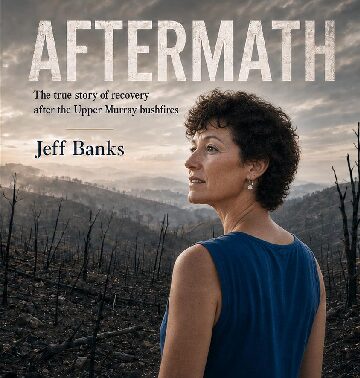
AFTERMATH Chapter 3 - The Inspection Tours

AFTERMATH Chapter 3 - The Inspection Tours | Travelling Around Australia with Jeff Banks

Those inspection tours were the beginning of recovery for me, although I did not understand that at the time. I thought recovery would begin when we opened the proper recovery centre, with services in place and people at desks and brochures in stands. In truth, recovery had already started out on those roads, walking beside people through ash, learning not to promise what we could not deliver, learning to sit quietly, learning that a blue vase or a melted tyre or a row of water jars could hold more meaning than any official report.
AFTERMATH

Chapter 3

Inspection Tours

The first time I drove out to inspect a burnt property, I still had ash in my head from the evacuation centre. Not literally, although there was ash everywhere by then, in the gutters, on cars, in the corners of rooms and probably in the seams of our clothes. But the ash in my head was different. It was the leftover confusion of those first days, when everything had been about opening doors, finding bedding, finding food, finding people, answering questions we did not yet know the answers to, and pretending there was some sort of plan hidden somewhere in a folder if only we could find the right folder.

Up until then, the work had still been tied to evacuation. That word carries a certain urgency. People are moving away from danger. They are sleeping in strange rooms, ringing relatives, wondering about pets, asking about roads, trying to find out whether the fire has taken their house or gone around it. There is fear in an evacuation centre, but there is also movement. People come in. People go out. Agencies arrive. Volunteers unload boxes. Someone asks about blankets. Someone else asks where the toilets are. It is chaotic, but it is the sort of chaos that keeps you standing up.

Recovery was different. Recovery started when the fire had passed through a place and left the question nobody wanted to answer: what now? Officially, there was a neat line between the evacuation centre and the recovery centre. Once the incident controller deemed the evacuation phase over, the evacuation centre could close and a recovery centre could open. That sounds simple when it is written down. In real life, of course, people were still coming in and out needing food, supplies, information, reassurance and a place where somebody could at least look them in the eye and say, “I don’t know yet, but we’ll try to find out.”

So we kept things going longer than the official line probably required, because people do not stop needing help just because a word changes on a whiteboard. Somewhere in that space between evacuation and recovery, while we were still running on fumes and stubbornness, I was given another job. Council had to start doing what were called secondary assessments of burnt homes. That meant going out to properties the fire services and police had identified as damaged or destroyed, and checking whether the site was safe enough for owners to return, or in many cases, safe enough for owners who were already there to keep standing in the ashes of their own lives.

I was not a building inspector. I was not an environmental health officer. I was not a tree specialist, a firefighter, a mental health worker, an electrician, a fencing contractor, a stock agent or a miracle worker, although in those first weeks people probably needed all of those things and more. I was a council worker with a community engagement background, a municipal recovery role, a pair of newly acquired steel-capped boots, a thick cotton work shirt that was not official council uniform, and a twelve-page form that managed to make the end of the world look like an administrative exercise.

The form asked sensible questions, in its own boring way. Was the house still standing? If it was standing, what sort of condition did it appear to be in? Were there open sewers? Were there live wires? Were there dangerous trees hanging over the driveway or above where people would need to walk? Was there water available? Were septic tanks visible? Were fences damaged? Were sheds gone? Was there anything so obviously dangerous that people should not be there at all? Later, that information would go into a statewide system so the government could begin to understand the size and cost of the disaster. At the time, it was just me standing in front of someone whose house had burnt to the ground, trying to ask whether I could check their septic.

If I had been organising the process, I would have mapped the roads and worked through them in some sort of logical order. First road, second road, third road, keep going until we had covered the district. But disasters have a way of attracting systems that look very sensible from a distance and slightly mad when you are the one holding the clipboard. The people in charge wanted us to go first where they believed the greatest damage had occurred, because they needed to know what was gone and what was still standing. Each day we were given a list of houses to find, which might have been funny if we had not been driving through country that still smelt like the inside of a burnt shed. We would manage six or eight places in a day, come back exhausted, then find some of the same places on the next day’s list.

The other complication was that we were going into areas that had not really been checked. The flames had gone through, but that did not mean the country was safe. Trees could still come down. Roads could be blocked. Bridges could be damaged. Stumps were still smouldering in odd places. The weather was well over forty degrees, the sort of heat that feels personal, and the ground itself seemed to be radiating something back at us. It was decided that we would go out with the army, which by then had been brought in to help with the recovery effort. Each of us was given an army vehicle, an army driver, another soldier, chainsaws, emergency supplies and the vague comfort of knowing that if something went wrong, at least we would be in a vehicle that looked as though it could drive over the problem.

Jen and I were the two council people doing these early assessments. Jen had more sense than I did about practical outdoor safety. Before we went anywhere, she said we needed proper boots, not ordinary work shoes, and she marched me down the street to get steel-capped ones. She also said we were not wearing council polo shirts out there, because a thin polo was not going to be much good if a chunk of burning charcoal dropped out of a tree onto us. We bought thick cotton work shirts instead and later got into trouble for not wearing uniform, which still makes me laugh a bit. If the choice was between being identifiable as council and being slightly less likely to get burnt, I was fairly comfortable with our decision.

The soldiers I travelled with were not local. I think they were from Western Australia, or somewhere that was certainly not the Upper Murray. They were keen, polite and very capable in their own way, but they had no idea where they were going. We had daggy maps that were not accurate, phones trying to find addresses in hills and valleys where reception came and went as it pleased, and a daily list of properties that had no real logic to it. The army boys had big four-wheel-drives and chainsaws. I had a clipboard and a sense that none of us really knew what we were about to see.

They were good with physical danger straight away. Driving along a dirt road, one of them would say, “I don’t like the look of that tree,” and go around it. Another would notice something still smoking near the edge of the track and steer wide. They understood hazards, machinery, logistics and how to keep moving in difficult conditions. What they were less prepared for was civilian grief. They had been told not to speak unless spoken to, not to get involved, to stand back and let us do the talking. In theory that probably sounded respectful. In practice, a traumatised farmer looking at a soldier standing stiffly in full uniform with his shirt buttoned to the neck in forty-degree heat did not necessarily feel reassured.

Halfway through the first day, I looked at the soldier in charge of my vehicle and said he was going to die if he did not loosen his shirt. He said he was not allowed to. I said, “Well, I’m not telling anyone. Are you?” He thought about that and decided I might have a point. Then I told him the uniform and the straight face were actually frightening some people. They were already traumatised. Seeing a soldier looking like he was about to deliver bad news from a war zone was not going to help. I suggested he undo a button, relax his face, sit down if there was somewhere to sit, and join in enough to look like a human being rather than a government-issued statue.

That was a strange part of those days, teaching soldiers how to soften themselves in front of people whose lives had just burnt around them. They were trained to compartmentalise, and I could almost see them put their faces on before they stepped out of the vehicle. It was a stoic, no-expression face, as though whatever happened in front of them would be filed away somewhere internal and dealt with later, if ever. After a couple of days with us, they started laughing a bit in the car, talking about what they had seen, asking questions, and admitting when something had got to them. Then, just before we drove back into town, they would collect themselves again, button the shirt back up and become soldiers.

The army’s presence meant different things to different people. For some, it was comforting because the army could do things nobody else could do. They had big machinery, logistics, temporary bridges, staging areas, tent cities, kitchens, bathrooms and the ability to move large burnt things that councils could not even begin to shift. For others, the sight of them made the scale of the disaster suddenly real. If the army was here, then this was not just a local fire. This was something bigger than any one town, any one council or any one farmer could manage. That frightened people at first, but the army did make an effort not to take over. They invited locals to look around their setup, talk to them and understand that they were there to support, not occupy.

Even so, the best thing the army brought was not always the thing they thought they were bringing. They brought distance. To them, a burnt house was a burnt house. That sounds harsh, but sometimes it was useful. A local person could not bulldoze a home without seeing the birthday parties, the verandah, the dog bowl, the washing line and the years of family history buried in the rubble. The army could do the job because they did not know the people. Locals brought the opposite. They brought knowledge of gullies, springs, tracks, rock formations, old creek crossings and the sort of common sense that never appears on a map. I saw locals stop army machinery and say, “Don’t cross there, there’s a spring under that crust,” or “Don’t go up that track, that rock will give way.” Most of the time, that knowledge was respected, and that mattered. It gave people a small piece of dignity in a situation where nearly everything else had been stripped away.

The first property I officially inspected stays with me as clearly as anything from those weeks. We got lost getting there, which was not a great start, but eventually found the driveway and followed it in through country that had been wiped clean. There was no fence. That was the first thing I noticed, although I probably did not understand the full meaning of it at the time. You do not usually drive up to a farming house with no fence along the driveway, no paddock lines, no boundary, no sense of containment. It felt as though the land itself had lost its grammar.

There were sheds and yards still standing, which seemed impossible given what had happened around them. There was enough rubble near the sheds to know a house had been there, but nothing that told you it had been a home. No garden. No fruit trees. No flower beds. No footpath. No ordinary domestic clues. You could see the remains of a chimney and bits of brick, but not the shape of family life. I remember thinking that they had not just lost the building they lived in. They had lost the evidence that this place had ever held them.

A man was wandering around near the shed when we pulled up. His parents, wife and children had been evacuated and were safe. He had stayed to fight the fire. The fire had taken his home and his parents’ home, but somehow left his shedding and yards. It had taken nearly all his stock. It had taken tree plantings he had put in as part of an environmental vision for the land. It had taken the old family house where he had grown up. Yet he kept saying he had not lost any people, and that was what mattered. He said it because it was true, but also, I think, because he needed something solid to stand on.

I introduced myself gently, trying to come across less like council and more like a country woman who had turned up to ask, “How are you going, mate?” He could not really focus his eyes. He was there, but not quite there. He wandered rather than walked, moving from one thing to another without actually doing anything, because there was nothing useful left to do. I explained why we had come, that I needed to look at the site and work out what support might be needed, what was dangerous, what had survived and what had not. He said there was nothing left. I said I understood what he meant, but there were still septic tanks, power lines, sheds, water, access and other things we needed to check so that someone did not get hurt later. He nodded and said he would show us.

He showed us his own house first, or what had been his house. Then we walked down the hill a bit and he pointed to another burnt patch I had not even recognised as a second home. He said, “This is Mum and Dad’s place. This is our family history gone.” I remember those words clearly. He had been raised there. His childhood was there. His parents had inherited it through family. The farm had carried generations, and now the house that held that history was just another low shape of ash and twisted things. I think, in that moment, he was more devastated by losing his parents’ home than by losing his own, even though his own was probably newer and more expensive to rebuild.

The silence around that place was not peaceful. It was waiting. It was like sitting in a theatre before the curtains open, when everyone goes quiet because something is about to happen, except here the thing had already happened and nobody knew what the next scene was meant to be. There were no birds. No stock sounds. No ordinary farm noise. When we spoke, our voices sounded too loud, as though conversation itself was intruding on something. It was hard to build any intimacy just standing there in that hollow silence with a clipboard. I learnt something at that first house that stayed with me through the rest of the inspections. Do not stand and talk if you can help it. Either sit properly and breathe with people, or walk beside them. Standing still in ash with forms between you makes everything feel official and empty.

There was another lesson in the shed. The man kept saying, “At least I’ve got my shed. My shed’s got all my equipment in it.” It was something to hold onto. We walked around to check that there was nothing burnt in the back of it, nothing dangerous that had been missed. From a distance the tractor looked fine, but when we got closer the tyres had melted into black puddles. The fire had not entered the shed, but the heat had been so fierce that it melted the tyres from outside. That was when I began learning to look for nails too. Nails can get so hot they soften or fail, and then things that appear to be standing may only be balanced by habit and luck. Fire does not always behave in a way that makes sense. A wooden stockyard might survive while tractor tyres melt. A house might disappear while a shed beside it stands. It starts to feel, very quickly, as though the fire had a mind and chose what to take.

The smell of those places stayed with me long after the work ended. I reckon it stayed for twelve months. It was not the smell of burnt gum leaves. That smell has its own sharpness, almost honest in a way. A burnt landscape smells different to a burnt house, and a burnt house smells different to a burnt machinery shed. Around a house site, the smell is complex and sour, full of things that were never meant to be burnt together. Around sheds, there was diesel, burnt rubber, oil, metal, plastic, insulation and all sorts of things that got into your clothes and under your fingernails. No matter how often I showered, washed my hair or changed clothes, I could still smell it. I used to think it was between my toes.

Most people we met on those early inspections were not openly emotional at first. They were stoic, which is a word that gets used a lot in country disasters and sometimes hides as much as it reveals. They knew things would be burnt. They knew it might be bad. Sometimes it was worse than they expected and sometimes, by some strange grace, not as bad. But there was often this clamped-jaw determination not to react in front of us. Farmers, particularly the men, would say, “It’ll be right,” or “The bloke down the road copped it worse than me,” or “We’ll see this through.” For the first six weeks, there were very few public tears. Not none, but very few. The tears came later, once the plug could not be held in place anymore.

One man’s house had survived, but only just. The fire had burnt right up to the front step and come from the other direction at the back, taking nearly everything around the house except a garden shed attached to the rear. He had this tiny safe space between two burns where we could sit out of the sun. His wife made us a cup of tea, and I do not know how many cups of tea I drank in those weeks. I do not even drink tea normally, but there are times when the drink itself is not the point. It is the ceremony of sitting down, the pause, the permission for everyone to breathe.

He was very matter-of-fact at first. What will be, will be. No use whingeing. No use getting emotional. We have to go forward from here. I told him we had boring forms to fill in and would need to have a wander around, but first we could just sit in the quiet for a minute. He stretched his legs out, folded his arms and said, “Yeah, yeah, we’ll be right.” Then he burst into tears. His wife looked shocked, as though she may never have seen that happen before. There was nothing to do but sit there and let him cry. Sometimes the most useful thing you can do is not rush in to fix a moment that cannot be fixed.

When he could speak, he talked about the fire trucks driving past while he was fighting to save his place. He had stayed after being told to evacuate, and because he had made that decision, the firefighters could not stop to help him. He did not understand that at the time. He only knew he was there with his house and his wife, and trucks were going past to the next place. He felt let down by a system he had trusted for a long time. I could understand why the system had rules. I could also understand why, from his verandah, with flames around him, those rules felt like betrayal.

That was one of the hard truths of the inspections. People’s stories did not always fit neatly with the official story. In places like Cudgewa, where the fire had come down one way and burnt one side of town, then turned and came back through the other side, every person seemed to have a different version of what happened. That did not mean they were wrong. It meant they had experienced different pieces of the same terror. One person saw the fire come from the hill. Another saw it come from the road. Another remembered a truck going past. Another remembered a neighbour shouting. Another remembered the wind changing. Our job was not to decide whose version was the truth. Our job, at least in those moments, was to listen.

People apologised for being upset, but not always in the way you might expect. Men would suddenly say they had to go and do something, then wander off to perform a small, useless task somewhere else. They might move a piece of tin, check a tap that no longer worked, look at a fence that was obviously gone, anything that gave them a reason to step away before their face betrayed them. Wives often apologised for husbands. “I’m sorry, he’s upset,” they would say, or, “I’m sorry, he can’t think through this right now.” I used to wonder how often those women had been holding everyone else together long before the fire came.

For farming people, the first practical concerns were often fencing and water. Housing mattered, of course it did, but in those first weeks most people seemed to find somewhere to stay. Stock could not wait. If boundary fences were down, surviving cattle and sheep were out, mixed with someone else’s, wandering, stressed, injured or impossible to contain. Water was just as urgent. How do you get water to animals when tanks have burnt, pipes have melted, pumps are gone and the landscape is black? Feed mattered too, but fences and water came first. Insurance came up a lot as well, not in a greedy way, but in a bewildered way. What am I covered for? How do I get the assessor here? What counts as damage when the thing that was damaged is now a pile of ash?

The Upper Murray is a place where people are used to doing things for themselves. That independence can be admirable and maddening in equal measure. Many had stayed to defend their properties because they had done it before or had grown up around fire. They had tanks, hoses, cleared gutters, defendable spaces and plans in their heads. Most of the farmers who lived directly off the land were well prepared by any ordinary measure, but this fire was not ordinary. No two fires behave the same, and this one was faster and more unpredictable than many expected. It is sheer bloody luck that more people were not killed.

One farmer talked about the plantings around his place. He had put in Australian native trees and shrubs for stock shelter, and his wife had talked him into planting two European trees in the garden. He did not seem especially fond of those two European trees before the fire, but afterwards he looked at them differently. The native shelter plantings had gone up like matches. The European trees were damaged but still there. He said he would never plant the same way near the house again. That was the sort of knowledge people were gathering in real time, not from theory or policy, but from looking at what burnt and what somehow did not.

Sometimes the smallest surviving thing caused the biggest reaction. There is a little village called Towong just outside Corryong, and it was hit hard. On one road, the fire seemed to have played some cruel game. It burnt two houses, left the next one, burnt another, left two more. Jen and I were together that day, working up the road and doing the assessments. One house at the top of a hill had not burnt, although the fire had come right up to the back verandah. It had beautiful views down the Murray River, the sort of view that would ordinarily make you stop and feel lucky to be alive. That day it was hard to know what to feel.

Around the back verandah there was a long row of water jars sitting along the edge. I asked the owner what they were. He said they were water jars. I asked why they were there, because sometimes my questions were not very sophisticated. He said he had not known what else to do, so he put jars of water along the verandah, hoping they might help save the house. The house was still there, so he half laughed and said maybe it worked. Then I noticed black dots in the window frame and asked whether he had used black nails. He came over, looked, and realised the heat had scorched and partly melted the nails in the frame. That undid him. He had worked so hard, done everything he could think of, and the house had survived, yet even the nails had not really survived.

A couple of houses down, another home was gone. The rubble was no more than about sixty centimetres high, flattened into the ground. In the middle of it sat a little blue and white flower vase, about four inches high, upright and untouched. The house around it had been destroyed. The garage roller door had melted so that glue hung down like syrup where the door had been. Yet this tiny vase sat there as if someone had placed it carefully on the ashes afterwards. The neighbour came down while we were looking around and burst into tears when she saw it. She said, “How can it be so bloody choosy?” There was no answer to that. The fire had taken whole houses and left ridiculous little objects sitting like evidence of a logic none of us could understand.

Another place that stays with me was the old Mitchell property near Towong. It had been a beautiful historic mansion on a ridge overlooking a valley, known because of the family connected to it and because of the history it held. There was the big two-storey house, the pool, the pool house, and other buildings nearby. The fire wiped out the main house. It took the whole bloody thing, including contents that held national and family history, and left the pool and pool house close by. In the middle of the burnt garden, after beautiful old trees and landscaping had been crisped, there was a gladioli flower standing there, not even in season, somehow not burnt. We brushed past it and just stared. It was one of the weirdest things I saw.

Humour turned up too, because it always does in country places, often at the wrong time and usually when people need it most. Black humour is not disrespect in those situations. It is a pressure valve. At one place down a beautiful valley, we were talking with an older farmer who had saved his house but lost his stock. He had spent generations building those bloodlines, and they were gone in a day. His grandson, about nine or ten, came running up and told his grandfather to come and look at the creek. We walked down and found the creek running black with sludge, with huge Murray cod floating dead on the surface. The old fellow looked at them and said, “Where the bloody hell were they when I was trying to catch them?” It was funny and awful at the same time, which is how a lot of those days were.

Another day in the Pheasant Creek area, or one of those little pockets where every track seems to have its own rules, we pulled up at a run-down old farmhouse that had somehow survived. One spark looked as though it should have taken the whole place, but there it still was. A limping old kelpie growled at us from near the gatepost, and an elderly man sat on the back verandah with a smoke, his feet up and a cuppa beside him. He yelled out, “Mavis, come out!” We went through our whole explanation with him, talking about what we needed to check and why. He answered everything, nodded along, gave every impression that he knew the property inside and out. Then, after the entire spiel, he yelled again, “Mavis, you better come out and listen to this.” It turned out Mavis was the farmer, not him. He had been pretending the whole time that he knew what he was talking about.

There were also people who did not want us there at all. Some refused help outright. One man would not let anyone perceived as government through the front gate, even though he needed support. Jen and I both had a crack at it and got nowhere. In the end, we had to work through a neighbour to get him what he needed. Another man was very chatty at the front of his place, almost too chatty. The fire had burnt into the back of his yard but not taken the house, and he kept telling us there was no need to check. I finally said, “Mate, is there something you don’t want us to look at?” He admitted the back of his greenhouse had burnt and melted, but he did not want anything done about it. I looked at the greenhouse, looked back at him and said we would check the septic around the back and not worry about what we did not need to worry about. We were not the police. We were there to make sure people were safe. There were a couple of places where it was fairly obvious people had been growing expensive things in greenhouses, and honestly, in that moment, melted marijuana was not high on my list of recovery concerns.

The properties themselves kept producing hazards nobody had warned us about. One day Jen and I were together with a few extra helpers, including a building inspector. The owner was not there, so we were checking the house and sheds when we heard this ping, ping, ping. It took us a minute to work out what it might be, and then someone said, “I think that’s bullets.” We all got back to the cars and waited. After it went quiet, the brave building inspector went to look and found a packet of .22 bullets in the shed that had been heated by the fire and had decided, some time later, to fire themselves off. We laugh about it now. It was not funny at the time.

There were heartbreaking requests too, often small ones. Near Walwa, we went up a narrow, snaking track to an old run-down house where an older woman lived alone. The house had not burnt, but the country around her had. We thought she might need water, so we had taken supplies. She told us her story, how she had brought up children there and lived there most of her life. Then she said she knew other people had been getting those big cubes of water and asked whether she could have one. Technically, she probably did not qualify in the way the system would have liked, but the system was not standing in front of her.

We asked about her tank and how water ran inside the house. She said she did not have running water inside. I asked how she showered. She said they filled the bath with buckets from outside. I asked about the toilet. She said they went down the back under a tree. She had raised four children in that house without running water, and all she wanted from us was a water cube she might later use as a tank to modernise the place. She also told us the house had been saved because she looked after the tree fairies and had been talking to them. I understood why some people might have kept their distance from her, but it broke my heart that she had lived like that for so long and nobody had helped her get something as basic as water inside the house.

Not all the damage was visible from the road, and not all of it was about buildings. Animals were everywhere in the story, even when we did not see them. If we saw injured stock or were told about them, we passed that on to the agriculture people. If pets needed help, there were volunteer vets we could contact. A family of vets turned up at one stage, I think a husband, wife and daughter, and simply made themselves available. “Send us where you need us,” they said, which was such a relief. Wildlife was harder. We did not see as much injured wildlife as people might imagine, because often animals either got out or died. There was not much in between.

The stock losses were devastating in ways people outside farming do not always understand. It was not only the financial value, although that was enormous. It was bloodlines built over generations, breeding decisions, years of work, the pride of a herd or flock shaped by a family’s eye and judgement. Then there was the cruelty of what happened after. Farmers who had put injured animals down often piled the dead stock and buried them because they could not bear to look out the kitchen window at them. Then environmental rules meant some were told to dig them up again so they could be buried under proper supervision. I understand what the EPA was trying to do. There are reasons for rules around contamination and disposal. But there are times when a system can be technically right and still be almost unbearably cruel. Asking a farmer to look at dead cattle or sheep day after day because the proper process has not yet caught up is horrific.

One of the stories I still find hardest was not at the property itself but came through someone I knew. A woman who worked for council as a maternal and child health nurse had a property that was severely damaged. She and her husband had not owned it long, and he was ex-army, very ordered, the sort of man who needed things just so. They were devastated. She told me about a neighbour up the hill who rang because her husband had gone out with a gun to put down sheep and had not come back. She was frightened. The nurse went up and found him sitting there after shooting his animals, thinking there was no point going on. She had to talk him out of shooting himself. That is the part of recovery that does not fit on the forms. You can count burnt houses, damaged fences and lost stock. It is much harder to count the moment a man sits with a gun and cannot see past the dead sheep in front of him.

There was another man near Walwa who had evacuated from a small inherited family farm. The old house was rough, but he had plans to restore it to its historic beauty. For years he had collected the materials he needed, little by little, and stored them in the big shed behind the house. When the house was lost, he could still say, “It’s okay, I can rebuild. I’ve got everything I need in the shed.” We talked to him over the back fence for quite a while before I realised he had no shoes on. He had lost them somewhere. He was staying in a tent on the block. I organised to come back with shoes, clothes and whatever else he needed. Two days later, as I was about to head back, I heard that something had been smouldering unnoticed after the fire had gone through. The shed had caught alight and he had lost the lot. To be burnt twice like that felt so cruel it was almost hard to take in.

The inspections changed the way I understood farming, even though I had grown up around it. Farming had become more technical than the version many people carry in their heads. These people were not just putting stock in paddocks and hoping for rain. They were making long-term decisions about bloodlines, shelter belts, erosion, forestry plantings, pasture, water and soil. Some had planted things fifty years earlier, knowing the benefit would come later. They thought about water not as something that simply fell from the sky, but as a resource with value. When donated water arrived, they had to decide how much went to the household and how much went to keeping stock alive. That is a level of calculation most people never see.

What also became clearer was the character of the district. If I had to sum it up in one sentence, it would be the thing we heard over and over again: “I’m right, mate. Check on John down the road. I think he copped it worse than me.” People would be standing in front of their own burnt house, their own dead paddocks, their own melted machinery, and still ask about the neighbour. Sometimes it was genuine concern. Sometimes it was also a way of not looking too closely at their own hurt. Either way, it said something about them. These were isolated communities where people might not always agree, might not always like each other, and might have feuds older than some council policies, but when disaster came through, they measured themselves partly by whether someone else needed more.

That does not mean everyone experienced the fire the same way. They did not. A farmer who lost fences but not a house had a different recovery to a family who lost everything. A person who stayed and fought had a different grief to someone who evacuated and came home to ash. A town street where some houses burnt and others survived carried a different burden again, because survival can bring guilt as well as relief. Recovery was not one story. It was hundreds of stories overlapping, contradicting, repeating and sometimes sitting silently beside each other because there were no words that could make sense of it.

For us, the work was up and down like a yo-yo. Some days I felt positive because we were helping, even in small ways. We could organise water, pass on concerns, connect someone with support, identify hazards, make sure people were not entirely alone. Other days I was angry because the system did not work as well as people needed it to. Some of that was nobody’s fault. Disasters are messy. Some of it was very much the fault of systems that had been designed in neat rooms by people who had probably never stood in a burnt paddock trying to explain a twelve-page form to a man with no shoes.

The stories weighed on us. The soldiers saw that too. One day, after we had visited a man who had lost almost everything and had really only saved his dog, we got back in the vehicle and the soldier in charge was visibly cut up, at least as much as a soldier allowed himself to show. He said something like, “I don’t know how you keep doing this. I couldn’t do this all the time. I don’t know how you get the words out.” I did not really know either. You get the words out because someone has to. Then later, sometimes much later, the words come back and sit with you.

At the end of those days, leaving a property was not the hardest part. Arriving was harder. Leaving was almost a gift, and I have always felt a bit guilty about that. I could get back in the vehicle. I could go back to town, or mostly back to the motel, shower, change clothes and pretend for a few hours that I had stepped out of it. The people on those properties did not get to leave their loss behind. It was there when they woke up, outside the kitchen window, beside the driveway, in the paddocks, under their boots and in the smell of their clothes.

What I carried home was the smell, always the smell, and the sense that life is not bloody fair. You can talk about fire behaviour, climate, preparedness, agency decisions, fuel loads, warnings, personal responsibility and all the rest of it. Some of those conversations matter. But when you are standing with a farmer whose stock are dead, whose fences are gone, whose family house is ash and who is still asking you to check on the bloke down the road, the big explanations do not help much. Farmers live at the whim of weather, disease, markets, politics and now fires that can move in ways even experienced people struggle to understand. They do not expect life to be easy, and they will whinge about it like everyone else, but mostly they keep going because what else is there to do?

Those inspection tours were the beginning of recovery for me, although I did not understand that at the time. I thought recovery would begin when we opened the proper recovery centre, with services in place and people at desks and brochures in stands. In truth, recovery had already started out on those roads, walking beside people through ash, learning not to promise what we could not deliver, learning to sit quietly, learning that a blue vase or a melted tyre or a row of water jars could hold more meaning than any official report.

I also learnt that recovery was not about putting things back the way they were. Some things could never be put back. A family home might be rebuilt, but the original house was gone. A farmer might buy new stock, but the bloodlines were gone. A garden might grow again, but the tree planted by someone’s grandfather was gone. The old normal had burnt with everything else. What people were beginning to do, even in those first shocked days, was search for a way to live with the new shape of things.

That is a terrible intimacy, walking through someone else’s loss. You see what the fire has exposed and what it has erased. You see the practical and the sacred lying together in the same ash. A septic tank, a melted nail, a dead cod, a child’s vase, a water cube, a dog, a pair of missing shoes, a farmer’s tears after sixty years of holding them in. You go there to assess whether a place is safe, and you come away understanding that safety is a much larger thing than the form allows. It is not only whether the trees might fall or the wires are live. It is whether people can stand there long enough to take the next step, even if the next step is only to ask after the neighbour down the road.

Author

Menu