

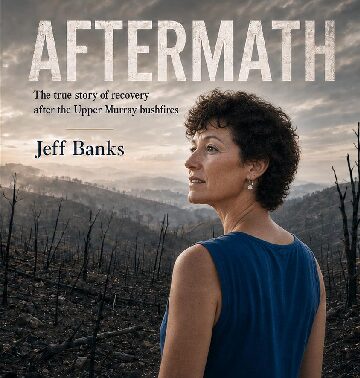
AFTERMATH Chapter 2 - Opening the Doors

AFTERMATH Chapter 2 - Opening the Doors | Travelling Around Australia with Jeff Banks

Opening the doors did not fix anything. It simply made a place where the fixing, grieving, arguing, feeding, worrying and starting again could begin. At the time, that felt like nowhere near enough. Looking back, I think it was the only honest place to start.
AFTERMATH

Chapter 2

Opening the Doors

By the time I walked into the evacuation centre at Corryong, it already felt as though the doors had been open for years. In truth, they had only been open a few days, but disaster does that to time. It stretches some hours until they feel endless, then collapses whole days into a blur of smoke, faces, radios, mattresses, cups, names and questions nobody can answer.

I had not simply driven to Corryong. You could not simply drive anywhere by then. The roads were still closed, the fire was still active, and the only way through was in a controlled convoy. There was a lot of wrangling involved in being allowed into it, because they were trying to keep the convoy as short and safe as possible. I was going up to relieve the woman who had been trapped there for the first four or five days, and I went with my little bag of clothes, hoping I might only be stuck there three or four days myself. Hope, I was learning, was not much of a plan, but sometimes it was all you had room for.

We gathered at the Tallangatta showgrounds, a strange collection of people and vehicles waiting to be told whether we were allowed to go. There were Department of Agriculture people, fire people, forest management people, supplies for the supermarket and pharmacy, and a few of us who fell into that uncomfortable category of bureaucrats, though none of us felt especially bureaucratic by then. Someone was deciding who could go and who could not, and then, with great care, they decided the order of the vehicles.

The thing at the front of the convoy was a fuel truck. That stayed with me. We were heading into active fire country, and to my mind a great big fuel truck at the front of the line did not seem like the most calming choice. Apparently, it had excellent safety equipment around it, and there were water trucks placed in the convoy too, but that did not stop me sitting there thinking, well, this is an interesting way to die.

The road from Tallangatta to Corryong is windy and hilly at the best of times, and with a fuel tanker in front it became a very slow trip. Maybe that was just as well. Nothing about that drive was something you wanted to meet quickly. The smoke thickened as we went, until it was not only something you could see but something you could taste. It sat in your mouth, in your nose, on your skin and in your thoughts.

About halfway up, near what I knew as the Shelley Forestry Camp, we were told to pull off and wait. The fire had come back to the road ahead of us, and we could not get through. We parked in a rough circle, like wagons drawn up against a threat, except this threat was not imaginary and it was not polite enough to stay in one place. We had bottles of water, bags of clothes and a convoy of essential people, but none of that made us feel especially in control.

We waited there for about an hour and a half. Nobody knew whether we would be turned around, let through, or left there until some other decision was made by someone further up the road. During that wait, people who had already seen the worst of it started telling stories. Firefighters talked about checking houses to see whether people were alive or dead inside them. Others spoke about farms, roads, sheds and places I knew by name but could no longer picture properly through the smoke.

I was already anxious about going up, because I knew the work would be hard and emotional when I got there. Hearing those stories before I even arrived added another weight to it. I had thought I was going to relieve someone, open a few doors, organise some bedding, keep track of supplies and do whatever else needed doing. That still sounds like a lot, but it was nothing like the truth.

Eventually, we were allowed to continue. The order of the convoy was shuffled a little, but the fuel truck stayed at the front, which I still found fairly horrifying. We crawled on through the smoke, and before long the country began to change. At first, the fire damage seemed almost gentle, if there is such a thing. A bit of burnt grass. A fence gone. A wooden post burnt away with wire hanging where it had been.

Then, a few kilometres further along, the wire itself was gone. The trees were no longer singed or burnt partway up their trunks. They were black statues, standing without leaves, without shade and without any of the familiarity trees are supposed to have. Smoke clung to everything. It did not float above the country so much as stick to it, wrapped around fences and gullies and paddocks, making the whole place feel as though it had not yet decided whether the fire was finished with it.

There were places where the ground still smoked like something from another country altogether. It was not mist, though it looked a little like that from a distance. It was fire still hiding under the ground, in roots, logs and pockets of earth. That was the eerie part. You could not always see flame, but you knew it was still there, waiting.

As we got closer to Corryong, the damage became harder to understand. Sheds had not just burnt. They had melted. A metal cattle grid had slumped into its own hole. Galvanised water tanks had turned into puddles. There were homes where the fire had burnt right up to the front steps and stopped, as though it had changed its mind at the last second. There were other places where the house was gone and some useless bit of metal was left standing nearby, which somehow made it worse.

We passed the first house that had burnt, and the man beside me recognised it before I did. He said something like, “Wasn’t that so-and-so’s place?” and suddenly it was not damage anymore. It was someone’s home. It was a kitchen table, a hallway, a back step, a washing basket and a view someone had looked out at every morning. We had not lost lives there, as far as we knew, but homes had been lost, and knowing the difference did not make the second loss small.

We passed the cemetery, and at first glance it looked as though even that had gone. The fencing and driveway were burnt, the trees around it were gone or blackened, and some of the headstones were marked by soot. As we crept past, we could see most of the graves themselves seemed intact, but even that felt unsettling. A cemetery is meant to be where people rest after everything else is over. Here it looked as though even the dead had been touched by the aftermath.

When we reached Corryong itself, I realised the phrase “the fire reached the edge of town” had not prepared me. The fire had burnt around the metal sculptures at the entrance, taken a house on the edge, gone around the service station and taken another house after that. It had not politely stopped at the town boundary. It had come in far enough to make its point.

The main street was almost empty. There was hardly a person to be seen and hardly a sound to be heard. It did not feel like a town going about its business after a fright. It felt like a town holding its breath. The life of the place had drawn itself into one point, and that point was the evacuation centre.

The evacuation centre was the school gym. When we pulled around the back, I saw that the fire had burnt right up near the back fence. It was close enough to make you look twice, close enough to make you wonder what it must have felt like inside when the flames were visible and the power was out and nobody knew where the fire was going next. For a moment, when we got out of the cars, nobody came out to greet us. We stood there looking at the building, looking at the burnt ground, listening to the heavy quiet.

Then the doors opened, not in any grand or ceremonial way, but in the ordinary way doors open when someone finally hears people outside. Someone came out from the centre, and the spell broke a little. People began talking, sorting themselves out, finding where they needed to be and what they were supposed to do. I walked inside already carrying the drive in my body, and what I found there was not chaos exactly. Chaos has a certain energy to it. This was more disjointed than chaotic, as though too much had happened too quickly for anyone to put it into proper order.

There were people in small groups, talking quietly, waiting, asking questions, standing up, sitting down, going out and coming back. There were mattresses piled in columns, crates of things that had come from somewhere, food that might have been donated or supplied or simply found, and bedding in every possible state of usefulness. There were people who had nowhere else to be and people who would not stay no matter how much we worried about them. There were volunteers who were evacuees themselves, and there were official people trying to do official things in a place that had very little patience left for official manners.

The woman I had come to relieve was there, and she was bright and bubbly in that way people sometimes are when they are far beyond tired. It was not cheerfulness, not really. It was shock and stress wearing a cheerful hat because there was no other hat left. She tried to tell me what had happened and what systems were in place, but her words came in bits and pieces. She had not slept properly for four or five days, and at one point she had been in that centre with about 360 people, no power, no communication, no clear idea where the fire was, and flames close enough to make them wonder if they were going to live.

I still cannot quite imagine that night. They had huddled inside that gym with no way of knowing what was happening outside, and somehow she had found a way to feed them. The supermarket had no power, so the food was going to go off anyway, and the owner donated what he could. She broke into, or found a way into, the school kitchen area and cooked spaghetti bolognese for hundreds of people with whatever help she could gather. Disaster reports might later call that “meals provided,” but that does not come close to what it was.

She had been called to set up the centre while she was out with her family somewhere, and she had gone straight from there. She had not gone home first. She arrived wearing bathers with a dress over the top, found the shire offices, looked for the emergency evacuation centre box and could not find it. Eventually, with another council worker, she broke into a storage room and found the box on a high shelf. She was a short woman, and when she pulled it down, it landed on her head. Then, after all that, the first instruction was to put the kettle on.

I had seen that same instruction before, and I had been about as impressed as she was. There you are, with fire coming, roads closing, communication down and people frightened, and the first thing on the list is to put the kettle on. At first it sounded ridiculous, as though the box had been packed by someone who had never felt an actual emergency breathing down their neck. Later, I came to understand it differently. The kettle was not the answer, but it was a beginning.

Opening the doors was the real beginning, though. Once the doors were open, the centre was no longer just a building. It became the place people came when they had nowhere else to put their fear. It became the place where practical things and human things got tangled together, because in disaster they are never separate for long. Water, bedding, food, medication, names, news, toilets, showers, car parking, cups of tea, missing neighbours and exhausted volunteers all became part of the same work.

I do not know whether anyone ever really has to tell practical women to put the kettle on. It is just what you do. Someone is cold, frightened, displaced, grieving or in shock, and before you can fix anything else, you give them something warm to hold. You make tea whether they drink tea or not. You put a cup in their hand because hands need something to do when the mind has stopped working properly.

That is not sentimental. It is practical. A cup of tea does not rebuild a fence, replace stock, bring back a house, clean ash out of a tank or tell you whether your neighbour is safe. It does, however, say someone has seen you. It says you are not just another name on a list or another household in an affected area. It gives you a minute in which you are treated like a person, not a problem to be processed.

One of the first things I had to do was work out what was already happening. My colleague had done an extraordinary job under impossible conditions. She had set up a communication area in the little kitchenette and written down routines and bits of information, which was a gift. The school itself turned out to be a good place for an evacuation centre once we had access to it properly. Someone from the school came with keys and more or less said, use what you need and we will worry about it later.

That kind of generosity mattered. It meant we could use the commercial kitchen because the school taught cooking. It meant we had office spaces where workers could step away and rest for a while. I had brought some bedding for our own team, not because I expected comfort, but because I knew we would need somewhere to lie down if we were going to keep functioning. Even then, you had to make yourself leave the main space, because every time you stepped away you felt as though something might happen without you.

There were official people who had jobs to do, and there were unofficial people who had simply become necessary. The official structure mattered, but it was not enough on its own. In those first days, leadership often meant looking around, finding the person who seemed capable of doing a thing and giving them that thing before either of you had time to overthink it. It was not neat. It was not a plan written on a whiteboard after consultation. It was, “You look like you can manage food, can you manage food?” and, “You are worried about the car park, go and fix the car park.”

One young council worker, still finishing his training as an engineer, became one of those people you thank God for, even if you are too tired to say it properly. He noticed the car park was a mess, with trucks blocking cars, cars blocking access and no real pattern to any of it. I had enough in front of me, so I told him to go outside, work out a solution and come back to tell me what it was. Off he went, found a tin of yellow paint somewhere, marked out car parks, marked disabled parking and brought a bit of order to a place where order was hard to find.

There was also a small church woman who had been giving pastoral care almost nonstop. She was tiny, in her seventies, and an absolute force of nature. She came in and started ordering people around because that was her way of helping and because she had been running on care, faith and exhaustion for days. I tried the gentle approach first. I told her I appreciated what she was doing and that she needed to rest. She had no intention of resting.

I suggested she at least sit with a group and have a cup of tea. She had too much to do. In the end I had to tell her she was not in charge, and that she either needed to listen to me or leave. She huffed off, offended, and I could not blame her entirely. A couple of hours later she came back and more or less said her intention was to do the right thing, and if she was not doing that, she accepted it. From then on we got on very well, and she became one of the people who helped hold the place together.

That was one of the early lessons. People who want to help can still get in the way. People who are exhausted can look like leaders, and leaders can look like nuisances, and sometimes the only difference is whether someone has slept. I had to learn when to push someone to stop and when to let them keep going because stopping would break them. There was no perfect judgement in that. There was just watching closely and hoping you noticed before someone fell apart.

Water was the first great need. Safe drinking water. I reckon we could have filled Sydney Harbour with the amount of bottled water that went through that centre, and I know that is a ridiculous thing to say, but it felt true at the time. The smoke and ash had damaged creeks and rivers, and the little water left in tanks after the drought was often no good. Ash sitting on corrugated iron and washing into a tank could make the water unsafe, and many household systems were useless without power.

Food was next, though food in that first week did not have the tidy rules it would have had in normal times. In Tallangatta, where the hall was near the council offices, it made sense that sooner or later the health people would come across and talk about food safety. In Corryong, food equalled survival. You used what was there, with as much common sense as you could manage, because the alternative was not feeding people.

The supermarket was extraordinary. If we needed something, they wrote it down and gave it to us, and we worried about payment or paperwork later. The pub was excellent too. The pizza shop had a generator and could make a hundred pizzas when needed, which in those circumstances felt like a miracle with cheese on top. Businesses that could barely trade themselves became part of the feeding system because that is what country towns do, especially when there is no time to form a committee first.

The other desperate need was information. People wanted to know where others were. Had anyone seen Fred? Had anyone checked that farm? Had anyone heard from the family in the next valley? On days when the smoke was not too bad and we could get some connection with Tallangatta, we faxed our sign-in sheets down and they faxed theirs up, and we tried to match names and places as best we could. It sounds almost old-fashioned now, but in that moment a faxed sheet of names was a lifeline.

The background noise of the centre was not just people talking. It was radios asking whether someone had been checked on, whether a road was passable, whether a truck could get through, whether a farm had water, whether a person had been seen. That constant questioning kept reminding us this was real. It was not an exercise. It was not a scenario. Somewhere out there, beyond the gym walls, people had stayed to defend their homes, stock, sheds, valleys and everything familiar to them, and we did not always know who was safe.

Some people came through the doors with burns, cuts and scrapes and did not ask for medical help. “She’ll be right,” they would say, because they had bigger things to worry about. Medication became a concern because people do not keep spare supplies of everything they need sitting in the pantry, and the pharmacist had evacuated. Later, the pharmacy opened as needed without question, with staff unlocking doors and helping where they could, but in those first stretches every little need had to be solved almost from scratch.

People also needed to feel useful. That was one of the clearest things I learned. They needed something to do with their hands because their minds were full of too much. I made up jobs for people when I had to. I had one woman whose job was to make cups of tea, whether people wanted them or not. They were getting tea because she needed to be busy, and keeping her busy kept her from tipping over into whatever she could not afford to feel yet.

We moved drums from one place to another when they did not strictly need to be moved. We sent people down to the supermarket for a tin of beans or something equally minor. We had people clean things that were not especially dirty and shuffle things that did not especially need shuffling. That might sound foolish in ordinary life, but ordinary life had burnt around the edges. Purpose was medicine, and sometimes the job itself mattered less than the fact that someone had been trusted with it.

A lot of the volunteers were displaced themselves. They were not separate from the affected people. They were the affected people. Many were older women, because the men were still out fighting, mopping up, checking stock, trying to save what could be saved or just refusing to leave the places they knew. These women came into the centre with their own fear and grief, put on a hi-vis vest, picked up a clipboard or a kettle or a box of food, and became part of the emotional infrastructure of the place.

That phrase probably sounds grander than the work looked. The work looked like cups of tea, sandwiches, checking if someone had eaten, asking if someone had slept, writing names down, noticing when someone had gone too quiet, and sitting beside a farmer who had come in after days on a fire truck and could not yet speak. It looked like women who knew how to run food banks, kitchens, families, committees and small crises, suddenly applying all those skills to a large crisis without making a song and dance about it.

The donations began with time. That is what I remember most clearly. Food and goods came too, of course, but first there were people willing to do whatever was needed. When a large amount of food came up in the convoy and we had no forklift to move it, our young council worker walked down the street to see who in town might have one. He found a garage with a forklift and asked the man there if he could help move pallets of food. The man said he would. When we offered to write down the fuel so he could be reimbursed, he said no. Forklift, time and fuel were his bit.

That sort of thing happened again and again. The church packets with toothbrushes, toothpaste, soap, deodorant and menstrual products were incredibly thoughtful, because it is one thing to tell people they can have a shower in the school gym and another thing entirely to realise there is no soap, no clean towel and no small private dignity left. Those little packs mattered because they recognised that people were still people with bodies, embarrassment and routines, not just evacuees.

Other donations were harder. Not at first, because in the first days we needed almost everything. Later, as convoys became more regular and people were able to move around a little more, generosity became another thing to manage. People brought blankets that did not smell especially clean, mattresses we did not need, clothes in garbage bags, camping equipment, kids’ toys when there were not many kids there, and tomatoes. So many tomatoes. It was summer in Corryong, and apparently every second person had tomatoes to spare.

It is difficult to tell someone their kindness has become a problem. Most people arrived with good hearts and no understanding of what storage, sorting, hygiene, timing and usefulness meant inside an evacuation centre. Sometimes we showed them rather than told them. We would take them to the storage area and say, “Oh gee, I wonder where this will fit,” and then ask whether they might be able to hang onto it at home until we had room. Sometimes we accepted things and dealt with them later, because a person standing in front of you with a bag of bedding is not always the right person to receive a lecture on logistics.

There were some moments that would have been funny if they were not so close to being dangerous. A couple of days in, the young council worker and I were outside talking about car parking when he asked what some drums were beside the back wall. We went over and realised they were drums of aviation fuel. They were sitting against the evacuation centre while a bushfire had been burning up to the back fence. Once we realised what they were, his trusty forklift came in handy again and they were moved, but I still think about how easily that could have gone wrong.

The centre became a place where official and unofficial systems overlapped. Fire trucks would come in to load up with fresh water and food to take out to people who had stayed on their properties. The little church woman organised food going out with them and, clever woman that she was, began sending notes asking people to tell us who they were, how many were there, what they needed and who else was safe nearby. Those bits of information helped us understand what was happening in the valleys beyond our reach.

Those valleys mattered. Recovery was not one thing spread evenly across “the community.” It was different in every valley, every farm, every family and every little settlement. People knew what had happened in their own patch, but they did not know what had happened over the next ridge. Some had saved their homes but lost sheds, stockyards and fences. Some had lost homes but saved lives. Some had water for the moment but no way to keep it safe. Some had neighbours they trusted and others were already hearing the first cracks in relationships under pressure.

There were tensions around firefighting too, and they came into the centre with the firefighters and farmers. The local CFA volunteers, mostly farmers and community members, had often been going for 24, 36 or 48 hours with little food, little water and not much rest. They would come in grey-faced and hollowed out, tired to every cell in their body. At the same time, they had watched paid crews working shifts, getting breaks, meals, showers and the kind of support that volunteers did not always receive. That created anger, and I could understand it.

The volunteers looked old, even when they were not. That was one of the ways tiredness showed. Shoulders rounded. Feet dragged. Faces went grey. Decisions stopped making sense. People became grumpy or illogical, or they went quiet in a way that made you watch them more closely. Out in the community, tiredness could look like aggression or depression, depending on the person and the hour. In the centre, it could look like someone insisting they were fine while holding a cup they had forgotten to drink from.

We had to manage the helpers as much as the affected residents at times, because the helpers were affected too. Trauma snowballs slowly. You do not notice it building while you are still able to do the next task. You hear one story, then another, then another. You comfort someone, solve a problem, dodge a complaint, find water, move food, make a cup of tea, check on a volunteer, and then start again. You keep stepping up because stepping up is what the next moment requires.

Council had a good system of making us rotate out, even when we said we could stay longer. They would not let us just keep going. We had to go home, and not back to work either. Home. At the time, being made to leave could feel frustrating, because the work was unfinished and there were people you cared about still in front of you. Looking back, it probably saved us from doing more harm to ourselves and possibly to others.

I had to learn that lesson the hard way. At one point, before my rostered time was up, my back started to spasm because I was overtired. I had to ring Tallangatta and say I needed to come home. That was difficult, because part of you feels you have failed if your body makes the decision before your sense of duty is ready to agree. I got an earful for letting myself get too tired, which was probably fair. Leadership is not only telling other people to rest. Sometimes it is admitting you should have stopped sooner.

Leadership in that centre did not look like sitting down to write a plan. Nobody had that luxury. It looked like being brave enough to make a decision when none of the options were especially good. It looked like throwing out tomatoes because there was nowhere to store them and they were going to go off. It looked like telling a church volunteer she had to step back, telling a government worker she could not take a tea break while twenty people waited for emergency money, and telling someone from Tallangatta that what they wanted would not work on the ground.

That argument with the government worker has stayed with me because it said so much about the difference between the office and the aftermath. She and her colleague were tired, and in normal circumstances they would have been entitled to their break. But there were people queued out the door waiting to access immediate assistance, and those people had been burnt out, frightened, cut off and pushed past anything normal. I told her she was not leaving them standing there while she followed office rules. I would make her an instant coffee if she needed one, but she was not walking away from that queue.

We made friends afterwards, as often happened. Most people came with good intent. They simply had not thought through what it would mean to bring their normal workplace habits into a place where normal had been burnt away. The people coming in did not need to be told to wait because someone was having a tea break. They needed someone to look them in the eye, sit them down, and help them take the next small step. Sometimes that step was filling in a form for money. Sometimes it was finding medication. Sometimes it was just asking, “What do you need right now, this minute?”

There were moments of unexpected warmth too. A Sikh group from Melbourne arrived with a food van and began cooking meals outside the centre for lunch and dinner. The smells coming through the evacuation centre were wonderful, but the first day people were cautious and hardly anyone touched the food. I felt embarrassed for them, so the next day a couple of us made a point of going out and eating not just one course but several, to show people it was safe and good. Once people realised that, they came from everywhere.

That food van never questioned whether the same person came back twice, or three times, or seven times. They just cooked and served. Rotary and Lions groups came too, from all over the place, doing barbecues for lunch and dinner until we reached a point where meals were no longer one of our biggest worries. That was a strange kind of relief. We were still dealing with food donations, storage and supplies, but meals themselves were being carried by people whose names I often did not know and whose kindness I will not forget.

There were people who came through the centre and stayed with me in other ways. One man from Cudgewa, whom I will call Mitch, had done the tree-change thing and bought a rundown place he intended to renovate. He had the materials on site, and the fire took the house, the materials and almost everything else, leaving little more than trees and the burnt remains of an old bus. He could have been flattened by that. Instead, once he could get to a phone, he started making calls.

Mitch came from a high-pressure marketing background and seemed to see every problem as something to be pushed through or around. Generators started arriving. Farming equipment turned up. He had contacts in music and somehow bands began playing at the pub in Cudgewa. Food was donated, meals were cooked, and the pub, which had not usually opened every night, became a place where locals could get fed. It was extraordinary, though not everyone saw it that way. In small rural places, being new can last a long time, and people did not always thank him for acting before asking permission.

That was another lesson in recovery. Help is not always received in the spirit in which it is offered. Communities are not simple, and disaster does not make them simple. It can bring out generosity, courage and humour, but it can also bring out suspicion, old grudges, fear and resentment. People who had been seen as strong sometimes panicked. People no one had paid much attention to became pillars. Some were praised, some were criticised, and some carried on anyway because something needed doing.

One of the Cudgewa women set up an unofficial relief point in the hall there after the fire had torn through that little place from one side and then the other. She was a character, and I mean that in the best sense. At one stage she went down to a staging area wearing a hi-vis vest she had given herself so people could find her at the hall, told someone she needed a car to go and collect a person from Albury, and they simply gave her one. They must have assumed she was part of the official operation. Off she went, picked up her friend, and brought her back to help.

You could not make that up, and if you did, people would say it was too unlikely. Yet that was how so much of the early aftermath worked. People stepped into gaps and sometimes stepped over lines because the gaps were more urgent than the lines. There were risks in that, of course, and not all initiative was sensible, but without that kind of local nerve we would have been sunk.

As the days went on, I began to understand the difference between charity and recovery. Charity is what you do today to make someone feel better for the next five minutes. It has its place, and in those first days it was essential. Give them water. Feed them. Find them a towel. Let them sit somewhere safe. Put the kettle on.

Recovery is deeper and harder. Recovery is the conversation where you say, “I can give you more bottled water today, but if we use the tanker to wash your roof, the next rain might actually give you safe water again.” Recovery is saying no to fifty bales of hay until someone has checked whether the shed is safe, whether the ground is still burning underneath, whether there is a tractor to move it, whether the stock can use it and whether the person asking needs it now or simply needs to feel as though something is being done. Recovery is not less kind than charity, but it is not always as immediately comforting.

That distinction would become clearer later, when we moved out of the evacuation centre phase and into secondary inspections, recovery hubs, community planning and all the long, slow work that comes after the cameras and convoys. But even in the gym, with mattresses piled up and water bottles everywhere and cups of tea appearing whether anyone wanted them or not, the shape of it was already there. Recovery would not be a straight road out of disaster. It would be one step forward, three steps back, and then the same step forward again.

Opening the doors did not mean we had answers. It meant we had agreed to let the need come in, whatever shape it took. Some of that need came in quietly, with a farmer who sat and stared into a cup. Some of it came in angry, demanding water, information or help we could not always provide. Some of it came in carrying donations, too much of one thing and not enough of another. Some came in wearing a hi-vis vest and looking for a job because standing still was too dangerous.

When I think back to that centre now, I do not see one grand moment. I see thousands of small, almost invisible acts. A cup placed in a shaking hand. A name written on a list. A packet of toothpaste and soap. A forklift moving food. A volunteer being sent for a walk before she cracked. A firefighter taking food back out to a valley. A woman making tea because if she stopped moving she might fall apart. A school kitchen opened without fuss. A pizza shop oven kept going by generator. A note sent with supplies asking, who are you, how many are there, and what do you need?

That was the work before we knew it was the work. We thought we were managing an evacuation centre, and we were. We thought we were dealing with bedding, water, food, car parking, donations, missing people, government assistance and tired volunteers, and we were. But underneath all that, we were holding a wounded place together for long enough that people could begin to understand what had happened to them.

I had driven into Corryong already traumatised by what I had seen on the road. Then I walked through the doors of the gym and saw that the wound was larger than burnt land. It was in the people waiting for news, the people trying to help, the people too tired to make sense, the people angry because anger was easier than fear, and the people who came in for a cup of tea and left again because they still had animals, neighbours, paddocks or ghosts to check on.

Opening the doors did not fix anything. It simply made a place where the fixing, grieving, arguing, feeding, worrying and starting again could begin. At the time, that felt like nowhere near enough. Looking back, I think it was the only honest place to start.

Author

Menu