
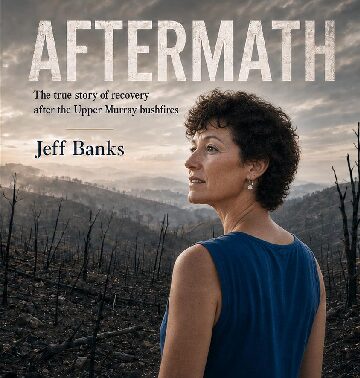
AFTERMATH Chapter 10 - Recovery to Statewide Plan

AFTERMATH Chapter 10 - Recovery to Statewide Plan | Travelling Around Australia with Jeff Banks

The danger is always that by the time the story reaches Treasury, it has become a number. My job, as I understood it, was to keep putting the person back into the number, the valley back into the region, the farm back into the statistic and the voice back into the plan. That was not always neat work. It was not always comfortable work. Sometimes it meant arguing gently, sometimes arguing firmly, and sometimes driving someone down a road until they could see for themselves what no report had managed to explain.
AFTERMATH

Chapter 10

Recovery to Statewide Plan

By the time the State wanted a statewide recovery plan, I had learned to be suspicious of the word community. It is a lovely word, community, and it sits nicely in a report. It makes people feel as though they are talking about something warm, shared and understood. It gives the impression that everyone affected by the fire stood in the same place, felt the same thing, needed the same help and would recover at roughly the same pace if only the right program was put in place.

That was not the Upper Murray, and it never had been. By then I had sat in enough halls, driven enough roads, stood in enough burnt paddocks and listened to enough tired people to know that community was not one thing. Corryong was not Cudgewa. Cudgewa was not Walwa. Walwa was not Tintaldra. A farm up a steep track with no phone service was not the same as a house on the edge of town, even if both had been touched by the same fire. The word community could hide a lot of things if you let it, and government had a habit of letting it.

So when the work began to convert local recovery plans into a statewide plan, I was pleased we had done the hard thing first. We had not tried to squeeze the Upper Murray into one neat document and pretend that was close enough. We had done separate community recovery plans for each community in the Upper Murray area, and there was a separate approach for the Alpine area because the impact there was different again. That mattered more than some people probably realised at the time, because the differences were not cosmetic. They were differences of terrain, loss, access, fear, identity and practical need.

It meant we had an evidence base, and not just the kind of evidence base that government usually likes because it comes with headings and numbers. We had an evidence base of lived experience. We had what people had said mattered to them. We had what they had repeated, worried over, argued about and carried in their faces when they walked into a meeting already tired. We had the small details sitting underneath the big themes, and in recovery those small details often told the truth better than anything else.

When the State started gathering those plans together, the question became what the higher-level common things were and what needed to go into a plan that could sit across the whole state. That sounds simple enough until you remember that every time you lift something up to a higher level, something else can fall away. A local phrase becomes a theme. A family’s need becomes a category. A valley’s isolation becomes a transport issue. Before long, what began as a person’s life can become a neat dot point.

That was the fear we carried into the process. All of us working in that space worried local voices would be diluted, although in truth I think we worried they would not just be diluted but not heard at all. There is a difference between being softened and being silenced, and we were alert to both. We had spent too much time getting people to trust us to then turn around and let their words disappear into a government process that looked tidy but meant very little back on the ground.

That was the moral weight of it for me, because it was not just a planning exercise and it was not just another stage in a recovery framework. It was the question of whether the human story could survive the machinery that was about to process it. I know that sounds a bit grand, but that was how it felt. People had told us things they had not told everyone, and sometimes they had done that because we had turned up enough times to be believed. Once they had trusted us with those stories, I felt a responsibility to make sure they did not get stripped of their meaning as they travelled up the line.

To be fair, I think the people at state level who were driving the State Plan did take the community voice seriously. I do not say that lightly because I have seen enough bureaucracy to know good intentions can still flatten people if you are not careful. In this case, the intent was right. They did look for the learning. They did try to build the community knowledge into the plan. They did not treat those local plans as window dressing, and that mattered.

Even so, a statewide plan is a very different beast to a community recovery plan. It was never going to directly reflect what each community had said in a way that people could point to and say, “There we are.” That was not its purpose. Its job was to gather the common lessons and shape them into something government could own, fund, justify, measure and be accountable for. The community owned its story, but government owned the plan, and those two things do not always sit comfortably together.

State government works in a way that is policy-driven, hierarchical and almost military in its structure. I do not say that as an insult, because in an emergency, and sometimes in recovery, structure is necessary. Someone has to decide. Someone has to account for the money. Someone has to make sure what is being promised can actually be delivered. But that way of working does not always translate well to community, because community is messy, emotional, inconsistent and deeply local.

Treasury, of course, sits over everything like the keeper of the numbers. In public service life, everything seems to come back to Treasury eventually, no matter how human the issue was when it began. By the time it reaches certain levels, it has to become a number, a category, a cost, a benefit, a line in a budget or a risk on a register. That is the clinical nature of it, and I understand why it exists, but it can feel a long way from a burnt farm, a community hall or a person trying to work out how to keep going.

That has always frustrated me, because numbers can tell anything you want them to tell depending on how you line them up. You can say seventy-five per cent of people were satisfied with something and make that sound like a good result. But if I am sitting in a hall with those people and one in four of them are not happy, that feels very different to me. One in four is not a rounding error when you can see their faces, hear their frustration and know what it has cost them to even be there.

That was the tension I felt all the way through. I understood the need for the plan to become something government could work with. I understood the need for categories, themes, outcomes and measures. But I also knew numbers would never tell you what it meant for a farmer to look across country he had worked all his life and not know where to begin. Numbers would not tell you what it meant for a woman to sit in a meeting and say very little because the loudest voices in town had already taken up all the space. Numbers would not tell you what it felt like to know help existed somewhere, but the road, the terrain, the phone coverage and the weather still put it out of reach.

That is why I made a personal point of putting stories into my reporting wherever I could. Sometimes they were formal and sometimes they were anecdotal. Sometimes they were just the example I gave in a meeting when people were drifting too far into process and needed to be brought back to earth. I wanted the reports to have a human pulse because otherwise the work became too easy to discuss at a distance. A service delay was not just a service delay. A grant guideline was not just a grant guideline. A road closure was not just a road closure. Each of those things landed on someone’s kitchen table, someone’s farm gate, someone’s ability to get through another day.

That shocked some people in my own organisation at times. I can remember people almost expecting it from me after a while, as if there would always be a Tracey story attached to whatever issue we were discussing. I did not do it to be colourful. I did it because otherwise the discussion could float above people’s lives without ever touching them. If we did this, that would happen in community. If we failed to do that, this would be the result. That was the sort of reporting I tried to do because I could not see another way to keep people real inside a system that naturally turns them into cases, numbers and priorities.

I did not see my job as protecting the character of each community. That was not mine to protect, because communities protect their own character, sometimes beautifully and sometimes fiercely, and sometimes by arguing among themselves until everyone is exhausted. My job was to amplify their voices where I could. My job was to make sure the people sitting further away from the fireground understood that one-size-fits-all recovery would not work, no matter how tempting it was to package it that way.

That became especially important when people from Melbourne or from state level came up to the area. At first, I do not think many of them really understood the difference between one community and another. They used the word community as though it was a catch-all phrase for everybody, and I do not blame them for that completely. If you have not stood there, it is hard to understand how different two places can be when they sit close together on a map. Maps are useful things, but they are also liars in country like that.

A road on a map can look like an easy drive until you are on it in fog so thick you can barely see the bonnet. A highway can sound like something broad, reliable and safe until you realise the Murray Valley Highway from Wodonga up towards Corryong is not anyone’s idea of a freeway. A place can look connected because a line runs near it, but that does not mean there is phone service, power security or anyone nearby if something goes wrong. Those are the things a map does not say, because a map does not get cold, tired, frightened or stuck.

I seemed to become the person who organised itineraries when dignitaries came to my patch. I think people learned fairly quickly what I would do to them. I would get them in a car and drive them around the burnt places. Then I would tell them the stories of those places, not as a performance, but because the country itself could explain things I would never have managed in a briefing note.

One of the early bosses reckoned I should have been a tour operator. I took that as a compliment, although I do not think my version would have made anyone want to buy a postcard. It was not a scenic tour. It was a reality tour. I would take them through Cudgewa and let them see the damage there. Then I would take them through Walwa and let them see that the damage was different. Both had been drastically impacted, but not in the same way, and you could not honestly compare them once you had seen them properly.

You could not say, “This worked there, so it will work here,” without sounding as though you had missed the whole point. I used those trips to make the differences visible, because visibility matters when decisions are being made by people who may never otherwise understand what is hidden inside a word like community. It is very easy to homogenise people from a distance. It is much harder to do that after you have stood in their valley, seen the shape of their loss and heard why the standard answer will not fit.

There were stories I dragged out often because they explained more than any table could. One was the lack of three-phase power in places where people needed it. Another was the phone hopscotch system one valley used because there was no phone service to the end of the valley. Messages were radioed from one house to the next, passed down the line like something from another era, except it was happening in the middle of a modern recovery operation. If you do not build those stories in, every community starts to look the same from a distance.

I talked about one valley where people could stand on their front verandah and see the Snowy hydroelectricity system just across the river, but when the fires went through, they still had no power for weeks. The electricity, in the way people understood it, went down to Melbourne and came back up again. On paper, that probably had a technical explanation. From the verandah of a house without power, it felt absurd, and absurdity is often where people first start to understand the gap between system logic and lived reality.

Some stories were harder because they showed just how limited ordinary recovery options could be once terrain got involved. I remember trying to explain the situation of a man who lived alone up a remote road in a rough old house most people would probably not think twice about passing by. His fences had been damaged, and he needed them rebuilt to make his farm workable and keep his stock safe. But the country was so steep that no one wanted to touch it, because wanting to help and being able to help are not always the same thing.

BlazeAid did extraordinary work after the fires. They were coordinated, practical and respected, and they rebuilt fences for people who desperately needed that help. But even they could not take on every piece of country. This man’s land was too dangerous. You could not just roll in with machinery and start putting posts in as though it was a flat paddock beside a road. I had to use a lot of visual storytelling to explain why we needed another way to help him.

I had to describe the steepness, the danger, the rocks, the awkwardness of the land and the fact that a normal solution would not work there. Eventually we found someone who could help build those specific fences, but even the photos from that work were confronting. The fence line looked crooked if you did not know the country. If you did know the country, you understood the posts had gone where posts could go. Granite does not move aside politely because a recovery program has a preferred layout. A fence on that sort of land is not just a fence. It is an argument between need, terrain, danger and stubbornness.

Those were the kinds of things I carried into planning discussions, not because I wanted to make everything dramatic, but because without them people would make decisions from an office and believe they understood the problem. They would look at assets, land size, insurance status, grant categories and kilometres of fencing, and think the situation had been captured. It had not been captured, not really, because the hardest parts of recovery were often the parts that did not fit neatly into a spreadsheet.

One of the things that always frustrated me was the way rural people and farming communities could look well off on paper while having no cash to deal with what was in front of them. A farm is an asset. Land is an asset. Machinery is an asset if you write it down in a register. But you cannot always take an asset register to the chemist. You cannot buy groceries with the theoretical value of a property that has just been burnt, shocked, isolated or underinsured.

I grew up on a farm, so I understood some of that before I ever worked in recovery. I understood that a rural community could be resilient and socially connected without everyone being best mates with their neighbour. I understood school committees, local councils, volunteer rosters, community events and the quiet expectation that if something needed doing, someone would turn up. My own father had been a local councillor for more than twenty years, so I had grown up around the idea that community work was not abstract. It was people in rooms, people giving time, people carrying responsibility whether they had the energy for it or not.

That helped me build trust more quickly than I might have otherwise. It did not mean I knew everything about what people were going through, because I did not. Nobody from outside the fire’s direct impact should ever pretend that. But it meant I could hear certain things without needing them explained from the beginning. I knew the difference between looking all right and being all right. I knew the difference between owning land and having money. I knew the pride that made people reluctant to ask and the desperation that sat underneath when they finally did.

Trust was the currency of recovery, although no one put that in quite those terms on a budget line. I spent a lot of time in committee meetings, probably more than I strictly needed to if you looked at my job description. Some of those meetings could have been delegated. Some were long, cold, circular and held at times and in places that made me wonder why I had not chosen an easier life. But I needed to hear people myself. I needed to know with certainty what I was advocating for and why.

I would ask, “Is this what you mean?” and then ask it again another way. Not because I wanted to annoy people, although I probably did at times, but because once I carried their words into another room, I had a responsibility to get them right. The further those words travelled from the person who first said them, the easier it was for them to become something neater and less true. That was the part that sat heavily with me, because a slightly wrong translation can still do damage if it becomes the version government acts on.

If we got the statewide process wrong, communities might not get what they needed. That was not just a theoretical risk. The biggest danger was losing the engagement of the local organisations that mattered most on the ground, organisations like CFA and SES, as well as local councils and the community groups that were already carrying more than people could see. If the State Plan missed the mark entirely, people would not simply shrug and keep going. They would disengage. They would stop trusting the process. They would see it as something done to them, not with them. Once that happens, you do not get it back easily.

I do think the statewide process helped connect communities in some ways. It gave structure to the recovery planning work. It gave communities a common cause and something to gather around. It created a way for local priorities to be spoken into a bigger system. That was valuable, and I would not dismiss it. But it also made things harder in other ways, because government timetables came with pressure. Grants came with deadlines. Plans had to be done in certain ways by certain times. Services arrived according to schedules that made sense to the system but not always to the people who were supposed to use them. Recovery does not care that a funding round closes on Friday.

That was another tension I pushed back on all the time. I pushed back against my own organisation when it wanted to move at a pace or in a way that community was not ready for. I pushed back with Council because Council had its own agenda, and that was not always the same as the community’s agenda. I pushed back with state colleagues when I thought the human impact was being missed. I also pushed back with community when I thought expectations were unreasonable or when a few loud voices were starting to stand in for everyone else.

That last part mattered, because community-led recovery does not mean the loudest person in the room gets to decide for everyone. Some community leaders were wonderful. Some carried enormous responsibility and did it with generosity. But a few assumed that what they thought was what everyone thought, and I had to say, in one way or another, “Hang on, there are more people in this community than just your friends.” That could make for lively discussion, although I do not think I ever got into what I would call a proper barney with anyone.

I pushed back with services too, particularly around mental health. I never thought it was enough for a service to sit in an office and say, “We are open for business. Come in if you have mental health issues.” That might work in some contexts, but it was not going to work well enough there. Firstly, people might not recognise they had mental health issues. Secondly, if they did recognise it, they might not admit it. Thirdly, even if they admitted it, why should they leave their farms and come to an office when their whole focus was trying to get the farm functioning again?

There was something almost insulting about expecting people to fit their distress neatly into an appointment model when their lives had been blown apart and their days were ruled by fencing, stock, insurance, roads, ash, mud and exhaustion. You had to go to people. You had to understand the shape of their days. You had to be useful before you expected them to be vulnerable. It sounds obvious now, but obvious things still need saying when systems are under pressure and people retreat to the model they already know.

There were times when the pushback became very practical. I remember one small park restoration project that became tangled in confusion over who owned the land, who had responsibility for managing it and what could actually be done there. To the community, it was a small project that mattered. To government, it became a knot of delegation, responsibility and risk. I got sick of the argy-bargy, which is probably not the official recovery term for it, but it will do.

At some point I had what I would politely call a little tantrum. I got on the phone and told the people involved to turn up on site so we could talk face to face and sort it out. If someone said they were in Wangaratta or somewhere else and could not see the issue, my view was fairly simple. Get in the car. Come and stand where the community is standing. Then we can all hear what everyone is actually saying, rather than passing interpretations back and forth until the original problem is buried under process.

That sort of thing should not have been remarkable, but it was often what made the difference. Get people in the same place. Ask, “Is that what you meant?” Ask, “Did you hear what they said?” Keep going until the fog lifts a bit. Not all the way, perhaps, but enough to move. That is not a sophisticated method, and it would never make an exciting flow chart, but sometimes recovery comes down to making people stand in the same place until they remember there is a real thing in front of them.

There were plenty of times I felt listened to. Not always agreed with, but listened to and respected. That distinction matters, because being heard is not the same as getting your own way. My state government colleagues often listened carefully, even when they had reasons not to do exactly what I wanted. Most of the time, the community listened too, especially as trust built over time and they worked out I was not there to tell them how to recover.

In the beginning there was some of the expected suspicion. I was wearing a government hat, so for some people that meant I was probably not worth listening to. Others assumed they knew more than I did, and in some cases they certainly did. I was not there to pretend otherwise. But that did not last too long because I am not that sort of person. I was not there to big-note myself or tell people how to recover. I was there to listen, translate, argue when needed and keep trying to get practical help to line up with actual lives.

The tricky part came when I had to use the trust I had built to help other people get a hearing. Sometimes I would be out with someone the community did not particularly like or trust. That might have been because of environmental issues, public land questions, amenities, responsibility for assets or some previous history I did not fully understand. In those moments I became a bridge whether I liked it or not, and being a bridge sounds noble until you remember people drive over bridges.

The process of turning local plans into a statewide plan was a larger version of that same work. It required translation in every direction. I had to translate community reality into language government could act on. I had to translate government processes back to community without making excuses for them. I had to hold enough of both worlds in my head to stop one from completely overwhelming the other.

I did not always get that right. No one would. But I took it seriously because I knew what was at stake. If those community recovery plans had been written from an urban office, they would have been useless pieces of paper. They might have looked polished. They might have had good headings, clean formatting and all the right words about resilience, rebuilding and wellbeing. But they would not have understood what mattered to each community. They would not have understood what each community had the capacity to do. They would not have understood the dignity involved in being able to shape your own recovery rather than simply receive someone else’s version of it.

I was glad the department kept using words like community-centred, community-driven and community-led. I know we could not always live up to those words completely. Government rarely can. But at least the intent was there, and intent matters when people are exhausted. Still, intent does not pay for everything, and it does not magically create the time, people or money needed to do recovery properly.

A community-centred approach is expensive. People do not always like to hear that because community sounds like something warm and voluntary that should somehow cost less. In reality, doing it properly takes time, staff, travel, listening, repetition, local knowledge, flexibility and patience. It takes people willing to go to the meeting again, drive the road again, explain the same thing again and sit with people who are angry, grieving, confused or just plain over it. It is much cheaper to write a plan in an office, but it is just not worth much if it does not land in the lives of the people it is supposed to help.

I have thought about that more as time has gone on. The financial context now is different from what it was then, and the amount of support going to community is different. I am not in that space in the same way now, so I do not pretend to be completely up to date with every current plan or setting. But I do know this: if government still wants to hold on to a community-centred approach, it has to understand the cost of doing that well. You cannot claim the moral credit of listening to community while removing the resources that make listening possible.

There is also something deeper that still bothers me about the way public systems measure recovery. We are not good enough at mapping human impact. We evaluate what can be counted because counting is easier to defend. We count attendance, grants, projects, kilometres, dollars, services and satisfaction. Those things matter, but they do not tell the whole story, and sometimes they create the illusion that the whole story has been told.

They do not tell you who stopped coming to meetings because they felt unheard. They do not tell you which family looked stable from the outside but was falling apart quietly. They do not tell you which person was vulnerable after the fire even though they had not been vulnerable before it. They do not tell you what happened to pride, identity and belonging when a farm stopped looking like the farm someone had known all their life. Those things are harder to record, but that does not make them less real.

If you go into a community and actually listen, you pick up who is on shaky ground. It is not always the people who were most vulnerable before the fire. Disaster rearranges people. It takes the strong and makes them brittle. It takes private people and puts their needs on display. It takes those who were already struggling and sometimes pushes them beyond the point where ordinary help is enough. Those were the things people told me, sometimes directly and sometimes in the spaces around what they said.

I held those things closely. I felt personally responsible for honouring them because recovery had to mean everybody, not just the people who were easiest to help or loudest in the room. That is where the statewide plan could either help or harm. At its best, it gave recognition to the common patterns across communities without pretending they were identical. It showed respect for the work communities had done in their own plans. It gave government a way to think about recovery beyond the first practical rush.

At its worst, or perhaps just at its most limited, it still had to pass through the bureaucracy. It had to fit around government needs and priorities, because that is what a state plan does. The bureaucracy owned it and was accountable for delivering it. That meant there was always going to be argy-bargy, always going to be compromise, always going to be the risk that the human story would be tidied up until it no longer sounded human.

That was the line I kept trying to hold. Sometimes holding that line looked like a report with a story in it. Sometimes it looked like a car full of visitors being driven through burnt country. Sometimes it looked like pushing back against a deadline. Sometimes it looked like sitting in another freezing meeting because I needed to hear the words myself. Sometimes it looked like telling someone from a city office that no, a main road on a map did not mean there was phone service, help nearby or any guarantee someone would be found quickly if they left the road.

I learned that lesson myself one night when I hit a deer while driving in rain on a road that looked perfectly sensible if you only saw it as a line on a map. I was not speeding. I was doing about forty because visibility was poor. The deer came out of nowhere, the car was damaged, and there was no phone service. When people later asked why I had not rung someone, the answer was simple. I could not. There were no farms close enough to walk to safely, so I got out, bent the panels enough with my hands so the wheels could turn, and drove home.

After that, processes changed. People wanted to know when I got home. Bull bars appeared on vehicles. The map had not changed, but understanding had. Another colleague became known for hitting wombats, which sounds almost funny until you remember what sort of roads we were driving, at what hours, in what weather and through what country. Black ice, fog, animals, no phone service, steep drops, long distances and fatigue were not colourful extras. They were part of the work, and they were part of the reality people in those communities lived with long before we arrived.

That was the country we were asking people to recover in. I think that is what I wanted the statewide plan to hold, even if it could never say it quite that plainly. I wanted it to hold the fact that recovery in the Upper Murray was not an abstract public policy challenge. It was farmers trying to fence impossible country. It was valleys passing messages by radio because phones did not reach. It was people seeing electricity produced across the river while they sat without power. It was towns that looked close together on a map but lived very different versions of loss.

It was helpers trying to stay useful without becoming heroes. It was communities trying to be heard without being turned into a slogan. I believe we did a good job, although I am cautious saying that because recovery is too complicated for anyone to claim success too loudly. I would never call it wildly successful or pretend there were no gaps. But I do think we did what we could, to the best of our ability, with the knowledge, resources and constraints we had at the time.

The State Plan did not save every local detail, and it was never going to. But I do believe the community voice made it into the room. I believe the people working at that next level took it seriously. I believe the local plans gave the statewide work a stronger foundation than it would otherwise have had. That matters to me, because in the end, plans pass through systems, but recovery passes through people.

The danger is always that by the time the story reaches Treasury, it has become a number. My job, as I understood it, was to keep putting the person back into the number, the valley back into the region, the farm back into the statistic and the voice back into the plan. That was not always neat work. It was not always comfortable work. Sometimes it meant arguing gently, sometimes arguing firmly, and sometimes driving someone down a road until they could see for themselves what no report had managed to explain.

If we had not done that, if we had let the machinery of planning roll over the top of those communities without resistance, something important would have been lost. Not just detail. Not just local colour. The truth would have been lost, and once that happens, recovery becomes something written about people rather than carried with them. I could not let that happen without a fight, so I kept listening. I kept checking. I kept telling the stories. And whenever the system reached for a number, I tried to make sure there was a human being standing somewhere behind it.

Author

Menu