

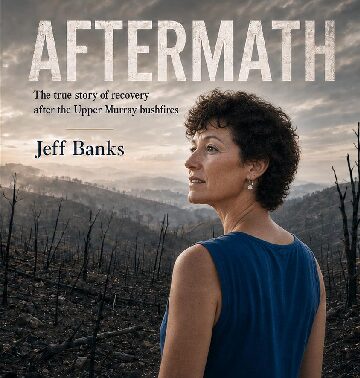
AFTERMATH Chapter 1 - Putting on the Virtual Kettle

AFTERMATH Chapter 1 - Putting on the Virtual Kettle | Travelling Around Australia with Jeff Banks

Looking back, that first day was not the beginning of recovery in the neat way people might like to say it was. Recovery had not begun just because we had opened a hall, made tea, found bedding, and written down names. For many people, the worst of what they had lost was not even fully known yet.
AFTERMATH

Chapter 1

Putting on the Virtual Kettle

The hall was cold when I first opened it, which still seems ridiculous to say because it was the height of summer and the sort of day where the heat sits on your shoulders before you have even done anything. But that was how it felt. Cold, empty, echoing, and far too big for what I knew was coming through the doors.

It was the community hall across the street from the council offices in Tallangatta, the sort of place you walk into for a meeting, a school concert, a community lunch, or something cheerful enough that the size of the space feels useful. That morning it felt like a problem. The ceilings were too high, the floor too bare, the walls too far apart, and the sound of every chair leg scraping across the floor seemed to announce that none of us really knew where to start.

I had been trained for this, at least that was the theory. I had done the sessions, read the material, spoken to people who had worked in evacuation centres before, and built up enough understanding to know the job was not just about opening a door and telling people to come in. I knew there would be forms, processes, agencies, safety checks, food, bedding, records, people, animals, vehicles, information, and a hundred other things that would all become urgent at exactly the same time.

What I did not know was what it would feel like when all of those things landed on top of each other before I had even had time to take a proper breath. There is a big difference between being prepared in a room during a training session and standing in a hall with smoke in the air, council staff following you across the road, community members appearing from nowhere, and everyone looking at you as though you have the answer.

That was the first real weight of it. Not the fire itself, not yet, but the expectation. People crowded around me with all the right intentions, asking, “What do you want me to do?” over and over again, and I remember thinking, I do not even know what I am doing yet, let alone what I want twenty other people to do.

They were good people. That matters, because none of this is a criticism of the people who turned up. They left desks, homes, shops, routines, and whatever else they were doing because they knew something terrible was happening up the valley and they wanted to help. But good intent does not automatically become useful action, and in those first moments it felt a bit like walking into a yard with a bucket of wheat when the chooks already know you are coming.

They came at me from every direction, eager, worried, energised, and a little panicked themselves. Some wanted to move furniture, some wanted to make food, some wanted to know where the fire was, and some seemed to expect I would be able to tell them, minute by minute, exactly what was happening up the road. The truth was I had the same patchy information as everyone else, and most of the time I was in the dark too.

That is one of the first things disaster teaches you. Everyone assumes someone knows. Someone in uniform, someone from council, someone with a radio, someone with a folder, someone standing near the door looking official. But in those early hours a lot of us were working with fragments, rumours, radio messages, road closures, names of places, names of farms, and the deepening sense that this was bigger than the plan we thought we had.

The plan, when stripped down to its most insulting little memory, seemed to begin with the kettle. Somewhere in the emergency supplies, or in the thinking behind them, there was the idea that the first thing you did was put the kettle on. I know the heart behind it was good. Country people understand the comfort of a cuppa, and there is something deeply human about offering warmth, even on a forty-degree day, to someone who has just come through fear.

But standing there in that hall, with people about to arrive who might have left homes, stock, pets, neighbours, and family members behind, “put the kettle on” felt nowhere near enough. It felt like someone had imagined an evacuation centre as a neighbourhood house with a bit of drama attached, as though women would come in, make tea, pat people on the shoulder, and everything would settle itself. That was not the job in front of us.

The first thing was not the kettle. The first thing was making sure people could get in safely, park somewhere without blocking access, bring in dogs or whatever animals they had bundled into the car, and not trip over power cords or furniture we had dragged into the wrong place. The first thing was working out where to put the registration table so that ten people arriving at once did not create a blockage at the door.

The first thing was also knowing that the system wanted people to fill in a complex form before they were properly received. Name, address, where they had come from, who they might have left behind, details they could barely hold in their heads. On paper it made sense, because we needed to know who was safe and who was missing, but on the ground it was one of the stupidest first barriers I had ever seen.

People came through the door in shock, or confusion, or exhaustion, or high spirits that were really only shock wearing a different hat. The system expected paperwork. The people needed to be looked in the eye and reminded they had made it to a safe place.

So I broke the first rule almost immediately. I would get a first name, a last name, and an address if they could give it to me. Then I would put a name tag on them and say something along the lines of, “Go and get a cup of tea, sit down, put your feet up. I’ll come and find you in a little while and we’ll do the rest.”

That was not me being rebellious for the sake of it. It was me trying to put the human being ahead of the form without losing the form altogether. The bureaucracy still mattered, because records mattered, reimbursement mattered, accountability mattered, and later on every piece of paper would matter more than any of us realised at the time. But a person who has just been driven out of danger should not have to prove their usefulness to a form before they are allowed to sit down.

That became the balancing act from the first hour. Human need on one side, bureaucracy on the other, and no neat line between them. We needed milk, tea, sanitising equipment, bedding, tables, chairs, food, cups, bins, safe walkways, parking, volunteers, information, and some sort of order. We also needed receipts, records, dates, details, and evidence of what had been bought, borrowed, used, donated, thrown out or replaced.

Nobody had really trained us for the small administrative truths that become large under pressure. We knew council would eventually be reimbursed for the costs of setting up and running the evacuation centre, but we did not understand at the start that every single thing needed a piece of paper attached to it. I was ordering milk here, tea there, cleaning things somewhere else, and trying to keep people safe while some future version of myself apparently needed a neat folder with every receipt clipped into place.

Those little things sound petty when you say them afterwards. They were not petty at the time. Every missing receipt, every unlabelled item in a fridge, every donated blanket, every box of supplies, every well-meaning person who dropped something off and disappeared, added another layer to the pressure already sitting in the room.

At the same time, the hall itself had to be turned into something it was never built to be. It was a huge open space, which sounded useful until you imagined a traumatised person walking into it and needing somewhere quiet to sit. There was no natural privacy, no warmth, no corners that felt safe, and no easy way to separate the person who wanted to talk from the person who could not bear to hear another word.

We dragged furniture, shifted tables, tested spaces, and tried to create little areas where people could feel held without feeling trapped. The scraping of chairs and tables across that floor is still part of the memory. At first it was all sharp noises and echoes, the sound of movement without order, and the chatter of helpers trying to work out what had to be done.

Then, as the morning went on, the sound changed. The hall began to fill with a hum. It was never quiet again after that, not properly, not even overnight when there were beds and people lay down as if sleep might come. There was always someone talking, asking, crying quietly, walking, coughing, moving, checking, waiting, or listening for news.

The first people through the doors were not evacuees in the way people might imagine. They were council officers and local people who had followed me over or arrived close behind, all saying some version of, “Put me to work.” That was both wonderful and overwhelming. I needed them, but I also needed to keep them from becoming another group of people I had to manage emotionally.

Volunteers came in with energy, urgency, and genuine concern written across their faces. They also came expecting direction. It took me a little while to get my own head in order, but once I could see who was steady, who understood logistics, who had a calm way with people, and who would be better making beds than sitting with trauma, I began to divide the work.

That was another early lesson. Not every kind person is useful in every role. Some people can sit with another human being in distress without filling the silence or making it about themselves, while others are much better carrying boxes, setting up mattresses, organising food, or keeping the kitchen running. None of those jobs is lesser, but putting the wrong person in the wrong place can do damage when people are already raw.

By about ten o’clock, the first evacuees started to arrive. The fire had been going all night, and we had been told soon after I arrived at work that morning to set up the centre. Those first two hours before people came in had seemed frantic, but when I look back now, they were almost a luxury. Once people started arriving, the work changed from preparation to response, and response does not wait politely while you finish setting up.

The first arrivals were generally people from further away from the fire front. They had been moved as a precaution and came in with a strange brightness about them, almost as though this was an unexpected interruption rather than the beginning of something terrible. Some were chatty, some made jokes, some looked around for familiar faces, and some treated it almost like a community gathering that had got out of hand.

I do not say that critically. That was where they were on the line of the thing. They were worried, of course, but not yet hollowed out by it. They could still ask for what they needed, recognise people across the room, make decisions, fill in forms with a bit of help, and say, “Don’t worry about me, I’m fine love,” even if they were not entirely fine.

As the day went on, the faces changed. People began arriving with more smoke in their clothes, more uncertainty in their voices, and less ability to make decisions. They were still functioning, but only just. They could tell you where they had come from, maybe who they were worried about, and sometimes what they needed, but you could see the strain beginning to pull words out of order.

Then came the ones who had left in more of a hurry. They might have grabbed a bag, but the bag would contain the oddest collection of things, because panic does not pack logically. They might have one shoe on, or no proper clothes, or a dog under one arm and no medication, or medication and no shoes. They might have remembered an instrument, paperwork, bank details, or something sentimental, and forgotten the thing anyone standing outside the situation would call obvious.

At one point we had a large number of people come in from a folk festival that had been in the path of the fire. There were hundreds of them, and they brought their own particular kind of chaos. Some were drunk, some were high, some were excited, some were traumatised, and many were all of those things at once.

They had made the decision to leave, been convoyed down, and then started to understand what they had passed through or what they had escaped from. Many had musical instruments and smoking gear, because those were the things closest to hand or closest to identity when they had to move. Very few had sensible clothes, and some had no shoes, but they were still people who had been frightened and displaced, and they deserved the same dignity as anyone else.

That mattered to me. It would have been easy for some people to judge them, especially when they were laughing or loud or jolly in the same building as farmers who might have lost everything. But shock comes in different forms, and stress does not always arrive with a bowed head and a quiet voice. Sometimes it arrives giggling, talking too fast, and asking strange questions.

So part of the job became managing the mix of people as much as managing the centre itself. You could not sit a laughing group of festival evacuees beside someone who had just lost stock, fencing, sheds, and the shape of their life. You could not let people gather in corners swapping horror stories when others were still waiting to hear whether family, neighbours, animals or homes had survived.

Safety was not only about fire, roads, cords, or parking. It was emotional safety too. It was watching the room constantly, reading faces, listening for voices rising, and knowing when to shift someone to a quieter space before the situation tipped into anger, panic, or collapse.

As afternoon moved toward evening, the people coming in were closer to the fire in every sense. They smelt of it. It was not just ordinary smoke, the sort you smell after a campfire or a burn-off. It was a dead smoke, thick and sour, caught in hair, skin, clothing, bags, blankets, and breath.

By night, that smell had become part of the building. At first the hall smelt of dust from moving furniture and opening up a space that had been sitting empty. Later there was food from the kitchen, tea, cakes, casseroles, people, sweat, summer heat, and the usual smells of a crowded hall. But over all of it came that smoke, and once it settled in, it seemed to press down on everything.

People would ask for a shower because they wanted it off them. I understood that, but after a while I also understood it would not come off properly. Even after people washed and changed, it stayed in their hair and skin, and by the time there were enough people in the hall, the whole place carried it.

We knew before long that much of the donated bedding would have to go. There are practical truths in recovery that feel wasteful until you are standing in the middle of them. You could not wash that smell out, not properly, and you could not keep giving traumatised people bedding that carried the smoke of someone else’s escape.

The food was another lesson in the difference between community instinct and official requirement. People brought casseroles, cakes, trays, and whatever they could make, and the kindness of it was beautiful. In a place like Tallangatta, people do not wait for permission to help. They cook, carry, drive, open sheds, find blankets, make calls, and turn up.

For a while we used what came in because we needed it. Then the health officer arrived, and of course donated food could not be served in the way people imagined it could. Rules are rules, and food safety matters, but try explaining that to a community that has just cooked half its heart into a casserole dish because it wants to feed people who have run from fire.

The local shops were extraordinary. The bakery and supermarket kept sending things over, and the baker seemed to have an endless supply of trays that arrived without fuss. “This is for the volunteers,” was the spirit of it. Don’t ask, just take it, keep going.

That is the part of country communities that outsiders sometimes romanticise and insiders sometimes take for granted. People can be difficult, blunt, stubborn, funny, suspicious, generous, and deeply practical all in the same hour. They might grumble while handing you exactly what you need.

By dark we had police, ambulance, Red Cross, counsellors, and just about every service under the sun coming through or trying to establish themselves. You could tell quite quickly who had been properly trained and who had read something once and thought that would be enough. On the ground, theories either bend toward the person in front of you or they become useless.

The police were a steady presence, and their radios became one of the ways we understood the fire’s movement. We did not have a clean map view in those early hours. We had names. Brown’s place. Smith’s place. That track. This road. A location that meant something to locals and very little to anyone else.

That made the fire feel personal as it moved. It was not a red line on a screen. It was eating through people’s places, one familiar name at a time. Even when the radios were turned down as low as they could be, I heard things I would rather not have heard and carried information I could not always share.

People asked constantly, “Where is it now?” I understood why. If your home, animals, neighbours, or family are somewhere up that road, you do not ask once and then patiently wait. You ask again and again, because the answer might have changed in the last five minutes and the last answer may already be useless.

The next day we got a large printout of the area and began marking what we knew, updating it as best we could. It was not perfect, but it gave people something to look at instead of looking into our faces and hoping we had better news hidden there. Sometimes in a disaster, even an imperfect map is a kindness because it gives fear somewhere to land.

The questions people asked when they came in told you how close they had been to danger. Those on the fringes usually scanned the room for people they knew, made a joke, found a chair, and managed themselves. The next lot asked about someone else before they asked for food, water, a bed, or the bathroom. “Have you seen Fred?” “Do you know where Mary is?” “Has anyone heard from them?”

The ones who had come from closest to the fire often asked for nothing at all. They could not. They stood there blankly, or sat where they were put, or stared at the floor as though the floor might explain what had just happened. If you asked whether they wanted a cup of tea, they might grunt, or nod, or not answer, because the question itself was too large.

With those people we learned to slow everything down. You did not hand them a full meal and expect them to eat it. You gave them a small amount of food on a plate, because a full plate could be too much to think about. You did not fill a cup of tea to the top, because hands shake and hot tea goes everywhere, so three-quarters full became another tiny piece of wisdom no manual had bothered to mention.

You reminded them where they were. “You’re here at Tallangatta. You’ve made it to the evacuation centre. You’ve spoken to Fred over there. You’ve had a cup of tea. Do you need another one?” It sounds almost childish when written down, but it was not childish. It was grounding.

The counsellors were invaluable when the deeper trauma began coming through the door. Sometimes we would make the tea, find the quietest place we could, and hand someone over knowing we might not see them properly for an hour. Other times there was no immediate handover, just sitting beside someone long enough for their eyes to come back into the room.

I remember one man I knew well, a strong farmer, the sort of man who usually had plenty to say and would often be the one telling everyone else what ought to be done. He came in vacant, lost, and deeply still. I kept saying, “Neil, it’s Tracey. Neil, it’s Tracey,” and there was nothing coming back.

That frightened me in a way I had not expected. It is one thing to understand shock as a concept. It is another to see it sitting in the face of someone you know, someone you have always understood as resilient, fiery, capable, and hard to knock over. When a person like that disappears behind his own eyes, you understand something has happened that no procedure can tidy up.

There was an older couple later that night, around midnight, who taught me another version of the same thing. They came in laughing and joking, high-spirited in a way that seemed almost out of place. At first glance you could have mistaken it for relief or personality.

Then, as we sat with them and heard enough to understand what they had escaped, it became clear they were not laughing because it was funny. They were laughing because their bodies had not caught up with the fact they had come within a whisker of dying. Shock can look like silence, but it can also look like hysteria dressed up as good humour.

There was humour in the hall, though. There had to be. Cockies manage stress with humour, sarcasm, and a sort of humility that can sound brutal if you do not know how to hear it. Someone would say a shed had gone and then add that it needed knocking down anyway, or make some dry remark about finally getting around to replacing something that had just been burnt to the ground.

The emergency services people were masters of dark humour too. They could turn almost anything into a joke, not because they did not care, but because they had been caring for years and needed a valve somewhere. The trick was knowing when humour was helping people breathe and when it was about to tip into hysteria, disrespect, or harm.

That was the constant work of the room. Watching, listening, adjusting. Moving people before they clashed. Keeping volunteers busy so they did not stand together retelling the worst things they had heard. Protecting the people who had been hit hardest from having to perform their trauma for the curious or the frightened.

I had to think about the volunteers as well as the evacuees. They were absorbing things too, often without realising it. They had come to help, and in their minds helping meant doing something useful with their hands, but they were also hearing stories, seeing faces, smelling smoke, and watching people they knew come undone.

The helpers were not heroes in the way people like to use that word later. They were people doing their best inside a situation that kept asking more of them. Some were magnificent. Some needed managing. Some found their place quickly, while others were overwhelmed by the very thing they had turned up to help fix.

I was not above that either. I was functioning, but functioning is not the same as being untouched. Every waking moment I was conscious of where the fire might be, who was coming next, what we had missed, what we had failed to record, what we still needed, and whether the room was about to become unsafe in some new way I had not anticipated.

The first time I remember having to push my own fear aside was when I heard my colleague in Corryong was trapped. She had gone up there to set up the evacuation centre, and then the road situation and communications collapsed around her. Phone lines were down, the smoke was too thick for the satellite phone to work properly, and we did not know if she was safe.

That was when the scale of it shifted inside me. Until then I had been busy enough to keep the fear moving. But hearing she was trapped made it real in a different way. She was up there, we could not reach her, and if they got her out there was every chance my job would be to go in and replace her.

I remember thinking, that could be me. Not in a dramatic way, not with music swelling in the background, just as a plain practical fact. If she came out, I might go in. Her hard place might become mine, and this so-called easy evacuation space in Tallangatta might be the calm before the thing I had not yet understood.

That is another thing I learned early. You can be trained and still be making it up as you go along. Both can be true. Training gives you a frame, but it does not give you the exact person walking through the door with one shoe, the exact volunteer who wants to help but cannot stop talking, the exact smell of a hall full of smoke-soaked clothing, or the exact moment when a farmer you know cannot recognise your voice.

In the middle of all this, the kettle did matter, but not in the way the manual seemed to think. A cup of tea can be a beautiful thing. It can give a person something warm to hold, a small point of normality, and a moment where somebody has recognised them as an individual rather than a problem to process.

But it is not the first act of recovery. It is not magic. If you shove a cup into the hand of someone who is shaking, frightened, angry, or barely present, they may drop it, spill it, refuse it, or throw it back at you. The cup of tea only means something when it comes after recognition.

The real hospitality was not the kettle. It was looking at someone properly and saying, “What do you need from me right now?” It was sitting beside them long enough to hear the answer, or to understand there would be no answer yet. It was putting a hand on a shoulder when that was welcome, finding dry clothes, calling over a counsellor, locating a dog, writing down a name, checking if they had medication, or simply reminding them they had made it here.

That is why I think of it now as the virtual kettle. Not the actual one bubbling away in the kitchen, although that certainly worked hard. The virtual kettle was the thing we were really trying to put on: a sense of warmth, safety, dignity, and human recognition inside a system that still needed forms, receipts, rules, and records.

The system did not disappear because people were traumatised. In some ways it became more demanding. We still needed to know who had arrived, who had not, what had been spent, what had been donated, what could be used, what had to be thrown out, who needed medical care, who needed counselling, who had animals, who had nowhere to go, and who was waiting for news that might break them.

But if the system came first, we would have failed them. That was the line I kept coming back to, even before I had words for it. People’s physical safety first, then their mental safety, and then the paperwork as soon as we could get to it without making things worse.

By the end of that first day, if it even had an end, the hall no longer felt empty. It was full of beds that people lay on but did not sleep in, full of chairs that held bodies too tired to sit upright properly, full of police radios, food smells, smoke, murmured conversations, and the footsteps of people walking because standing still meant thinking. It was full of names being repeated, places being asked about, and the strange country humour that comes out when people have no other tool left in their hands.

Every so often I would walk outside and down the street just to get away from the hum. Not far, because there was too much to do, but far enough to let my head come back together. The quiet outside was not really quiet, not with the smoke and the knowledge of what was happening up the valley, but it was quieter than the hall.

Then I would go back in. There was always someone else at the door, someone else asking where the fire was, someone else needing a form but not yet able to hold a pen, someone else with a dog, a bag, a story, or a silence. There was always another small decision that mattered more than it looked as though it should.

Looking back, that first day was not the beginning of recovery in the neat way people might like to say it was. Recovery had not begun just because we had opened a hall, made tea, found bedding, and written down names. For many people, the worst of what they had lost was not even fully known yet.

What began that day was something rougher and more honest. It was the work of holding people in the first hours after the world had shifted under them. It was the beginning of understanding that recovery would not mean putting things back the way they were, because for many people there would be no way back to that.

I had walked into the hall thinking I was trained to set up an evacuation centre. By the time the smoke had settled into the walls and the night had filled with people who could not sleep, I understood the training had only brought me to the door. The real work began when the door opened, and the first person walked in carrying more than any form could hold.

Author

Menu