

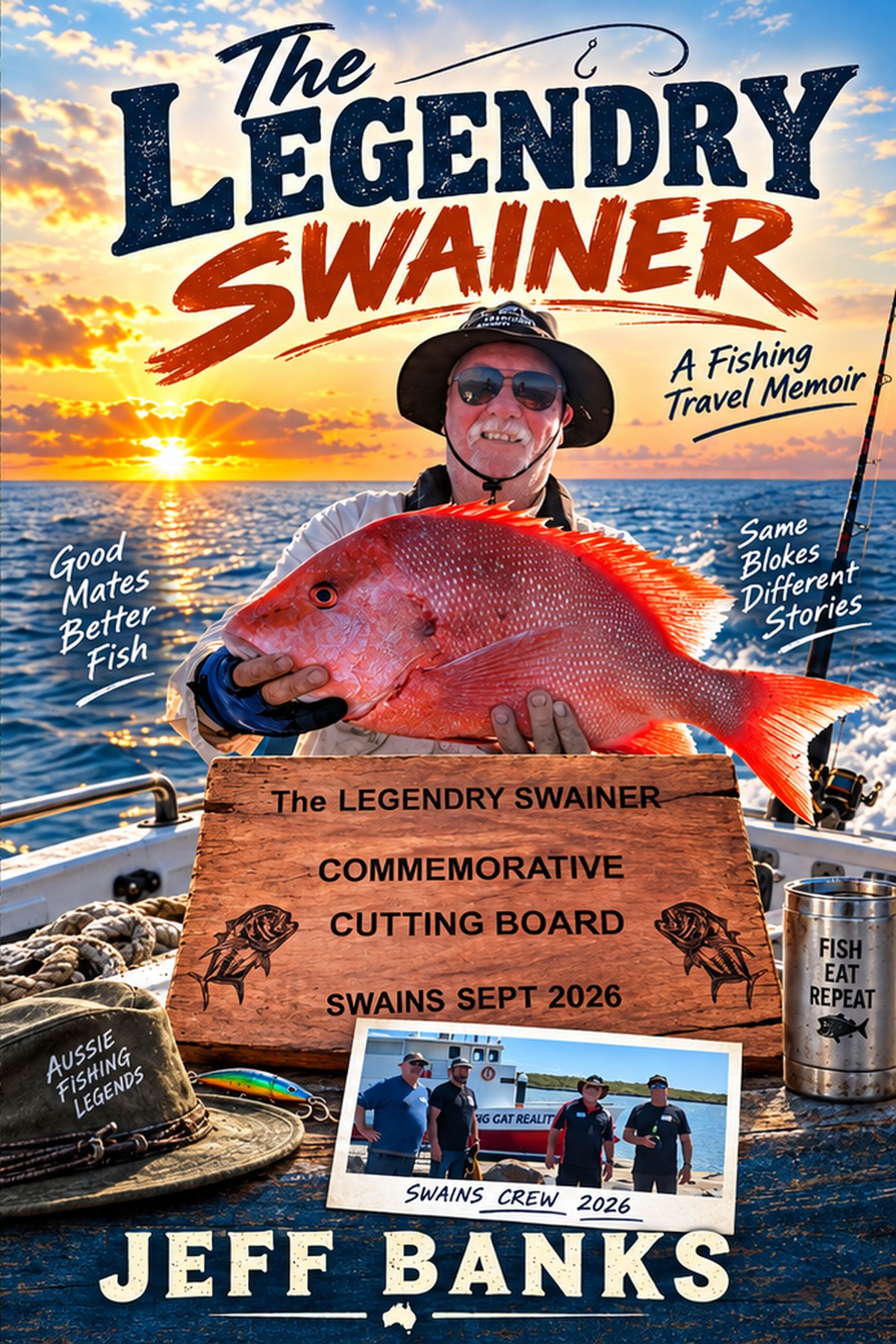
THE LEGENDRY SWAINER - Chapter 9 - Day Three - The Shark Gambit

THE LEGENDRY SWAINER - Chapter 9 - Day Three - The Shark Gambit | Travelling Around Australia with Jeff Banks

In both cases, failure quickly became public property. Lose a fish to a shark and three other fishermen could immediately explain your mistake; lose a hand of cards and everybody around the table suddenly knew which card you should have kept. The only defence was to win often enough to earn the right to provide the same assistance to somebody else.

The Legendry Swainer

Four Mates, Seven Days and Far Too Much Confidence

Chapter 9 — Day Three: The Shark Gambit

Almost every serious fishing trip eventually produces sharks, although on this trip they were beginning to operate in two entirely different spheres. There were the sharks beneath us, the deep-sea taxmen who had apparently decided that anything we hooked represented assessable income, and later there would be the recreational variety gathered around a deck of cards, where the objective was much the same but the victims usually surrendered their losses voluntarily.

My first problem with Day Three, however, had arrived the night before and had nothing whatsoever to do with fish. At about 9.45, well after most sensible people aboard Big Cat Reality had surrendered to sleep, my phone began sounding an alarm with the persistence of something convinced the vessel was sinking. I tried several times to shut it down, pressed things that appeared designed to shut it down and eventually began pressing almost anything in the hope that modern technology might recognise desperation as a legitimate command.

This is one of the small frustrations of phones that seems completely disproportionate to the event itself. They spend most of their lives sitting quietly in a pocket until the precise moment your attention is somewhere else, then suddenly decide there is information you cannot possibly continue living without. At home you tolerate it because there is generally time to investigate why some application believes your immediate attention is required, but a hundred nautical miles offshore I was less interested in notifications, updates, moisture warnings or whatever other emergency the phone had manufactured for itself.

The more I tried to silence it, the more irritated I became, which naturally made me less capable of performing the apparently simple task of silencing it. Logic was progressively replaced by increasingly firm finger pressure, as though a touchscreen might respond better if it understood I was becoming angry. Somewhere in there I realised that the Tangles tag I had been trying to distance myself from during the fishing was perhaps broader than first thought, because I had now managed to become tangled in technology without a fishing line anywhere near me.

Eventually the alarm stopped and I lay there waiting for the inevitable abuse from surrounding cabins. I expected at least one voice to enquire whether I planned to evacuate the vessel, throw the phone overboard or perhaps continue experimenting with alarms until breakfast, but apparently nobody had been disturbed enough to consider strangling me in my bunk. This was mildly disappointing because I had already prepared several excellent explanations involving faulty technology and circumstances completely beyond my control.

The phone had been complaining earlier about moisture, which on a fishing boat seemed a little precious for an item being carried around primarily as a camera. We were living in an environment where saltwater, spray, fish slime and wet hands were hardly unexpected developments, yet the phone had apparently encountered dampness and decided working properly was now optional. By morning it was more than an hour behind the boat clock, suggesting either the moisture had affected its concept of time or somewhere during the night I had crossed into another Australian time zone without Big Cat Reality moving.

Normally I would have wanted to fix it, because there is something about a device displaying information you know to be wrong that keeps demanding attention long after the information has ceased to matter. Out there, though, the correct time was largely academic because breakfast, dory departures and fishing sessions were all being organised by people with considerably larger clocks than mine. The phone could believe whatever time it liked provided the camera still worked when somebody finally caught something worth photographing.

What annoyed me more was the way the whole episode had dragged my attention away from where I wanted it to be. One of the pleasures of being that far offshore was that normal life had been reduced to an unusually manageable collection of questions involving weather, bait, tackle, fish and whose turn it was to be ridiculed. A phone insisting on adding software warnings and mysterious alarms to that list felt like somebody had smuggled a small piece of ordinary life aboard when I had been quite happy leaving it on the mainland.

There was also a certain indignity in being capable of standing in a dory and imagining myself ready to do battle with Spanish mackerel, giant trevally or whatever else Swains Reef might produce, while being comprehensively rattled by a small rectangular object I actually owned. A pelagic could take line, a shark could take the fish and a reef could take the whole rig, and each of those outcomes would at least qualify as fishing. Being defeated by an alert box asking me to acknowledge something I neither understood nor cared about was considerably harder to defend.

By breakfast I had therefore adopted the most technically sophisticated solution available to me: ignore it. The phone was now primarily a camera, its clock was fiction and any future electronic complaint would need to compete with the possibility of an actual fish. Tangles might still have been hanging around my reputation, but I preferred my tangles to involve leaders, hooks and something pulling on the other end rather than a machine demanding that I press “OK” before it would leave me alone.

Breakfast quickly established that my phone was a minor technical issue compared with the subject dominating everybody else’s conversation. The wind was still discussed because wind on a fishing boat always earns a seat at breakfast, but the sharks had moved rapidly up the agenda after imposing themselves on catches the previous day. Fish were being taken on the way to the boat with such efficiency that several anglers had begun speaking about the taxman as though the Australian Taxation Office had opened an offshore branch at Swains Reef.

Steve and I listened with the quiet satisfaction of people who had so far escaped assessment. Touch wood, we had not lost a fish to a shark, and apart from those cruising around the back of Big Cat Reality while the crew cleaned and cryovaced the catch, we had barely seen one. This could have been clean living, superior fishing technique or, more realistically, the fact that our catch numbers had not yet reached a level capable of attracting the attention of the statistical department.

Whatever the reason, we were tax-free and consequently buoyant as we headed out for Day Three. Confidence is a wonderful thing when built upon absolutely no evidence, and by this stage Steve and I had accumulated enough of it to believe we were about to have a very good day. Somewhere beneath us, several sharks were presumably reviewing our file.

We had a plan, and like most fishing plans formed before the first lure hits the water, it sounded excellent. More importantly, it sounded informed, which is not always the same thing. We had rods suited to the job, reels carrying enough line to reach halfway to New Zealand, especially the 1,600 metres of braid attached to Steve’s electric reel, boxes of lures selected for every conceivable circumstance and enough collective experience to discuss pressure edges, trolling runs and casting angles with the authority of men who had clearly spent far too much money getting ready.

There is an old fishing insult about being “all the gear and no idea”, and none of us had any intention of qualifying for it. We had the gear in abundance, certainly, but we also had a theory, and having a theory immediately separates the properly prepared fisherman from the bloke who simply throws something shiny into the water and hopes for divine intervention. At least that was the way we preferred to look at it, because once four fishermen have invested heavily enough in equipment, confidence becomes almost a moral obligation.

The plan itself was beautifully simple on paper. We would work a pressure edge along the reef, trolling it first, then drifting back against it and throwing stickbaits into the shallows before turning around and trolling through again. The theory was that anything toothy lurking over the coral might be tempted away from its stronghold and into deeper water, where we could engage it under circumstances marginally more favourable to us.

This was the point where confidence began wandering into negotiation with nature. We were effectively proposing that fish living permanently on Swains Reef should abandon the exact environment that gave them every advantage and follow our lure into open water because four visiting fishermen had developed a strategy over breakfast. Put like that, there were perhaps weaknesses in the plan, but such weaknesses are much easier to identify after the fish have ignored you.

Still, there is something reassuring about having a plan even when the fish have not been consulted. It gives everyone something to do, something to believe in and, most importantly, something to blame when events begin departing from expectation. Without a plan, failure is simply failure; with a plan, failure can be attributed to tide, current, angle, lure choice, boat position, fish behaviour or some minor deficiency in somebody else’s execution.

Somewhere in the background sat the famous warning about the best-laid plans of mice and men. Steinbeck had certainly led us to it, even if the original line had travelled through Robert Burns before reaching him, and where it was supposed to lead four fishermen at Swains Reef was less obvious. What mattered was that we had arrived at the water armed with equipment, strategy and the confidence of men who believed preparation entitled them to a result.

Whether that belief had any standing with the inhabitants of the reef was another matter entirely. The fish had their own plans, the sharks almost certainly had better ones and neither group appeared particularly interested in attending our briefing. For the moment, however, we were organised, equipped and optimistic, which is about as close as fishermen ever get to certainty before the first cast.

There is something wonderfully optimistic about four fishermen arriving at Swains Reef and developing strategies for controlling where predatory fish should conduct themselves. We were essentially knocking on their front door, dragging food past the lounge room window and hoping that, if they came outside angry enough, they would obey our preferred rules of engagement. The plan was nevertheless sound enough to deserve a trial, which is approximately the highest standard most fishing strategies ever need to meet.

The fish started coming, although once again they appeared determined to demonstrate that our trophy rules had not been drafted with the full biodiversity of Swains Reef in mind. Hussars, iodine bream, wrasse and assorted other inhabitants kept climbing aboard, giving Steve an increasingly impressive collection of species while producing remarkably little improvement in his official score. Had we created an ancillary-fish competition, Steve could probably have established an unbeatable lead before lunch.

This was becoming one of the peculiarities of his trip. As the professional fisherman among us, Steve seemed capable of catching almost everything that lived underwater, provided it was not necessarily something receiving full recognition under the rules I had so carefully constructed before we left home. By my reckoning he was heading towards twenty different species, and if the Legendry Swainer trophies had included a category for marine biological sampling, the rest of us could have stopped competing.

Then came the “cobia”, or at least what, for several very enjoyable minutes, looked sufficiently like a cobia to have us behaving as though something important was about to happen. In the water the shape was right enough to lift expectations quickly, and as Steve worked it closer to the boat the possibility of a serious trophy contender began taking hold. Seventy-five centimetres was the magic mark, so suddenly this was not merely another fish but something requiring measurement, witnesses and, preferably, a photograph capable of causing immediate discomfort on Trevor and Ian’s boat.

The anticipation lasted almost all the way to the landing net. Once the fish was aboard, however, the magnificent potential cobia underwent the disappointing administrative process known as species identification and became something I had already developed a rather strained relationship with on this trip: a remora. I had been catching enough of the bloody things to regard them less as an interesting reef species and more as aquatic gatecrashers, turning up when something considerably more desirable had been expected.

Steve, naturally, had to catch a particularly good one. If we were going to be plagued by remoras, apparently even those were going to become competitive, and his stretched out to seventy-four centimetres on the measure. That was an impressive remora by any standard available to us, but an impressive remora remained a remora, which meant it was going straight back over the side and contributing absolutely nothing to either of the trophies.

The seventy-four centimetres, however, was too attractive a number simply to throw away with the fish. Had it really been the cobia we first thought we were looking at, it would have fallen agonisingly one centimetre short of the legal mark, which gave the whole story exactly the sort of credibility required for mischievous purposes. It was close enough to sound plausible, disappointing enough to demand sympathy and sufficiently irrelevant to the actual score that nobody could accuse us of trying to steal a trophy.

At that point the old philosophy of never giving a sucker an even break asserted itself. Steve and I looked at one another and, without requiring anything resembling a formal meeting, decided there was absolutely no reason Trevor and Ian needed immediate access to the full taxonomic details. We had a seventy-four-centimetre fish, we had briefly believed it was a cobia and we had two competitors elsewhere who could be relied upon to react satisfactorily if told only those parts of the story.

So for a while the remora enjoyed an unexpected promotion. It became Steve’s seventy-four-centimetre cobia, a fish tragically one centimetre short of legality and therefore unable to trouble the official score, although naturally impressive enough to be mentioned at the first available opportunity. We were not cheating because it could not count, which is the sort of distinction men make when they know perfectly well they are behaving badly but would still like the conduct classified correctly.

The beauty of the ruse was that there was no practical purpose to it whatsoever. We gained no points, altered no trophy position and improved our day’s catch by precisely nothing, but we did possess information capable of annoying the opposition and that was reason enough to use it. Fishing with mates occasionally creates moments when truth remains important, but not so important that it has to arrive immediately.

Eventually, of course, the remora would have to return to being a remora. Until then, Steve had a seventy-four-centimetre cobia, I had the pleasure of assisting in the deception and Trevor and Ian had been given another small reason to wonder exactly what was happening on our dory. In a competition already beginning to take itself far more seriously than its creators had any right to expect, that made the fish considerably more useful than it had any business being.

Steve had actually caught a genuine cobia as well, but it was a very small one and went back over the side without troubling either the trophy committee or the galley. The seventy-four-centimetre remora was far more useful because, with suitable editing, it allowed us to report a seventy-four-centimetre cobia that had missed legality by one miserable centimetre. It could not count anyway, so truth temporarily became less important than the opportunity to annoy Trevor and Ian.

This is where fishing statistics become dangerous when supplied by fishermen. We did not technically claim a trophy fish because that would have required evidence, measurement and probably an inquiry, but we were quite happy to let the figure of seventy-four centimetres drift around without immediately burdening it with species identification. Bragging rights operate under a considerably lower evidentiary standard than trophy rights, which is fortunate because fishermen have developed several highly effective ways of describing fish without becoming trapped by facts.

Ask a normal person how long something was and he might hold up two hands, establishing at least the beginning and end of the object under discussion. Fishermen will do that too, although the distance between the hands has an interesting tendency to increase as the story ages, particularly if nobody present was there when the fish was caught. Poetic licence can apparently enter through the shoulders and work its way down both arms until a respectable fish becomes something requiring substantially more space.

The more accomplished storyteller, however, does not make the mistake of using two hands at all. He simply holds up one hand, palm flat, somewhere around chest height and says, “It was about that big,” leaving everyone else to determine where the fish started, where it finished and whether the hand represents its nose, its tail or merely the point at which ordinary measurement ceased to be useful. It is a wonderfully efficient system because a single hand imposes no inconvenient upper limit.

There is genius in that approach. Two hands can later be compared, challenged or reproduced by an unsympathetic witness, whereas one hand creates only an impression and impressions are considerably harder to cross-examine. The listener supplies the missing half of the measurement, usually with assistance from tone of voice, widened eyes and the solemn expression of a man who has seen something extraordinary and is still coming to terms with it.

The method becomes even more effective when describing the one that got away. A landed fish has photographs, scales, tape measures and witnesses conspiring against exaggeration, while a lost fish has nothing but memory and opportunity. Hold up one hand for one of those and the fish can continue growing for years without ever encountering the administrative inconvenience of being measured.

Our seventy-four-centimetre “cobia” therefore sat in a particularly attractive part of fishing folklore. There was a genuine number attached to it, which gave the story credibility, but enough information was missing to allow imagination to do some useful work before the truth arrived. Steve and I did not need to stretch our hands apart or improve the measurement because the number itself was already doing the heavy lifting.

All we really had to do was mention seventy-four centimetres and allow Trevor and Ian to picture the rest. If either of them chose to imagine a magnificent cobia sitting one centimetre short of legality, that was hardly our responsibility. We were merely supplying data, and what another fisherman did with incomplete data was surely a matter for him.

The legitimate fish were still coming and Steve produced a very good red throat emperor among them, but by then he was also developing something far more entertaining than another addition to the esky. He had started working out ways of bringing hooked fish to the boat without presenting them on a straight, predictable line to the sharks waiting below. What began as a few instinctive sweeps of the rod was gradually turning into a repertoire of moves, each designed to make the taxman’s final approach just that little bit more difficult.

The water made the whole thing wonderfully visible. It was so clear that from a considerable distance away from the dory we could often see the fish coming towards us and, beneath or behind it, the darker shape of a shark beginning to take an interest. There was no mystery about what was developing because the entire contest could unfold in front of us, the hooked fish struggling towards the boat while something much larger began closing the distance with the calm confidence of a creature that had done this many times before.

That was when Steve would start dancing. He would sweep the rod hard to one side and the fish would change direction, then bring it back the other way as the shark adjusted its line, producing a zigzagging approach that bore increasingly little resemblance to simply winding a fish towards the boat. The taxman would line up what looked like a straightforward assessment, Steve would suddenly shift the taxable asset several metres sideways and the shark would be forced to recalculate.

The Shark Avoidance Waltz, as it deserved to become known, became better with practice. Steve added little changes of direction, sudden lifts, harder sweeps and the occasional frantic burst of winding whenever he sensed the shark had committed itself to one line of attack. There were plenty of occasions when we could see the inevitable about to happen, the shark accelerating towards a fish only metres from the boat, before Steve changed the angle at precisely the right moment and the fish arrived beside us intact.

Those were surprisingly satisfying victories. The shark might remain below us waiting for the next opportunity, but for that particular fish the assessment had been avoided and there was something almost triumphant about lifting it aboard while the taxman circled underneath without receiving its expected share. Steve’s professional fishing experience was showing itself in the speed with which he adjusted, because what had initially looked like desperate improvisation was becoming something repeatable enough that we began expecting him to try it every time a shark appeared.

From where I sat it really did resemble a dance, albeit one in which only one participant understood the choreography. Steve moved the rod, the fish followed, the shark countered and Steve changed direction again, while I provided the entirely unnecessary service of calling out the shark’s position as though he could not see the large grey shape in water clear enough to count its fins. At times the hooked fish seemed to cover twice the distance necessary to reach the dory, but if that extra travelling kept all of it attached, nobody was going to criticise the route.

The technique worked best when the fish itself was manageable. With a smaller red throat, trout or assorted reef fish, Steve could dominate its direction sufficiently to make the shark chase rather than intercept, and more than once the monster of the deep was thwarted just as taxation appeared inevitable. You could almost imagine the paperwork being prepared before Steve moved the fish sideways and cancelled the transaction.

The problem came when something substantial took the bait. A decent fish already has its own ideas about direction, particularly when there is reef beneath it, and much of the angler’s attention is devoted simply to stopping it reaching structure, managing the drag and maintaining enough pressure to remain connected. Once the fish was strong enough to dictate part of the fight, Steve’s beautifully developing dance routine lost several of its available steps.

Add a serious shark to that equation and the elegance disappeared very quickly. Steve could still sweep the rod, change angles and try to drag the fish away from the approaching shadow, but there comes a point where the taxman is too fast, the fish is too heavy and the fisherman has run out of dance floor. Then the crystal-clear water became less entertaining because we could see exactly what was about to happen and were powerless to prevent it.

When that moment came, the shark usually ended the performance with brutal simplicity. There would be one sudden surge, sometimes a flash of white or grey beneath the boat, and a rod that had been heavily loaded a second earlier would spring back towards Steve as though somebody had cut the music. The Shark Avoidance Waltz had plenty of successful performances during the day, but every so often the taxman decided he had watched enough dancing and collected anyway.

I discovered this personally when I hooked something that gave me enough encouragement to believe, briefly, that I was in the contest. There are few sensations in fishing more effective at removing all rational thought than the first serious pull from something you cannot see, and for a period I was enjoying the belief that this might become one of those fish discussed later over dinner. Then the shark apparently decided the preliminary negotiations had gone on long enough and headed west.

There was no suggestion that it might stop west of the boat, either. The line disappeared with the sort of purpose normally associated with somebody leaving a meeting after hearing the words “any other business”, and eventually the inevitable happened. Whatever fish I had originally hooked became irrelevant because the only participant still connected to me was considerably larger and had no interest in appearing in our photographs.

My failure naturally became public property, which is the proper destiny of all fishing failures among mates. The fish I had never seen could immediately be classified by everyone else, its likely size assessed and my ability to have landed it subjected to peer review. In fairness, I was entitled to conduct exactly the same examination when the shark population turned its attention elsewhere.

Trevor provided much better material. Somewhere during his battle with the taxman he lost about fifty metres of line and, more impressively, the tip of his rod, converting an unsuccessful shark encounter into a tackle-management seminar for everybody within speaking distance. A busted line is an ordinary fishing failure, but damaging a rod gives your mates something tangible to point at while explaining what you did wrong.

The exact circumstances naturally depended upon who was telling the story. Trevor had fought a monster requiring extraordinary measures, while those less emotionally invested in his defence were prepared to consider whether perhaps the rod had simply been asked to perform duties outside its employment contract. Whatever the finding, the shark won, Trevor’s rod was shorter than it had been at breakfast and the incident had therefore satisfied every reasonable definition of a successful day for the rest of us.

Ian, meanwhile, managed something entirely more constructive by bringing up two legal coral trout on the one drop. Catching one good coral trout is enough to generate satisfaction, but two appearing from the depths together introduces the irritating possibility that the bloke beside you might actually know what he is doing. This was particularly inconvenient when that bloke was Ian, because neither Trevor nor I regarded increased evidence of competence among the opposition as being in the broader interests of the competition.

Their dory was becoming its own travelling circus by the afternoon. Ian later seemed uncertain whether the latest holder of the unofficial title of Tangles was their allocated crewman or Trevor himself, such was the frivolity surrounding whatever had occurred aboard their boat. I was delighted to discover the nickname was travelling because its departure from my shoulders represented one of the more satisfying transfers of responsibility during the trip.

Trevor had another argument available for prosecution before the day was finished, this one involving a Spanish mackerel. He believed the fish should somehow receive recognition because he had touched the leader, despite the unfortunate detail that Ian’s subsequent gaffing attempt had resulted in the mackerel continuing its life elsewhere. Under Trevor’s interpretation, physical contact with the leader apparently constituted possession.

I rejected the submission with the calm objectivity expected of the person keeping the score, although it should be remembered that the rules themselves had not been drafted over the back of a beer coaster. They were specific, reasonably detailed and at least loosely based on the sort of formalities used in fishing tournaments, where generations of disappointed anglers have already tested almost every conceivable interpretation of the word “caught”. We had merely adapted some of that seriousness to a competition between four blokes on holiday, which seemed perfectly sensible once bragging rights became involved.

More importantly, these were not rules I had written in secret and sprung upon unsuspecting competitors once we reached Swains Reef. Trevor had been involved in their development, offering opinions, helping shape what should and should not count and presumably approving the general principle that a fish needed to be properly landed before it could trouble the scorekeeper. This was now an inconvenient piece of history because there are few things more irritating than discovering that the rule operating against you is one you helped write.

The rule in this case was beautifully uncomplicated. The fish had to be landed, and “landed” did not mean admired briefly beside the boat, touched on the leader or brought sufficiently close that everybody involved felt emotionally entitled to ownership. It had to come aboard and become part of the day’s recorded catch, because without that line the competition would rapidly descend into claims about fish that were nearly gaffed, almost netted, definitely legal and probably enormous had somebody only been given another thirty seconds.

Trevor’s Spanish mackerel therefore presented no real administrative problem, although it created considerable difficulty for the aggrieved angler. He had fought it, brought it within range and reached the point where Ian was attempting to gaff it, so for a brief and apparently intoxicating period Trevor had already begun mentally allocating the points. Ian’s contribution with the gaff then returned the fish to the ocean, leaving Trevor with the memory, the argument and absolutely nothing that satisfied the rule he had helped establish.

That was where the consternation began because Trevor was behind in the score. Men trailing in competitions possess an extraordinary ability to discover nuances in regulations that appeared perfectly clear when those same regulations were being written, and Trevor was now approaching the wording with the enthusiasm of somebody seeking an emergency constitutional amendment. Had he been five fish in front, I strongly suspect he would have demanded strict compliance, photographic evidence and perhaps a statutory declaration from the deckhand.

His argument centred on the fact that he had touched the leader, which seemed to him to establish some form of constructive possession. There may even be fishing tournaments somewhere that recognise leader touches in particular forms of competition, but ours did not, and Trevor had enjoyed ample opportunity to suggest otherwise during the drafting process. If he now believed leader contact should constitute a completed catch, the proper time to discover that principle had probably been before Ian missed with the gaff.

I could see the emotional appeal of his position, but emotional ownership was not a recognised category under our rules. Nor was there any clause stating that a fish became yours because you had invested sufficient effort in bringing it close enough to inspect before it escaped. The Spanish mackerel had been very nearly Trevor’s, which in fishing is an important distinction because “very nearly” is where some of the best stories live, but unfortunately our trophies were being decided on fish rather than stories.

I therefore upheld the original ruling with all the impartiality of a man who currently benefited from it. The fish had not entered the boat, Ian’s gaffing had not improved the situation and the score remained unchanged, leaving Trevor staring at a regulation partly of his own making. It was difficult to portray the tribunal as corrupt when the appellant had assisted in writing the legislation.

That did not stop him trying. Trevor regarded the decision with the sort of disappointment normally reserved for discovering that the judiciary has been stacked against you, while I regarded his dissatisfaction as evidence that the rules were functioning exactly as intended. After all, a good rule should apply equally to everyone, especially when applying equally to everyone happens to disadvantage Trevor.

The episode confirmed something increasingly obvious about our competition. The rules produced absolute certainty right up until the moment they cost somebody points, at which stage wording became ambiguous, precedent became relevant and reform suddenly seemed essential. Trevor’s particular difficulty was that any attempt to denounce the system required him to overlook the inconvenient fact that his fingerprints were all over its creation.

The Spanish mackerel was therefore more than a lost fish. It was a lost scoring opportunity, a lost chance to close the gap and a small lesson in the dangers of helping draft regulations before discovering which side of them you are eventually going to occupy. Trevor could blame Ian, the gaff, the fish or even the bloke holding the pen, but somewhere underneath all of that sat the uncomfortable truth that he had helped write the rule now being used against him.

By then it was becoming apparent that the sharks were winning every engagement on both boats once they became seriously involved. We had tried pressure, direction changes, quick retrieves and whatever other tactics could be invented after the event, but ultimately a large shark at Swains Reef was operating with advantages not available to four middle-aged fishermen in aluminium dories. The best we could usually achieve was to inconvenience it briefly before contributing another meal.

That did not mean we stopped trying. There is a particular stubbornness involved in fighting a fish you suspect has already ceased to exist, because the moment the weight changes you know perfectly well what has probably happened but some irrational piece of you still wants to see how the contest ends. Usually it ended with the line parting, followed by a detailed explanation from somebody not holding the rod about what the person holding the rod should have done.

By the time we returned to Big Cat Reality, the first bottle of Wild Turkey had also reached the end of its useful life. I had ordered two for the trip, a decision that now looked less like over-catering and more like prudent provisioning, although I saw no particular need to provide Robyn with a detailed consumption report. Ian reached a similar conclusion regarding his two bottles of Scotch, demonstrating that confidentiality remained one of the strongest bonds developing aboard the vessel.

The back deck had settled into its now familiar late-afternoon rhythm. Fish came aboard from the dories, the crew worked through cleaning and cryovacing the day’s catch, and everybody gradually changed from fishermen still discussing what might have been into passengers waiting to be fed. One of the crew skippers attempted to organise a photograph of the entire group, while several crew members offered the alternative view that obtaining drinks represented the more urgent operational priority.

The photographic department eventually had plenty to work with anyway because the sunset provided one of those evenings when Swains Reef reminded us where we actually were. The sky changed across the water while people wandered around the deck with phones in hand, each of us attempting to capture something that looked far better without a screen between it and us. For a little while the fish, trophies, sharks and disputed mackerel could wait.

Pre-dinner food then appeared in the form of oysters Kilpatrick and coconut-soaked bream, which made waiting for the main meal a considerably easier exercise. We had drifted up to the upper deck with drinks in hand, spreading ourselves along the railings as the sun began slipping out of view and the western sky turned into long streaks of orange, gold and softer reds running across the horizon.

From up there the whole scene changed. At deck level you were part of the boat, part of the noise, part of the movement of people, tackle, food and fish, but from the upper deck you could look out across the water and appreciate just how far removed we were from anything resembling normal life. There was reef below us, open water stretching away in every direction and a sky slowly emptying itself of daylight with absolutely no regard for the fact that four grown men had spent most of the day arguing about fish.

I kept taking photographs, but after a while I found myself deliberately putting people into them. A sunset on its own could look magnificent, but somebody standing at the rail with a drink in hand gave the whole thing perspective, not so much grandeur as scale. The person became almost incidental to the photograph, a small figure surrounded by colour and water, and that was closer to how it felt to be there.

We did not look like explorers conquering some remote wilderness. If anything, we looked pleasantly lost in paradise, which was probably a far more accurate description of the week. The boat seemed tiny against the sky, we seemed smaller again and yet there was no sense of insignificance in that, only the satisfaction of being exactly where we wanted to be while the rest of the world got on perfectly well without us.

The food helped the mood considerably. Oysters Kilpatrick disappeared almost as quickly as they arrived, followed by the coconut-soaked bream, and conversation drifted back through the day’s fishing with the usual improvements being made to every story as it was retold. Successful fish became slightly more skilful, lost fish became slightly larger and every shark encounter developed another layer of tactical detail now that nobody was required to prove any of it.

There was plenty of chortling about the day’s conquests and even more about the failures, because by then the failures were becoming better stories than some of the fish actually landed. Trevor’s shortened rod, the Spanish mackerel that remained legally nonexistent, Steve’s Shark Avoidance Waltz and the seventy-four-centimetre “cobia” all found their way into circulation. Nobody needed to exaggerate very much because the raw material was already doing most of the work.

For a while, though, even the competition sat quietly in the background. The last bands of orange stretched across the sky, the water below took on the darker tones of evening and camera phones kept appearing as everyone tried to preserve something that photographs could only partly capture. It was one of those moments when the setting briefly became bigger than the fishing, even if we knew perfectly well the fishing would be back in charge by breakfast.

There are worse places to stand with a drink in your hand than on the upper deck of Big Cat Reality, more than a hundred nautical miles from the normal routines of home, eating superb food and listening to mates improve the day’s events with every retelling. The serenity was considerable, the company was excellent and, as an added bonus, Trevor’s Spanish mackerel still did not count.

After dinner another species of shark began circling, although these ones required cards rather than teeth. A group of the younger blokes had settled into a game they called Yani, and I found myself watching rather than participating, interested less in the cards than in what everybody did with them. Card games reveal people surprisingly quickly once there is something, however small, to win.

There were players who relied on bluster, players who seemed happier letting the game come to them and others who were there primarily because it was another way to enjoy the evening. Andrew was one of the more boisterous participants and had the sort of presence that could influence a table before the cards themselves had finished making their argument. Importantly, he could also back the noise with enough good play to prevent it being dismissed as noise alone.

Trevor walked past while I was watching and, from his point of view, apparently recognised something more sinister than casual interest. I was not simply standing beside a card game observing a few younger blokes enjoy themselves; I was, in Trevor’s mind, doing what a shark does before it decides whether something in front of it is worth eating. The circling had begun, the eyes were working and eventually, if somebody was foolish enough to invite me in, the attack would follow.

He therefore decided this was an appropriate moment to improve my reputation among people who had not yet formed one. “Don’t let him play,” was essentially the warning, because according to Trevor I was a card counter, a declaration that earned a wry laugh from Andrew and several suddenly more interested looks from around the table. I had managed to move from harmless spectator to possible security threat without touching a card, which was quite an achievement considering there was not actually any money at stake.

That absence of money did not seem to weaken Trevor’s case because, in his experience, money was never entirely the point. A card game still had a winner, it still had personalities around the table and it still provided the opportunity to work out who was playing the cards, who was playing the people and who was simply there for the enjoyment. To Trevor, my interest could therefore have only one logical explanation: I was gathering information for some future moment when I might decide to sit down and use it.

His accusation had plenty of history behind it. Over many poker nights at home, my sons and I had demonstrated the irritating habit of appearing to remember more about what had happened than Trevor considered reasonable, and in his version of events this had gradually evolved into card counting. I have always regarded the process as far less mystical, because what looks like memory from the other side of the table is often little more than probability, observation and remembering who tends to do what when the pressure changes.

An eidetic memory would have been wonderfully useful, but I have never needed one to notice that people reveal themselves constantly. A player hesitates where he would normally act quickly, becomes too confident when he wants everybody to believe confidence is natural, talks more than usual or suddenly becomes very quiet, and all those little changes become information whether he intends them to or not. Andrew’s more boisterous approach was part of his game because presence itself could influence the table, although importantly he was good enough to back the theatre with actual play often enough to make dismissing him dangerous.

That, I suspect, was what Trevor thought he could see happening as I stood there watching. The cards themselves were almost secondary because I was watching the people holding them, and to somebody who had sat across poker tables from me often enough, that apparently looked very much like a predator taking measurements before deciding whether to strike. There might have been no cash prize, but pride, competition and the possibility of winning have always been perfectly adequate currency among men.

Whether I ever intended to join the game was almost irrelevant once Trevor had announced his theory. In his mind the shark was already in the water and the only sensible course was to warn the potential prey before somebody innocently dealt me a hand. After a day spent watching real sharks circle hooked fish beneath the dory, it was mildly satisfying to discover that by evening I had apparently become one myself.

Watching the card game also made the day fall neatly into place. The sharks beneath the boat had operated without subtlety, taking whatever opportunity we presented and leaving us with damaged line, damaged tackle and stories about fish nobody could prove had existed. The sharks around the cards were playing a gentler game, studying one another, looking for weakness and trying to take advantage without making the victim realise too early what was happening.

In both cases, failure quickly became public property. Lose a fish to a shark and three other fishermen could immediately explain your mistake; lose a hand of cards and everybody around the table suddenly knew which card you should have kept. The only defence was to win often enough to earn the right to provide the same assistance to somebody else.

Day Three had given us plenty to work with. Steve had caught almost enough species to begin compiling his own field guide, Ian had produced two legal coral trout on one drop, Trevor had shortened a rod and attempted to claim a Spanish mackerel through the developing legal doctrine of leader possession, while I had discovered that a shark heading west could remove confidence at roughly the same speed it removed line. Nobody had landed the monster fish that would define the trip, but we had accumulated something almost as valuable.

We had ammunition. On a trip like this, a fish may eventually be eaten, a bottle emptied and a damaged rod repaired or replaced, but a mate’s publicly witnessed failure can remain in circulation indefinitely. With four more fishing days still ahead of us, the supply was beginning to look very healthy.

The Completely Impartial Scorecard — Day Three

Trophy One: Trevor remains in front, courtesy of the piece of bait masquerading as plate fish found inside his mac tuna.

Trophy Two: Still Steve, who remains the only man to have produced a trevally and therefore continues to benefit outrageously from the simple administrative requirement that somebody actually catch one.

Jeff’s assessment of proceedings: Deeply suspicious that Trevor’s developing interpretation of the rules is motivated primarily by a desire to ensure the keeper of the score does not win.

Steve’s current regret level: Decreasing rapidly. He is now catching almost every species apparently available at Swains Reef, even if most of them were inconsiderately omitted from the trophy rules.

Biggest claim made without sufficient supporting evidence: Trevor’s suggestion that his Spanish mackerel should count because he touched the leader. Ian’s gaff error returning the fish to the ocean is regrettable, but the rules contain no sympathy clause.

Most successful new fishing technique: Steve’s Shark Avoidance Waltz. Highly effective against fish small enough not to require it and considerably less useful when the taxman arrives with serious intent.

Equipment currently requiring explanation: Trevor’s rod, now approximately one tip shorter than when the day began.

Most biologically diverse fisherman: Steve, by a margin significant enough to suggest we may need to create an award simply to clear his collection of species from the statistical system.

Ancillary fish championship: Steve and Jeff would be dominating if hussars, iodine bream, wrasse and assorted other non-approved species were recognised by a more enlightened governing body.

Friendship currently under review: The relationship between the blow-in boatie and the crew aboard Trevor’s dory. Early indications suggest they may be discarding him tomorrow.

Tangles: No longer Jeff. Determining whether the title presently belongs to Trevor or his crewman has been referred to those with better access to the evidence.

Author

Menu