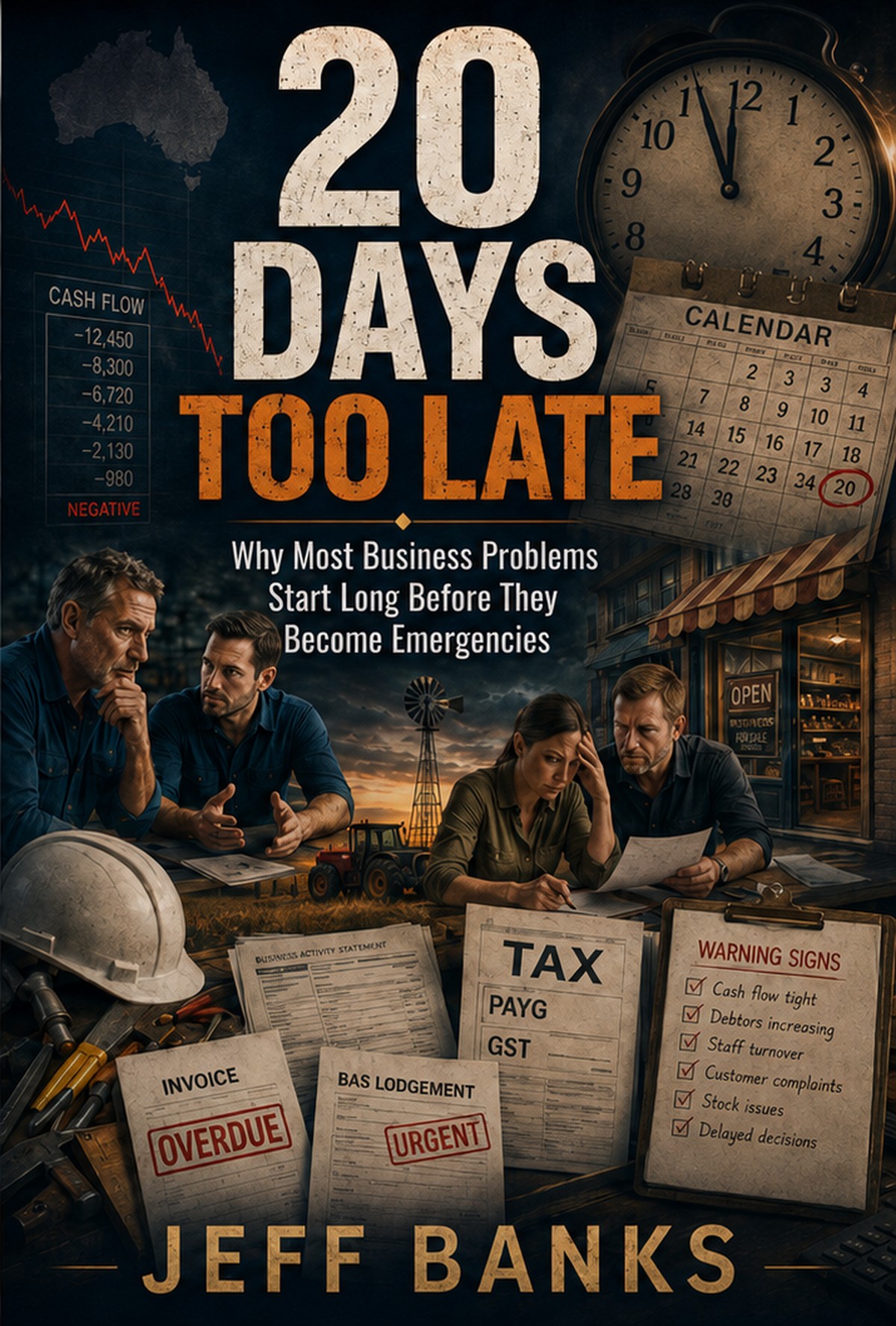
20 DAYS TOO LATE - Chapter 10 - Profit Is a Story

20 DAYS TOO LATE - Chapter 10 - Profit Is a Story | Travelling Around Australia with Jeff Banks

Before a business owner asks what can be done about tax, they should ask what the profit is telling them. Did the business improve because the model worked, or because the owner worked unreasonable hours? Did cash improve because profit was strong, or because bills were delayed? Did the business grow in a way that created resilience, or did it simply become larger and more fragile?

20 DAYS TOO LATE

Chapter 10

Profit Is a Story

There was a business owner I used to see every year who could tell you his sales figure before he sat down. He would walk into the office with the confidence of a man arriving at the football club after kicking six goals, and before the file had even been opened, he would tell me the turnover was up again. He knew the number because it mattered to him, and because it was the number he had been using all year to tell himself the business was going well.

The problem was that turnover was never the end of the story. It was barely the beginning, and yet it had become the number he measured himself by. He would talk about the extra staff he had taken on, the larger premises he had moved into, the new ute he had bought because the old one did not look the part anymore, and the bigger customers he was now dealing with. From the outside, it all looked like progress, and to be fair, some of it was progress.

Then we would get to the profit figure, and the room would change. Sometimes the profit had barely moved. Sometimes it had gone backwards. Sometimes the business had grown in every visible way except the one that mattered most, which was the ability to keep something after everyone else had been paid.

That is the part of business that can bruise the ego. It is one thing to say your sales have increased by three hundred thousand dollars. It is another thing entirely to discover that the three hundred thousand dollars brought with it two hundred and ninety thousand dollars of extra costs, stress, wages, materials, debtors, vehicle expenses, interest, mistakes and sleepless nights. At that point the increase in turnover is no longer a trophy. It is evidence.

Profit is a story. It tells you what really happened after the excitement, the effort, the invoices, the phone calls, the weekend work and the late-night emails have all been stripped away. It tells you whether the business model works, whether the pricing makes sense, whether the owner is being rewarded, whether customers are being served at a sensible margin, and whether the business is building strength or merely creating movement.

Many business owners do not avoid profit because they are careless. They avoid it because profit has a way of telling the truth without asking permission. Revenue allows for optimism, but profit asks questions. Revenue can flatter a business owner, but profit can quietly tap them on the shoulder and ask whether they have mistaken busyness for progress.

I have seen that moment many times across a desk. The owner is not necessarily shocked because the numbers are complicated. They are shocked because the numbers have confirmed something they already suspected but did not want to say aloud. They knew the business felt harder than it used to feel, and they knew the bank account did not seem to reflect the work being done.

That is often where the “20 Days Too Late” moment sits. It does not always arrive as a final demand from the bank, a liquidation notice or a furious creditor. Sometimes it arrives in a profit and loss statement that calmly explains that the business has spent the last twelve months working harder for less.

The painful part is that profit rarely disappears overnight. It leaks. It disappears into discounts that seemed harmless, overtime that nobody measured, jobs that were quoted too cheaply, customers who took too long to pay, stock that sat on shelves, vehicles that were upgraded too early, software subscriptions nobody reviewed and staff inefficiencies everybody worked around.

By the time the owner sees the annual accounts, the story has already been written. The accountant may be the one reading it aloud, but the business wrote it every day. It wrote it in the quotes sent out in July, the wages paid in August, the stock ordered in September, the customer discounts allowed in October, the uncollected invoices in November and the rushed decisions made in December.

Profit is not merely an accounting outcome. It is the biography of the business for that year, and every business owner should be willing to read it before the final chapter has already been printed.

The great temptation in business is to believe that profit is what is left over after the real work has been done. In that view, the real work is serving customers, producing goods, completing jobs, managing staff, answering emails and keeping everyone happy. Profit then becomes whatever remains at the bottom of the page, almost like a surprise that appears after the adults have finished talking.

That is a dangerous way to think about it. Profit should not be treated as the leftovers. It should be designed into the business from the beginning, because if it is not deliberately planned, it is very easily consumed by everyone else.

The landlord gets paid before the owner. The staff get paid before the owner. The supplier gets paid before the owner. The bank gets paid before the owner. The ATO eventually gets paid before the owner as well, and usually with far less sympathy than the owner might have hoped for. If the owner waits to see what is left, they may discover they have built a business in which everybody has a better claim on the cash than they do.

That is why profit tells such an important story. It reveals the pecking order inside the business. It shows whether the owner has built an enterprise or merely created a place where other people are paid first and the owner absorbs whatever shock remains.

This is especially common in family businesses. A husband and wife will work long hours, take modest drawings, lend personal money back into the business, use the family home as security and reassure each other that things will improve once sales increase. Then sales do increase, but the pressure remains. The machinery is newer, the staff list is longer, the customers are larger, and the drawings are still treated as something that can be reduced whenever the business needs help.

In those cases, the profit figure is not just a business number. It is a family number, because it tells the story of what the business has demanded from the household. It tells the story of missed holidays, postponed repairs, school fees juggled around BAS payments, and partners who quietly wondered whether the dream was worth the cost.

A profit and loss statement will never show the emotional price of business ownership. It will not show the argument at the kitchen table, the owner lying awake at two in the morning, or the way a child learns not to ask whether Dad is coming to the weekend game. Yet the numbers often contain the footprints of those things, because poor profit usually does not stay neatly inside the business.

Profit is the business making a contribution back to the people who carry the risk. Without that contribution, the business can become a demanding hobby with an ABN attached. It may look respectable from the street, and it may even impress people who judge success by vehicles, uniforms, equipment or premises, but it is not doing the job a business is supposed to do.

One of the most common traps I saw was the owner who treated profit as a tax problem. They would come in near the end of the financial year and ask what could be done about tax, often with the tone of someone who had been wronged by the universe. They were not asking what the profit meant. They were asking how to make the tax disappear.

There is a place for tax planning, of course. This book is heading toward that very subject, and I have spent more than forty years having those conversations. But tax planning should not be confused with profit denial, because a profitable business is not sick merely because tax is payable.

Tax is usually the final scorecard. It does not create the profit, and it does not explain the profit. It simply turns up after the business has already had the year it had, and it asks for its share of the result.

The better question is not always, “How do we reduce the tax?” Sometimes the better question is, “How did we make this profit, and can we do it again?” That question is more useful, more confronting and much more valuable to the future of the business.

A business that makes profit accidentally is at risk, because it may not understand what caused the good result. A business that makes profit deliberately has knowledge it can use. It knows which customers matter, which jobs pay properly, which staff produce value, which products carry margin and which parts of the operation are quietly eating away at the result.

This is why profit is a story rather than a single number. The number at the bottom of the page is the ending, but it is not the plot. The plot is found in the gross profit percentage, the wage cost, the rent, the finance charges, the repairs, the bad debts, the stock write-offs and the owner’s drawings.

I once looked at a set of accounts for a business that appeared to be improving. Sales were up, gross profit was acceptable, and the owner was relieved because the business had survived a difficult period. Yet the net profit was poor, and the owner was frustrated because the harder he worked, the less he seemed to keep.

The story was sitting in the expenses. One cost at a time, the business had become heavier. A vehicle lease here, an extra staff member there, a larger insurance premium, additional advertising, more repairs, higher rent and finance costs attached to equipment that was supposed to make life easier. None of the decisions looked fatal on its own, but together they had changed the shape of the business.

That is how profit disappears in many small businesses. It is rarely stolen in one dramatic act. It is nibbled away by decisions that felt reasonable when made in isolation.

The owner had not been reckless. He had been busy, hopeful and slightly too willing to believe that growth would eventually tidy up the details. He was not an unintelligent man, and he certainly was not lazy. He had simply allowed the business to become more expensive before proving that the extra expense would produce a reliable return.

By the time he came in to discuss the result, the year was over. The decisions had already been made, the costs had already been incurred, the staff had already been paid and the equipment had already been financed. We could learn from it, but we could not rewrite it.

That is one of the hardest lessons in business. You can explain profit after the event, but you can only protect it before the event. Once the money has gone, the explanation may be useful, but it is not a refund.

This is why regular review matters. A business owner who waits until the annual accounts are prepared is often reading history. By then, the opportunity to adjust prices, renegotiate costs, review staff levels, change suppliers or stop accepting poor-margin work may have been available for months.

There is nothing wrong with annual accounts, but there is something wrong with pretending they are a steering wheel. Annual accounts are more like the rear-view mirror. They show where the business has been, and they may explain why there are dents in the side, but they are not much use if the owner refuses to look through the windscreen.

Profit needs to be watched while there is still time to do something about it. Not obsessively, and not in a way that turns the owner into a prisoner of spreadsheets, but regularly enough that the story is not allowed to drift unnoticed. A business owner does not need to become an accountant, but they do need to understand what the accounts are trying to say.

One of the great misunderstandings in small business is that profit belongs to the accountant. It does not. The accountant records it, explains it and sometimes helps improve it, but the profit belongs to the decisions made inside the business.

The owner decides what to charge. The owner decides which customers to serve. The owner decides how many staff are needed. The owner decides whether discounts are allowed. The owner decides whether work is quoted properly. The owner decides whether a job that loses money is accepted again because the customer is nice or because the business is scared of an empty diary.

Every one of those decisions eventually becomes part of the profit story. The accounts may use numbers, but the numbers were created by behaviour. That is why financial statements can be so revealing if they are read properly.

A gross profit percentage can tell the story of pricing discipline. A rising wage percentage can tell the story of productivity problems. Increasing repairs can tell the story of old equipment being pushed too far. High interest can tell the story of debt being used to cover cash flow rather than build productive capacity.

Bad debts can tell the story of trusting the wrong customers. Stock write-offs can tell the story of buying without control, or of optimism that sat in the storeroom until it became obsolete. Motor vehicle costs can tell the story of image, convenience or necessity, depending on how honest the owner is willing to be.

There is no moral judgement in those numbers. Businesses are human places, and human beings make imperfect decisions. The point is not to shame the owner, because shame rarely improves a business. The point is to read the story before it becomes too expensive to change the ending.

In my experience, many owners already know where the story is weak. They know which staff member is not pulling their weight. They know which customer consumes too much time. They know which product line looks impressive but produces little margin. They know which vehicle was bought too early, which premises are too large and which supplier has been allowed to become too comfortable.

The blind spot is not always ignorance. Often it is avoidance. The owner knows the issue is there, but the issue is inconvenient, awkward or emotionally loaded.

That is why profit can be confronting. It does not allow every problem to remain a matter of opinion. Eventually it puts a number beside the behaviour and asks whether the owner still wants to defend it.

I remember a trade business where one particular type of work was regarded as the prestige work. It was the work that looked good in photographs, impressed other people in the industry and made the owner feel that the business had moved beyond the small jobs that once filled the diary. The trouble was that the prestige work was chewing up time, staff and materials without producing the profit everyone assumed it produced.

The smaller jobs, the ones the owner almost looked down upon, were often better. They were quoted more accurately, completed more quickly and paid faster. They did not create the same sense of importance, but they quietly carried the business.

That discovery was not made by looking at turnover. Turnover loved the prestige work. The bank account did not. The profit story was quite different from the sales story, and it took a deliberate review to reveal the difference.

Once the owner saw it, he could not unsee it. That is both the gift and the nuisance of good numbers. They remove a few illusions, and while illusions can be comforting, they are very poor business partners.

Profit often improves when owners stop trying to impress the wrong audience. A business is not more successful because it looks busier, owns more vehicles, employs more people or occupies a larger shed. A business is more successful when it produces a durable return for the people taking the risk.

That sounds obvious, but business owners are surrounded by signals that encourage the opposite. Growth is celebrated. New premises are celebrated. Staff numbers are celebrated. Big contracts are celebrated. Revenue milestones are celebrated, and social media is full of business owners announcing achievements that may or may not have improved their lives.

Profit is quieter. It rarely photographs well, and it does not always make for an exciting post. Yet profit is what allows a business to survive a bad month, reward its owners, invest in better systems, pay tax without panic and make decisions from a position of strength.

That is why the absence of profit creates such vulnerability. A low-profit business has little room for error. One bad debtor, one broken machine, one sick key employee, one interest rate rise or one quiet trading period can turn pressure into crisis.

Owners sometimes think profit is about greed. It is not. Sensible profit is about resilience, because a business without profit is always one surprise away from asking for mercy.

In the Australian small business world, there are plenty of surprises. Rain does not fall when farmers need it. Builders get caught between fixed-price contracts and rising material costs. Retailers discover that stock bought with confidence in March looks very different by October. Professional practices carry staff through quiet months because good people are hard to replace.

A business with profit has choices in those moments. It can absorb a setback, negotiate calmly, invest carefully and sleep a little better. A business without profit has fewer choices, and the fewer choices an owner has, the more expensive every problem becomes.

That is another reason the profit story matters. It is not just about the year that has passed. It is about the options available in the year ahead.

A profitable business can decide. An unprofitable business must react. That difference may not appear in the accounts as a separate line item, but it may be the most important difference of all.

The owner of a profitable business can choose to upgrade equipment, reduce debt, pay bonuses, improve systems, take holidays, invest in marketing or build cash reserves. The owner of an unprofitable business often chooses from a much smaller menu, and that menu is usually written by creditors, banks, the ATO or sheer exhaustion.

This is where profit connects directly to cash. Profit and cash are not the same thing, and any accountant who has explained debtors, stock, loans and tax payments knows how quickly that distinction can matter. Yet profit remains one of the main sources of future cash strength, because a business that does not make profit must eventually find cash somewhere else.

That somewhere else is often the owner. It may be the home loan, the credit card, the overdraft, the unpaid superannuation, the delayed BAS or the supplier who is quietly becoming less patient. None of those sources is a strategy, even if they can keep the doors open for a while.

I have seen businesses survive for longer than expected by borrowing from the future. They delay tax, stretch suppliers, reduce owner drawings, refinance debt and hope the next good season will fix the last bad one. Sometimes they get away with it, and sometimes they do not.

The danger is that survival can be mistaken for success. A business can keep trading while getting weaker. It can keep sending invoices, paying wages and opening the doors each morning while the profit story underneath is deteriorating.

That is why business owners need to distinguish between movement and progress. Movement is activity. Progress is improvement. A business can have plenty of movement while making very little progress at all.

The owner who tells you they have never been busier may be telling you something useful, but not necessarily something good. Busy can mean demand is strong, pricing is right and systems are working. Busy can also mean the owner has priced too cheaply, accepted too much, delegated poorly and created a machine that consumes every available hour.

Profit helps sort the difference. It asks whether the busyness produced anything worth keeping.

This is particularly important for owners who are emotionally attached to being needed. Some business owners build their identity around being the person who fixes everything, answers every call and rescues every job. They can confuse exhaustion with importance, and for a while the business rewards that behaviour because customers like dealing with someone who never says no.

The accounts may eventually tell a different story. They may show that the owner is subsidising customers with unpaid time, solving problems that should have been priced into the job, and carrying a level of complexity that no sensible margin could support.

In that sense, profit can be an act of honesty. It forces the owner to admit that some work is not worth doing, some customers are not worth keeping and some habits are not noble. They are merely expensive.

This is not an argument for becoming ruthless. Most small businesses are built on relationships, and relationships matter. There are times to help people, carry loyal customers, support staff and make decisions that are not measured only in dollars.

The problem begins when exceptions become the business model. A favour is one thing. A pattern of unprofitable generosity is another, especially when the owner’s family, staff and creditors are the ones funding it.

There is a quiet discipline in profit. It does not require the owner to become hard, but it does require the owner to become clear. Clear pricing, clear expectations, clear review, clear margins and clear decisions about what the business exists to do.

When clarity is missing, the business fills the gap with hope. Hope is useful when it gets someone out of bed in the morning, but it is not much use as a costing system. Hope will not pay superannuation, replace equipment, fund tax or give the owner a decent return on the years they have invested.

One of the most useful questions a business owner can ask is simple: where did the profit come from? Not the sales, not the activity and not the noise, but the profit. Which customers, jobs, products, services or decisions actually produced the result?

The next question is just as useful: where did the profit go? That question is not about blame. It is about understanding whether the business is leaking value through poor pricing, waste, rework, slow payment, bad systems, unnecessary costs or owners who are too tired to keep watching.

These questions do not require a boardroom. They can be asked at a kitchen table, in a farm office, in a workshop, at the back of a retail store or in a ute with invoices spread across the passenger seat. The location does not matter. The willingness to ask matters.

In many cases, the answers are not mysterious. A retailer may discover that a large part of the stock range exists because it has always existed, not because it earns its space. A builder may discover that variations are being poorly documented and therefore poorly charged. A professional practice may discover that loyal clients are still paying fees set years ago when the cost of service was much lower.

A farmer may discover that machinery decisions are being made around tax, pride or convenience rather than long-term return. A tradesperson may discover that the jobs closest to home are more profitable than the glamorous jobs that involve travel, delays and unpaid quoting time. A family business may discover that a relative on the payroll is being protected emotionally while the business absorbs the financial cost.

These are not accounting problems in the narrow sense. They are business problems expressed through accounting numbers. That distinction matters because it means the solution is usually not found in the tax return.

The solution may be pricing. It may be saying no. It may be reviewing wages, changing suppliers, reducing stock, improving quoting, collecting debts faster or being brave enough to stop doing work that no longer makes sense.

The accountant can help identify the story. The owner still has to change the plot.

There is a moment in many businesses when the owner must decide whether they want comfort or truth. Comfort says the business is doing well because sales are up and people are busy. Truth asks why the profit is thin, why cash is tight and why the owner feels poorer than the turnover suggests.

Comfort is easier in the short term. Truth is kinder in the long term, because truth leaves room for action.

The “20 Days Too Late” moment often comes after comfort has been chosen too many times. The owner delays the price increase because customers might complain. They delay the staff conversation because it might upset the team. They delay the debt collection because they do not want to offend a customer. They delay the cost review because they are too busy doing the work.

Then one day they no longer have the luxury of delay. The bank wants answers, the ATO wants payment, suppliers tighten terms and the owner is forced to make decisions under pressure that could have been made calmly months earlier.

That is the true cost of not reading the profit story. It is not simply that profit was lower than expected. It is that the owner surrendered time, and time is often the most valuable asset in a business problem.

With time, a price increase can be introduced properly. With time, a poor customer can be replaced. With time, a staff issue can be managed fairly. With time, finance can be restructured before desperation enters the room. With time, a business owner can think.

Without time, every decision becomes sharper. The owner is no longer choosing the best option. They are choosing the least painful option from a list that has become shorter.

That is why profit review should not be reserved for the end of the financial year. Waiting until June to understand profit is like waiting until the last over to check the scoreboard. It may still be interesting, but the chance to change the match has mostly passed.

A business does not need perfect monthly accounts to improve. Perfection can become another excuse for delay, and I have seen owners avoid useful review because the information was not complete enough to satisfy some imaginary standard. The numbers do not need to be perfect to be useful.

What the owner needs is a rhythm of attention. Monthly is good for many businesses. Quarterly may be enough for some. The important thing is that the business has a habit of asking what is happening while the answer can still influence behaviour.

That habit changes the relationship between the owner and the accounts. The accounts stop being a historical burden prepared for the tax office and become a management tool. They become a conversation with the business rather than a document filed away after signing.

The conversation does not have to be complicated. Are sales where expected? Is gross profit holding? Are wages in line with activity? Are debtors under control? Are costs creeping? Is the owner being paid properly? Is cash improving or only appearing healthy because bills have been delayed?

Those questions are not glamorous, but they are protective. They help prevent surprises, and in business the absence of surprise is underrated.

There is a particular confidence that comes from knowing the story of your own profit. It is different from bravado. It is quieter, steadier and more useful.

The owner who understands profit can make decisions without guessing. They know what work to chase, what work to avoid, what customers to protect, what costs to challenge and what level of sales is required to support the life they are trying to build. That knowledge does not remove risk, but it makes risk more visible.

Business will always involve uncertainty. Customers change, weather changes, governments change, markets change and people change. No set of accounts can remove that uncertainty, and no adviser should pretend otherwise.

But uncertainty is not the same as ignorance. A business owner may not control the economy, interest rates or customer behaviour, but they can control how closely they watch their own margins, costs and profit drivers. They can control whether the story is read early or left until the final pages.

Profit also forces a business owner to confront what they actually want from the business. Some owners want growth. Some want stability. Some want a saleable asset. Some want a job they control. Some want to employ family, support a community, fund retirement or simply keep doing work they enjoy.

None of those goals is wrong. The problem arises when the profit story does not support the goal.

A business that is meant to fund retirement must produce more than wages. A business that is meant to be sold must show profit that a buyer can believe in. A business that is meant to support family members must be strong enough not to collapse under the weight of that generosity.

A business that is meant to provide lifestyle must not consume the life it was supposed to support. That sentence may sound simple, but I have seen many owners discover it far too late.

Profit is therefore not just a financial measurement. It is a test of alignment. It asks whether the business being operated is capable of delivering the life, security and future the owner says they are working toward.

When the answer is no, the owner has choices if the question is asked early. They can reshape the business, reduce complexity, change pricing, sell underperforming assets, narrow the customer base or reconsider what success should look like. Those choices are much harder when the question is avoided for years.

This is one of the reasons I have always been cautious about businesses that grow without review. Growth magnifies whatever already exists. If the business model is sound, growth may improve the result. If the business model is weak, growth can spread the weakness across a larger area.

A poorly priced business does not become better by doing more underpriced work. A badly managed debtor system does not improve because invoices increase. A weak staff structure does not become stronger because another layer is added. Growth can make good businesses better, but it can also make fragile businesses more dangerous.

Profit is the clue that tells you which one is happening. It shows whether growth is creating value or merely increasing exposure.

The owner who only watches revenue may miss that distinction until the pressure becomes impossible to ignore. They may celebrate the new contract without noticing that the margin is too thin, the payment terms are too long and the staffing requirement is too heavy. They may call it a breakthrough when it is actually a burden.

I saw versions of that story in many forms. A manufacturer took on a large customer that looked impressive but demanded pricing that barely covered the work. A professional firm accepted complex clients at fixed fees that no longer reflected the time involved. A retailer chased volume through discounts and then wondered why the shelves emptied faster than the bank account filled.

In each case, revenue told one story and profit told another. The mistake was not always taking the opportunity. The mistake was failing to measure what the opportunity was really worth.

This is why good business owners develop a healthy suspicion of impressive numbers. They do not dismiss them, but they ask what sits beneath them. They know that a large invoice can still be a poor result, and a smaller job can sometimes be a better one.

That kind of thinking is not natural to everyone. Business owners are often optimistic by necessity, because it takes optimism to start, employ, borrow, build and keep going when sensible people might have chosen an easier path. Optimism is not the enemy.

Unexamined optimism is the enemy. Profit is one of the tools that keeps optimism honest.

The best owners I dealt with were not always the most sophisticated. Some were not comfortable with accounting language, and some would happily admit they did not enjoy financial reports. But they paid attention to the right things, asked questions when something felt wrong and did not treat the numbers as an annual inconvenience.

They understood their business in practical terms. They knew which jobs made money, which customers paid on time, which staff were productive, which suppliers were fair and which costs needed watching. Their knowledge was not always polished, but it was grounded.

Those owners were rarely surprised. That did not mean nothing bad happened to them. It meant they usually saw enough of the story early enough to respond.

The opposite was also true. Owners who ignored profit often lived in a world of sudden emergencies. The tax bill was sudden, the overdraft pressure was sudden, the supplier problem was sudden, the lack of cash was sudden and the poor annual result was sudden. Yet in most cases the warning signs had been there for months.

The numbers had been whispering before they started shouting. The owner simply had too much noise around them to listen.

That is the discipline this chapter is really about. Not accounting expertise, not textbook analysis and not turning every small business into a miniature corporate finance department. It is about listening early enough.

Profit whispers through small changes. A margin slips by two percent. Wages creep up. A customer takes longer to pay. Discounts become normal. Freight increases. Bank interest rises. Stock turns more slowly. None of those things may justify panic, but all of them deserve attention.

Ignore enough whispers and the business eventually gets louder. By then, the conversation is usually less pleasant.

The owner who reads the profit story early is not trying to predict the future perfectly. They are trying to avoid being ambushed by their own business. That is a much more realistic goal, and it is one every owner can pursue.

There is also a dignity in understanding profit. It allows the owner to stop apologising for needing the business to work. Small business owners often feel guilty about raising prices, chasing debts or refusing unprofitable work, as though the business exists to absorb everyone else’s discomfort.

But a business that does not make profit cannot serve anyone for long. It cannot employ reliably, support customers properly, invest in quality, pay suppliers, meet tax obligations or provide security for the owner’s family. Profit is not a dirty word. It is the condition that allows the business to keep its promises.

This is especially important in communities where relationships are close. Country businesses, family businesses and long-standing local operators often carry emotional obligations that larger businesses do not feel in the same way. They sponsor the junior football club, help customers through rough patches, employ people they know and continue relationships that are personal as much as commercial.

There is value in that. Business is not merely numbers on a page, and any adviser who forgets that will give sterile advice. Yet the numbers still matter, because a generous business that becomes weak will eventually disappoint the very people it tried to help.

Profit gives generosity a foundation. Without it, generosity can become a slow form of self-harm.

The lesson is not to become mean. The lesson is to become sustainable. A sustainable business can choose where to be generous because it knows what it can afford. An unsustainable business is generous until it is exhausted, and then everyone is surprised when the generosity stops.

That is why profit deserves respect. It is not the whole story of business, but it is one of the chapters that determines whether the rest of the story can continue.

As this book moves toward the mid-year review and then into the final twenty days before year-end, profit becomes increasingly important. Tax planning without understanding profit is a strange exercise. It is like discussing the final score without watching the game.

Before a business owner asks what can be done about tax, they should ask what the profit is telling them. Did the business improve because the model worked, or because the owner worked unreasonable hours? Did cash improve because profit was strong, or because bills were delayed? Did the business grow in a way that created resilience, or did it simply become larger and more fragile?

These are not questions to leave until June. They are questions for the middle of the year, when there is still enough time to adjust the direction of the business before the result hardens into history.

That is where the next conversation belongs. If profit is the story of what has happened, the mid-year review is the moment when the owner decides whether the ending is still negotiable. It is the point where the business can stop drifting, look honestly at the first half, and decide whether the second half needs a different kind of attention.

Many owners wait until the year is nearly over before asking those questions. By then, the accounts may still be accurate, the tax planning may still be useful and the adviser may still do what can be done. But too often the best options have already expired, not because they were never available, but because nobody stopped early enough to read the story while it could still be changed.

Author

Menu