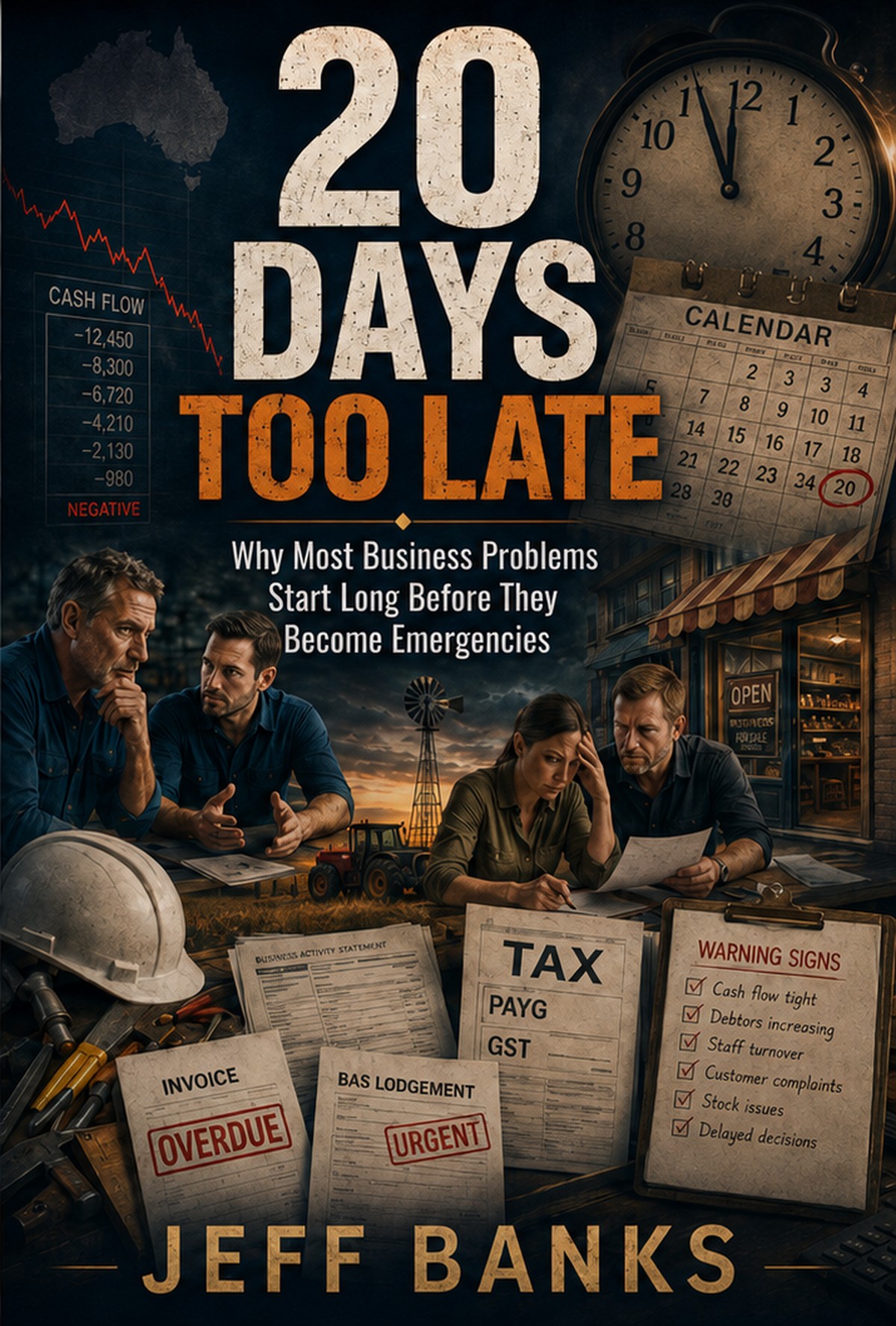
20 DAYS TOO LATE - Epilogue - No Surprises

20 DAYS TOO LATE - Epilogue - No Surprises | Travelling Around Australia with Jeff Banks

The warning signs were there. The opportunity to act existed. The outcome was not always avoidable, but the surprise often was. So if this book leaves you with anything, let it be this. Do not wait until the desk is covered in urgent papers, the bank is impatient, the tax bill is due, the staff issue has spread, the customer debt has gone bad or the business feels as though it has backed you into a corner.

20 DAYS TOO LATE

Epilogue

No Surprises

By the time a business owner walks into an accountant’s office with an emergency, the emergency is usually no longer the real problem. The real problem happened earlier, when the first warning sign appeared and was explained away as timing, bad luck, a difficult customer, a temporary cash squeeze, a lazy employee, a slow month, a quiet quarter or one of those things that apparently happens to everyone in business.

I have seen that scene play out in many forms over more than forty years. Sometimes the chair on the other side of the desk was occupied by a farmer, sometimes by a tradie, sometimes by a retailer, sometimes by a professional person who had built a respectable practice but never quite built a business that could breathe without them. The industry changed, the numbers changed, the personalities changed, but the pattern rarely did.

Most of them did not come in because they had suddenly discovered a problem. They came in because the problem had finally become impossible to ignore. By then the choices were fewer, the costs were higher, the emotions were sharper and the advice they needed was often advice they would have found much easier to follow months earlier.

That is the quiet cruelty of business problems. They are at their cheapest when they are easiest to deny, and they become most obvious when they are most expensive to fix. The invoice for delay is rarely presented on the day the delay begins, which is why so many otherwise sensible people allow it to accumulate.

This book began with a title that sounded like a tax planning warning. Twenty days before the end of the financial year, there are things a business owner can still do, questions still worth asking and decisions still worth making. There are also many things that cannot be repaired simply because the calendar is now too close to the line.

In truth, though, the title was never really about tax. Tax just happens to be the place where many business stories are finally forced to tell the truth. The end of the financial year does not create the story, it simply records the decisions that have already been made.

That is why tax can feel so unforgiving. It has no interest in the explanation, the intention, the stress, the hope, the plan, the almost, the nearly or the “we meant to get to that.” It looks at what happened and quietly places the result on the table.

Business owners often arrive at that table wanting a better outcome. They want less tax, more cash, a cleaner structure, a better story and a result that feels more like the business they believed they were running. The difficulty is that numbers are not especially impressed by belief.

Numbers are not cruel, but they are honest. They do not care whether the owner worked hard, lost sleep, missed family dinners, answered emails on Sunday nights or kept pushing through when common sense suggested a break. They simply report the accumulated effect of decisions, habits and delays.

That is why the best business owners I met were not always the cleverest. Some were very clever, of course, but cleverness was never the whole explanation. The ones who endured were the ones who paid attention before they were forced to.

They watched the small things. They noticed when a good customer stopped paying on time, when a staff member’s attitude shifted, when stock started moving more slowly, when the bank account no longer matched the profit and when a business partner began avoiding difficult conversations. They understood that a business rarely whispers without eventually raising its voice.

The more I watched business, the more I came to believe that management is often just the art of listening before the shouting starts. That may not sound grand enough for a business textbook, but it is closer to the truth than many polished theories I have heard. A business talks to its owner constantly, but not every owner wants to hear what it is saying.

One business owner once told me that he did not like looking at figures because they put him in a bad mood. I understood what he meant, because numbers can do that when they contradict the story we would rather believe. The problem, of course, was that ignoring them did not improve his mood in the long run.

The numbers were not creating his discomfort. They were simply pointing to the place where discomfort already lived. His margins were thin, his debtors were slow, his stock was too high and his drawings had slowly become a second business the first business could no longer afford to support.

There was no dramatic collapse at the beginning. There was only a little tightness here, a delayed supplier there, a quiet extension of the overdraft, a private decision not to mention something to the bank and a growing reliance on a good Christmas to repair a bad year. By the time he wanted the business fixed, we were not dealing with a current problem so much as a long conversation he had refused to have with himself.

That is how many business problems grow. They are not explosions at first, they are leaks. A leak does not feel urgent when the floor is still dry enough to walk across, but the floor is not the measure of the problem.

Cash is perhaps the clearest example. Profit may keep accountants busy, but cash keeps the doors open. Many business owners know this in theory, yet still behave as though a profitable set of accounts can somehow pay wages, suppliers, tax and the mortgage.

Cash is not a theory. It is the oxygen of a business, and like oxygen, people tend to notice it most when it is missing. The business that waits until it is gasping for air has already left the sensible conversation too late.

Revenue has a similar habit of flattering people. Turnover can make a business owner feel important, especially when the phone is ringing and the vans are moving and the staff look busy. Yet revenue without margin is just noise with a bank account attached.

I have seen businesses grow themselves into trouble. They took on more work, hired more staff, bought more vehicles, rented more space and congratulated themselves on becoming bigger. What they did not notice soon enough was that each extra dollar of turnover was carrying too little profit and demanding too much cash.

That is one of the great traps of business. Growth feels like success because it is visible, while profitability often feels dull because it sits quietly in the background. The trouble is that dull things often keep businesses alive while exciting things slowly drain them.

The same is true of customers. Every business owner knows there are customers who make life difficult, but not every business owner has the courage to admit that some customers are not worth keeping. A bad customer can disguise themselves as revenue for a surprisingly long time.

They complain more, pay slower, demand more, respect boundaries less and somehow occupy more space in the owner’s head than their profit could ever justify. The owner knows this, the staff know this and sometimes even the customer knows this. Still, the relationship continues because saying no feels risky and delay feels easier.

That is another version of being twenty days too late. It is not always a tax decision or a cash flow decision. Sometimes it is the decision to stop allowing one unreasonable person to set the emotional climate of the whole business.

Staff issues work the same way. Very few employee problems arrive without warning, although many employers pretend they do. There is usually a conversation avoided, a standard lowered, a behaviour excused, a performance issue tolerated or a small act of disrespect recast as personality.

Business owners can be remarkably brave in some areas and strangely timid in others. They will sign leases, borrow money, take commercial risks and work themselves into the ground, yet they will avoid a ten-minute conversation with an employee who is damaging the culture of the business. By the time action is finally taken, the cost has usually spread beyond that one person.

There is always a reason for delay. The owner is busy, the employee knows the system, the Christmas rush is coming, the market is tight, the business cannot afford disruption or everyone is already under pressure. Those reasons may be understandable, but understandable does not mean harmless.

Structures matter in the same quiet way. Nobody gets excited about trusts, companies, partnerships, asset protection and succession planning in the same way they get excited about a new contract or a new piece of equipment. Structures are rarely urgent until suddenly they are.

I have seen families discover too late that the business was never as protected as they thought. I have seen business partners realise too late that goodwill, control, debt and expectation had never been properly discussed. I have seen people assume that because everyone got along at the beginning, they would automatically get along when money, illness, divorce, retirement or death entered the room.

That may sound gloomy, but it is not intended to be. It is simply a reminder that good structures are not built for the easy days. They are built because business eventually produces days when goodwill alone is not enough.

Succession is perhaps the most human example of all. Many business owners know they will not be there forever, but they run the business as though forever is still a reasonable working assumption. They keep the knowledge in their head, the relationships in their hands and the authority in their chair.

Then one day they want to sell, step back, slow down or pass the business to family, and they discover that the business was never truly separate from them. The thing they thought they owned has, in a practical sense, owned them for years. The price of that discovery can be financial, but it is often emotional as well.

The best businesses are not free from problems. That is another myth worth discarding before the book closes. Every business has difficult customers, awkward staff issues, cash pressure, tax obligations, uncertainty, bad months, wrong decisions and surprises that nobody could reasonably predict.

The difference is not that good businesses avoid difficulty. The difference is that good businesses avoid being surprised by the difficulties they had enough information to anticipate. That is a much more achievable standard than perfection, and it may be a much more useful one.

No surprises does not mean nothing ever goes wrong. It means fewer things go wrong in ways that should have been obvious. It means the owner is not constantly ambushed by their own business.

There is a dignity in that approach. It is not flashy, and it does not make for exciting business conference speeches. It is the dignity of knowing where the money is, knowing who owes you, knowing what your margin is, knowing which customers are worth keeping, knowing what your tax position is likely to be and knowing which conversations cannot be avoided much longer.

That kind of knowledge gives a business owner something more valuable than comfort. It gives them choice. Choice is the thing delay gradually removes.

When an owner acts early, there are usually options. They can adjust prices, reduce costs, change payment terms, speak to the bank, restructure debt, let a customer go, manage a staff issue, review stock, change drawings, make superannuation contributions, defer a purchase, bring advice into the room or simply stop pretending that momentum is the same as progress.

When an owner acts late, many of those options have already disappeared. The bank is no longer patient, the supplier is no longer flexible, the staff member has already poisoned others, the customer debt is already doubtful, the tax bill is already due and the business owner is no longer choosing from good options. They are choosing from whatever remains.

That is the real meaning of twenty days too late. It is the moment when the owner discovers that time was not neutral. While they waited, the problem kept working.

I do not say that with judgment, because I have never believed most business owners are lazy or foolish. Most are tired, stretched, hopeful, stubborn, loyal, distracted and human. They are trying to keep too many balls in the air with hands that never feel quite sufficient for the task.

That is why empathy matters in business advice. A person sitting across the desk with a problem does not need a lecture about what they should have done six months ago. They probably know enough of that already, even if they have not said it aloud.

What they need is honesty without cruelty. They need someone willing to say, “This is where we are,” and then help them understand what can still be done. Good advice begins with reality, because anything else is just comfort dressed up as strategy.

Reality is not the enemy of hope. In business, reality is often the only place where useful hope begins. False hope tells an owner that the next good month will fix everything, while useful hope asks what needs to change before the next good month arrives.

I have always preferred the second kind. It is less romantic, but it has a better survival rate. A business owner who can face reality early may still have to make difficult decisions, but at least those decisions belong to them.

There is a strange peace in knowing the truth early. It may not feel like peace at first, because the truth often arrives wearing work boots and carrying an invoice. Yet once the truth is on the table, the owner can stop spending energy on avoidance.

That is one reason regular review matters. A mid-year review, a quarterly conversation, a cash flow forecast, a debtor review, a stocktake, a margin check or a proper discussion about tax is not just an administrative exercise. It is a way of asking the business to speak before it has to scream.

Some owners resist that because they fear what they might find. I understand that fear, but I have rarely seen ignorance make a business stronger. The unopened envelope still contains the same bill, and the unread report still contains the same result.

There are, of course, genuine surprises in business. Droughts happen, markets shift, customers fail, governments change rules, technology disrupts industries and life has a way of walking into the office without an appointment. No book, adviser or review process can remove uncertainty from business.

The aim is not to eliminate uncertainty. The aim is to stop adding avoidable blindness to unavoidable uncertainty. Business is hard enough without giving problems a head start.

If there is one lesson I hope remains after all the stories and observations in this book, it is that attention is underrated. Paying attention sounds ordinary, but it is one of the most powerful habits a business owner can develop. It notices what pride misses, what optimism softens and what busyness hides.

Attention asks why the bank account is tight when the profit looks good. It asks why revenue has increased but the owner feels poorer. It asks why a customer who keeps everyone busy seems to leave no money behind.

Attention asks why the employee who was once excellent now seems disengaged. It asks why a business partner has gone quiet, why the structure no longer fits, why the tax result feels surprising and why the owner is always exhausted but never further ahead. These are not dramatic questions, but they are often the questions that save a business from dramatic consequences.

The best business owners are not fortune tellers. They do not see the future with mystical clarity or avoid every wrong turn. They simply pay attention to what is already in front of them.

They recognise warning signs while the signs are still small. They ask difficult questions before the answers become urgent. They seek advice before advice has to become rescue.

Most importantly, they act while they still have choices. That may be the simplest and hardest business lesson of all. Knowledge without action is just a more informed form of delay.

A business owner does not need to become an accountant to understand their business. They do not need to know every section of tax law, every technical rule or every possible planning strategy. They do, however, need to know enough to ask better questions.

They need to know whether profit is becoming cash. They need to know whether revenue is creating wealth or just movement. They need to know whether their customers, staff, structure and habits are helping the business become stronger or quietly making it more fragile.

They also need to know when to bring someone else into the conversation. Good advisers do not remove responsibility from the owner, but they can help the owner see what familiarity has hidden. Sometimes the most valuable sentence in business is not a clever answer, but a simple question asked early enough to matter.

That is why this book has not tried to turn accounting into theatre or taxation into drama. The drama was always in the human behaviour around the numbers. The figures were merely the footprints left behind.

Behind every set of accounts there is a story. There are decisions made at the kitchen table, risks taken in the ute, conversations postponed after dinner, invoices sent late at night, wages paid before the owner drew a dollar and quiet compromises nobody else ever saw. Business is not separate from life, no matter how neatly we try to file it.

That is also why business advice should never forget the person. A business problem may appear on a balance sheet, but it usually sits in someone’s chest long before it reaches the accountant’s desk. The owner carries it home, wakes with it at three in the morning and tries to sound confident when confidence has become a daily performance.

No surprises is not just a financial principle. It is a kinder way to live in business. It reduces the number of shocks that steal sleep, damage relationships and turn manageable issues into private burdens.

There will still be hard days. There will still be bills, decisions, mistakes, tax, staff, customers, banks and all the other moving parts that make business both maddening and strangely addictive. Yet hard days are easier to bear when they are not made harder by things that could have been seen earlier.

Twenty days before year-end is still worth something. A business owner can still review their position, ask questions, check cash, consider superannuation, think carefully about equipment purchases, understand tax and avoid being surprised by the final scorecard. It is not too late for everything, and that matters.

But the deeper lesson is that the best tax planning does not begin twenty days before year-end. The best cash flow planning does not begin when the overdraft is full. The best staff management does not begin after the culture has cracked.

The best succession planning does not begin when the owner is already exhausted. The best structural advice does not begin after a dispute, a claim, a divorce, an illness or a death. The best business decisions are usually made before circumstances force the owner’s hand.

That is not a call for panic. It is a call for attention. It is an invitation to stop waiting for urgency before giving important matters the dignity of time.

If there is comfort in all this, it is that improvement does not require perfection. A business does not need to become flawless to become better. It only needs to become more honest with itself, a little earlier and a little more often.

Look at the numbers before they become frightening. Have the conversation before silence becomes expensive. Ask for advice before the choices narrow.

Pay attention to the customer who costs more than they pay. Pay attention to the staff member who changes the room. Pay attention to the business structure built for a life you no longer live.

Pay attention to the cash, because cash will tell you things profit is too polite to say. Pay attention to the tax result, because tax is often the final scorecard rather than the opponent. Pay attention to the small discomfort, because small discomfort is often wisdom arriving early.

In the end, that may be the whole book. Business disasters are rarely caused by one bad day. They are usually built out of small warnings left unattended until the owner can no longer choose the easy repair.

The great advantage of paying attention is not that it guarantees success. Nothing does. The advantage is that it gives the owner a chance to act while action still matters.

That is what I mean by no surprises. Not a business free of uncertainty, not a life free of trouble and not an owner who never makes mistakes. Simply a business where fewer problems are allowed to become emergencies through neglect.

For more than forty years, I watched businesses tell their owners the truth. Some owners listened early, some listened late and some only listened when the truth had become impossible to avoid. The difference between those groups was often not intelligence, effort or ambition, but timing.

The warning signs were there. The opportunity to act existed. The outcome was not always avoidable, but the surprise often was.

So if this book leaves you with anything, let it be this. Do not wait until the desk is covered in urgent papers, the bank is impatient, the tax bill is due, the staff issue has spread, the customer debt has gone bad or the business feels as though it has backed you into a corner.

Ask the question earlier. Read the numbers earlier. Have the conversation earlier.

Because once options disappear, every problem becomes twenty days too late. And in business, as in life, the best time to discover the truth is while you can still do something useful with it.

Author

Menu